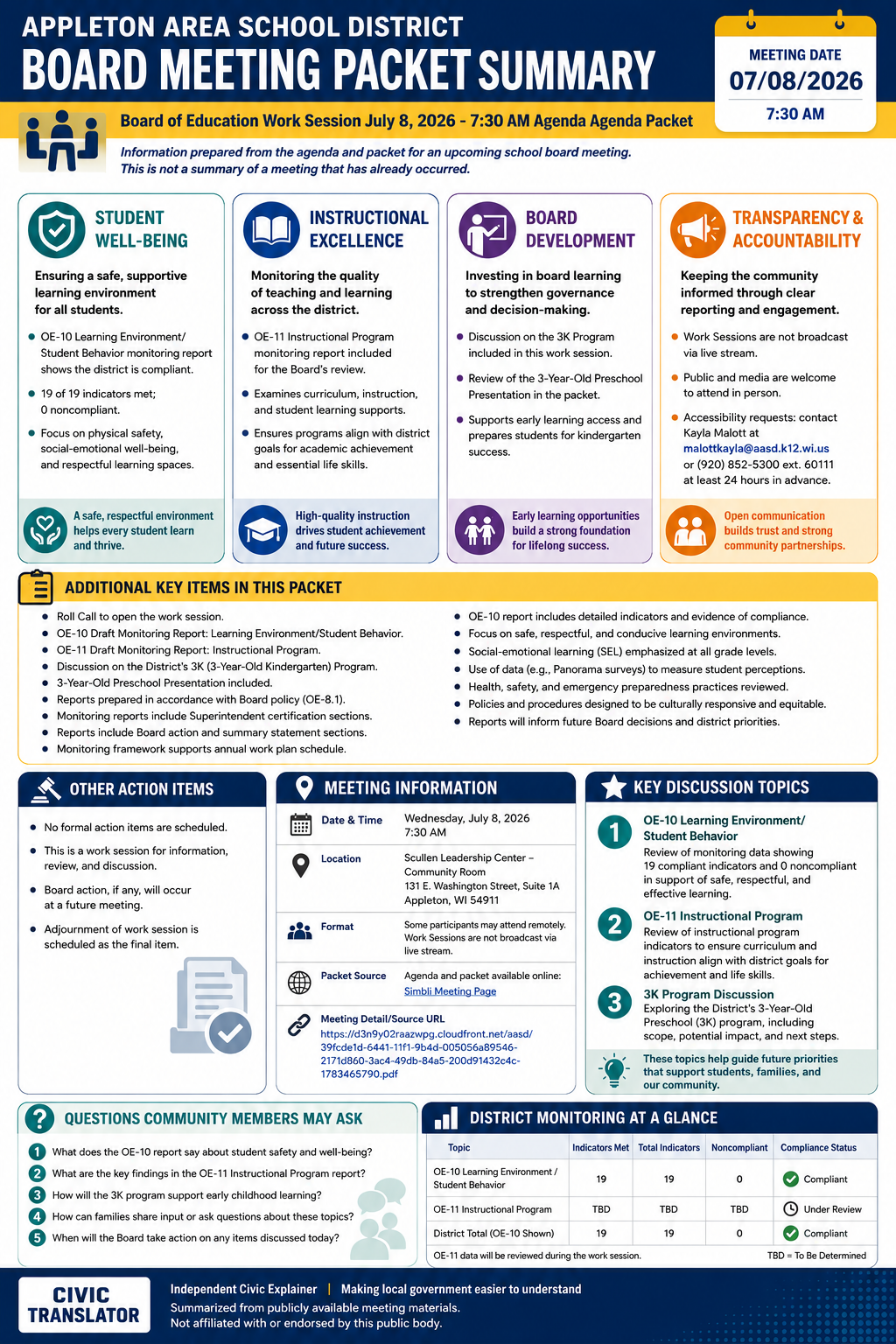
This work session is primarily a board oversight meeting rather than a meeting focused on contracts or budget approvals. The Board of Education is reviewing two major Operational Expectations monitoring reports: OE-10 on Learning Environment and Student Behavior and OE-11 on the Instructional Program. Both reports are certified by the superintendent as fully compliant with board policy.
The reports provide a detailed look at district performance in school climate, student behavior, attendance, curriculum, instructional quality, technology, and academic programming. Rather than proposing major policy changes, district leaders present evidence that existing systems are meeting governance expectations while identifying areas for continued improvement.
Board members are also scheduled to hold a development discussion regarding the district's 3-year-old preschool (3K) program. The agenda indicates this is a discussion supported by a presentation rather than a scheduled vote, suggesting the board is gathering information before future decisions.
The packet contains no major contracts, construction approvals, tax actions, or large financial commitments. Instead, it emphasizes accountability, continuous improvement, and monitoring of district operations affecting students, families, and staff.
Major Discussion and Action Items
Review of Learning Environment and Student Behavior (OE-10)
The board will review whether the superintendent has met district expectations for maintaining safe, respectful, and effective learning environments. The superintendent certifies compliance with all 19 monitored indicators.
Evidence includes districtwide implementation of behavioral expectations, annual social-emotional learning activities, restorative practices, student safety initiatives, emergency response preparedness, attendance systems, and discipline monitoring. Board members are expected to determine whether the evidence supports a finding of compliance.
Social-Emotional Learning and Student Wellness
The district reports that all K-8 schools provide universal social-emotional learning, although implementation quality varied while teachers adapted to new instructional materials. Elementary schools currently use Second Step and Character Strong resources, while middle schools have expanded Character Strong and Sources of Strength programming.
District leaders indicate that future board approval of a universal elementary SEL curriculum would include implementation monitoring and fidelity checks.
School Discipline, Safety, and Equity
The packet highlights multiple indicators demonstrating district oversight of student discipline.
Key reported outcomes include:
- 82% of students received no office discipline referrals during the 2026 school year.
- All office discipline referrals were documented and closed with assigned resolutions.
- Two newly hired administrators completed restorative practices training.
- The district continues monitoring disciplinary disparities using WISE data and local data systems.
- Seclusion and restraint incidents declined from 186 during the prior school year to 111, the lowest level since the 2021-22 school year.
- The district reports it is not identified by the Wisconsin Department of Public Instruction for excessive use of seclusion or restraint.
These measures are intended to demonstrate both accountability and continued progress toward equitable discipline practices.
Student Safety and Anonymous Reporting
The district continues using the Speak Up Speak Out reporting system for anonymous safety concerns.
The report documents:
- 534 total reports during 2025-26.
- 241 bullying reports.
- 29 cyberbullying reports.
- 24 suicide-related concerns.
- All reports were closed by administrators.
The most common administrative responses included discussions with students, ongoing monitoring, parent notification, disciplinary action when appropriate, and investigation of reports determined to be unfounded.
Attendance Improvement Strategies
Attendance remains a major operational priority.
The district describes a structured attendance process that includes attendance teams in every school, automated notification letters, progressively intensive interventions, attendance frameworks, collaboration with families, and referral procedures involving local law enforcement when legally appropriate.
The report also emphasizes collecting feedback from students and families to improve intervention strategies.
Instructional Program Monitoring (OE-11)
The second major monitoring report evaluates whether instructional programs meet board expectations.
The superintendent reports compliance with all 27 indicators.
Highlights include:
- Current Individualized Education Programs (IEPs) for all students receiving special education.
- Progress monitoring for all Tier 2 and Tier 3 academic interventions.
- Curriculum aligned with district standards.
- Valid and reliable assessment systems.
- Access to elective opportunities and career planning.
- Technology protections for student devices.
- Preservation of instructional time.
Board members will review this evidence before determining compliance.
Curriculum and Academic Opportunities
The instructional report emphasizes broad access to academic programming.
The district reports:
- 100% curriculum alignment with district standards.
- Public availability of curriculum documents upon request.
- Annual calibration of common assessments.
- High school course guides available to families.
- Academic and Career Planning for grades 6-12.
- Continued access to Early College Credit and Start College Now opportunities.
- Elementary access to art, music, and physical education for all students.
Board Development Discussion on 3-Year-Old Preschool
The only board development item is a discussion regarding the district's 3K preschool program.
The agenda references a presentation but does not indicate formal action. The discussion likely provides board members with background information, program status, and potential future considerations regarding early childhood education.
Financial Matters
The work session packet contains no significant contract approvals, capital projects, bids, grants, tax actions, borrowing proposals, or major budget amendments.
Operational reports discuss existing district programs and services but do not request new appropriations or identify material expenditures requiring board approval during this meeting.
Policies, Ordinances, Resolutions, and Governance
The meeting centers on governance oversight rather than policy adoption.
The board is reviewing compliance with Operational Expectations:
- OE-10 Learning Environment and Student Behavior.
- OE-11 Instructional Program.
The superintendent certifies compliance with every monitored indicator in both reports.
The instructional report also notes that no graduation requirements or attendance boundary changes occurred without Board of Education approval, reinforcing governance compliance.
The discipline report states there were no significant board policy changes regarding student discipline during the 2025-26 school year.
The OE-10 report presents evidence regarding:
- Social-emotional learning implementation.
- School climate survey results.
- Discipline trends.
- Restorative practices.
- Student safety.
- Attendance systems.
- Health services.
- Emergency preparedness.
- Equity monitoring.
Notable statistics include:
- 130,705 student health room visits.
- More favorable Panorama survey responses regarding belonging and school safety.
- Annual monitoring of discipline disparities.
- Comprehensive emergency response training, including CPR and AED preparation.
The OE-11 report summarizes instructional quality by documenting:
- Annual IEP compliance.
- EL student testing and program exits, including 130 of 1,590 English learners (8%) exiting EL services after ACCESS testing.
- Curriculum alignment.
- Assessment reliability.
- Professional development.
- Technology safeguards.
- Student course access.
- Academic intervention monitoring.
- Program evaluation processes.
Personnel, Appointments, and Organizational Matters
The packet contains limited personnel actions.
Highlights include:
- Two new building administrators completed restorative practices training within required timelines.
- Building administrators participate in annual calibration and equity reviews.
- Nursing staff received advanced emergency response training.
- Staff completed districtwide behavioral support "Winter Reboot" professional development emphasizing behavioral supports, proactive strategies, and regulation practices.
No board appointments, employment agreements, or executive personnel actions are identified in the accessible packet.
Projects, Facilities, Infrastructure, and Operations
Operational updates include:
- Monthly inspection and maintenance of Automated External Defibrillators (AEDs).
- Annual cardiac emergency response training.
- Districtwide technology protections with Children’s Internet Protection Act-compliant filtering.
- Student access to instructional devices.
- Protected instructional time within school schedules.
- Ongoing attendance monitoring systems.
- Continuous implementation of behavioral support frameworks across schools.
No major construction or facilities expansion projects are included in the accessible materials.
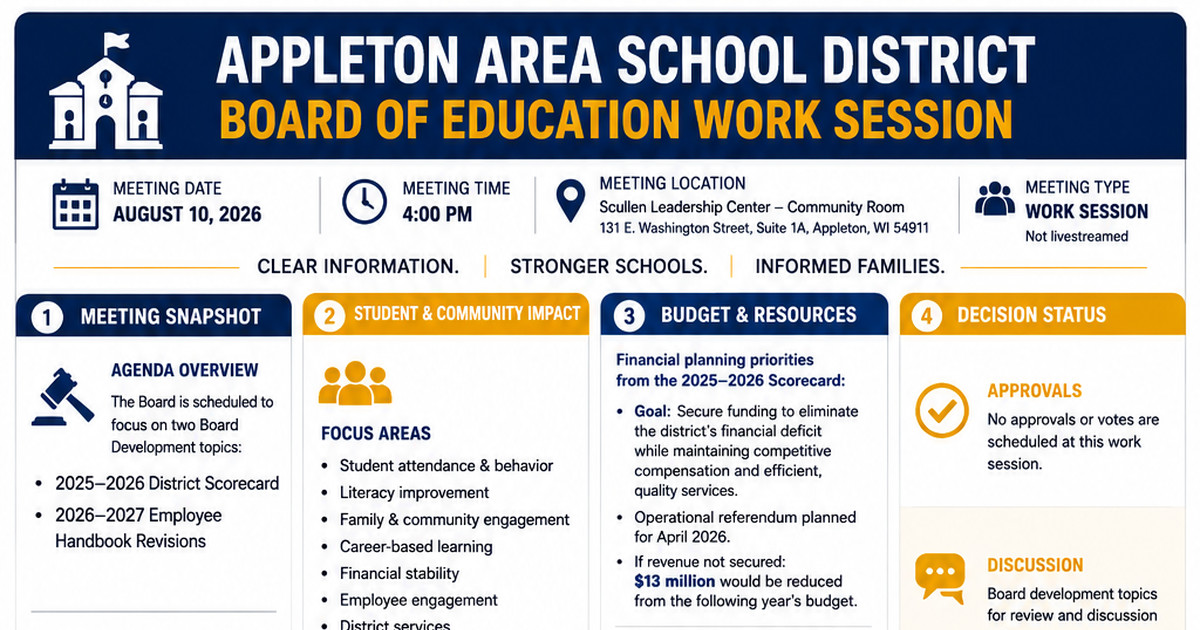
This work session is open to the public, although it is not livestreamed.
Members of the public and media may attend in person.
Accessibility accommodations may be requested through the district at least 24 hours before the meeting.
The agenda does not identify formal public hearings, public comment periods, or scheduled public testimony related to policy adoption.
Students may benefit from continued investments in social-emotional learning, improved attendance supports, equitable discipline practices, technology access, and expanded instructional opportunities.
Families receive ongoing communication regarding attendance, behavioral expectations, student safety, and academic planning.
District employees continue participating in professional development focused on instructional quality, restorative practices, emergency preparedness, and equitable implementation of district policies.
Taxpayers receive evidence that the board's governance system includes regular monitoring of operational performance rather than relying solely on annual reports or compliance audits.
Community organizations working with schools may continue partnering around attendance, student wellness, emergency response, and early childhood education initiatives discussed during the work session.
- How will the district strengthen consistent implementation of social-emotional learning across all elementary schools?
- What additional strategies are planned to reduce remaining discipline disparities?
- What contributed to the reduction in seclusion and restraint incidents?
- How will the board evaluate future success of the 3K preschool program?
- What attendance interventions have produced the strongest improvements?
- How are Panorama survey results being incorporated into school improvement planning?
- What additional supports are available for students experiencing chronic absenteeism?
- How will curriculum evaluations influence future instructional material adoptions?
- What metrics will the board monitor during the next OE-10 and OE-11 reviews?
- How will equitable access to advanced coursework continue to be monitored?
Important Dates, Deadlines, and Next Steps
- July 8, 2026: Board of Education Work Session to review OE-10, OE-11, and discuss the 3K preschool program.
- Following the work session, board members are expected to determine whether the evidence supports findings of compliance for both operational monitoring reports.
- Future board meetings may consider recommendations arising from the preschool discussion or future curriculum implementation planning, if brought forward by administration.
Key Takeaways
- The superintendent certifies full compliance with both operational monitoring reports.
- The board will review Learning Environment and Student Behavior performance.
- The board will review Instructional Program performance.
- Eighty-two percent of students received no office discipline referrals.
- Seclusion and restraint incidents declined substantially compared with the previous year.
- The district recorded more than 130,000 health room visits while maintaining emergency preparedness systems.
- Anonymous reporting continues to be an important student safety tool.
- Curriculum alignment and instructional quality remain central governance priorities.
- Students continue receiving access to technology, electives, career planning, and postsecondary opportunities.
- The board will discuss the district's 3-year-old preschool program as part of board development.
Official Sources
About the Public Body
- Name: Appleton Area School District
- Organization type: school-district
- Government body: school-boards
- Location: Appleton, wisconsin
- County: Outagamie
- Provider: granicus
Keywords
Appleton Area School District, Board of Education, July 8 2026, work session, OE-10, OE-11, learning environment, student behavior, instructional program, social-emotional learning, Character Strong, Second Step, restorative practices, Panorama survey, attendance, truancy, Speak Up Speak Out, school safety, curriculum alignment, IEP, English learners, ACCESS assessment, academic interventions, eduCLIMBER, technology access, 3K preschool, early childhood education, career planning, Appleton, Wisconsin