Appleton Area School District Packet Summary — August 10, 2026
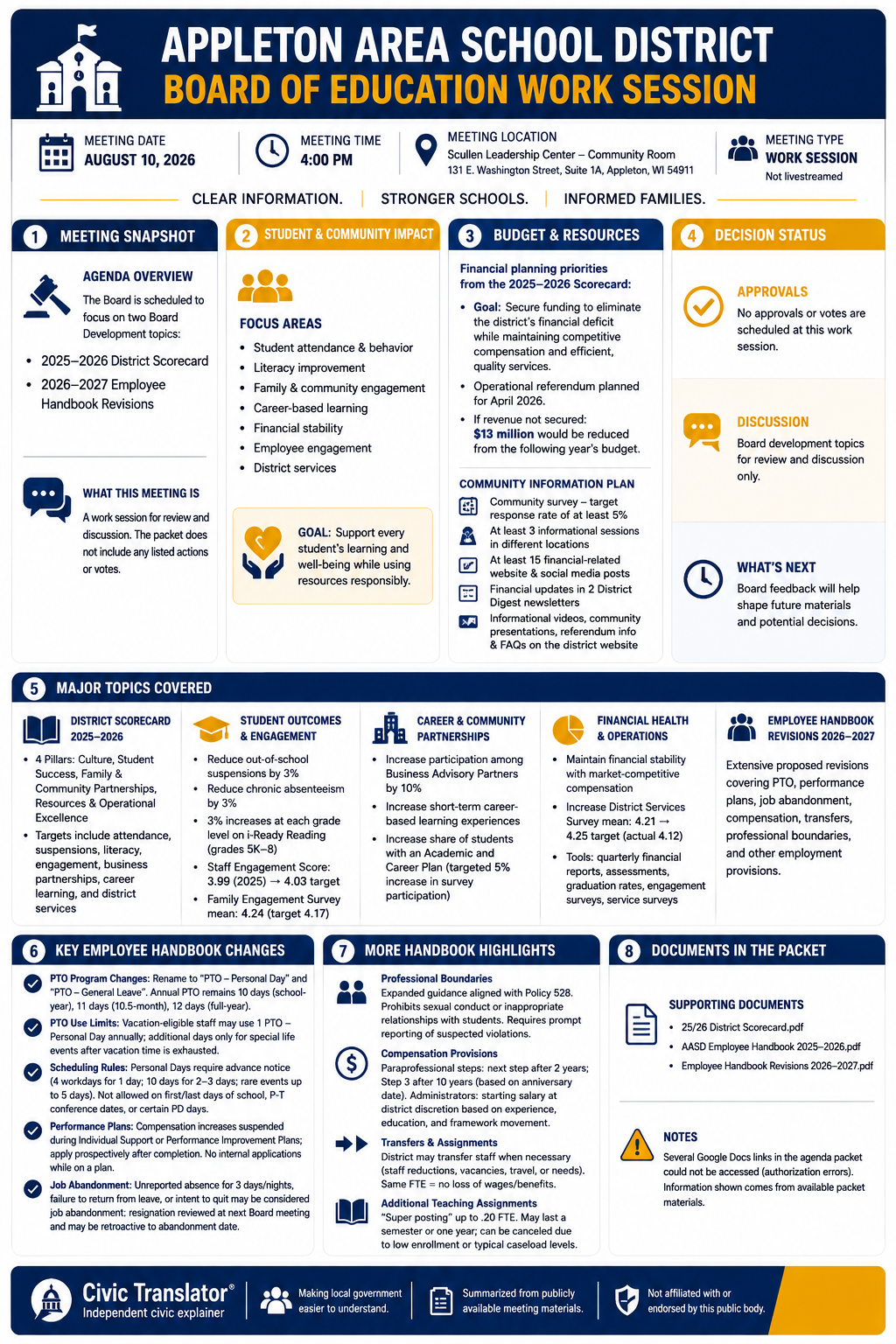
The Appleton Area School District Board of Education is scheduled to hold a work session at 4:00 p.m. on Monday, August 10, 2026, at the Scullen Leadership Center Community Room, 131 E. Washington Street, Suite 1A, Appleton. The agenda centers on two Board Development topics: the 2025-2026 District Scorecard and proposed revisions to the 2026-2027 Employee Handbook.
Key Items on the Agenda
2025-2026 District Scorecard
The Board is scheduled to review the district's 2025-2026 Scorecard, which organizes goals and measures around four pillars: Inclusive & Engaging Culture to Support Teaching and Learning; Student Success; Family & Community Partnerships; and Resources & Operational Excellence.
The scorecard identifies priorities involving student attendance and behavior, literacy, community communication and engagement, financial stability, employee engagement, career-based learning, and district services.
Among the stated targets and measures:
- Reduce out-of-school suspensions by 3% and chronic absenteeism by 3% by June 2026.
- Increase the Staff Engagement Survey mean score from 3.99 in 2025 to 4.03.
- Increase literacy proficiency through grade-specific measures, including 3% increases at each grade level on i-Ready Reading for grades 5K-8.
- Maintain the Family Engagement Survey mean of 4.17; the scorecard lists an actual result of 4.24.
- Increase participation among Business Advisory Partners by 10% by June 2026.
- Increase short-term career-based learning experiences and increase the share of students with an Academic and Career Plan, with progress measured through a targeted 5% increase in survey participation.
- Increase the District Services Survey mean score from 4.21 to 4.25; the scorecard lists an actual result of 4.12.
The scorecard also identifies quarterly attendance, suspension and financial reports; assessment results; graduation rates; engagement surveys; business participation; career-planning measures; and district-service surveys among the tools intended to monitor progress.
The scorecard states a goal of securing funding to eliminate the district's financial deficit while maintaining market-competitive compensation and benefits and improving the quality and efficiency of district services.
The document says the district planned to present the community with an operational referendum in April 2026. It also states that if referendum revenue were not secured, $13 million would be reduced from the following year's budget, with previously developed priorities guiding decisions and identified reductions in non-instructional budget areas intended to offset the shortfall and maintain financial stability.
The scorecard describes a community-information strategy that included:
- A community-wide survey with a target response rate of at least 5%.
- At least three community informational sessions in different locations.
- At least 15 financial-related posts on the district website and social media.
- Financial updates in two District Digest newsletters.
- Informational videos, presentations to community organizations, and referendum information and FAQs on the district website.
Employee Handbook Revisions
The Board is also scheduled to review proposed revisions to the 2026-2027 Employee Handbook. The revision document cites Operational Expectations Policy OE-8, under which the Superintendent informs the Board in advance of significant modifications to district policies, instructional programs or the employee handbook.
The proposed revisions cover mandatory training, job abandonment, employee evaluations and support plans, paid time off, compensation, transfers, professional boundaries and other employment provisions.
Paid Time Off Changes
A substantial portion of the proposed handbook revisions addresses the district's PTO pilot program. Administration says its analysis identified a need to clarify leave codes and address an increase in overall absences and the use of pre-planned PTO to extend vacations for some employee groups.
The revisions would rename:
- "Pre-Planned PTO" as PTO - Personal Day.
- "Unplanned PTO" as PTO - General Leave.
For full-time employees covered by the handbook, the proposed language continues annual PTO allocations of 10 days for school-year staff, 11 days for 10.5-month staff and 12 days for full-year staff.
For vacation-eligible employees, the revised language states that PTO is primarily intended for unexpected, short-notice absences rather than additional vacation time. Those employees could use one PTO-Personal Day annually; additional PTO-Personal Days would be approved for special life events only after available vacation time has been exhausted.
Administration says it will continue monitoring leave data and gathering staff feedback as the PTO pilot continues.
PTO Scheduling and Leave Rules
The proposed handbook provides more detailed procedures for requesting and recording leave.
For PTO-Personal Days:
- Time would be taken in full- or half-day increments.
- A one-day absence would need to be entered four workdays in advance.
- Educator and paraprofessional requests of more than one day, up to three consecutive days, would need to be entered 10 days in advance.
- A rare, once-in-a-lifetime event could be submitted to the Director of Human Resources or designee for consideration for up to five days.
- PTO-Personal Days could not be used on the first or last day of school, parent-teacher conference dates or certain designated professional-development days.
PTO-General Leave would cover needs such as illness, medical appointments, bereavement and emergencies. It could be taken in increments of one hour or more and would not be subject to pre-approval, although employees would have reporting and supervisor-notification requirements.
The proposed revisions would add consequences for employees placed on an Individual Support Plan or Performance Improvement Plan. Scheduled compensation increases would be suspended while an employee is on such a plan and, following successful completion, would apply prospectively from the completion date.
Employees actively on an Individual Support Plan also would not be eligible to apply for other positions until successfully completing the plan.
Job Abandonment
The proposed handbook adds a definition and procedures for job abandonment. Conditions include an unreported absence for three consecutive days or nights without prior communication, failure to return after an authorized leave expires, or actions demonstrating an intent to quit.
For employees who hold Board employment contracts under Wisconsin statutes, the proposed language says the Board would take action at its next meeting regarding the resignation of an employee who abandoned a position. Any resignation accepted by the Board in that circumstance would be retroactive to the date of job abandonment.
Professional Boundaries and Staff-Student Relationships
The revisions expand language concerning professional boundaries between employees and students and reference Policy 528, Professional Boundaries and Staff-Student Relationships.
The proposed language emphasizes role-appropriate communicative, physical, emotional and social boundaries; prohibits sexual conduct or inappropriate social or romantic relationships with students regardless of whether a student is 18 or older; and requires trained district employees and volunteers to promptly report known or reasonably suspected violations to an appropriate district official.
Compensation and Employment Provisions
The proposed revisions also address compensation and assignment rules for several employee groups.
For paraprofessionals, compensation increases would remain contingent on factors including satisfactory evaluations, available funding, base-wage negotiations and Board approval. Proposed language describes progression to the next step after two years and Step 3 after 10 years, based on the anniversary date.
For administrators, the district would retain discretion over starting salaries, taking into account factors such as prior administrative experience and education. The revisions also address movement within the administrative compensation framework.
The packet notes that additional revisions to the custodial and maintenance compensation section are expected in the near future. That work is described as aligning the handbook with a new compensation model developed from a market study, including efforts to incorporate applicable stipends and differentials into standard hourly rates.
Involuntary Transfers and Additional Teaching Assignments
Revised involuntary-transfer language would allow the district to transfer a qualified employee when necessary, including circumstances involving staff reductions, travel, vacancies or unforeseen staffing needs. Employees transferred to assignments with the same FTE would not lose wages or employee benefits because of the transfer.
For professional educators accepting an additional teaching assignment through a "super posting," compensation would be based on the FTE of the additional class, up to .20. The proposed language states that these assignments may last a semester or one year and may be canceled because of low enrollment or when courses or caseloads fall within a typical range.
What to Watch at the Work Session
The work session is structured around Board development rather than a listed action or consent agenda. The packet does not identify a scheduled vote on either of the two substantive agenda topics.
Key points for the Board's review include how the 2025-2026 scorecard measures progress across student outcomes, engagement and district operations, as well as the scope of the proposed 2026-2027 Employee Handbook changes. The handbook revisions are particularly extensive in the areas of PTO administration, employee performance plans, job abandonment, compensation practices and professional boundaries with students.