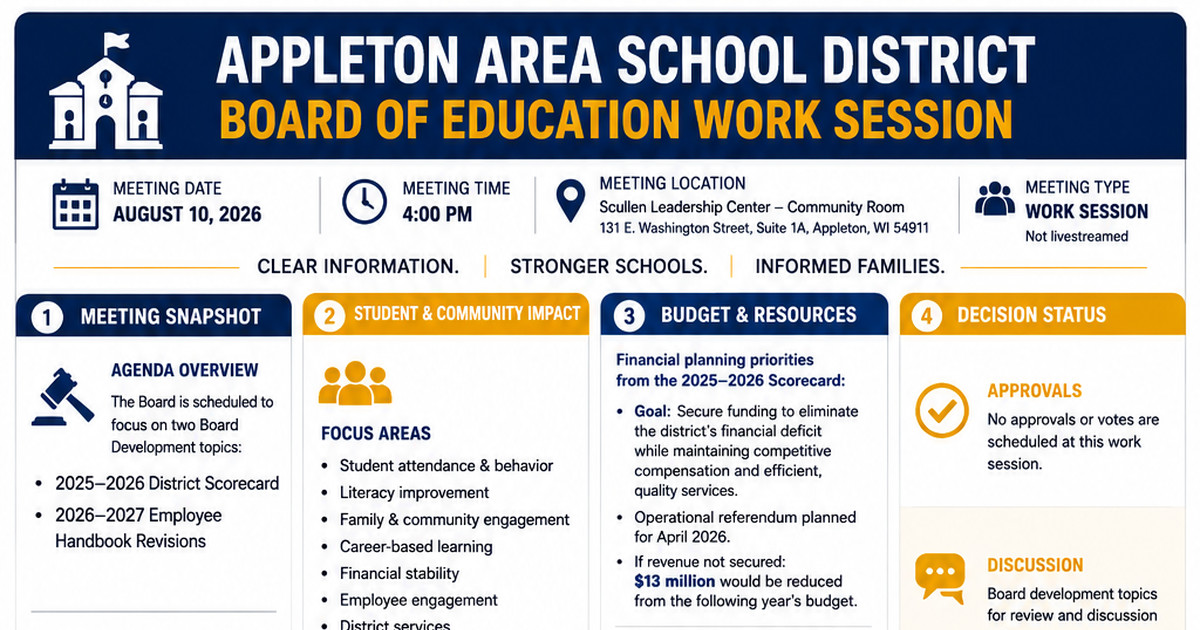
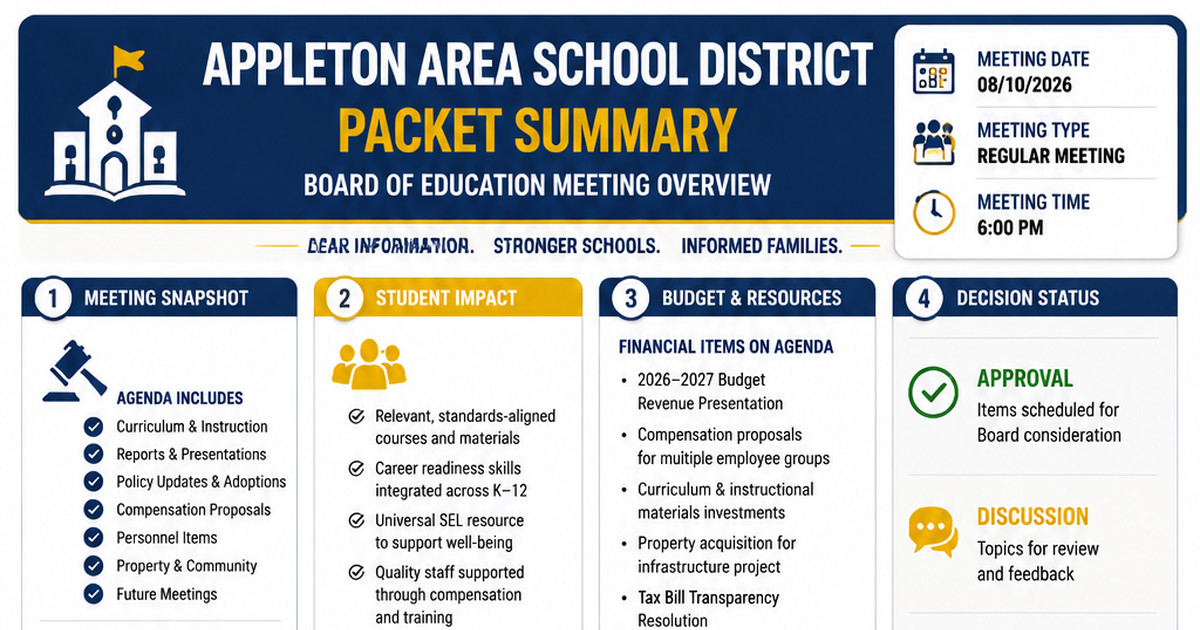
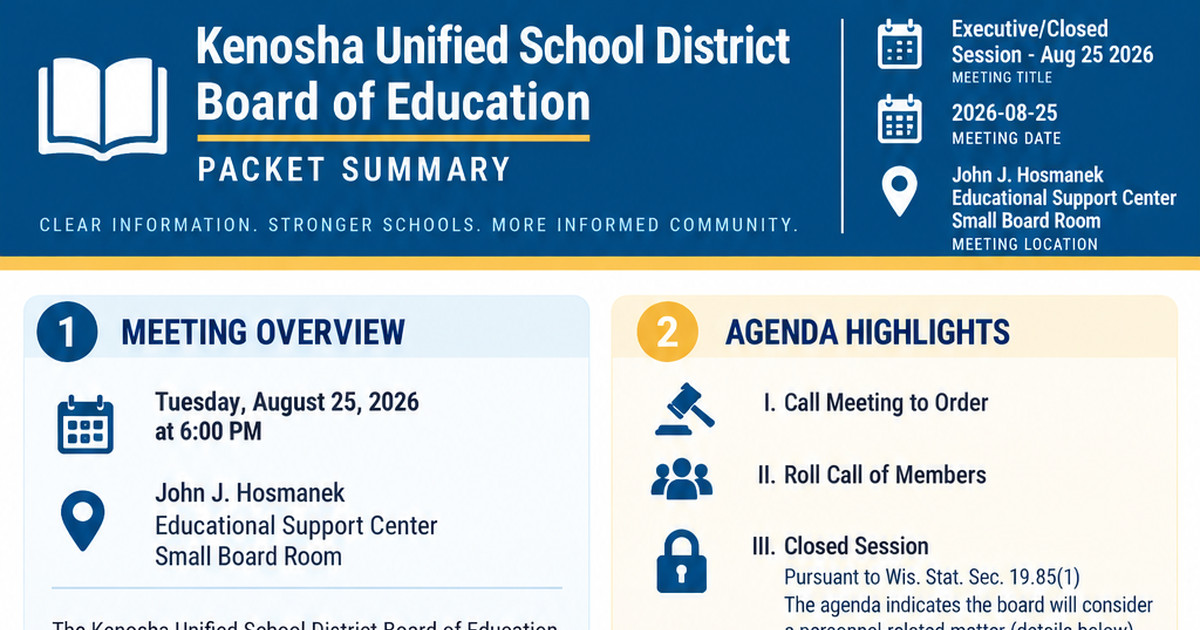
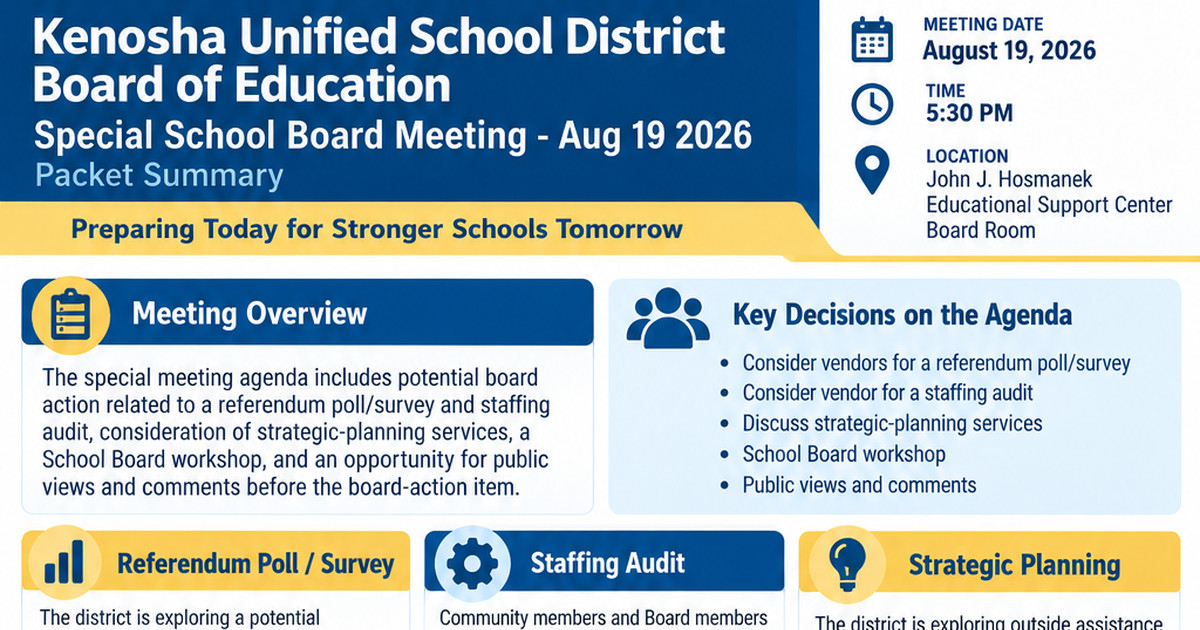
AASD School Board Agenda Explained — July 8, 2026. Civic Translator infographic generated from public meeting materials.
About this summary
Generated from official public meeting materials.
This summary was created from publicly available agenda, supporting documents, reports, attachments, packets, and other official pre-meeting materials published for the Appleton Area School District School Board meeting.
Civic Translator uses automated and AI-assisted publishing workflows. Official government records, agendas, packets, minutes, recordings, and notices remain the authoritative source.
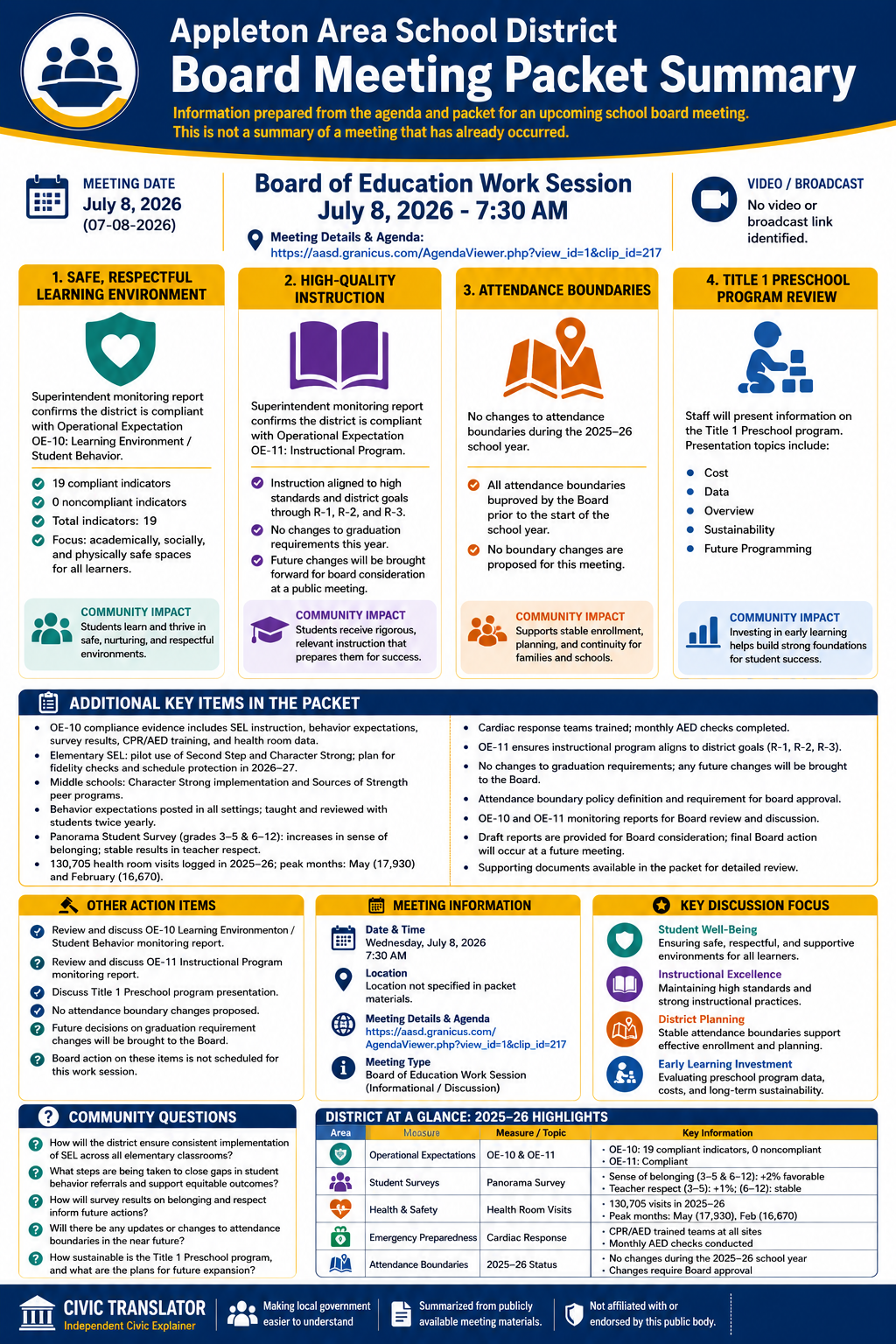
This work session centers on three major topics: the district's annual monitoring of student behavior and learning environment policies (OE-10), its review of instructional program performance (OE-11), and the future of the district's federally funded three-year-old Title I preschool program. Together, these items provide the Board with evidence about whether district operations comply with its governance policies while also beginning a broader discussion about early childhood programming and future funding priorities.
The two operational monitoring reports conclude that the superintendent is compliant with every measured indicator. The district reports meeting all 19 indicators under OE-10 for student behavior and learning environment and all 27 indicators under OE-11 for instructional programming. The reports highlight districtwide implementation of behavioral supports, instructional standards, student technology access, attendance monitoring, and curriculum alignment.
The preschool presentation raises one of the meeting's most consequential long-term policy questions. District leaders outline the financial impact of maintaining three-year-old preschool using Title I funds, present alternative funding approaches, and discuss possible program expansion. While no final decision is documented in the packet, the presentation frames future budget choices between preserving preschool, maintaining staffing within Title I schools, or identifying new community funding sources.
Residents, families, and employees should expect substantial discussion rather than immediate policy changes. The packet is largely informational, intended to help the Board evaluate district performance and begin considering future strategic and financial decisions.
Major Discussion and Action Items
Superintendent Monitoring Report: Learning Environment and Student Behavior (OE-10)
The district presents its annual monitoring report demonstrating compliance with Board Operational Expectations governing student behavior, school climate, attendance, discipline, and student well-being. The superintendent certifies compliance across all 19 indicators with no reported noncompliance.
Evidence includes districtwide implementation of social-emotional learning, behavioral expectations communicated to students and families, restorative practices, attendance intervention systems, emergency preparedness, and ongoing review of discipline data. The Board is expected to review the evidence and determine whether it agrees that district performance satisfies board policy.
Review of Instructional Program Performance (OE-11)
A second monitoring report evaluates instructional programming and curriculum. District administration reports compliance with all 27 indicators governing curriculum alignment, assessment quality, instructional time, technology access, graduation requirements, attendance boundaries, intervention systems, and student opportunities.
Highlights include annual updates of every Individualized Education Program (IEP), documentation of all Tier 2 and Tier 3 interventions, district curriculum aligned with adopted standards, valid academic assessments, guaranteed instructional time, and districtwide student access to instructional technology.
Future of Three-Year-Old Title I Preschool
The preschool presentation examines how the district currently operates federally funded preschool for eligible three-year-olds and evaluates future sustainability.
District leaders explain that Title I preschool serves children identified through developmental needs and residing within eligible attendance areas. The presentation discusses student outcomes, program longevity, costs, and future expansion opportunities while emphasizing that future financial choices will determine whether current programming continues in its present form.
Student Behavior, School Climate, and Safety
The district highlights multiple indicators suggesting improvements in student climate and school safety.
Student surveys showed favorable responses regarding classroom belonging, respect from teachers, and school safety. Spring-to-spring survey results increased approximately two percentage points in several reported measures. Districtwide implementation of behavioral expectations, restorative practices, and social-emotional learning continues to be emphasized.
Anonymous reporting through Speak Up Speak Out generated 534 reports during 2025-26. Bullying represented the largest category, followed by cyberbullying, school complaints, inappropriate conduct, vaping, and suicide concerns. All reports were documented as closed.
Equity in Discipline
The monitoring report emphasizes ongoing review of discipline disparities across demographic groups.
Administrators participate in calibration training to improve consistency when responding to student behavior. The district continues monitoring out-of-school suspension rates by demographic group using WISE data and eduCLIMBER while reporting continued reductions in seclusion and restraint incidents.
Combined seclusion-only and restraint-only incidents declined from 186 during the previous school year to 111 during 2025-26, the lowest level since the 2021-22 school year. The district also reports it is no longer identified by the Wisconsin Department of Public Instruction for excessive use of seclusion and restraint.
Attendance Improvement Strategies
Attendance remains another major operational focus.
Each school maintains attendance teams that monitor student attendance and coordinate intervention strategies. Automated notifications alert families as attendance thresholds are approached, while more intensive interventions involve attendance plans, family collaboration, and when necessary, referrals for truancy enforcement.
District staff also collect feedback from students and families regarding attendance interventions to improve future support efforts.
Academic Access and Student Opportunity
The instructional report emphasizes equitable student access to educational opportunities.
Secondary students continue to receive academic and career planning, postsecondary credit opportunities through Early College Credit and Start College Now, and access to elective pathways. Elementary students continue receiving art, music, and physical education, including students with disabilities through their IEPs.
Technology and Instructional Time
District administration reports every student had access to a district-provided instructional device during the 2025-26 school year.
Devices remain protected by continuous Children’s Internet Protection Act-compliant filtering, with no reported inappropriate internet access. Schools also continue protecting instructional time by maintaining required literacy, mathematics, and uninterrupted secondary core instructional blocks.
Financial Matters
The packet's most significant financial discussion concerns future funding for three-year-old preschool.
Maintaining preschool through Title I currently consumes a substantial portion of federal Title I funding. The presentation indicates preschool represented approximately 19% of the 2026-27 Title I budget, with per-student preschool costs estimated at $5,667 compared with approximately $393 per K-5 through grade 8 student supported by remaining Title I programming.
District staff estimate preschool represents roughly a $1.5 million impact within the overall Title I budget.
Three future options are presented:
Continue funding preschool through Title I while reducing staffing within Title I schools.
If community funding is pursued, projected costs are approximately $360,000 in 2026-27, $370,800 in 2027-28, and $381,924 in 2028-29 while serving 64 students annually.
An expanded preschool model would increase enrollment from 64 students to 96 and eventually 160 students, with projected budgets of approximately $360,000, $500,000, and $838,000 over three years while expanding facilities and wraparound services.
No major contracts, bond proposals, tax actions, or capital purchases requiring approval are identified within the accessible packet materials.
Policies, Ordinances, Resolutions, and Governance
The meeting primarily involves governance oversight rather than policy adoption.
The Board is asked to review superintendent monitoring reports for Operational Expectations OE-10 and OE-11 and determine whether evidence supports findings of compliance.
The instructional monitoring report also confirms:
No changes were made to graduation requirements.
No attendance boundary changes occurred during the reporting period.
No significant discipline policy revisions were adopted during the 2025-26 school year.
Reports, Presentations, and Informational Updates
The packet includes three substantive presentations.
The OE-10 report summarizes district performance regarding student behavior, discipline, attendance, restorative practices, emergency preparedness, equity, and school climate. Key findings include 82% of students receiving no office discipline referrals, over 130,000 health room visits documented, complete closure of more than 10,500 discipline incidents, and improved student perceptions of school safety.
The OE-11 report summarizes curriculum, instruction, assessment, technology, and student opportunity. It highlights complete compliance across instructional standards, annual IEP reviews, curriculum alignment, assessment calibration, device access, and instructional scheduling.
The preschool presentation introduces longer-term strategic discussions regarding early childhood education, Title I funding priorities, program sustainability, and potential future expansion.
Personnel, Appointments, and Organizational Matters
No major personnel appointments, executive employment agreements, or board appointments are included within the accessible packet.
The reports note ongoing administrator professional development, including restorative practice training for newly hired administrators and districtwide calibration training intended to improve consistency in student discipline decisions.
The preschool presentation discusses possible staffing implications depending upon future funding decisions, particularly if Title I resources continue supporting preschool versus staffing at Title I schools.
Projects, Facilities, Infrastructure, and Operations
Facility discussion primarily relates to possible preschool expansion.
Future expansion scenarios identify Horizons, Franklin, Foster, Jefferson, Edison, Dunlap, and a proposed AASD Early Learning Center as potential instructional sites over multiple years.
Operational reports also describe districtwide AED maintenance, monthly safety inspections, emergency response training, instructional technology deployment, attendance systems, and districtwide behavioral support implementation.
Public Hearings and Opportunities for Community Input
No formal public hearings, statutory hearings, bid openings, or public comment periods specific to individual agenda items are identified within the accessible packet.
Because this is a Board work session, discussion is expected to inform future decisions regarding preschool programming, operational monitoring, and strategic priorities before any subsequent formal action.
Community Impact
Students and families may ultimately be affected by future decisions regarding three-year-old preschool funding, expansion, or continuation.
Families also benefit from continued investment in social-emotional learning, restorative practices, attendance supports, school safety efforts, and instructional improvements documented throughout the monitoring reports.
District employees may experience staffing changes depending upon future preschool funding decisions if Title I resources must be reallocated between early childhood programming and staffing within Title I schools.
Taxpayers are provided transparency regarding district performance, governance compliance, and long-term financial planning even though the packet does not request new local tax authority or bond financing.
Questions Community Members May Want to Ask
How will the Board evaluate the long-term value of three-year-old preschool relative to other Title I priorities?
What evidence most strongly demonstrates preschool improves later student outcomes?
What funding sources are available if Title I funding is redirected?
What factors contributed to reductions in seclusion and restraint incidents?
How will the district continue reducing discipline disparities across student groups?
What additional strategies are planned to improve consistent implementation of social-emotional learning?
What metrics will determine whether preschool expansion should occur?
How will future staffing decisions affect Title I schools?
What additional supports are planned for students with chronic attendance challenges?
What future operational monitoring topics will come before the Board next?
Important Dates, Deadlines, and Next Steps
July 8, 2026: Board of Education Work Session reviewing operational monitoring reports and preschool programming.
2026-27 School Year: Potential implementation of an updated elementary universal social-emotional learning curriculum pending Board approval.
2026-27 Budget: Continued evaluation of Title I preschool funding strategy.
Future Board Meetings: Any changes to graduation requirements, attendance boundaries, preschool funding, or major instructional initiatives would require future Board consideration and approval.
Key Takeaways
The superintendent reports full compliance with all OE-10 student behavior indicators.
The superintendent also reports full compliance with all OE-11 instructional program indicators.
Eighty-two percent of students received no office discipline referrals during the reporting year.
Student survey results showed modest improvements in school climate and safety perceptions.
Seclusion and restraint incidents declined substantially compared with the previous year.
Every student continued to receive access to a district instructional device protected by continuous internet filtering.
The district is evaluating long-term sustainability of federally funded three-year-old preschool.
Preschool funding currently represents a significant share of Title I resources.
Future preschool expansion would require additional funding, facilities, and staffing.
The meeting focuses primarily on oversight, strategic discussion, and future planning rather than immediate policy changes.
Appleton Area School District, Board of Education, work session, OE-10, OE-11, learning environment, student behavior, instructional program, Title I preschool, three-year-old preschool, social-emotional learning, restorative practices, Panorama survey, attendance interventions, curriculum alignment, IEP, eduCLIMBER, technology access, Title I funding, preschool expansion, school safety, discipline equity, attendance framework, Early College Credit, Start College Now, AASD Early Learning Center, Appleton, Wisconsin