Kenosha Unified School District Board of Education Packet Summary — 2026-08-25
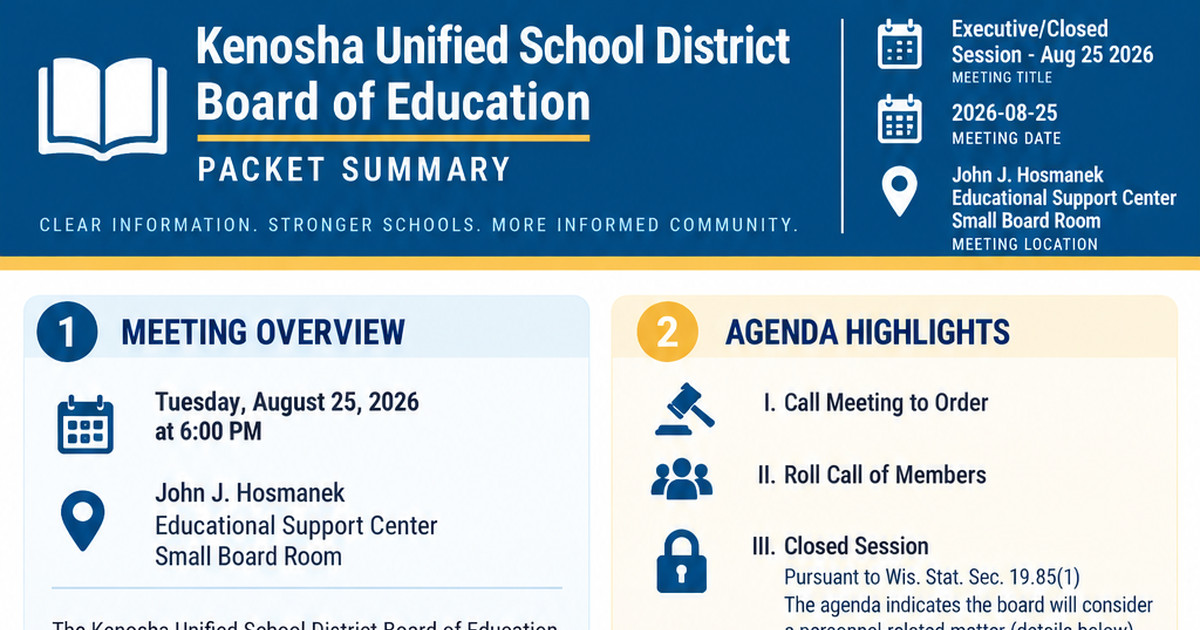
Meeting: Regular School Board Meeting - Aug 25 2026
Scheduled: August 25, 2026, at 7:00 PM
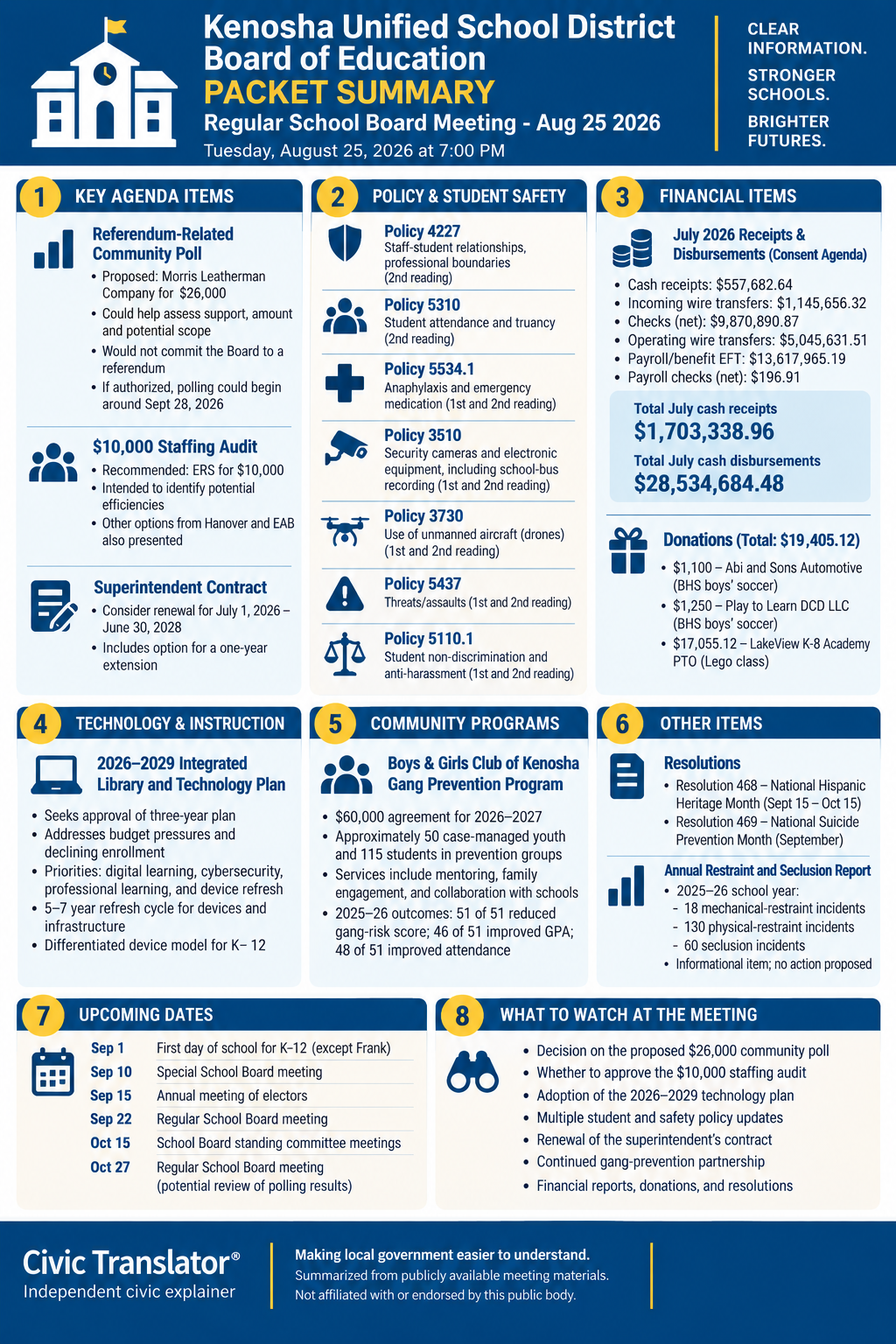
The Kenosha Unified School District Board of Education is scheduled to consider a wide range of policy, financial, technology, safety, staffing, and community-program items. Major proposals include selecting vendors for referendum-related polling and a staffing audit, adopting a three-year library and technology plan, updating multiple student and safety policies, renewing the superintendent's employment contract, and continuing the district's gang-prevention partnership with the Boys & Girls Club of Kenosha.
Key Items on the Agenda
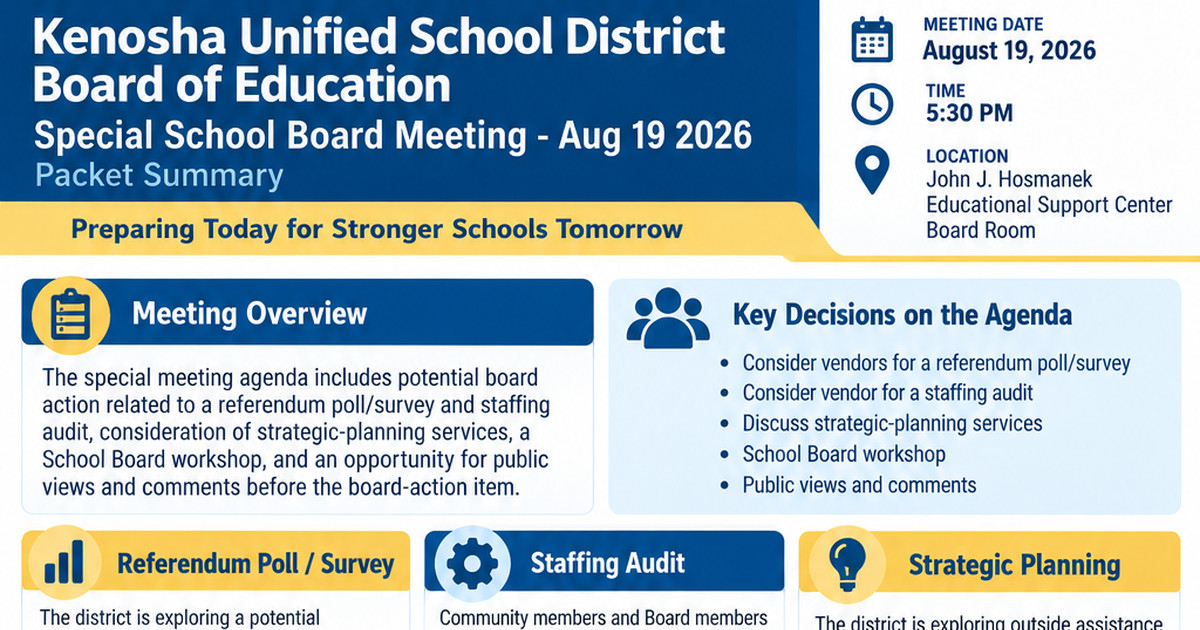
The Board is continuing to explore whether to pursue a potential referendum in April 2027. Administration proposes hiring Morris Leatherman Company for $26,000 to conduct a community poll that could help the Board evaluate whether to pursue a referendum, a possible referendum amount, and what could be included.
The packet emphasizes that authorizing a poll would not commit the Board to pursuing a referendum. Any decision to place a referendum on the April 2027 ballot would require separate Board action later.
The packet compares two polling options:
- Morris Leatherman Company: $26,000 for a referendum poll.
- Hanover: $25,000 for a referendum poll, or a three-year membership at $60,000 per year that could also cover a staff audit and strategic planning.
If authorized, community polling could begin around September 28, 2026, and run approximately two weeks. The tentative timeline calls for results to return to the Board on October 27, continued referendum discussions in November, potential engagement of Quarles to draft ballot language by December 8, and final ballot-language approval no later than January 26, 2027 if the Board decides to proceed. Election Day would be April 6, 2027.
$10,000 Staffing Audit
Administration recommends engaging ERS for $10,000 to conduct a staffing audit intended to identify potential efficiencies as the district faces ongoing financial challenges attributed in the packet to inadequate state funding.
Other options presented include:
- Hanover: $17,500–$24,500 for a staffing audit, depending on scope, or a three-year membership at $60,000 per year.
- EAB: Three-year membership costing $59,150 in year one, $67,650 in year two, and $71,000 in year three.
- ERS: $10,000 for the staffing audit as a stand-alone service.
ERS also offers strategic planning for $32,000, while Hanover lists strategic-planning services at $15,000–$24,500 depending on scope.
Superintendent Employment Contract
The Board is scheduled to consider renewing Superintendent Jeffrey Weiss' employment contract for July 1, 2026, through June 30, 2028, with an option for a one-year extension.
The packet states that Weiss was appointed superintendent effective October 1, 2022. His current contract had previously been extended through June 30, 2027. The proposed revised contract follows prior Board action aligning superintendent benefits and compensation with those of the district's educators.
Policy and Student Safety Items
Staff-Student Relationships and Professional Boundaries
Administration recommends second-reading approval of revisions to Policy and Rule 4227 — Staff-Student Relationships and Professional Boundaries.
The revisions incorporate requirements associated with 2025 Wisconsin Act 57, including parent/guardian notification requirements when a credible report involves specified alleged sexual misconduct or related conduct by school staff. Depending on when a report is received, notification would generally be required by 5 p.m. that school day or noon the next calendar day.
The proposed policy also strengthens expectations around professional boundaries. Among other provisions, it addresses:
- Grooming and inappropriate staff-student relationships.
- Use of district-approved communication platforms.
- Restrictions on personal email, phone numbers, messaging applications, and social-media connections with students.
- One-on-one meetings and video conferences.
- Reporting suspected policy violations and mandatory reporting obligations.
- Annual staff training.
- Potential disciplinary consequences for violations.
Student Attendance and Truancy
Policy and Rule 5310 — Student Attendance returns for a second reading after first-reading approval on July 28.
Administration says the policy was last updated in 2010 and proposes modernizing attendance terminology and procedures, updating references to local truancy ordinances, improving language for parents, and reflecting the district's transition to digital attendance monitoring.
Among the proposed provisions, the rule defines excessive excused absence as 10 or more cumulative days within a school year and habitual truancy as missing part or all of five or more days within a semester without an acceptable excuse. It also describes parent, student, teacher, student-support, principal, and district responsibilities and procedures for interventions and potential legal referrals.
Anaphylaxis and Emergency Medication
Administration recommends first- and second-reading approval of revisions to Policy 5534.1 — Anaphylaxis.
The proposal clarifies treatment when symptoms of anaphylaxis overlap with asthma. Under the revisions:
- Epinephrine remains the first-line treatment for suspected anaphylaxis.
- A bronchodilator may be used as an adjunct for a student with a diagnosed asthma condition and appropriate authorization.
- A bronchodilator must not substitute for or delay epinephrine.
- Staff should call 911 rather than administer a bronchodilator to a student in respiratory distress who does not have an asthma diagnosis on file when anaphylaxis or another medical emergency is suspected.
- Bronchodilator administration would be limited to trained personnel and would require documentation and notification.
Security Cameras and School-Bus Recording
Administration recommends first- and second-reading approval of Policy 3510 — Use of Security Cameras and Electronic Equipment.
The policy would establish districtwide parameters for surveillance and electronic monitoring, including placement, access, confidentiality, records retention, and authorized uses. It incorporates provisions related to 2025 Wisconsin Act 160, which the packet says expressly authorized Wisconsin school districts to equip school buses with both audio and video recording devices.
The proposed policy authorizes audiovisual recording inside district school buses subject to statutory notice, use, and confidentiality requirements. It also prohibits surveillance cameras in restrooms, locker rooms, and designated changing areas and limits access to surveillance records to authorized individuals with legitimate purposes.
New Drone Policy
Administration recommends first- and second-reading approval of Policy and Rule 3730 — Use of Unmanned Aircraft (Drones).
The proposal responds to Wisconsin Act 189, enacted April 3, 2026. The packet says districts must notify the public about restrictions on drone use around school property and establish a process through which outside parties can request authorization for specified uses.
The proposed policy generally restricts unauthorized drone operations over district property while schools are open or during Board-approved events. External requests would be submitted through an online application, and certain requests involving operations over district property would require a district response within five business days.
The accompanying rule establishes additional safety criteria for educational drone use, including supervision, operating locations, federal aviation requirements, proximity to people and property, and other risk factors.
Threats and Assaults Policy
Administration recommends first- and second-reading approval of revisions to Policy and Rule 5437 — Threats/Assaults.
The changes are intended to incorporate procedural protections for students with disabilities under IDEA, Section 504, and Wisconsin special-education law. The packet says no existing policy language is being removed.
The proposal adds procedures involving Manifestation Determination Reviews, continuation of a free appropriate public education, parental safeguards, disability-related considerations during threat assessments, and tracking of disciplinary removals. An MDR would be required within 10 school days when a disciplinary recommendation would result in a qualifying change of placement.
Student Non-Discrimination Policy
Administration recommends first- and second-reading approval of a revision to Policy 5110.1 — Student Equal Opportunity, Non-Discrimination, and Anti-Harassment in Education.
The packet identifies only one specific proposed change for 2026-27: updating the designated Compliance Officer and the officer's contact information. No other changes are recommended.
Technology and Instruction
2026–2029 Integrated Library and Technology Plan
Administration recommends approval of the 2026–2029 Integrated Library and Technology Plan.
The plan describes significant budget pressures affecting technology services. It notes declining student enrollment, increasing device costs, cybersecurity needs, uncertainty surrounding previously annual technology-refresh funding, elimination of building-assigned Instructional Technology Teacher positions, and reductions in secondary Library Media Teachers.
Major plan priorities include:
- Universal access to high-quality digital learning tools and resources.
- Digital and information literacy.
- Professional learning for educators.
- Data privacy and cybersecurity.
- A modified districtwide dedicated-device program.
- Network capacity and technical support.
- Sustainable technology funding and equipment replacement.
The plan describes a general 5–7 year refresh cycle for student and staff devices, infrastructure components, and wireless access points, with other network equipment generally refreshed every seven years.
It also proposes a differentiated student-device model. Grades K–1 would use shared grade-level devices; grades 2–5 would have classroom carts with individually assigned devices; grades 6–8 would have dedicated devices generally remaining at school; and grades 9–12 would continue dedicated 1:1 devices with expected take-home use.
Cybersecurity priorities include continued use of endpoint protection, content filtering, multi-factor authentication, disaster-recovery planning, security training, and 24/7 monitoring.
Community Programs and Student Services
$60,000 Gang Prevention Partnership
Administration recommends a $60,000 Fund 80 agreement with the Boys & Girls Club of Kenosha for the 2026–2027 Gang Prevention Education Program.
The district and organization have maintained the partnership for more than 20 years. The proposed program includes case management, mentoring, prevention groups, family engagement, incentive activities, and collaboration with schools and community agencies.
The proposed memorandum calls for approximately 50 case-managed youth and weekly prevention-group programming serving at least 115 students at Lance, Bullen, Mahone, and Washington middle schools. The agreement would run from September 1, 2026, through June 30, 2027.
The packet's 2025–26 year-end materials report that 51 youths received case-management services. Reported outcomes include:
- 51 of 51 reduced their gang-risk score.
- 46 of 51 improved their GPA.
- 48 of 51 improved attendance.
- 51 of 51 participated in at least four program activities per month.
For 2026–27, program goals include targets for avoiding new offenses, participation in non-gang activities, family involvement, gang-risk reduction, improved attendance, and improved academic performance.
Annual Restraint and Seclusion Report
The Board will receive the annual restraint and seclusion report as an informational item; no action is proposed.
For the 2025–26 school year, the packet reports:
- 18 mechanical-restraint incidents
- 130 physical-restraint incidents
- 60 seclusion incidents
The report explains that mechanical-restraint reporting includes qualifying use of handcuffs by school resource officers and other police officials on school property or during school functions. Wisconsin law requires annual Board reporting and submission of the district's report to the Department of Public Instruction by December 1.
Financial and Consent Items
July Cash Receipts and Disbursements
The consent agenda includes July 2026 receipts, wire transfers, payroll, and check registers.
Administration recommends approval of:
- $557,682.64 in cash-receipt deposits.
- $1,145,656.32 in incoming cash-receipt wire transfers.
- $9,870,890.87 in checks, net of voided batches.
- $5,045,631.51 in general operating outgoing wire transfers.
- $13,617,965.19 in net payroll and benefit EFT batches.
- $196.91 in net payroll check batches.
The financial report lists $1,703,338.96 in total July cash receipts and $28,534,684.48 in total July cash disbursements.
Donations
Administration asks the Board to accept three donations:
- $1,100 from Abi and Sons Automotive for Bradford High School boys' soccer.
- $1,250 from Play to Learn DCD LLC for Bradford High School boys' soccer.
- $17,055.12 from the LakeView K-8 Academy PTO for the school's Lego class.
The three donations total $19,405.12.
The agenda includes Resolution 468, which would proclaim September 15 through October 15 as National Hispanic Heritage Month and encourage schools to conduct educational activities connected to the observance.
Resolution 469 would proclaim September as National Suicide Prevention Month and encourage schools, families, and community partners to participate in ongoing prevention, education, and outreach efforts.
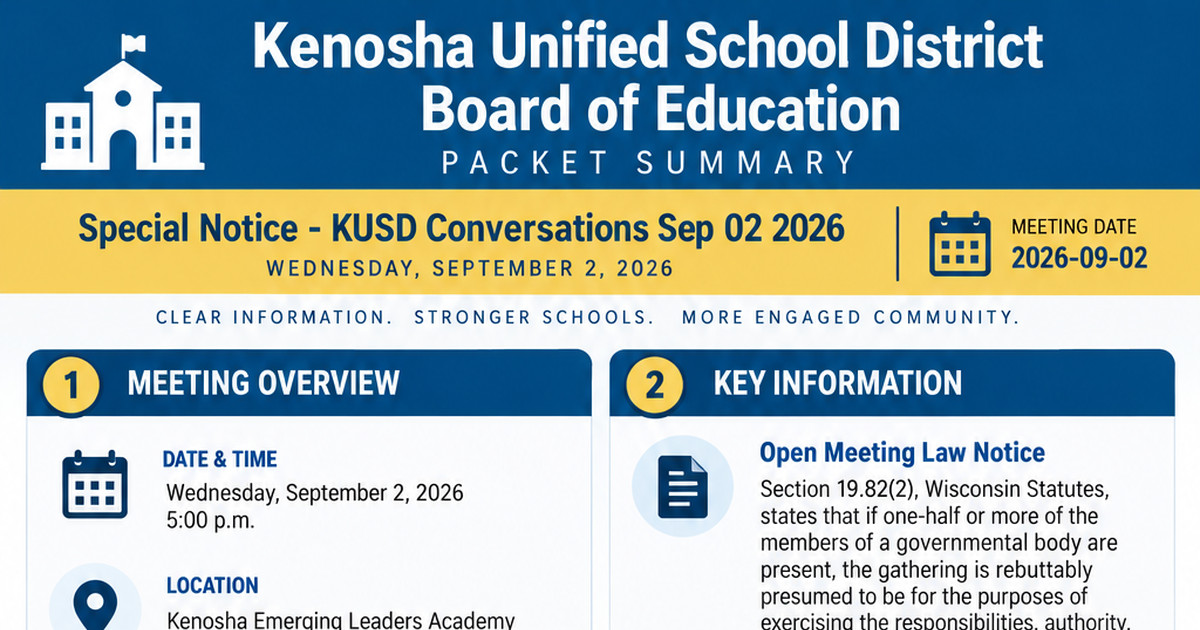
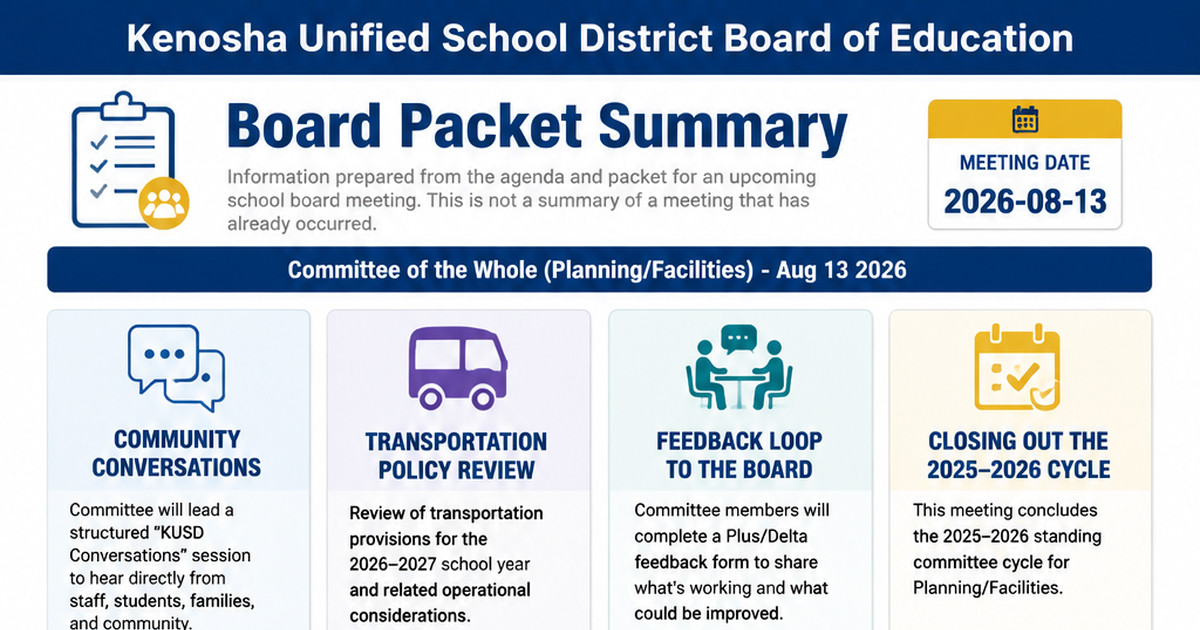
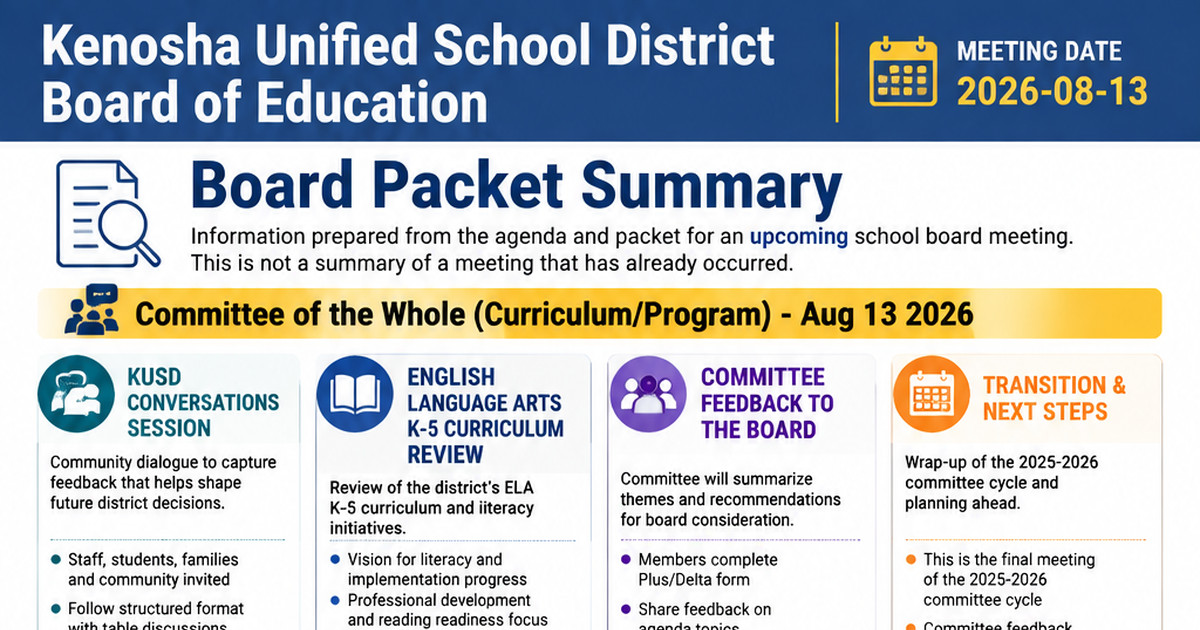
The Board is also scheduled to receive an informational recap of the August 13 Committee of the Whole meeting. Twenty-two members from the four standing committees participated in that pilot KUSD Conversations session, part of a community-engagement initiative intended to gather feedback and strengthen communication about district priorities and challenges. No Board action is requested on the committee recap.
What to Watch at the Meeting
- Referendum planning: Whether the Board authorizes the recommended $26,000 community poll will determine whether polling can proceed ahead of later decisions about a possible April 2027 referendum.
- Staffing and finances: The proposed $10,000 ERS staffing audit is intended to examine potential efficiencies amid the district's financial challenges.
- Technology tradeoffs: The three-year technology plan explicitly warns that funding and staffing constraints could reduce technology accessibility and availability.
- Student and school safety: Several proposed policies address professional boundaries, surveillance and school-bus recording, drones, anaphylaxis response, and disciplinary protections for students with disabilities.
- Superintendent contract: The Board is being asked to approve a contract running through June 30, 2028, with an option for another one-year extension.
- Community programming: The proposed $60,000 Boys & Girls Club agreement would continue gang-prevention and youth-empowerment programming through the 2026–27 school year.
Upcoming Dates
The packet's tentative Board and district calendar includes:
- September 1: First day of school for K–12 students, except Frank.
- September 10: Special School Board meeting.
- September 15: Annual meeting of electors.
- September 22: Regular School Board meeting.
- October 15: School Board standing committee meetings.
- October 27: Regular School Board meeting and, under the proposed referendum timeline, anticipated review of community polling results if polling is authorized.
Civic Translator summarized publicly available meeting materials from the Kenosha Unified School District Board of Education.