Meeting: 08/03/2026 - 05:30 PM Committee of the Whole Board Meeting
Scheduled time: 5:30 PM
Location: Smart Middle School, 1934 W. 5th St., Davenport, Iowa
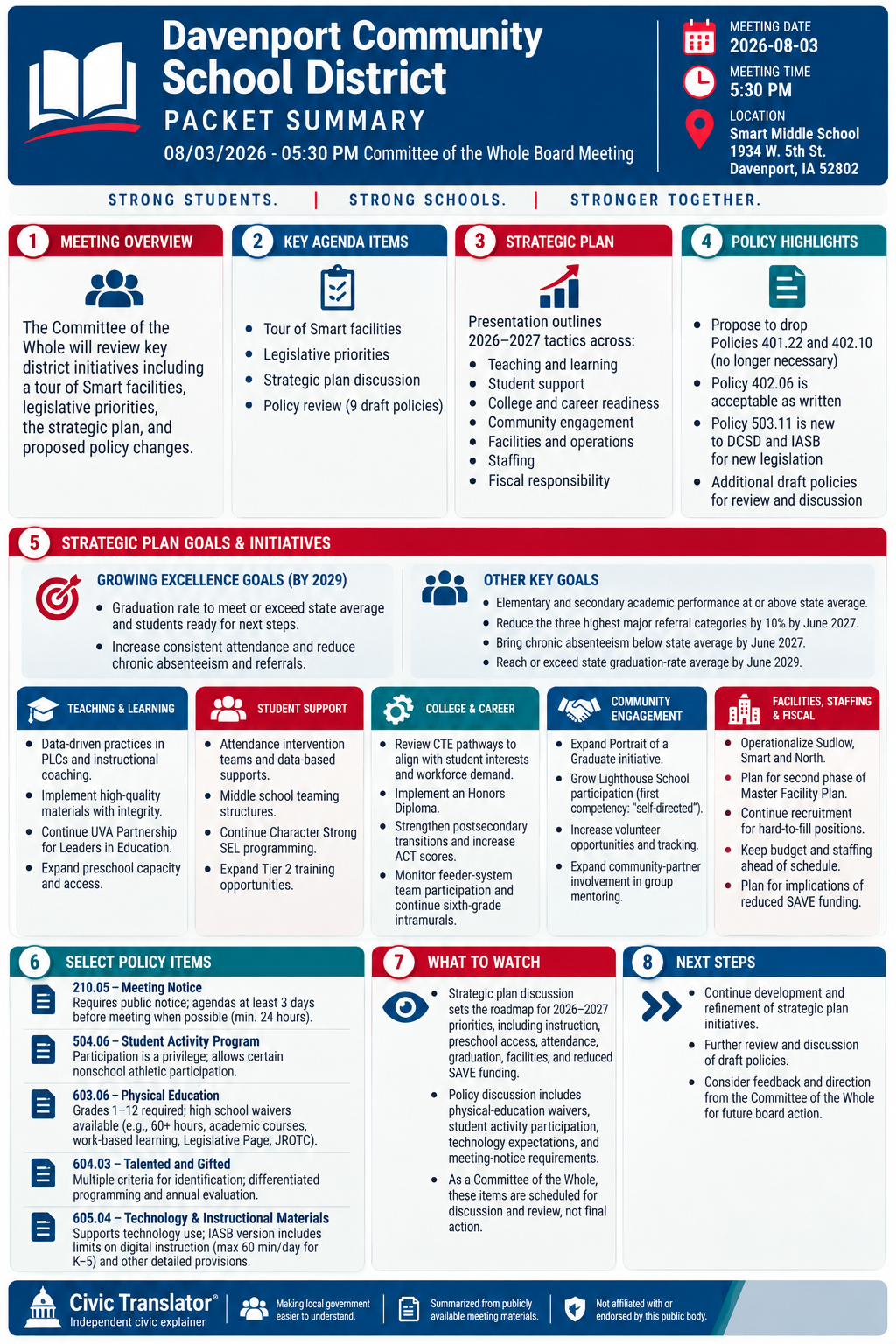
The Davenport Community School District Board's Committee of the Whole agenda centers on a tour of Smart facilities, legislative priorities, the district's strategic plan, and a substantial policy review. The packet provides the most detail on strategic priorities for 2026–2027 and proposed policy changes affecting technology use, physical education, student activities, gifted education, and board meeting notices.
Key Items on the Agenda
- Tour of Smart facilities: The agenda includes a tour of Smart facilities. The packet does not provide additional detail about the scope or purpose of the tour.
- Legislative priorities: The board is scheduled to discuss legislative priorities, though the packet does not provide supporting detail on specific priorities.
- Strategic plan: A board presentation outlines district goals and proposed 2026–2027 tactics across teaching and learning, student support, college and career readiness, community engagement, facilities, staffing, and fiscal responsibility.
- Policy review: The agenda includes nine draft policies. Packet notes indicate Policies 401.22 (IPERS Contribution) and 402.10 (Registration of Certificates) are proposed to be dropped because they are no longer considered necessary, while 402.06 (Employee Outside Employment) is identified as acceptable as written. 503.11 (Disruptive Behavior) is described as new to both the district and the Iowa Association of School Boards in response to new legislation.
Strategic Plan
The strategic planning presentation organizes district work around five focus areas: Excellence in Teaching and Learning, Support for Every Student, Opportunities to Excel, Connected with Our Community, and Smart Systems, Strong Schools.
Two broader Growing Excellence goals look toward 2029:
- Academic readiness and graduation success: By 2029, the district aims for its graduation rate to meet or exceed the state average and for students to demonstrate readiness for their next grade level or postsecondary plans.
- Student belonging and engagement: By 2029, the district aims to increase consistent attendance and reduce chronic absenteeism and referrals.
The board's strategic goals also include bringing elementary and secondary academic performance to or above state averages, reducing the three highest major referral categories by 10% by June 2027, bringing chronic absenteeism below the state average by June 2027, and reaching or exceeding the state graduation-rate average by June 2029.
Teaching and Learning
Proposed 2026–2027 work emphasizes strengthening classroom instruction and systems for responding to student needs. Planned tactics include embedding data-driven practices in Professional Learning Communities, using coaching and evidence of student learning to improve instruction, and implementing high-quality instructional materials and practices with integrity.
The district also plans to continue its University of Virginia Partnership for Leaders in Education work in learning lab schools. The presentation describes two priorities: improving Tier 1 instructional systems and strengthening a data-responsive coaching system.
For preschool, the district plans to monitor outcomes from the Madison and Jackson pilot program, identify sustainable funding, and implement Facilities Master Planning Committee recommendations intended to increase preschool capacity and access.
Attendance and Student Support
Improving chronic absenteeism remains a strategic objective. Proposed 2026–2027 tactics include using attendance intervention teams and data-based decision-making to align interventions with student needs, while engaging students and families on the importance of attendance.
At the middle-school level, the district plans to embed data-based decision-making into teaming structures so student supports can be better aligned with individual needs.
The district also plans continued implementation of Character Strong social-emotional learning programming across buildings, along with expanded opportunities for Tier 2 training.
College, Career and Extracurricular Opportunities
For 2026–2027, the district proposes reviewing Career and Technical Education pathways to better align them with student interests and labor-market demand. Other tactics include implementing an Honors Diploma, strengthening transitions to postsecondary opportunities, and increasing student ACT scores.
The strategic plan also calls for developing a system to monitor participation in feeder-system teams and continuing sixth-grade intramurals.
The district's Portrait of a Graduate initiative is scheduled to expand during 2026–2027. The plan calls for expanding Lighthouse School participation and having all schools implement the first competency, "self-directed."
Community engagement objectives also include marketing volunteer opportunities, tracking volunteer participation, and expanding community-partner involvement in group mentoring.
Facilities, Staffing and Fiscal Planning
The district's facilities work for 2026–2027 includes operationalizing Sudlow, Smart and North and continuing planning for the second phase of the Master Facility Plan, including capstone programming and special education.
For staffing, the district plans to continue a comprehensive marketing strategy focused on recruiting for hard-to-fill positions.
Fiscal objectives include keeping budget, staffing, and contract allocation ahead of schedule and using forecasting tools and relevant data to establish budgets and staffing patterns. The strategic presentation also specifically calls for planning for the implications of a reduction in SAVE funding.
Policy / Governance Items
Policy 210.05 — Meeting Notice
A draft district policy would continue requiring public notice for board meetings and work sessions, including the time, place, date, and tentative agenda. The district draft says agendas will be posted at least three days before a scheduled meeting when possible, with a minimum of 24 hours' notice.
The comparison material includes an adopted IASB version requiring notice in a publicly visible designated location and on the district's primary website at least 24 hours before the meeting. It also addresses how agendas amended within 24 hours of a meeting are to be identified and posted.
Policy 504.06 — Student Activity Program
The district draft states that participation in school activities is a privilege and generally provides students an opportunity to participate unless an activity is unavailable or participation is restricted for disciplinary reasons.
For high school athletes, the district draft allows participation in a nonschool-sponsored sport during the same season as a school-sponsored sport, provided the outside participation does not conflict with the school activity. The packet's IASB comparison presents several policy options on simultaneous nonschool athletic participation and also contains an optional provision concerning eighth-grade participation in high school athletics.
Policy 603.06 — Physical Education
The district's draft requires students in grades 1–12 to participate in physical education unless excused by the principal. For high school students, the draft describes several circumstances in which a waiver may be available.
Those circumstances include athletics or qualifying school-sponsored activities totaling 60 hours or more, enrollment in otherwise unavailable academic courses, certain school-sponsored work-based learning programs, participation in the Legislative Page Program, and JROTC. The draft states that JROTC participants would receive physical education credit based on their scheduled time in the program.
Policy 604.03 — Program for Talented and Gifted Students
The district draft says talented and gifted programming should be part of the overall instructional program, with procedures for development, implementation, and evaluation.
Identification is to use multiple criteria, with an expectation that the identified student population reflect the district's ethnic and cultural diversity as closely as possible. The draft also calls for differentiated curricular programming, support services, and annual review and evaluation for program improvement.
Policy 605.04 — Technology and Instructional Materials
The district draft supports technology and other innovative methods as part of the educational program. It assigns the superintendent or designee responsibility for developing and annually evaluating a technology plan and reporting recommendations to the board.
The packet's IASB comparison contains substantially more detailed provisions, including limits on digital instruction in kindergarten through fifth grade, parent or guardian requests for further reductions, restrictions on digital-device use during recess, and requirements associated with district one-to-one device programs. The IASB language shown in the packet contains an unresolved placeholder for the specific daily digital-instruction limit, while stating that the amount may not exceed 60 minutes per school day.
What to Watch at the Meeting
The strategic-plan discussion provides the clearest roadmap for district priorities in 2026–2027, including instructional improvement, preschool access, attendance, graduation, college and career readiness, facilities, and the financial implications of reduced SAVE funding.
The policy discussion also contains several consequential questions for the board to review, particularly proposed physical-education waiver provisions, student participation in school and nonschool athletics, technology expectations, and meeting-notice requirements. Because this is a Committee of the Whole packet, these items should be understood as scheduled discussion and review topics rather than completed board actions.