Meeting: Workshop/Business Meeting
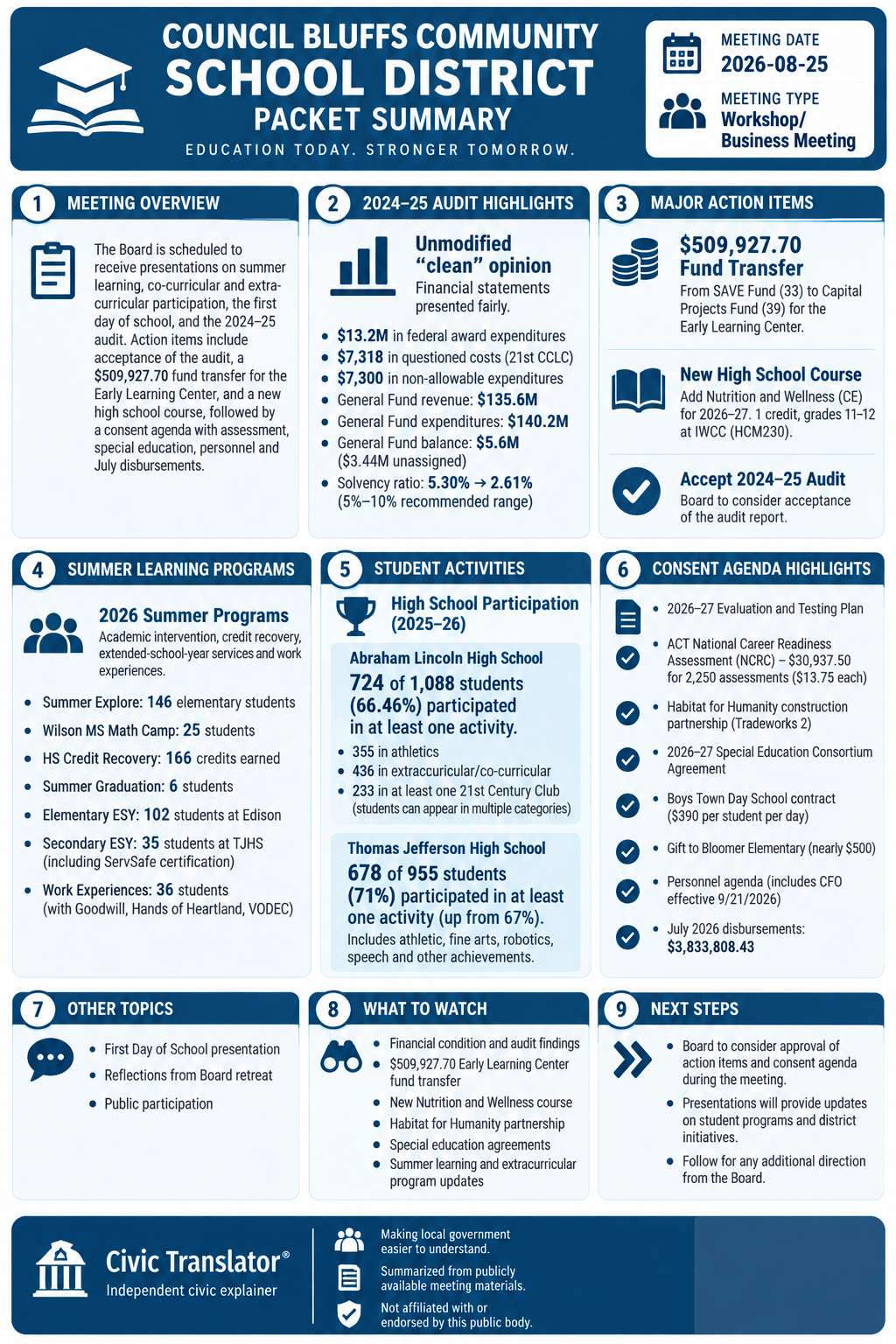
The Board is scheduled to receive presentations on summer learning, high school co-curricular and extracurricular participation, the first day of school, and the district’s 2024–25 audit. Action items include acceptance of the audit, a $509,927.70 permanent fund transfer for the Early Learning Center, and a new high school course, followed by a consent agenda covering assessment, career-readiness testing, special education services, a student construction partnership, personnel, and July disbursements.
Key Items on the Agenda
2024–25 Audit and Financial Position
The Board is scheduled to receive the district’s 2024–25 audit presentation and separately consider accepting the audit report. The independent auditor issued an unmodified, or “clean,” opinion, meaning the financial statements were presented fairly in all material respects under generally accepted accounting principles.
The audit materials also identify several issues for Board attention:
- The district reported $13.2 million in federal award expenditures during FY2025.
- Audit findings included material weaknesses related to financial-statement preparation, material audit adjustments and segregation of duties.
- Significant deficiencies included improper completion of employee personnel forms and inadequate monitoring of purchasing-card expenditures.
- The audit identified $7,318 in questioned costs tied to personal purchases improperly charged to the 21st Century Community Learning Centers federal program.
- Statutory findings included expenditures exceeding amended certified budget amounts in instruction and support services, approximately $7,300 in expenditures that were not allowable public-purpose expenditures, and one student activity account with a deficit balance at June 30, 2025.
- General Fund revenues were approximately $135.6 million, while expenditures were approximately $140.2 million. The General Fund balance declined to about $5.6 million, including roughly $3.44 million in unassigned fund balance.
The district's financial statements also report that its General Fund solvency ratio fell from 5.30% to 2.61% between June 30, 2024 and June 30, 2025. The report notes a State School Budget Review Committee recommended range of 5%–10%.
$509,927.70 Transfer for the Early Learning Center
The Board is scheduled to consider a resolution authorizing a $509,927.70 permanent cash and accounting transfer from the Secure an Advanced Vision for Education Fund, or SAVE Fund (Fund 33), to the Capital Projects Fund (Fund 39).
The proposed transfer is designated for the Early Learning Center and would be recorded as of June 30, 2026. The resolution states that the transfer is intended for allowable school infrastructure and physical-plant purposes.
New Nutrition and Wellness Course
The Board is scheduled to consider adding Nutrition and Wellness (CE) to the 2026–27 High School Program of Studies.
The proposed one-credit, semester course would be available to students in grades 11–12 at Iowa Western Community College as HCM230, with no prerequisite listed. Course content includes the science and nutritional value of food, analysis of meals and recipes, and the roles of fats, carbohydrates, proteins, water, minerals and vitamins.
Student Programs and Learning
Summer Learning Review
The Board is scheduled to receive an informational review of the district’s 2026 summer learning programs. The packet highlights academic intervention, credit recovery, extended-school-year services and work experiences.
Among the reported results:
- Summer Explore: 146 elementary students were served at Franklin Elementary, with eligibility based on winter reading or math screening.
- Wilson Middle School Math Camp: 25 students were served, with instruction focused on gaps identified through student data.
- High School Credit Recovery: Students earned 166 credits through programming at Kanesville Learning Center.
- Summer Graduation: Six students graduated, with a ceremony at Kanesville attended by more than 100 family members and friends.
- Elementary Extended School Year: 102 students attended programming at Edison, including targeted academic, social and functional-living instruction.
- Secondary Extended School Year: 35 students attended programming at Thomas Jefferson High School, including math, English language arts and functional-life-skills instruction. Students also completed food-handler training and received ServSafe Food Handler certificates.
- Work Experiences: 36 students participated through partnerships with Goodwill, Hands of Heartland and VODEC, with placements including CHI, Planet Fitness, YMCA and Goodwill.
Co-Curricular and Extracurricular Participation
The agenda includes an informational presentation on co-curricular and extracurricular programming at Abraham Lincoln and Thomas Jefferson high schools.
At Abraham Lincoln High School, the packet reports that 724 of 1,088 students, or 66.46%, participated in at least one activity during 2025–26. That included 355 students participating in sanctioned athletics, 436 participating in extracurricular or co-curricular activities, and 233 participating in at least one 21st Century Club; students can appear in more than one category.
At Thomas Jefferson High School, 678 of 955 students, or 71%, participated in at least one outside-of-the-school-day activity, up from 67% the prior year. The accompanying reports also document athletic, fine arts, robotics, speech and other student achievements from the 2025–26 school year.
Consent Agenda
2026–27 Evaluation and Testing Plan
The Board is scheduled to consider approval of the district’s 2026–27 Evaluation and Testing Plan. The plan establishes the framework for assessment design, administration, security, analysis and use of results across the district.
The plan includes district goals such as increasing the share of students reaching designated MAP achievement bands, having at least 60% of students meet individual MAP growth targets, increasing the percentage of graduates earning a diploma plus a second credential, and establishing transition, attendance and student-connection benchmarks. It also addresses state and national assessments, district assessments, testing accommodations and procedures for investigating possible test-security violations.
ACT National Career Readiness Assessment
The consent agenda includes the ACT National Career Readiness Assessment, or NCRC. Packet materials include an ACT WorkKeys quote totaling $30,937.50 for 750 assessments in each of three areas: Applied Math, Graphic Literacy and Workplace Documents.
The quote identifies a price of $13.75 per assessment component and states that it is informational rather than itself a contract or invoice.
Habitat for Humanity Student Construction Partnership
The Board is scheduled to consider an Educational Cooperative Construction Agreement with Habitat for Humanity of Council Bluffs as part of the district’s Tradeworks 2 course.
Under the draft agreement, students would construct portions of a home at Thomas Jefferson High School, including framing a temporary foundation, first-floor deck and walls; installing roof trusses, sheathing and roofing components; and installing weatherization wrap, windows, exterior doors and siding. Habitat for Humanity would purchase project materials, coordinate work outside the district’s responsibilities and manage movement of the home to its eventual site.
The agreement states there would be no fixed completion timeline, recognizing weather, class schedules, attendance and other factors. Students and parents would be required to complete Habitat for Humanity waivers, and job-site leaders would complete required “Competent Person Training.” The proposed agreement would remain in effect through June 30, 2027, with the possibility of subsequent one-year renewals by written agreement.
Special Education Consortium
The Board is scheduled to consider the 2026–27 Special Education Consortium Agreement covering instructional programs at the Child Saving Institute’s Lavigne Learning Center and Heartland Family Service’s Therapeutic School.
The agreement establishes Council Bluffs as the host district and fiscal agent for a multi-district consortium serving students who require specialized educational programming. Member districts remain responsible for their resident students and pay actual program costs, with monthly itemized billing. The agreement runs through June 30, 2027 and provides for annual renewal with school-board approval.
Boys Town Day School Contract
The consent agenda also includes a 2026–27 special education service agreement with Father Flanagan’s Boys’ Home for Boys Town Day School services.
The agreement provides Level III special education services for students with behavioral challenges and sets the educational-services rate at $390 per student per day. Billing is based on enrollment rather than attendance. The agreement runs from August 12, 2026 through May 31, 2027, with either party able to terminate upon at least 90 days' written notice.
Gift to Bloomer Elementary
The Board is scheduled to acknowledge and accept a donation from Dan and Nancy Kemp and their grandson Carson Kemp for Bloomer Elementary.
The packet says the family spent nearly $500 on backpacks, headphones, pencils, markers and other supplies for Bloomer students.
Personnel and July Disbursements
The consent agenda includes a personnel action report covering certified, administrative and classified appointments and classified and extracurricular resignations. Among the listed appointments is a Chief Financial Officer effective September 21, 2026.
The Board is also scheduled to consider July 2026 disbursements. The district’s AP Board Report lists a grand total of $3,833,808.43.
What to Watch at the Meeting
The district’s financial condition and audit findings are likely to be among the most consequential items in the packet. The clean audit opinion is paired with findings involving internal controls, purchasing-card monitoring, questioned expenditures, budget compliance and a substantially reduced General Fund balance and solvency ratio.
The Board also has several forward-looking operational decisions scheduled for consideration, including the $509,927.70 Early Learning Center fund transfer, the new Nutrition and Wellness course, the Habitat for Humanity construction partnership, and special education agreements. Separately, the summer learning and extracurricular presentations provide a broader look at student participation and programming before the Board moves into its action agenda.
The agenda concludes with an informational item for reflections from the Board retreat.