Meeting: 08/24/2026 - 03:00 PM Board of Education Meeting/Work Session Board Meeting
Scheduled time: 3:00 p.m.
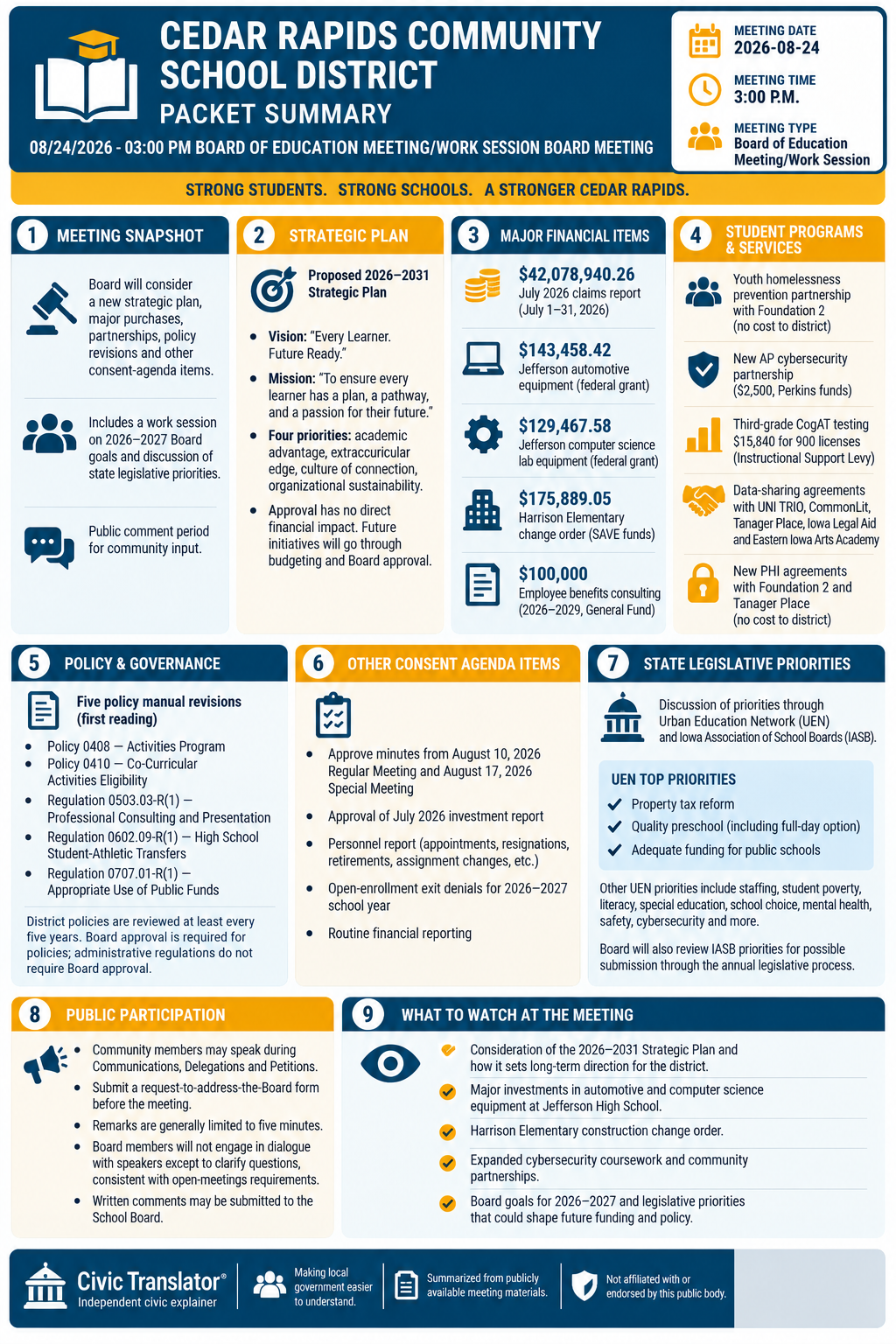
The Cedar Rapids Community School District Board of Education is scheduled to consider a new five-year strategic plan, major instructional-equipment purchases, a construction change order, student-service partnerships, policy revisions, and other consent-agenda business. The meeting also includes a work session on 2026–2027 Board goals and Board-level discussion of state legislative priorities.
Key Items on the Agenda
2026–2031 Strategic Plan
Administration recommends approval of a renewed 2026–2031 Strategic Plan, intended to guide district priorities, decision-making, and continuous improvement over the next five years. The plan was developed through a stakeholder process involving the Board, Strategic Planning Engagement Committee, staff, families, district leadership, and stakeholder social sessions.
The proposed plan retains the vision “Every Learner. Future Ready.” and establishes the mission: “To ensure every learner has a plan, a pathway, and a passion for their future.” It organizes district strategy around four priorities:
- Academic Advantage: rigorous instruction, personalized learning, advanced opportunities, and preparation for college, careers, and the workforce.
- Extracurricular Edge: athletics, fine arts, activities, clubs, leadership, and other experiences beyond the classroom.
- Culture of Connection: belonging, safety, relationships, stakeholder voice, community partnerships, and district pride.
- Organizational Sustainability: financial stewardship, facilities, staffing, and systems designed to support the district's long-term future.
The packet says approval itself has no direct financial impact. Future initiatives and resource allocations associated with implementation would go through established budgeting and Board approval processes.
Board Goals for 2026–2027
During the work session, the Board is scheduled to review and discuss its goals for the 2026–2027 school year. The stated purpose is to establish annual Board goals aligned with governance responsibilities and district priorities.
State Legislative Priorities
The Board is scheduled to discuss legislative advocacy through both the Urban Education Network (UEN) and Iowa Association of School Boards (IASB).
UEN's listed 2026 priorities include property tax reform, preschool, adequate public-school funding, staffing shortages, student poverty, English-learning services, literacy, high-school programming, special education, education savings accounts and school choice, mental health, district authority, safety, and cybersecurity. Its three top priorities are identified as property tax reform, quality preschool including a full-day option, and adequate funding for public schools.
For IASB, the Board is expected to review priorities that could be submitted through the association's annual legislative-priorities process. The Board Secretary is expected to submit the Board's selected priorities through the IASB survey.
Major Financial Items
$42.08 Million July Claims Report
The consent agenda includes the July 2026 claims report covering July 1–31, 2026, with claims totaling $42,078,940.26. Staff recommends approval of the report and ratification of the associated paid bills and payrolls.
The accompanying investment report shows $25,064,684.53 in investments purchased during July and $17,888,597.01 redeemed.
$143,458 Jefferson Automotive Equipment Purchase
Staff recommends a $143,458.42 purchase from Mohawk Lifts LLC for Hunter automotive equipment for Jefferson High School's automotive program. The package includes wheel-alignment equipment, tire changers, wheel balancers, an on-car brake lathe, accessories, installation, and training.
The district says the equipment would provide industry-standard technology for Career and Technical Education instruction. The purchase would be funded 100% through the federal Magnet Schools Assistance Program grant, with the district using Sourcewell Cooperative Contract #121223-MRL rather than a separate competitive bid process.
Jefferson Computer Science Lab Equipment
The Board is also scheduled to consider new Lenovo workstations and monitors for Jefferson High School's Computer Science Lab. The agenda describes a purchase of 33 workstations and 33 monitors at a stated financial summary of $129,467.58, funded entirely through the federal Magnet Schools Assistance Program grant.
The district proposes using NASPO purchasing agreements for the acquisition. The packet says the new equipment is intended to provide higher-performance technology for computer science instruction and related applications.
$175,889 Harrison Elementary Change Order
Staff recommends approval of Change Order #4 for $175,889.05 with Larson Construction Co., Inc. for additions and renovations at Harrison Elementary School.
The change includes multiple revisions attributed to unforeseen conditions, errors or omissions in plans and specifications, and owner requests. Examples include plumbing and HVAC revisions, a kitchen electrical panel, elevator vent/exhaust work, corridor lintel changes, IT-room wall finishing, and corridor-wall laminate.
The proposed increase would be funded through SAVE (Secure an Advanced Vision for Education). District construction tracking in the packet lists Harrison's project timeline as running from September 2025 to July 2027.
Employee Benefits Consulting
The consent agenda includes a proposed $100,000 agreement with TrueNorth Companies, L.C. for employee health-benefits consulting services. The agreement would cover the 2026–2029 school years, includes a three-year rate guarantee, and would be funded from the General Fund.
TrueNorth has been working with the district following a 2024 request for proposals connected to the district's transition out of the MIIP consortium effective July 1, 2025. Its work includes medical-plan analysis, design, implementation, maintenance, improvement, and employee-benefits communication.
Student Programs and Services
Youth Homelessness Prevention Partnership
Staff recommends a new memorandum of understanding with Foundation 2 Crisis Services for a community-based youth and young-adult homelessness prevention program. The agreement would expand an existing partnership to specifically support students and other young people under age 26 who are experiencing or at risk of homelessness.
District staff would identify and refer eligible individuals, while Foundation 2 would provide services such as assessments, case planning and management, life-skills support, supportive connections, and follow-up care. The agreement carries no cost to the district and is scheduled to remain in effect from August 1, 2026, through September 29, 2028, unless terminated earlier under its terms.
New AP Cybersecurity Partnership
The Board is scheduled to consider a new $2,500 agreement with Paradigm Cyber Ventures for Kennedy and Washington high schools. The partnership would support the new AP Cybersecurity course beginning in the 2026–2027 school year.
The package includes an AP-aligned cybersecurity curriculum, virtual labs, digital learning tools, Capture the Flag activities, incident-response scenarios, and CompTIA Security+ alignment and exam preparation. The proposed cost would be covered by Perkins Grant funds.
Third-Grade Cognitive Ability Testing
Staff recommends continuing the district's use of the Cognitive Abilities Test through Riverside Insights. The $15,840 agreement would provide 900 CogAT licenses for virtual testing of third-grade students during the 2026–2027 school year.
The packet identifies this as the district's eighth year using the assessment. Funding would come from the Instructional Support Levy.
Data Privacy and Community Partnerships
The consent agenda contains several ongoing or new data-sharing agreements designed to support educational and student services. The agreements listed in the packet carry no direct data-sharing cost to the district.
- UNI TRIO: Student information would support identification, recruitment, academic monitoring, intervention, and postsecondary advising for eligible first-generation and income-eligible students.
- CommonLit: Data sharing would support digital reading and writing lessons for grades 3–12 and related educational resources.
- Tanager Place: Shared information would support coordinated mental-health and substance-use assessment, referral, education, treatment, therapy, and consultation services.
- Iowa Legal Aid: A first-year data-sharing arrangement would support the Community Schools Program and onsite clinics at Hoover Elementary, Trailside Elementary, and Metro High School. Services include civil legal assistance involving issues such as housing stability, domestic-violence protection, custody, and identification.
- Eastern Iowa Arts Academy: A first-year data-sharing arrangement would support student enrollment, emergency-contact procedures, and student safety during academy-led activities for district students.
The packet says the district has modernized its data-sharing template with stronger security and governance provisions, including enhanced audit rights and explicit restrictions on providing protected district data to public or consumer-grade artificial-intelligence systems.
The Board is also scheduled to consider new Protected Health Information agreements with Foundation 2 and Tanager Place. Those agreements are intended to establish privacy and security requirements for handling PHI and carry no cost to the district.
Policy and Governance Items
Five Policy Manual Revisions
The Board is scheduled to review five revised policy-manual documents as first-reading drafts:
- Policy 0408 — Activities Program
- Policy 0410 — Co-Curricular Activities Eligibility
- Regulation 0503.03-R(1) — Professional Consulting and Presentation
- Regulation 0602.09-R(1) — High School Student-Athletic Transfers within the Cedar Rapids Community School District
- Regulation 0707.01-R(1) — Appropriate Use of Public Funds
The district reviews policies, regulations, and procedures at least once every five years. Board approval is required for policies, while administrative regulations and procedures do not require Board approval.
Other Consent Agenda Business
The consent agenda also includes several routine or administrative matters:
- Approval of minutes from the August 10, 2026 Regular Meeting and August 17, 2026 Special Meeting.
- A personnel report covering appointments, resignations, retirements, assignment changes, short-term contracts, and other routine personnel transactions.
- A recommendation concerning open-enrollment exit denials for the 2026–2027 school year.
- Approval of the July investment report and related financial reporting.
Public Participation
The agenda includes a public-comment period for communications, delegations, and petitions. Community members wishing to speak are directed to submit a request-to-address-the-Board form before the meeting, with remarks generally limited to five minutes.
The packet states that Board members generally will not engage in dialogue with speakers during public comment except to clarify the nature of a question or comment, consistent with open-meetings requirements. Written comments may also be submitted to the School Board.
What to Watch at the Meeting
The proposed 2026–2031 Strategic Plan is the central long-range governance item, setting a five-year framework around academics, extracurricular opportunities, community connection, and organizational sustainability. The subsequent work session on Board goals offers an opportunity to see how the Board's own 2026–2027 priorities may align with that broader strategy.
The agenda also combines significant near-term investments with longer-term policy choices: federal grant funding is proposed for major automotive and computer-science upgrades at Jefferson High School, while the Board will consider expanded cybersecurity coursework and multiple student-service partnerships. Legislative discussions may further clarify which state funding, governance, preschool, staffing, student-support, and other policy issues the Board wants emphasized in upcoming advocacy efforts.