Minneapolis Public School District Packet Summary — 2026-08-25
Finance Committee Meeting — 5:45 PM
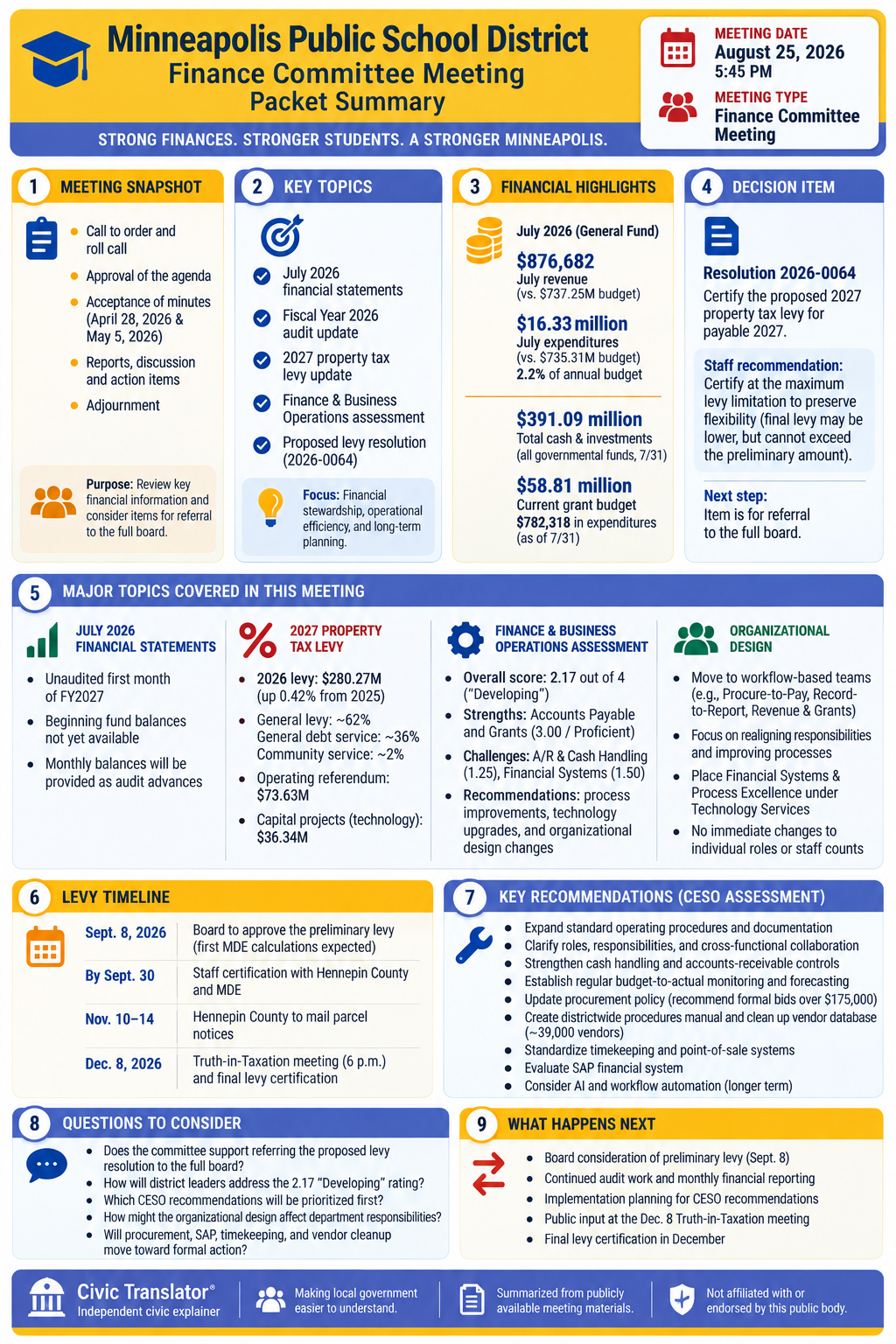
The Finance Committee agenda centers on four major financial and operational topics: July financial statements, the Fiscal Year 2026 audit, the proposed 2027 property tax levy, and an outside assessment of Finance and Business Operations. The committee is also scheduled to consider referring a proposed property tax levy resolution to the full board.
Key Items on the Agenda
- July 2026 financial statements: Staff is scheduled to present the district's unaudited financial position for the first month of FY2027.
- Fiscal Year 2026 audit update: The agenda includes an informational update on the audit.
- 2027 property tax levy: Staff will present the levy process and timeline ahead of preliminary certification in September and final certification in December.
- Finance and Business Operations assessment: The committee will review a comprehensive outside assessment that rates current operations and recommends changes to processes, technology, controls, and organizational structure.
- Proposed levy resolution: The committee is scheduled to consider Resolution 2026-0064 for referral to the full board.
Major Financial Items
July 2026 Financial Statements
The July financial report is unaudited and represents an early snapshot of FY2027. Actual FY2027 beginning fund balances are not yet available because preparation for the FY2026 audit is underway; monthly beginning and ending fund balances are expected to be presented once the audit has advanced enough to establish them.
For the General Fund, the report shows $876,682 in July revenue against a $737.25 million revenue budget, and $16.33 million in expenditures against a $735.31 million expenditure budget. The report notes that July General Fund expenditures represent 2.2% of the annual budget.
Across governmental funds, the report lists $391.09 million in total cash and investments at July 31. A significant portion is associated with the Building Construction Fund and must be spent on capital projects.
The packet also reports a $58.81 million current grant budget across listed grant sponsors, with $782,318 in current expenditures as of July 31.
2027 Property Tax Levy
The packet provides an overview of how Minnesota school district property-tax levies are established. Minneapolis Public Schools' total 2026 levy was approximately $280.27 million, up 0.42% from 2025.
The 2026 levy was composed primarily of:
- General levy: approximately 62% of the total.
- General Debt Service: approximately 36%.
- Community Service: approximately 2%.
Two voter-approved components are highlighted. The 2026 Operating Referendum levy is $73.63 million, while the Capital Projects Levy, or technology levy, is $36.34 million.
The packet cautions that a districtwide percentage change in the levy does not translate directly into the same percentage change for an individual property owner. Changes in the overall tax base and individual property valuations also affect individual tax bills.
Proposed Preliminary Levy Certification
Staff recommends certifying the proposed 2027 levy at the maximum levy limitation. According to the packet, this approach preserves flexibility because the final levy may be set below the preliminary amount but cannot exceed it.
The agenda lists Resolution 2026-0064 as an action item for referral to the full board. The attached draft resolution is intended for the September 8 board meeting and recommends maximum preliminary certification; the packet's presentation says the first Minnesota Department of Education levy calculations are also expected September 8.
The packet outlines the remaining schedule:
- September 8, 2026: School Board scheduled to approve the preliminary levy.
- By September 30: Staff certification of the preliminary levy with Hennepin County and the Minnesota Department of Education.
- November 10–14: Hennepin County is expected to mail parcel-specific notices.
- December 8, 2026: Truth-in-Taxation meeting scheduled for 6 p.m., including a levy overview and public comment, followed by final levy certification.
Finance and Business Operations Assessment
Overall Finding: "Developing"
The Center for Effective School Operations conducted a Finance Business Operations Assessment and Organizational Design Assessment between April and June 2026. The review covered areas including accounts payable, accounts receivable and cash handling, budgeting, financial systems, accounting, grants, payroll and benefits, procurement, and risk management.
The assessment gives Minneapolis Public Schools an overall Finance Operations score of 2.17 out of 4, categorized as Developing. The report describes the assessment as a point-in-time evaluation rather than an assessment of individual employees or positions.
Individual areas vary substantially. Accounts Payable and Grants each received 3.00 / Proficient, while Accounts Receivable & Cash Handling received 1.25 / Emerging and Financial Systems received 1.50 / Emerging. Budgeting and General Accounting Practices each received 2.00 / Developing.
CESO groups its recommendations into "Do Now," "Do Soon," and "Do Later" priorities. Its immediate recommendations include:
- Expand standard operating procedures and process documentation.
- Clarify department ownership, roles, responsibilities, and cross-functional collaboration.
- Strengthen cash handling, petty cash, and accounts-receivable controls.
- Establish regular budget-to-actual monitoring, including variance analysis, trend identification, forecasting, and accountability discussions.
- Update procurement policy.
On procurement, the assessment notes that Minneapolis Board Policy 3312 currently requires quotes at $25,000 and above and formal bids at $100,000 and above. CESO recommends aligning the policy with the state threshold described in the report, including formal bids for purchases exceeding $175,000.
Technology and Process Changes
Among its "Do Soon" recommendations, CESO proposes a districtwide operations procedures manual, a cleanup of the district's vendor database, standardized electronic timekeeping and point-of-sale systems, and an evaluation of the district's SAP financial system.
The report says the vendor database contains approximately 39,000 vendors, including inactive and duplicate records. It also identifies extensive reliance on spreadsheets, manual reconciliations, inconsistent timekeeping systems, and manual processes as sources of inefficiency and operational risk.
Longer-term recommendations include cross-training, a formal professional-development strategy, consideration of AI and workflow automation, and a future follow-up assessment.
Organizational Design
CESO concludes that many capacity challenges stem from fragmented processes rather than insufficient staffing. It recommends moving from siloed departmental structures toward workflow-based teams organized around functions such as Procure-to-Pay, Record-to-Report, Revenue and Grants, Workforce Financial Operations, and Financial Systems.
The proposed future-state model does not immediately change individual roles or staff counts. Instead, CESO recommends first realigning responsibilities and workflows, clarifying ownership, improving processes, and stabilizing systems before the district makes long-term staffing decisions.
A key structural recommendation is to place Financial Systems & Process Excellence under Technology Services, giving SAP and related financial systems dedicated technical leadership focused on system design, configuration, training, and process improvement.
CESO also recommends continuing to fill essential, system-critical positions while holding non-critical vacancies open until the proposed structure is implemented and stable.
What to Watch at the Meeting
The packet leaves several consequential issues for committee review rather than presenting them as completed district actions:
- Whether the committee supports referring the proposed maximum 2027 preliminary levy certification to the full board.
- How district leaders respond to the outside assessment's 2.17 / Developing overall rating and its recommendations for stronger financial controls and monitoring.
- Which of CESO's "Do Now" recommendations the district intends to prioritize and how implementation will be sequenced.
- How the proposed workflow-based organizational model could affect departmental responsibilities and future staffing decisions.
- Whether the recommended procurement-policy changes, SAP evaluation, standardized timekeeping, vendor cleanup, and other operational changes move toward formal district action.