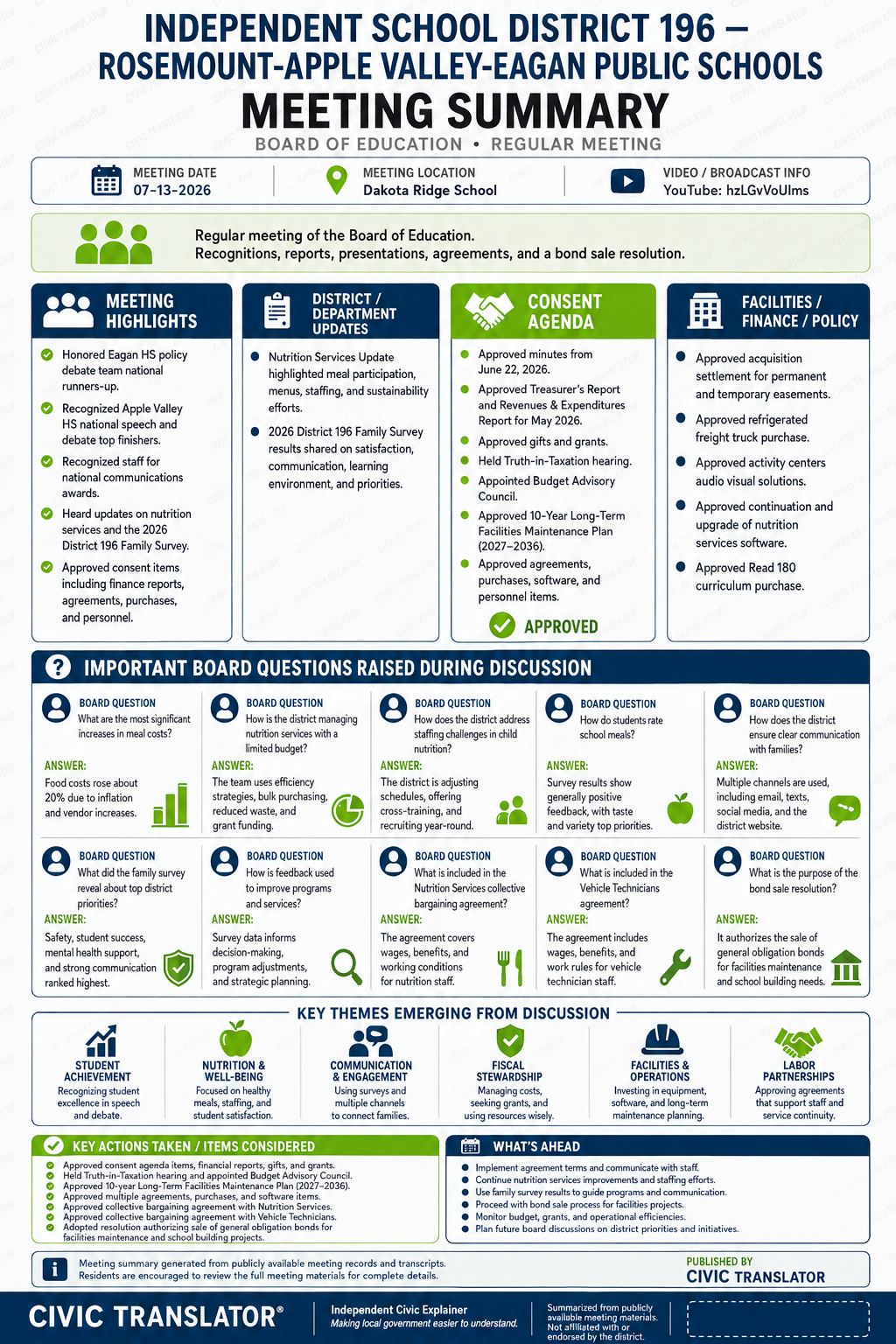
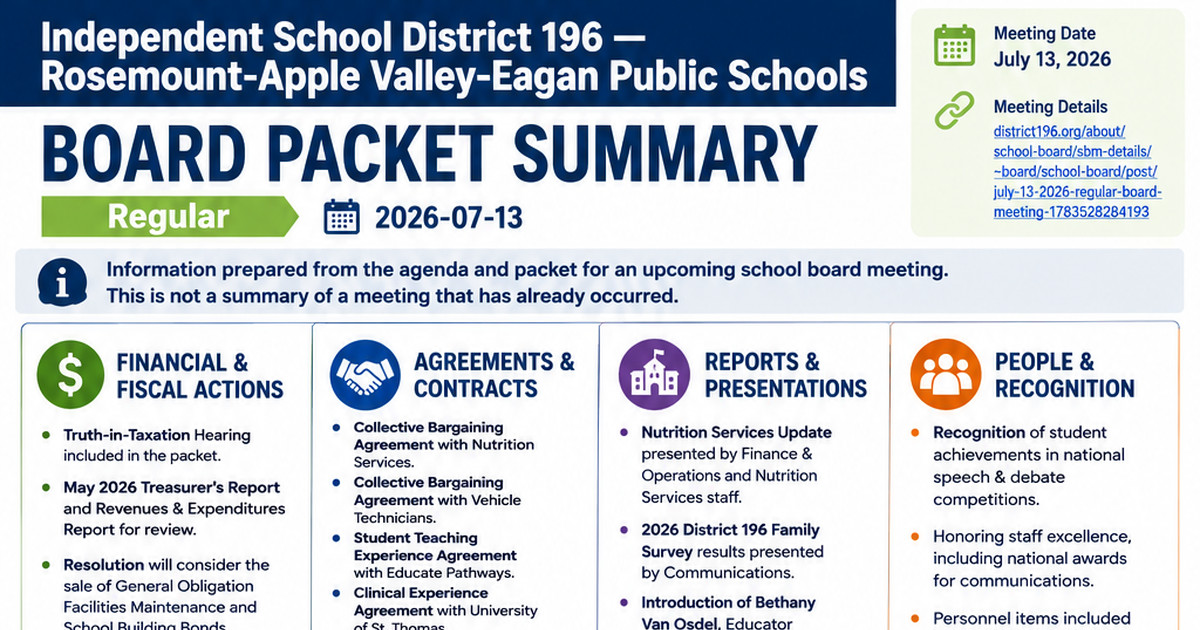
The Board of Education's July 13, 2026 regular meeting combined student and staff recognition, routine district business, two major operational reports, labor agreements and a significant step in the district's facilities financing program. The revised agenda was approved 6-0. The revision added recognition of Apple Valley High School speech and debate finalists and removed a school board member employment item from the consent agenda.
The board recognized exceptional student achievement in speech and debate. Eagan High School students reached the national championship round in policy debate, finishing as national runners-up after a tournament that began with 196 policy debate teams. Apple Valley High School students also earned several high national finishes, including national championships in original oratory and oral interpretation. District multimedia communications specialist Cliff Dodge was recognized for two National School Public Relations Association awards, including an Award of Excellence for the district's 12-part "Technology in Our Schools" series. District officials reported that the series generated more than 169,000 views and nearly 6 million minutes of viewing.
The board approved a 16-item consent agenda on a 6-0 vote. The package included the May 2026 Treasurer's Report and revenues and expenditures report, gifts and grants, a Truth-in-Taxation hearing item, Budget Advisory Council appointments, the 2027-2036 Long-Term Facilities Maintenance plan, personnel matters, student-teaching and clinical-experience agreements, activity-center audiovisual solutions, a refrigerated freight truck, continuation and upgrade of nutrition services software, Read 180, and an acquisition settlement involving permanent and temporary easements.
Nutrition Services presented its 2025-2026 year in review. The department operates 27 kitchens with 217 staff and reported serving approximately 1.3 million breakfasts and 3.4 million lunches during the year, or about 27,500 meals per day. Participation has continued to increase under Minnesota's Free School Meals for Kids program. The department is also expanding scratch cooking, local food purchasing and Farm to School activities while introducing new menu choices. Plans for 2026-2027 include additional culturally diverse and "flavor-forward" offerings such as breakfast egg rolls and chicken tikka masala, along with a Minnesota-focused harvest meal.
The district also presented results from its first systemwide family survey. About 5,778 responses represented 6,802 students, approximately 23% of the student population. Because participation was voluntary, administrators cautioned that the results should be treated as directional feedback rather than a statistically representative sample. Even so, 90% of respondents rated the quality of their child's education as excellent or good, including 52% who rated it excellent. Families also gave strong marks to staff caring about students, school technology support and feeling welcomed as partners.
The family survey also identified areas for improvement. Families raised concerns about transportation reliability, behavior and discipline, screen time and technology limits, communication from teachers and the information available to help families support learning at home. The district plans to use school-level survey reports in improvement planning, continue consolidating communications through ParentSquare, develop guidance on effective teacher-family communication, provide additional technology-monitoring information and expand family engagement work. Administrators also said future annual surveys should be conducted earlier, with April identified as a preferable period.
Transportation remained an important concern because it emerged as the most frequently cited districtwide issue in open-ended survey responses. Administrators said the district had already moved to the opt-in Plan My Ride process, improved recruiting and staffing for the coming year and approved a new routing software system. Broader transportation reliability changes include school start-time changes planned for fall 2027.
The board separately approved two collective bargaining agreements, both on 6-0 votes. One covers Nutrition Services employees represented by Minnesota Teamsters Public and Law Enforcement Employees Union Local 320; the other covers district vehicle technicians represented by the same union. Both agreements run from July 1, 2026 through June 30, 2028. Both include compensation changes and district health-insurance contribution increases of 12% in the first year and 9% in the second year, along with other contract changes.
The board also unanimously authorized the next step toward issuing $148.75 million in general obligation bonds: $35 million in long-term facilities maintenance bonds and $113.745 million in school building bonds. District staff described this as the final of three bond issuances associated with the referendum financing program. The resolution allows the district's financial advisers to seek proposals; the final bond sale is expected to return to the board for award to the lowest bidder, with the sale anticipated in early 2027.
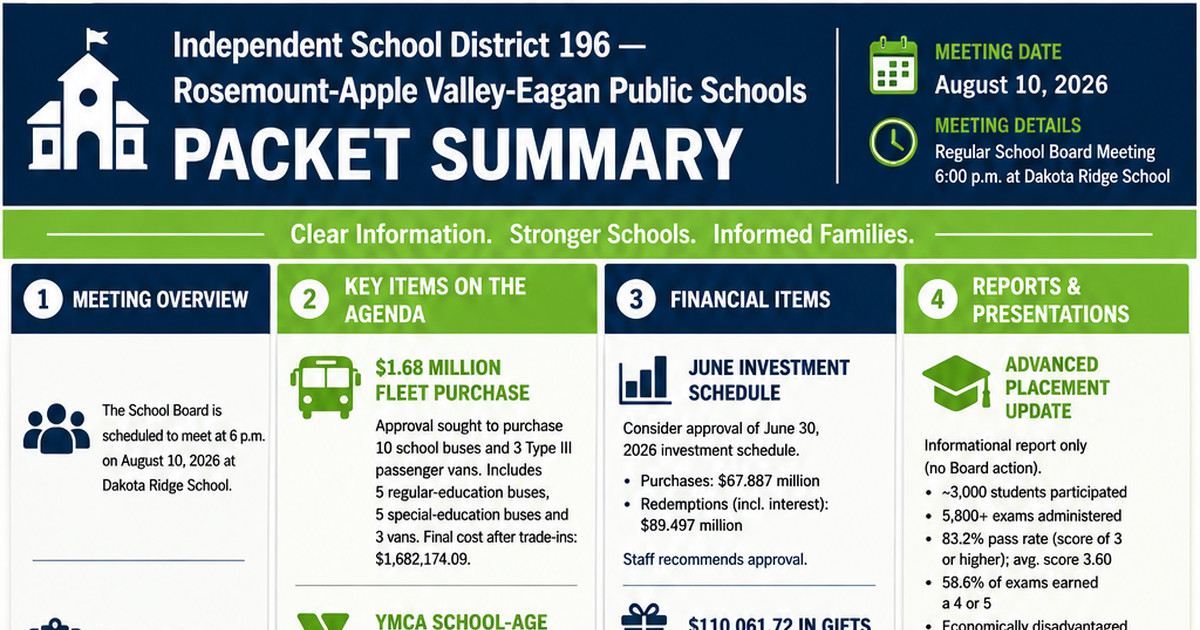
Finally, the superintendent reported that preparations for the 2026-2027 school year are underway. A back-to-school resource hub has been launched with information on contact updates, school supplies, immunization records and athletic forms, and fall sports registration was scheduled to open during the week of the meeting. The next regular Board of Education meeting was announced for Monday, August 10.
Major Discussion and Action Items
2025-2026 Nutrition Services Year in Review
Nutrition Services described a large districtwide operation involving 27 kitchens and 217 employees. During the year, the department served approximately 1.3 million breakfasts and 3.4 million lunches, averaging about 27,500 meals each school day.
Administrators said participation has increased with Minnesota's Free School Meals for Kids program. At the same time, the department has intentionally moved toward more complex, made-from-scratch food preparation. That requires more labor per meal, but staff described the change as an investment in food quality.
The department introduced six new breakfast entrees and 12 new lunch entrees during the year. Examples included fresh-baked croissants, school-made breakfast sandwiches, scratch-baked muffins, shredded chipotle chicken sandwiches, ramen bowls and turkey-avocado melts.
Farm to School work remains a significant part of the program. District staff reported a second consecutive Minnesota Department of Agriculture Golden Drumstick Award and described partnerships with Minnesota growers, Harvest of the Month activities and student experiences connecting agriculture with cafeteria meals.
Environmental initiatives are also expanding. Nutrition Services plans to compost food scraps in district kitchens, with the goal of diverting organic material from landfills, reducing methane emissions and lowering refuse costs.
For 2026-2027, the department plans additional menu experimentation informed by student "kitchen cabinet" groups. Proposed offerings include breakfast egg rolls, chicken tikka masala and a harvest meal featuring Minnesota turkey, wild rice and seasonal vegetables.
Board discussion focused heavily on communication with families, use of participation data, cultural representation in menus and the connection between nutrition and student readiness to learn. Staff said ParentSquare and other communications tools could be used to publicize local-food and harvest events more effectively.
No separate formal vote was required on the Nutrition Services report.
2026 District 196 Family Survey
The district presented results from its first systemwide survey open to all families. The survey was administered in May and June and received approximately 5,778 responses representing 6,802 students, about 23% of district enrollment.
Administrators emphasized that the voluntary survey was not a random sample. The results therefore provide useful directional information but should not be treated as statistically representative of every District 196 family.
Overall perceptions were positive. Ninety percent of respondents rated the quality of their child's education as excellent or good, with 52% selecting excellent. Other reported findings included:
- 82% said their child enjoys school.
- 93% said teachers and school staff care about their child.
- 87% believed their child would be well prepared to advance to the next level.
- 91% said school adults respect customs and traditions important to their family.
- 91% said information provided by the school is easy to understand.
- 80% believed they had the information needed to support learning at home.
- 91% said they feel welcomed and valued as partners when visiting school.
- 81% believed technology provides personalized learning opportunities.
- 91% said schools provide adequate support for student devices.
- 90% considered technology skills and digital literacy essential for the future.
Technology responses varied by grade level. At the elementary level, 66% of parents said an iPad was not needed at home. At middle and high school levels, 70% said students needed the device at home at least a few days per week or daily. Overall, 75% said they knew how to monitor and limit iPad use at home, with reported confidence declining from 82% at elementary level to 73% at high school level.
Open-ended responses praised caring teachers and staff, student opportunities, specialized programs, community, inclusion and belonging. Areas for improvement included teacher communication, information for supporting learning at home, perceived consistency of school rules, transportation reliability, behavior and discipline, screen time and technology limits.
The district plans to provide school-specific results to principals for use in school improvement planning. It also intends to continue consolidating communication through ParentSquare, establish better guidance about the frequency and type of teacher communications, provide additional resources to families supporting learning at home, and expand information about behavioral expectations and technology controls.
The survey is expected to become annual, with administrators recommending an earlier administration period around April rather than the busy end-of-school period in May and June.
Transportation Reliability
Transportation emerged as the leading districtwide concern in the family survey's open-ended responses.
Administrators acknowledged that the previous year's transportation problems were not acceptable and outlined changes already underway. These include the opt-in Plan My Ride process, additional recruiting and staffing, and a new routing software system previously approved by the board.
The district's larger transportation reliability plan also includes school start-time changes expected in fall 2027.
This was discussed as part of the survey report rather than as a separate action item at this meeting.
Nutrition Services Collective Bargaining Agreement
Human Resources presented a tentative two-year agreement with Minnesota Teamsters Public and Law Enforcement Employees Union Local 320 covering Nutrition Services employees.
The agreement runs from July 1, 2026 through June 30, 2028. Union members approved the tentative terms on July 3, 2026.
Changes include adjustments to the salary schedule and longevity differentials, an increase in the double-school differential and minor contract-language changes. The district's contribution toward health insurance increases 12% in the first year and 9% in the second year.
A board member highlighted progress toward wages that better support employees and emphasized recognition of Nutrition Services employees as district staff.
The board approved the agreement 6-0. The motion was made by Leah and seconded by Jackie.
Vehicle Technicians Collective Bargaining Agreement
The board considered a second two-year agreement with Minnesota Teamsters Public and Law Enforcement Employees Union Local 320, this time covering district vehicle technicians.
The agreement runs from July 1, 2026 through June 30, 2028. Bargaining-unit members approved its terms on June 23, 2026.
The agreement includes salary and differential changes described in the board exhibit, a 12% increase in the district health-insurance contribution during year one, a 9% increase during year two and minor language changes.
Human Resources emphasized the technicians' role in keeping district buses operating safely for students, drivers and chaperones. Board discussion also highlighted that District 196 directly employs its vehicle technicians and Nutrition Services staff rather than outsourcing those functions.
The board approved the agreement 6-0. Jackie made the motion and Catherine seconded it.
General Obligation Facilities Maintenance and School Building Bonds
The board considered a resolution authorizing the next stage in issuing $148.75 million in general obligation debt.
The proposed issuance consists of:
- $35 million in general obligation long-term facilities maintenance bonds.
- $113.745 million in school building bonds.
Staff said the action is part of the district's debt issuance process and aligns with the payable 2027 property-tax levy certification cycle.
Approval authorizes the district's financial advisers to solicit proposals. The final bond sale is expected to be awarded to the lowest bidder at a future board meeting, with the transaction anticipated in early calendar year 2027.
During board questions, staff confirmed that this represents the final of three planned bond issuances associated with the referendum financing. Staff referenced a first issuance of $300 million in 2023 and another $100 million issuance the previous year.
Anna moved approval and Sakaudin seconded. The resolution passed 6-0.
Consent Agenda
The board approved all 16 consent-agenda items together without removing an item for separate consideration. The vote was 6-0.
Items included the June 22 meeting minutes, May financial reports, gifts and grants, the Truth-in-Taxation hearing, Budget Advisory Council appointments, the 2027-2036 Long-Term Facilities Maintenance plan, personnel, student-teaching and clinical-experience agreements, audiovisual solutions for activity centers, a refrigerated freight truck, Nutrition Services software, Read 180 and an acquisition settlement involving permanent and temporary easements.
Because these items were approved as a single consent package and were not individually discussed during the meeting, the available meeting discussion does not establish additional details such as individual contract amounts or terms for each item.
Student Speech and Debate Recognition
Eagan High School's policy debate program was recognized after students reached the final round of the National Speech and Debate Association national tournament. The tournament began with 196 policy debate teams, and the Eagan team finished as national runners-up after 16 rounds. Eagan also received recognition as a School of Outstanding Distinction, placing among the leading programs at the national competition.
Apple Valley High School students were recognized for multiple high finishes at national speech and debate competitions, including national championships in original oratory and oral interpretation.
These were recognitions rather than board action items.
National Communications Awards
Multimedia communications specialist Cliff Dodge and the district communications team were recognized for two National School Public Relations Association honors.
A "Personal Finance" video earned a national Award of Merit. The district's 12-part "Technology in Our Schools" series earned an Award of Excellence.
The district reported that the technology series generated more than 169,000 views and nearly 6 million minutes of watch time across social media and YouTube. It was developed in connection with public communication about technology investments ahead of the 2025 technology levy election.
District Facilities and Summer Construction
The superintendent reported that 12 construction projects were underway across District 196 during the summer.
Projects include new activity centers at all four comprehensive high schools as well as maintenance and improvement work at other schools.
The update emphasized the work of construction crews, contractors and district employees working through summer conditions. No separate facilities action was taken during this portion of the meeting.
Back-to-School Preparation
The superintendent announced that the district had launched a centralized back-to-school resource hub for the 2026-2027 school year.
The hub includes reminders and information for updating family contact information, locating school-supply lists, submitting immunization records and completing athletic forms.
Fall sports registration was scheduled to open during the week of the July 13 meeting.
Votes, Decisions, and Direction
- Revised agenda: Approved 6-0. The revised agenda added Apple Valley High School speech and debate recognition and removed the school board member employment item from the consent agenda.
- Consent agenda: Approved 6-0 as a 16-item package. No item was removed for separate consideration.
- Nutrition Services collective bargaining agreement: Motion by Leah, seconded by Jackie. Approved 6-0. Agreement covers July 1, 2026 through June 30, 2028.
- Vehicle Technicians collective bargaining agreement: Motion by Jackie, seconded by Catherine. Approved 6-0. Agreement covers July 1, 2026 through June 30, 2028.
- General obligation facilities maintenance and school building bond resolution: Motion by Anna, seconded by Sakaudin. Approved 6-0, authorizing the district to proceed toward issuance and sale of $148.75 million in bonds.
- Adjournment: Approved 6-0. The transcript clearly records Anna making the motion but does not clearly preserve the identity of the member who seconded it.
- Nutrition Services report: Presented and discussed; no separate formal action was required.
- 2026 District 196 Family Survey: Presented and discussed; no separate formal action was required. Administrators identified follow-up work involving communications, family engagement, school improvement planning, technology guidance and transportation.
Financial Matters
The most significant financial action was authorization to proceed with $148.75 million in general obligation debt. The amount consists of $35 million in long-term facilities maintenance bonds and $113.745 million in school building bonds. The district expects the bonds to be sold in early 2027, with the final sale awarded through a future board action after proposals are solicited.
Staff characterized this as the final issuance in a three-part financing sequence associated with the district's referendum program. The earlier issuances referenced during discussion were $300 million in 2023 and $100 million in the prior year.
The board also approved the Treasurer's Report and Revenues and Expenditures Report for May 2026 through the consent agenda.
The consent agenda included gifts, grants, the 2027-2036 Long-Term Facilities Maintenance 10-Year Plan, activity-center audiovisual solutions, a refrigerated freight truck, continuation and upgrade of Nutrition Services software, Read 180 and an acquisition settlement agreement for permanent and temporary easements. These items were approved collectively, and the meeting discussion available here does not provide verified individual dollar amounts for them.
Both labor agreements have financial implications. For Nutrition Services and vehicle technicians, the district's health-insurance contribution will increase 12% during the first year of the agreements and 9% during the second year. Salary schedules and differentials also change, although the specific salary figures contained in the board exhibits are not established in the available extracted packet text.
Policies, Ordinances, Resolutions, and Governance
The principal formal resolution concerned the sale of general obligation facilities maintenance and school building bonds. Approval authorized the district to proceed with the financing process, rather than constituting the final award of the bonds. A later board action is expected after bids or proposals are received.
The consent agenda included the district's 2027-2036 Long-Term Facilities Maintenance 10-Year Plan and a Truth-in-Taxation hearing item. Both were approved as part of the consent package, but they were not separately discussed during the meeting.
The family survey presentation may lead to administrative guidance rather than immediate board policy changes. District staff intend to examine expectations for teacher-family communications, including frequency and communication practices, as ParentSquare becomes the district's primary communications platform.
Administrators also identified possible additional guidance for families regarding behavioral expectations, discipline procedures and student technology use. These were described as follow-up areas, not adopted policies at this meeting.
Reports, Presentations, and Updates
The Nutrition Services report documented increased participation, expanded scratch cooking, Farm to School programming, environmental initiatives and menu development. The department reported serving about 4.7 million breakfasts and lunches combined during the year.
The 2026 Family Survey established a new districtwide benchmark for family perceptions. Results were broadly positive but identified communication, transportation, behavior and discipline, home-learning support and technology use as areas requiring attention.
District officials said school-level survey results would be provided to principals and incorporated where appropriate into school improvement planning. Cabinet had also begun reviewing qualitative comments and demographic cross-tabulations.
The district intends to continue expanding ParentSquare while reducing reliance on multiple separate communications systems. Staff described the original implementation as a multi-year transition intended to replace tools such as Remind, private teacher text messaging, SignUpGenius and various forms.
The superintendent also reported on National Disability Pride Month and highlighted district programs supporting people with disabilities, including Project Explore, Community Education, special education, unified sports, Best Buddies and adapted athletics.
Personnel, Appointments, and Organizational Matters
The superintendent's recognition portion included the introduction of Bethany Van Osdel to the district's Instruction and Achievement team. Her work will support English Language and intervention services along with specialist areas including physical education, performing arts and visual arts.
The board's consent agenda also included personnel matters and appointments to the Budget Advisory Council. Because these were not separately discussed, additional appointment or personnel details should not be inferred from the meeting discussion.
The two approved collective bargaining agreements cover district-employed Nutrition Services workers and vehicle technicians. Board members emphasized the importance of these employees to district operations and noted that both functions are staffed by district employees.
Projects, Facilities, Infrastructure, and Operations
District 196 had 12 construction projects underway at the time of the meeting. The superintendent specifically identified new activity centers at all four comprehensive high schools along with maintenance and improvement work elsewhere in the district.
The consent agenda included audiovisual solutions for the activity centers and the 2027-2036 Long-Term Facilities Maintenance plan.
The board also approved an acquisition settlement agreement involving permanent and temporary easements. The available meeting discussion does not establish additional property details or financial terms.
Transportation operations remain a major district focus. Administrators reported continued work on Plan My Ride, staffing and recruitment, implementation of new routing software and school start-time changes planned for fall 2027.
Vehicle technicians are directly connected to those operations. Human Resources described their work maintaining buses and supporting safe transportation for students, drivers and chaperones.
Nutrition Services operations are also changing. Composting is planned for district kitchens, local sourcing is expanding, and the department is using meal-volume data to coordinate purchasing with farms and suppliers.
No substantive public testimony is documented during the major report and action items covered in the meeting transcript. The chair repeatedly invited questions or comments from the audience during presentations and action items, and no audience comments were recorded in those portions.
Community input nevertheless played a major role through the 2026 Family Survey. Approximately 5,778 responses representing 6,802 students provided feedback about education quality, school climate, communication, technology, transportation, behavior and other district services.
The district also described year-round feedback channels including parent-teacher conferences, school site councils, PTOs, advisory councils, email, community listening sessions and targeted engagement. The superintendent had conducted listening sessions with Spanish-speaking families as part of a board goal to engage communities that may be underrepresented in traditional feedback processes.
Administrators said community listening sessions had previously surfaced concerns about iPad use and screen time, demonstrating that survey findings were consistent with feedback received through other channels.
Questions and Answers
Board members asked Nutrition Services how families learn about menus, locally sourced foods and special harvest meals. Staff said parent volunteers are important partners at schools with active Farm to School programs and identified ParentSquare as an increasingly useful way to communicate districtwide. Communications staff and video resources could also help publicize the program.
A board member asked how Nutrition Services uses its participation data. Staff explained that projections such as approximately 27,500 meals per day help farmers, manufacturers and other suppliers plan the quantity of ingredients the district will need.
Board discussion also addressed cultural representation in school meals. Nutrition Services said student "kitchen cabinet" groups provide feedback about foods students eat at home, helping the department develop recipes and menus that better reflect the district's student population.
During the family survey discussion, board members asked about communication practices and how much communication families should receive from teachers. Administrators said the district has not historically established a common expectation for frequency or method and plans to convene a work group to identify best practices without creating information overload.
A board member clarified whether monthly community forums were the same community listening sessions referenced in the presentation. Staff confirmed that monthly community listening sessions are part of the district's feedback system and noted that screen-time and iPad concerns had surfaced through those sessions.
During consideration of the bond resolution, a board member asked whether this would be the final bond sale associated with the referendum financing. Staff confirmed that it would be the last of three issuances, following a $300 million issuance in 2023 and a $100 million issuance the previous year.
Students and families will see continued changes in school meals, including additional menu choices, locally sourced foods, scratch cooking and culturally diverse offerings. Increased participation means Nutrition Services is serving roughly 27,500 meals each school day.
Families can also expect communication changes. ParentSquare is moving toward becoming the central district communication platform, while administrators plan to develop clearer expectations for teacher-family communication and provide more information about supporting learning at home.
Families concerned about technology may receive additional guidance on device monitoring, filtering and screen-time controls. Elementary iPads generally remain at school unless there is an instructional reason to send them home, reflecting earlier family feedback.
Transportation changes will continue to affect students and families. Plan My Ride, staffing efforts and routing software are intended to improve reliability, while larger school start-time changes are planned for fall 2027.
District employees in Nutrition Services and vehicle maintenance are affected directly by the newly approved two-year labor contracts. Both agreements alter compensation and increase the district's health-insurance contributions.
Taxpayers and property owners have a stake in the $148.75 million bond issuance process. The board's resolution allows the financing process to proceed, but the actual bond sale and lowest-bidder award are expected to return to the board.
Students, staff and community users will also be affected by ongoing construction. Twelve projects were underway across the district, including activity centers at all four comprehensive high schools and other maintenance and improvement work.
- How will the district measure whether the transportation changes improve on-time and reliable service during 2026-2027?
- What performance measures will be used to evaluate the new routing software and Plan My Ride system?
- How will families be involved before the fall 2027 school start-time changes are implemented?
- What communication standards will the district establish for teachers using ParentSquare, and how will it balance timely information against message overload?
- How will school-specific Family Survey findings be incorporated into individual school improvement plans?
- What steps will the district take to increase participation in future Family Surveys beyond the approximately 23% of students represented this year?
- What are the total projected district costs of the Nutrition Services and vehicle technician collective bargaining agreements over their two-year terms?
- What will the final debt-service and property-tax implications of the planned $148.75 million bond issuance be after interest rates and bids are known?
- When will the board receive the final bond-sale proposals and make the award?
- What are the schedules and budgets for the four high-school activity centers and the district's other summer construction projects?
- How will Nutrition Services measure student acceptance, food waste and cost effectiveness as it expands scratch cooking and new menu choices?
- What additional resources will families receive for monitoring student devices and supporting learning at home?
Important Dates and Next Steps
- 2026-2027 school year preparation: The district's back-to-school resource hub is available to families with information on contact records, supplies, immunizations and athletics.
- Week of July 13, 2026: Fall sports registration was scheduled to open.
- July 1, 2026-June 30, 2028: Term of the approved Nutrition Services collective bargaining agreement.
- July 1, 2026-June 30, 2028: Term of the approved Vehicle Technicians collective bargaining agreement.
- 2026-2027: School-level Family Survey results are expected to inform improvement planning and district follow-up.
- Future survey cycle: Administrators recommended moving the annual Family Survey to approximately April, shortly after spring break.
- 2026-2027: Continued ParentSquare rollout and development of teacher-family communication best practices are planned.
- 2026-2027: Transportation work will continue through Plan My Ride, staffing, recruiting and implementation of the new routing system.
- Early 2027: The district anticipates selling the authorized facilities maintenance and school building bonds. A future board meeting is expected to award the sale to the lowest bidder.
- Fall 2027: School start-time changes are planned as part of the broader transportation reliability strategy.
- 2027-2036: Period covered by the Long-Term Facilities Maintenance 10-Year Plan approved through the consent agenda.
- Monday, August 10: Next regular Board of Education meeting announced at adjournment.
Key Takeaways
- The revised meeting agenda was approved 6-0.
- The board approved all 16 consent-agenda items on a 6-0 vote.
- The consent agenda included May 2026 financial reports, gifts, grants and the 2027-2036 Long-Term Facilities Maintenance plan.
- The consent package also included activity-center audiovisual solutions, a refrigerated freight truck, Nutrition Services software, Read 180 and an easement settlement.
- Nutrition Services operates 27 kitchens with 217 employees.
- The district served approximately 1.3 million breakfasts and 3.4 million lunches during 2025-2026.
- Nutrition Services reported serving about 27,500 meals per school day.
- The district plans additional scratch cooking, local sourcing, composting and new menu choices.
- Approximately 5,778 responses were received for the 2026 Family Survey, representing 6,802 students.
- About 23% of the student population was represented in the voluntary survey.
- Ninety percent of respondents rated their child's education excellent or good.
- Ninety-three percent said teachers and school staff care about their child.
- Transportation reliability emerged as the leading districtwide concern in open-ended survey responses.
- Communication, behavior and discipline, screen time and support for learning at home were also identified as improvement areas.
- The district plans to continue consolidating family communications through ParentSquare.
- The Family Survey is expected to become an annual exercise, with an earlier spring administration recommended.
- The Nutrition Services collective bargaining agreement was approved 6-0.
- The Vehicle Technicians collective bargaining agreement was approved 6-0.
- Both labor agreements run through June 30, 2028 and include district health-insurance contribution increases of 12% in year one and 9% in year two.
- The board approved a resolution advancing $148.75 million in general obligation bonds on a 6-0 vote.
- The bond authorization consists of $35 million for long-term facilities maintenance and $113.745 million for school buildings.
- The bond sale is anticipated in early 2027 and is expected to return to the board for final award.
- Twelve construction projects were underway across the district, including activity centers at all four comprehensive high schools.
- Transportation improvements include Plan My Ride, staffing efforts, new routing software and start-time changes planned for fall 2027.
- The next regular Board of Education meeting was announced for Monday, August 10.
Official Sources
About the Public Body
- Name: Independent School District 196 — Rosemount-Apple Valley-Eagan Public Schools
- Organization type: school-district
- Government body: school-boards
- Location: Rosemount, minnesota
- County: Dakota County
- Provider: finalsite
Keywords
Independent School District 196, Rosemount-Apple Valley-Eagan Public Schools, Board of Education, regular meeting, Dakota County, Rosemount, Minnesota, Nutrition Services, Family Survey, ParentSquare, transportation reliability, Plan My Ride, school meals, Farm to School, student technology, screen time, collective bargaining, Nutrition Services employees, vehicle technicians, Teamsters Local 320, general obligation bonds, school building bonds, facilities maintenance, activity centers, long-term facilities maintenance, school construction, speech and debate, community engagement, 2026-2027 school year, school communications