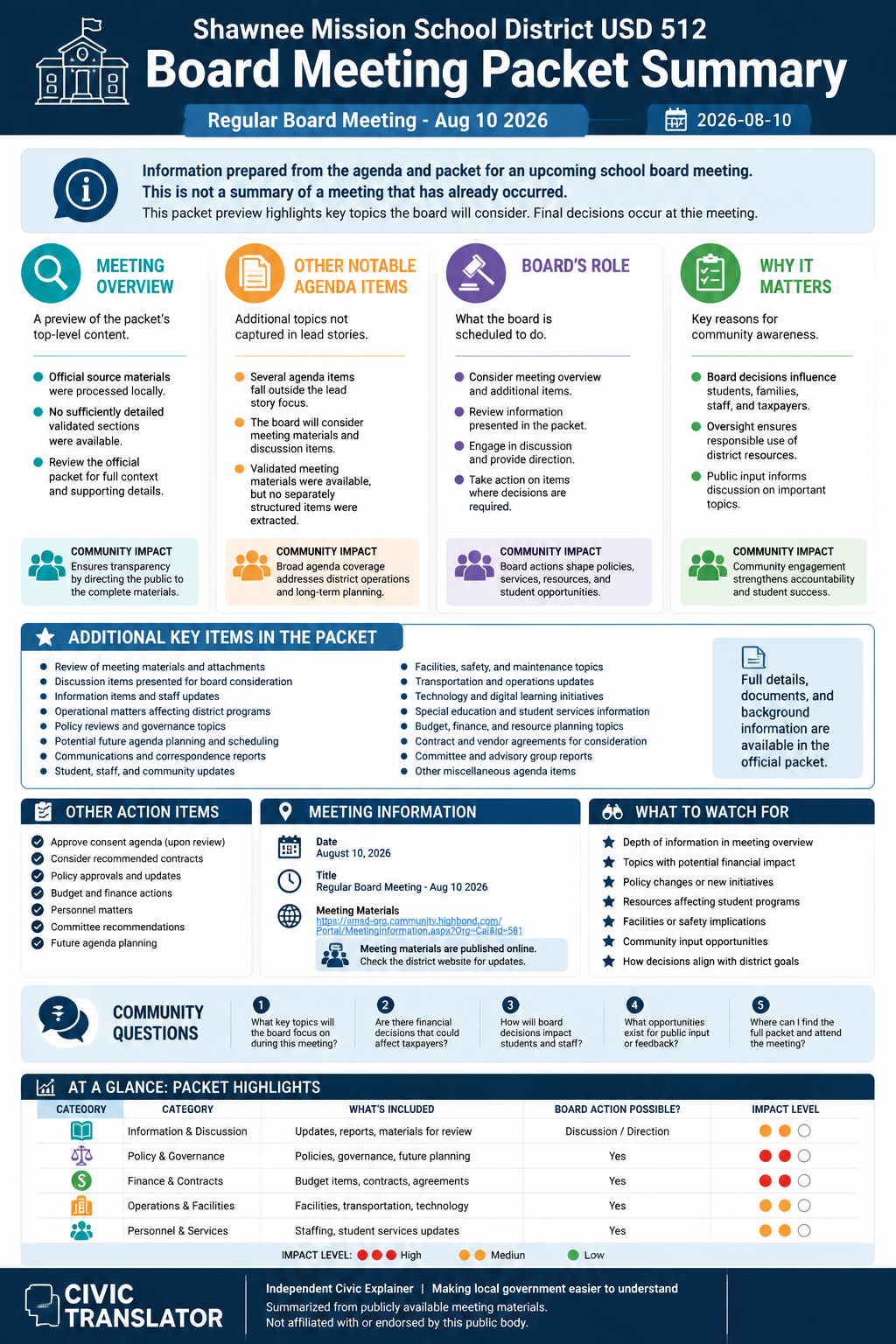
The Shawnee Mission School District USD 512 Board of Education’s Aug. 10, 2026 regular meeting focused on preparing for the 2026-2027 school year, including instructional priorities, technology planning, staffing agreements, operational contracts, and updates to district improvement goals. The meeting took place at the Center for Academic Achievement in Overland Park.
A major theme was improving student learning through districtwide systems. Administrators presented updates on Kansas Education Systems Accreditation (KESA), District Wildly Important Goals (WIGs), and the district’s approach to high-quality instruction. The district highlighted continued work around Response to Intervention, professional learning communities, student engagement, graduation rates, and classroom instructional practices.
Technology and artificial intelligence remained significant community issues. The Board reviewed progress on Strategic Plan Strategy 4: Technology, including plans for an instructional technology framework, professional development, age-appropriate technology guidance, and future work related to AI and digital learning.
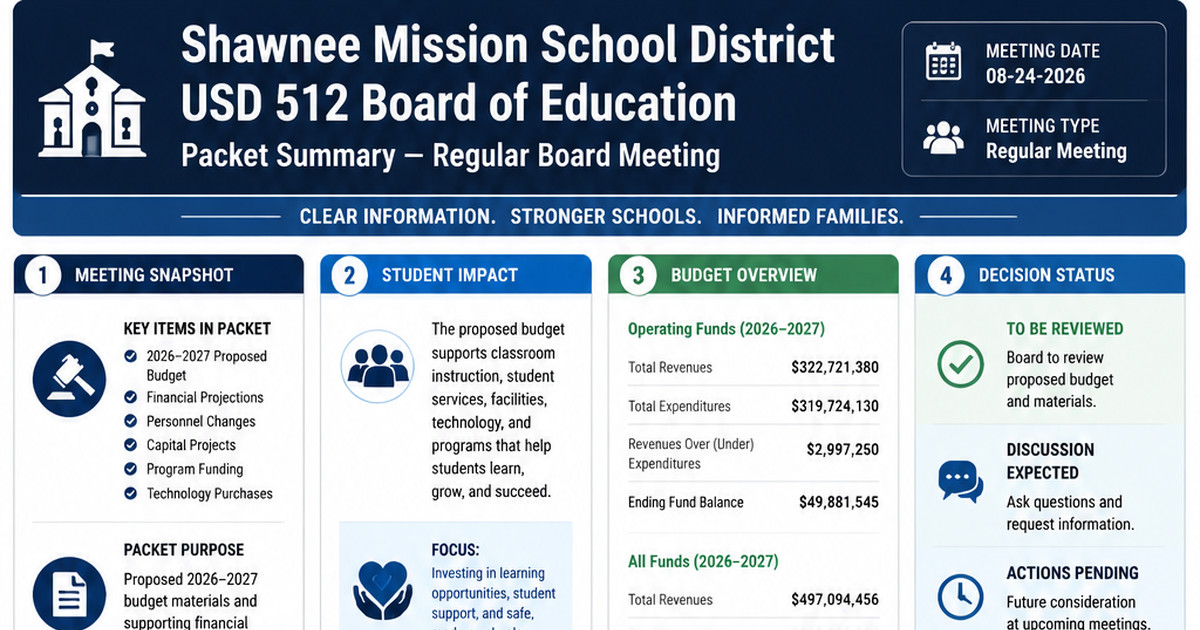
The Board also considered and approved several financial and operational matters affecting the upcoming school year. These included employee compensation agreements, substitute staffing services, technology purchases, special education contracts, transportation services, facilities expenses, and public hearings related to the 2026-2027 budget and revenue neutral tax rate.
Major Discussion and Action Items
District Improvement Goals, KESA, and Student Achievement
District leaders presented an update on KESA accreditation work and the district’s Wildly Important Goals. The presentation described efforts to build a continuous improvement system focused on instructional quality, professional learning communities, and measurable student outcomes.
The district’s two major WIGs are increasing student achievement through Response to Intervention (RTI) systems and increasing high school graduation rates by improving attendance and student engagement.
For 2026-2027, district actions include strengthening Tier 1 and Tier 2 instruction, expanding RTI leadership teams, using walkthrough data to identify professional learning needs, and continuing PLC practices. The district also identified goals involving academic growth, attendance improvement, reduced chronic absenteeism, and increased graduation outcomes.
The matter is important because it establishes the framework administrators and schools will use to measure instructional progress and allocate professional development resources.
High-Quality Instruction and Classroom Practices
The Board reviewed the district’s work to define high-quality instruction. The presentation emphasized a classroom approach centered on clear learning objectives, meaningful feedback, student engagement, and effective instructional strategies.
The district described expectations that students should understand what they are learning, receive regular feedback, participate actively, and experience safe classroom environments where they have a voice.
Administrators also discussed the use of walkthrough tools and instructional data to identify areas for improvement and guide professional learning.
Instructional Technology and Emerging Technology
The Board received an update on Strategic Plan Strategy 4: Technology. District leaders reported progress toward ensuring technology is used intentionally and appropriately to support student learning.
The district plans to move forward with the PICRAT framework for instructional technology and begin formal professional learning during fall 2026. The framework is intended to help educators evaluate how technology supports teaching and learning.
The district is also continuing work on age-appropriate technology guidance, baseline technology skills for students and staff, and community feedback opportunities.
Artificial intelligence was discussed as part of the broader technology conversation. The district noted that educational platforms increasingly include AI tools and that technology use must occur with clear teacher guidance and attention to academic integrity.
Employee Compensation and Labor Agreements
The Board considered multiple compensation-related items for the 2026-2027 school year.
The Board was asked to ratify the Professional Negotiated Agreement with NEA-SM. The agreement would increase the professional employee salary schedule by 2.1% on the base, with a total compensation package increase ranging from 2.1% to 4.54%.
The Board also considered salary schedules and personnel agreements for classified employees, school psychologists, parent educators, and administrators. These proposals generally included a 2.1% base salary increase, with total compensation changes varying by employee group.
The agreements establish compensation structures for district employees during the upcoming school year.
Substitute Services Agreement
The Board approved a contract with Kelly Education for substitute services during the 2026-2027 school year.
The estimated annual cost is approximately $7 million, with final costs dependent on actual substitute service needs. The expense will be paid from operating funds.
District officials previously reviewed substitute service operations, including absence levels, fill rates, and renewal information. The contract is intended to maintain classroom coverage and support district staffing needs.
Special Education Services and Student Support Contracts
The Board approved several contracts supporting special education services and educational programs.
Approved items included agreements with Cornerstones of Care, Kansas State School for the Deaf, Kansas State School for the Blind, Lakemary Center, The Brighthouse Academy, KVC Behavioral Healthcare, Behavioral Health Allies, and Summit Achievement Center.
These contracts provide educational programs, related services, transportation, paraprofessional support, or specialized services for individual students based on district needs.
Costs included:
- Cornerstones of Care: up to $60,000
- Kansas State School for the Deaf services: up to $48,000
- Kansas State School for the Blind services: up to $65,000
- Lakemary Center: up to $115,000
- The Brighthouse Academy: up to $101,000
- KVC Behavioral Healthcare Missouri: up to $65,000
- Behavioral Health Allies/Milestones Academy: up to $175,000
- Summit Achievement Center: up to $690,000
These expenses are primarily supported through special education operating funds.
Facilities, Technology, and Equipment Purchases
The Board approved several operational purchases and technology investments.
A major facilities-related item was ratification of an emergency purchase of pool equipment, parts, and related services for Shawnee Mission North High School from Commercial Aquatics Services, Inc. The cost was $75,024.57 and was funded through the Capital Fund.
Technology-related purchases included:
- Cisco Digital Network Architecture licensing: $131,889.60
- Apple replacement charging adapters and cables: up to $72,500
- Apple device repair spending authority: up to $475,000
- Securly Pass and Securly Flex subscriptions: $47,599.60
- FileBound Enterprise Content Management software: $21,898.25
These items support district infrastructure, device management, student services, and technology operations.
Financial Matters
The Board approved claims totaling $11,444,163.91.
Additional approved expenditures included:
- Health Science Concepts and Skills textbooks from Goodheart-Wilcox Publisher: $20,355.68 plus a 5% contingency, funded through Carl D. Perkins Career and Technical Education Act funds.
- Everway educational subscriptions: $70,140 from the Special Education operating fund.
- PebbleGo database renewal: approximately $67,945.60.
- Project Lead The Way participation fee: approximately $55,250.
- YouScience licenses: $26,550 through Perkins Program Improvement Grant and Career and Technical Education funds.
- Journify Learning software and training resources: $48,384.
- Kansas State College and Career Program support: $28,000.
- Pur-O-Zone toilet tissue purchase: approximately $104,000.
- Elementary math manipulatives: approximately $89,818.30.
The Board also approved notices for public hearings regarding the 2026-2027 budget and revenue neutral tax rate.
Policies, Ordinances, Resolutions, and Governance
The Board approved several policy-related actions.
A revised Board Policy JCEC regarding assembly and speech was approved. The revision addresses student safety by specifying that students may not leave school grounds during the school day for protests.
The Board rescinded the previous JCDC policy regarding personal electronic devices and approved a new JCDC policy addressing student personal electronic communications devices.
Updated elementary, middle school, and high school student and parent handbooks for 2026-2027 were also approved.
The Board approved an agreement with NEA-SM creating work groups to study and provide advisory recommendations on issues discussed during negotiations.
The Superintendent’s report highlighted preparation for the new school year, including enrollment verification, transportation registration, the transition to ParentSquare for district notifications, and summer enrichment activities involving more than 3,200 students.
The district also discussed continued strategic planning work and opportunities for community participation in Action Teams beginning Aug. 13.
The Board received updates from committees including the Shawnee Mission Education Foundation, Kansas Association of School Boards, Policy Review Committee, Finance and Facilities Committee, and Real World Learning Team.
Personnel, Appointments, and Organizational Matters
The Board approved the Human Resources agenda, including personnel appointments, leaves, resignations, and retirements.
Reported resignations included:
- Kayla Clark, kindergarten teacher at Bluejacket-Flint Elementary
- Thomas Kepple, resource teacher at Mill Creek Elementary
- Nia Madison, math teacher at Westridge Middle School
The district also approved supplemental coaching appointments, including girls flag football head coaches at East, North, Northwest, South, and West high schools, and a girls softball head coach at Shawnee Mission East.
Projects, Facilities, Infrastructure, and Operations
The Board approved a Right of Entry Agreement at Brookwood Elementary School benefiting the City of Leawood.
The Board also addressed transportation operations through approval of a renewed contract with Assisted Student Transportation for alternative transportation services. The agreement runs Aug. 1, 2026 through July 31, 2027, with an estimated annual base cost of $2,059,178.85.
A bond-funded signage package for the new Shawnee Mission Early Childhood Education Center was previously approved at a cost of $212,800.
The Board approved publication of notices for the 2026-2027 budget hearing and revenue neutral rate hearing.
Community members also previously participated in public discussion regarding technology, artificial intelligence, and student device policies. Speakers raised questions about AI use, school-issued devices, classroom technology, and the pace of policy development.
- Students and families will see continued district work on instructional quality, technology guidance, transportation, and student support services.
- Employees will be affected by new compensation agreements and salary schedules for the 2026-2027 school year.
- Taxpayers will be impacted by budget decisions, public hearings, operational spending, and capital investments.
- Students requiring specialized services will continue receiving support through contracted providers.
- Families will receive updated communication systems through the transition to ParentSquare.
- Schools will continue implementing improvement strategies focused on achievement, attendance, and engagement.
- How will the district measure whether technology investments improve student learning outcomes?
- What feedback opportunities will families have regarding instructional technology policies?
- How will the district monitor progress toward the 91% graduation rate goal?
- What factors determine the final cost of substitute services each year?
- How will the district evaluate the effectiveness of the new personal electronic communications device policy?
- What outcomes are expected from the new NEA-SM work groups?
- How will special education contracts be monitored for student outcomes and service quality?
- What information will be provided during the budget and revenue neutral rate hearings?
Important Dates, Deadlines, and Next Steps
- Aug. 10, 2026: Regular Board Meeting.
- Aug. 11, 2026: Policy Review Committee meeting.
- Aug. 12-14, 2026: First Days of School.
- Aug. 13, 2026: District begins seeking volunteers and nominations for Strategic Plan Action Teams.
- Aug. 20, 2026: Finance and Facilities Committee first meeting of the year.
- Aug. 22, 2026: Kansas Association of School Boards meetings and Suburban Balance Education Summit.
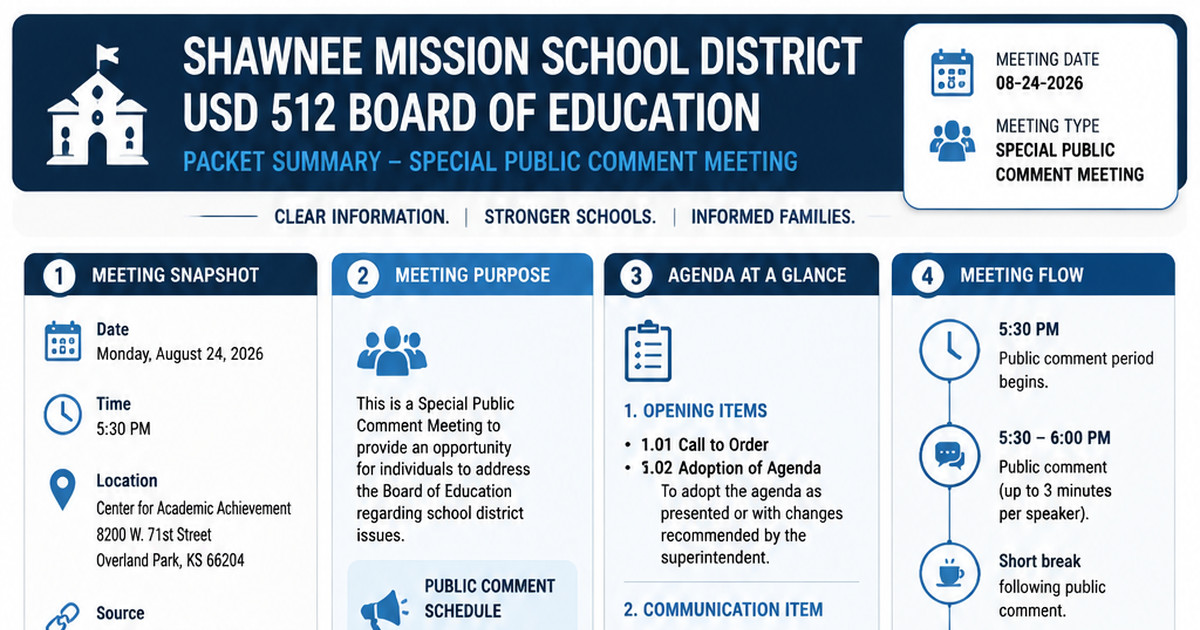
- Aug. 24, 2026: Next regular Board of Education meeting.
Key Takeaways
- The Board reviewed major academic improvement efforts through KESA and District WIG goals.
- Response to Intervention and professional learning communities remain central district priorities.
- Instructional technology planning will continue through fall 2026.
- The district is developing guidance around technology use, AI, and classroom practices.
- Employee compensation agreements include a 2.1% base salary schedule increase for multiple groups.
- Substitute services through Kelly Education are estimated at approximately $7 million annually.
- The Board approved more than $11.4 million in claims.
- Special education contracts support students requiring specialized services.
- Technology infrastructure and device support remain significant operational investments.
- Public hearings will address the 2026-2027 budget and revenue neutral tax rate.
Official Sources
About the Public Body
- Name: Shawnee Mission School District USD 512 Board of Education
- Organization type: school-district
- Government body: school-boards
- Location: Shawnee Mission, kansas
- County: Johnson County
- Provider: diligent-community
Keywords
Shawnee Mission School District, USD 512, Board of Education, Regular Board Meeting, August 10 2026, Johnson County Kansas, KESA, Wildly Important Goals, student achievement, Response to Intervention, graduation rate, instructional technology, artificial intelligence, technology policy, professional negotiated agreement, NEA-SM, employee compensation, substitute services, Kelly Education, special education, transportation, budget hearing, revenue neutral rate, facilities, digital learning, ParentSquare, strategic plan, high quality instruction, student devices