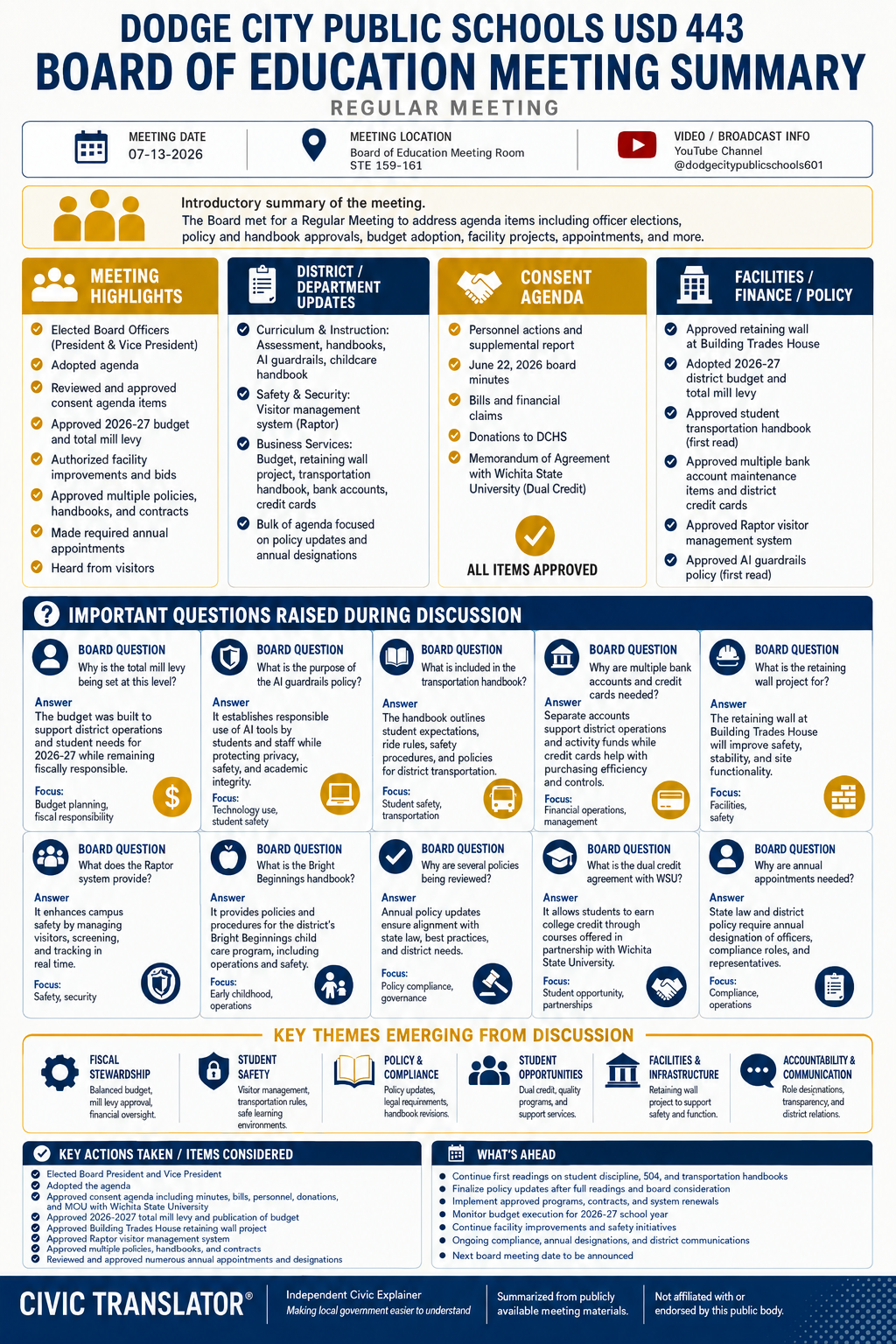
The Dodge City Public Schools USD 443 Board of Education held its regular meeting on July 13, 2026, at the Board of Education Meeting Room, 2112 First Avenue. The meeting marked an important annual organizational point for the district: the Board elected its president and vice president, adopted its agenda, handled annual appointments and designations, approved the consent agenda, and considered budget, facilities, curriculum, safety, technology, banking, policy, and student-service matters.
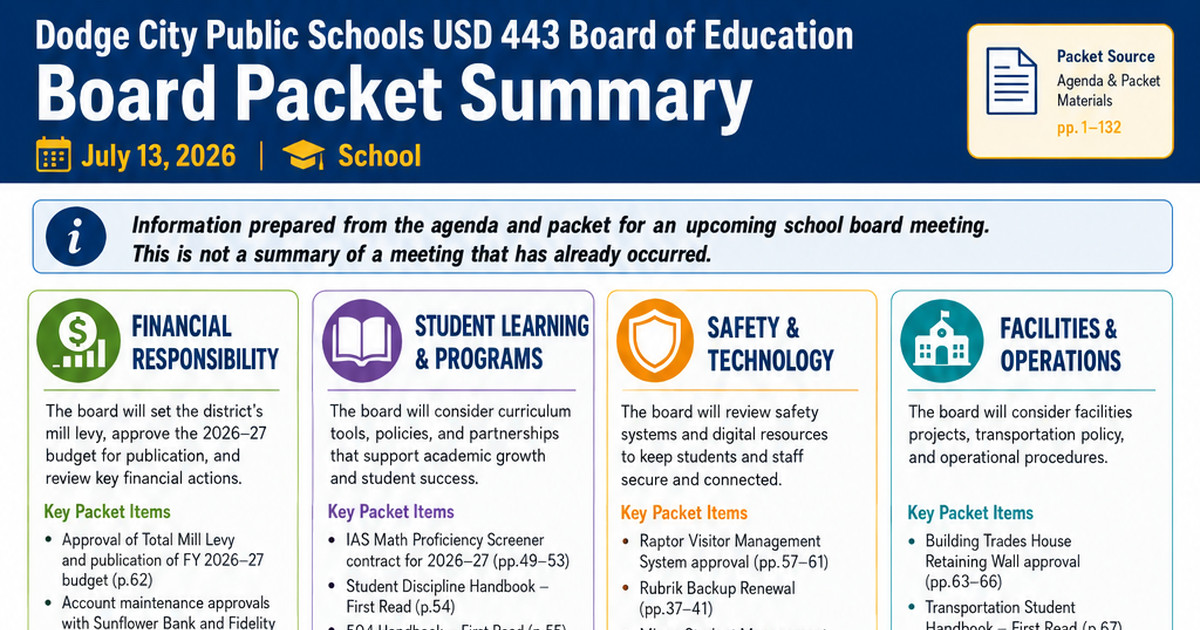
A major financial action was approval of the total mill levy and publication of the district's FY 2026-2027 budget. A mill levy is the property-tax rate used to generate local revenue for school operations and other authorized purposes. The action moves the district's annual budget process forward and establishes the framework for how district programs, staffing, facilities, and other services will be financed. The available meeting materials establish that the budget and total mill levy were approved, but do not provide a verified vote breakdown in the materials available for this summary.
The Board also approved work on a retaining wall at the Building Trades House. District materials treated the project as a facilities and safety matter intended to improve the stability, safety, and functionality of the site. This is significant not only as a capital improvement but because the Building Trades House is connected to the district's hands-on educational programming.
Several technology and safety decisions were addressed. The Board approved the Raptor Visitor Management System, which is intended to improve management of campus visitors through visitor screening, tracking, and related safety functions. The Board also considered proposed "AI Guardrails" for the first time. Those guardrails were presented as a framework for responsible use of artificial intelligence by students and staff, with attention to privacy, safety, academic integrity, and appropriate educational use. Because this was a first reading, the AI framework remained in the policy-development process rather than representing a final policy action at this meeting.
Student rules and handbooks were another major theme. The Board approved updated Bright Beginnings materials and reviewed the Student Discipline Handbook, Section 504 Handbook, and Transportation Student Handbook as first-reading items. The Bright Beginnings Early Head Start Child Care Partnership handbook included a new breastfeeding policy, while early-childhood handbook changes also addressed student electronic communication devices, inclement-weather parking procedures, and other operating guidance. The transportation, discipline, and Section 504 documents remained in the review process for subsequent consideration.
The consent agenda covered a broad range of district business. Materials identify personnel actions, the June 22 Board minutes, monthly bills and financial claims, $1,450 in donations to Dodge City High School, banking changes, district credit-card limits, the KASB Legal Assistance Fund contract, early-childhood handbooks, technology and educational-service renewals, and a Wichita State University/WSU Tech dual-credit agreement. The dual-credit agreement continues opportunities for eligible high school students to earn concurrent or dual credit while still enrolled in USD 443.
Annual financial controls also received attention. The Board addressed signature-card changes at Sunflower Bank and Fidelity State Bank and approved district credit-card arrangements. The packet listed an aggregate authorized credit limit of $152,000 across district cards, with the Business Office responsible for monitoring expenditures. The Fidelity State Bank update reflected staffing changes affecting the Dodge City High School Activity Fund, while the Sunflower Bank update addressed authorized signers associated with Comanche Middle School.
The annual organizational portion of the meeting established or renewed a large number of statutory and administrative roles. These included the Board clerk and treasurer functions, legal counsel, attendance and hearing officers, Freedom of Information responsibilities, workers' compensation and unemployment-insurance administration, KPERS representation, Section 504/ADA and anti-discrimination compliance responsibilities, internet-protection compliance, homeless- and foster-student coordination, E-Rate administration, the district depository, bond counsel, and other required functions. The annual process is important because it formally assigns responsibility for legal compliance and continuity of district operations.
Several recurring governance resolutions and annual operating decisions were also before the Board, including meeting dates, current written policies, accounting practices, record destruction, home rule, petty cash, activity funds, retired technology equipment, mileage reimbursement, organizational charts, the school calendar, substitute-teacher rates, meal prices, and other annual designations. The packet identified the State of Kansas mileage reimbursement rate as 72.5 cents per mile beginning July 1 and proposed the district use that rate for 2026-2027.
The meeting also set up work that will continue into the new school year. First readings of the Student Discipline, Section 504, Transportation, and AI Guardrails materials indicate that policy and handbook work was not finished on July 13. The district was also entering its summer enrollment and back-to-school period, with centralized enrollment, staff events, the start of classes, and additional Board meetings scheduled over the following weeks.
Major Discussion and Action Items
FY 2026-2027 Budget and Mill Levy
The Board approved the total mill levy and publication of the FY 2026-2027 district budget. This was one of the meeting's most consequential financial actions because the annual budget determines how resources are allocated to district operations, staffing, instruction, facilities, and other services.
The mill levy determines the property-tax rate associated with district funding. The materials available for this summary establish that the Board approved the budget-related action but do not provide a sufficiently supported exact mill rate or a member-by-member vote.
Building Trades House Retaining Wall
The Board approved a retaining-wall project at the Building Trades House. The project was presented as necessary to improve safety, site stability, and functionality.
The Building Trades House connects the facilities issue with the district's career and technical education activities. The project therefore affects both district property management and an instructional setting used to support student learning.
Raptor Visitor Management System
The Board approved the Raptor Visitor Management System. The system is intended to strengthen school security by improving the district's ability to manage, screen, and track visitors entering district facilities.
Implementation will affect school offices, staff responsible for admitting visitors, and community members entering participating school buildings. The action reflects the district's continuing emphasis on student and campus safety.
Artificial Intelligence Guardrails
The Board received a first reading of proposed AI Guardrails. The framework addresses responsible use of artificial intelligence by students and staff and is intended to balance educational uses of AI with concerns about privacy, safety, academic integrity, and appropriate technology use.
Because this was a first reading, the materials do not establish final adoption of the AI Guardrails. Additional consideration is expected before the framework becomes final district policy or guidance.
Student Discipline and Section 504 Handbooks
The Student Discipline Handbook and Section 504 Handbook were presented for first readings.
The discipline handbook addresses student expectations and procedures for responding to misconduct. The Section 504 material relates to the district's responsibilities under federal disability law to ensure eligible students receive appropriate accommodations and equal access to education.
These items remained under review rather than reaching verified final approval at this meeting.
Transportation Student Handbook
The Board conducted a first reading of the Transportation Student Handbook. The handbook addresses expectations for students using district transportation, including riding rules, safety requirements, procedures, and district transportation policies.
The document directly affects students who ride district buses and their families. Final action was not established at this first-reading stage.
Bright Beginnings and Pre-K Handbooks
The Board considered updated Bright Beginnings and Sunnyside Pre-K materials. The Bright Beginnings Early Head Start Child Care Partnership handbook included a breastfeeding-policy addition intended to improve staff knowledge.
Other early-childhood handbook updates addressed student electronic communication devices, inclement-weather parking procedures, and clarified operating language. The packet indicates that the Bright Beginnings Policy Council had approved the Child Care Partnership handbook on May 7, 2026 before its second-reading consideration by the Board.
Dual-Credit Partnership with Wichita State University/WSU Tech
The consent agenda included a Memorandum of Agreement with WSU Tech for 2026-2027. The partnership allows eligible high school students to participate in approved dual-credit and concurrent-enrollment opportunities.
The agreement addresses course offerings, instructor qualifications, student eligibility, curriculum alignment, and program administration. The packet states that approval did not create additional financial obligations requiring separate Board action; program revenues, fees, and instructor stipends are handled under the agreement.
KASB Legal Assistance Fund
The Board considered the district's annual Kansas Association of School Boards Legal Assistance Fund agreement. The service gives Board members and administrators access to KASB attorneys for school-law questions and helps preserve confidential attorney-client representation.
The annual fee identified in the packet was $3,100 for FY 2026-2027.
Banking and Credit-Card Controls
The Board addressed updates to bank-account authority following administrative staffing changes.
For Comanche Middle School accounts at Sunflower Bank, the proposed update removed Rachael Webb and John Schartz and added Jonathan Hansen and Ty Thomas. For the Dodge City High School Activity Fund account at Fidelity State Bank, the change removed Shawn Steiner and added Derek Schoenthaler.
The district also annually establishes credit-card limits under Board Policy GANA. The packet listed total authorized limits of $152,000 across district cards and stated that the Business Office monitors expenditures monthly.
Annual Appointments and Organizational Procedures
The Board completed its annual appointments and organizational procedures. These actions maintain legally required and operationally necessary roles for the coming school year.
The packet addressed the Board clerk and treasurer, school attorney, attendance and suspension/expulsion hearing officers, Freedom of Information officer, workers' compensation representatives, KPERS representatives, Section 504/ADA compliance officers, federal anti-discrimination compliance, Children's Internet Protection Act compliance, homeless- and foster-student coordination, E-Rate administration, the district depository, bond counsel, health-benefit consulting, claims administration, and related responsibilities.
Annual Resolutions and Operating Rules
The organizational agenda included annual resolutions and recurring operating decisions. These included establishing Board meeting dates, rescinding prior-year policy actions and adopting current written policies, waiving specified accounting requirements for 2025-2026, authorizing destruction of eligible records, establishing home-rule authority, creating petty-cash and activity funds, and authorizing recycling of retired technology equipment.
The Board also addressed the annual school calendar, substitute-teacher rates, meal prices, mileage reimbursement, organizational charts, student fees, graduation requirements, and immunization policy.
Votes, Decisions, and Direction
The meeting materials support the following actions or status determinations:
- Board officers, including president and vice president, were elected. The available materials do not provide a sufficiently supported vote breakdown or officer names for this July 13 election.
- The meeting agenda was adopted.
- The consent agenda was approved, including personnel and supplemental personnel actions, the June 22, 2026 Board minutes, bills and financial claims, donations, agreements, handbooks, banking items, credit-card controls, and other listed consent business.
- The FY 2026-2027 total mill levy and publication of the district budget were approved.
- The Building Trades House retaining-wall project was approved.
- The Raptor Visitor Management System was approved.
- The Bright Beginnings handbook materials scheduled for final consideration were approved.
- The WSU Tech/Wichita State University dual-credit Memorandum of Agreement was approved through the consent agenda.
- District bank-account maintenance and credit-card items were approved through the consent agenda.
- The KASB Legal Assistance Fund agreement was approved through the consent agenda.
- Annual appointments, designations, organizational procedures, and required resolutions were acted upon as part of the Board's annual organization.
- The Student Discipline Handbook received a first reading; no verified final adoption occurred at this stage.
- The Section 504 Handbook received a first reading; no verified final adoption occurred at this stage.
- The AI Guardrails received a first reading; no verified final adoption occurred at this stage.
- The Transportation Student Handbook received a first reading; no verified final adoption occurred at this stage.
- The available materials do not provide sufficiently supported mover, seconder, individual-vote, or roll-call details for these July 13 actions, so those details are not attributed here.
Financial Matters
The Board's most significant financial action was approval of the FY 2026-2027 budget and total mill levy. This establishes the district's annual spending and local property-tax framework. The materials available for this summary do not establish a reliable exact mill rate.
The Board approved the Building Trades House retaining-wall project. The project supports site safety and stability, although an exact verified contract amount is not stated here because it is not sufficiently established by the available extracted materials.
The KASB Legal Assistance Fund agreement carried an annual cost of $3,100 for FY 2026-2027.
The district's credit-card schedule established a combined authorized limit of $152,000 across district cards. These are spending limits rather than a planned expenditure of $152,000. Policy requires district monitoring of card activity.
The Board accepted $1,450 in donations for Dodge City High School. The listed donations included support for boys cross country and boys golf.
Board members may receive reimbursement for home internet used for district business of up to $75 per month, with funds available through the Board of Education Expense budget in the General Fund.
The annual organizational materials proposed use of the State of Kansas mileage reimbursement rate, identified as 72.5 cents per mile beginning July 1, for the 2026-2027 school year.
The packet also established substitute-teacher rates including $130 per day for 10 or fewer continuous days, $155 per day for 11-40 continuous days, $210 per day for more than 41 continuous days in the same position, and $225 per day for a long-term substitute identified as Teacher of Record.
Policies, Ordinances, Resolutions, and Governance
The Board considered KASB policy updates resulting from legal and administrative review. The packet identified 18 existing policy revisions, two regulation revisions, and one policy reintroduction. Some changes were described as legally required, while others were recommendations for clarity.
The Board's annual governance work included electronic communications and internet access for Board members. District-owned devices remain district property, and Board communications remain subject to applicable policies and the Kansas Open Meetings Act. Internet reimbursement for district business is capped at $75 per month.
First readings were conducted for the Student Discipline Handbook, Section 504 Handbook, Transportation Student Handbook, and AI Guardrails. These first readings allow the Board and administration to review proposed rules before final action.
Annual resolutions addressed Board meeting dates, continuation of current written policies, accounting practices, record destruction, home rule, petty cash, activity funds, and disposal or recycling of retired technology.
The Board also renewed or established annual compliance and governance responsibilities covering Section 504/ADA, federal anti-discrimination requirements, internet protection, public information, attendance, student hearings, claims, retirement-system representation, and other statutory responsibilities.
Reports, Presentations, and Updates
Curriculum and instruction matters included the district's math proficiency screening arrangements, handbook updates, student discipline and Section 504 guidance, and AI Guardrails.
Safety and security matters included approval of the Raptor Visitor Management System. The system is intended to strengthen visitor screening and campus access management.
Business Services presented the budget and mill levy, the Building Trades House retaining wall, banking and credit-card controls, annual organizational matters, and the Transportation Student Handbook.
The available meeting transcript does not provide reliable speaker-by-speaker coverage of these deliberations, so this summary does not attribute specific discussion comments that cannot be verified from the meeting materials.
Personnel, Appointments, and Organizational Matters
The consent agenda included personnel actions and a supplemental personnel report. Public packet materials identify appointments, separations, transfers, substitute assignments, and extra-duty work.
Among the listed appointments was Violet Johnson as Assistant Principal at Comanche Middle School, with a July 28, 2026 start date. The packet also listed multiple teacher, librarian, paraprofessional, and other staffing appointments for the upcoming school year.
The Board also completed annual organizational appointments and designations. These responsibilities include Board clerk and treasurer functions, legal counsel, attendance and hearing officers, compliance officers, insurance and benefit representatives, public-information responsibilities, E-Rate coordination, student-support liaisons, financial officers, and other positions required to maintain district operations.
Projects, Facilities, Infrastructure, and Operations
The Building Trades House retaining wall was a principal facilities action. The project is intended to address safety, stability, and site functionality.
The Raptor Visitor Management System represents an operational change in building security and visitor management. Schools using the system will have a more structured process for admitting and tracking visitors.
Transportation operations were addressed through the first reading of the Transportation Student Handbook. The document establishes student expectations, safety procedures, and policies for district transportation.
Technology operations were addressed through annual internet-access rules, credit-card and banking controls, software and service renewals, and a resolution concerning recycling retired IT equipment.
The district was also preparing for the beginning of the 2026-2027 school year through enrollment activities, staff preparation, transportation planning, and implementation of updated handbooks and procedures.
The agenda provided a recognition-of-visitors period during which members of the public could present ideas or concerns regarding USD 443 schools. The Board's stated procedure provides that no action is taken during this portion of the same meeting.
The available materials do not provide sufficiently supported details about substantive July 13 public comments, individual speakers, or specific concerns raised. No names or comments are therefore attributed here.
Questions and Answers
The available source materials do not support a reliable speaker-by-speaker reconstruction of Board questions and staff answers. However, the issues before the Board centered on several practical questions:
- The budget and mill levy raised the question of how the district will fund operations and student needs during FY 2026-2027 while maintaining fiscal responsibility.
- The AI Guardrails raised questions about how students and staff may appropriately use artificial intelligence while protecting privacy, safety, and academic integrity.
- The Transportation Student Handbook addressed what rules and procedures students and families must follow when using district transportation.
- Banking and credit-card actions addressed how the district maintains financial controls while allowing administrators to conduct necessary district business.
- The retaining-wall project addressed how the district will improve safety and stability at the Building Trades House.
- The Raptor system addressed how the district will manage and screen campus visitors.
- Annual appointments addressed who is formally responsible for the district's statutory, financial, compliance, and administrative duties.
Students and families will be most directly affected by the handbook and policy work. Transportation rules, discipline procedures, Section 504 guidance, early-childhood handbooks, and future AI rules all shape students' day-to-day experience.
Students seeking postsecondary opportunities benefit from continuation of the WSU Tech dual-credit partnership, which allows eligible students to earn college credit through approved concurrent-enrollment programs.
Taxpayers and property owners are affected by the approved FY 2026-2027 budget and mill levy because the mill levy determines the local property-tax rate supporting district finances.
School visitors and families will encounter new or continued visitor-management procedures as the Raptor system is implemented.
Employees are affected by annual personnel actions, organizational assignments, technology and internet-use rules, compliance responsibilities, and handbook changes.
Early-childhood families are affected by updated Bright Beginnings and Sunnyside Pre-K guidance, including operating procedures and policy changes.
District administrators and Board members are affected by annual banking, credit-card, compliance, legal, communications, and organizational requirements intended to provide continuity and accountability.
- What is the final FY 2026-2027 mill levy, and how does it compare with the prior school year?
- Which major spending categories account for the largest changes in the 2026-2027 district budget?
- What is the final cost and implementation schedule for the Building Trades House retaining-wall project?
- At which schools will the Raptor Visitor Management System be used, and what will visitors need to do when entering a building?
- What changes, if any, will be made to the AI Guardrails before final Board consideration?
- How will teachers and students be trained on responsible and academically appropriate use of AI?
- What are the most significant proposed changes in the Student Discipline and Section 504 handbooks?
- What changes in the Transportation Student Handbook will families notice during the 2026-2027 school year?
- How many students are expected to participate in the WSU Tech dual-credit program during 2026-2027?
- How does the district monitor use of its $152,000 in aggregate credit-card authorization to ensure appropriate spending?
- What performance or safety measures will the district use to evaluate the Raptor visitor-management system?
- When will the first-reading handbook and AI items return to the Board for final consideration?
Important Dates and Next Steps
- July 14, 2026, 7:00 AM-7:00 PM: Centralized Enrollment at the Civic Center.
- July 15, 2026, 7:00 AM-7:00 PM: Centralized Enrollment at the Civic Center.
- July 27, 2026, 6:00 PM: Board of Education Work Session in the Board Room.
- August 6, 7, 10, 11, and 12, 2026: Educator Support Program activities.
- August 7, 2026, 6:00-7:30 PM: Student and Family Engagement Back to School Night at the Civic Center.
- August 10, 2026, 6:00 PM: Board of Education meeting in the Board Room.
- August 13, 2026: All Staff Breakfast at 7:15 AM and Convocation at 8:00 AM at the Civic Center.
- August 18, 2026: First day of classes for K-12 students.
- August 21, 2026: First day of school for preschool students.
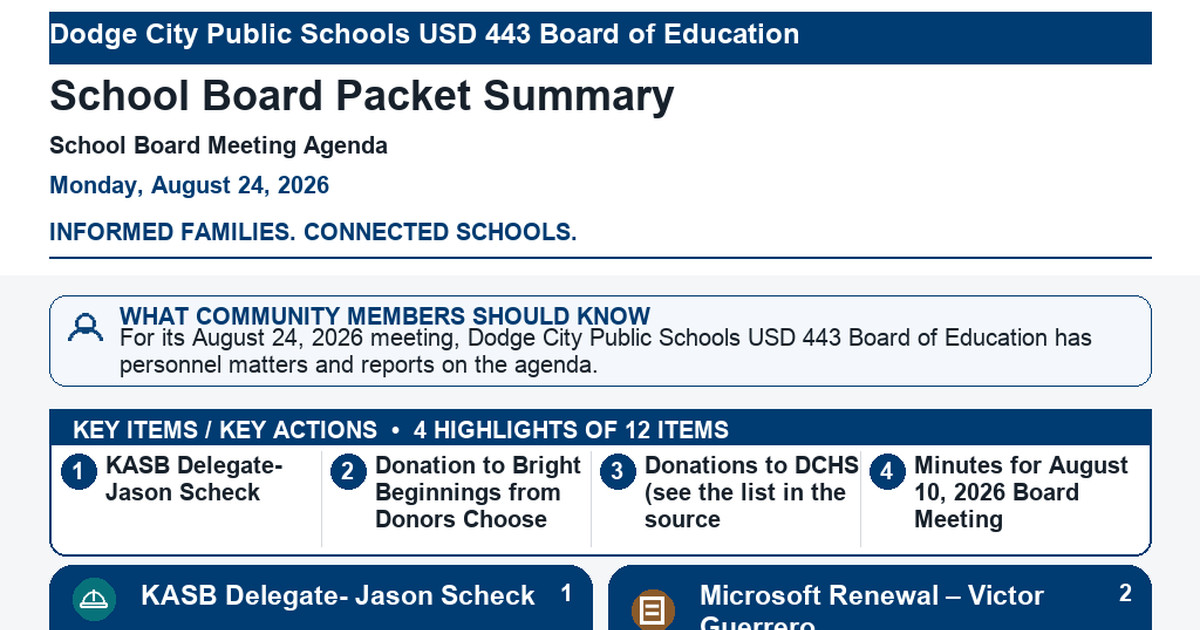
- August 24, 2026, 12:00 noon: Board of Education meeting in the Board Room.
- The Student Discipline Handbook, Section 504 Handbook, Transportation Student Handbook, and AI Guardrails remain items to watch after their first readings.
- District staff will proceed with implementation of approved budget, facilities, security, banking, personnel, contractual, and organizational actions.
Key Takeaways
- The Board held its regular meeting on July 13, 2026.
- Board president and vice president positions were elected as part of annual organization.
- The Board adopted the meeting agenda.
- The consent agenda was approved.
- The Board approved the FY 2026-2027 budget and total mill levy.
- The Board approved a retaining-wall project at the Building Trades House.
- The Board approved the Raptor Visitor Management System for campus visitor management and safety.
- AI Guardrails received a first reading rather than verified final adoption.
- The Student Discipline Handbook received a first reading.
- The Section 504 Handbook received a first reading.
- The Transportation Student Handbook received a first reading.
- Updated Bright Beginnings and early-childhood handbook materials were considered and approved as applicable.
- The WSU Tech dual-credit agreement continues concurrent and dual-credit opportunities for eligible high school students.
- The KASB Legal Assistance Fund agreement carries a $3,100 annual fee.
- District credit cards have a combined authorized limit of $152,000; this is a spending ceiling, not an appropriation to spend that full amount.
- The consent materials included $1,450 in donations for Dodge City High School activities.
- Banking signature authorities were updated to reflect administrative staffing changes.
- Board-member home-internet reimbursement for district business may be up to $75 per month.
- The packet identified the State of Kansas mileage reimbursement rate as 72.5 cents per mile beginning July 1.
- Numerous annual statutory and administrative appointments were renewed or established.
- Annual resolutions addressed meeting dates, policies, accounting, records, home rule, petty cash, activity funds, and retired technology.
- Centralized enrollment was scheduled for July 14 and 15.
- A Board work session was scheduled for July 27.
- K-12 classes were scheduled to begin August 18, with preschool beginning August 21.
- Additional Board meetings were scheduled for August 10 and August 24.
Official Sources
About the Public Body
- Name: Dodge City Public Schools USD 443 Board of Education
- Organization type: school-district
- Government body: school-boards
- Location: Dodge City, kansas
- County: Ford County
- Provider: smartsites-documents
Keywords
Dodge City Public Schools, USD 443, Dodge City Board of Education, Ford County, Kansas, July 13 2026, regular meeting, 2026-2027 budget, mill levy, Building Trades House, retaining wall, Raptor Visitor Management System, school safety, AI Guardrails, artificial intelligence, Student Discipline Handbook, Section 504 Handbook, Transportation Student Handbook, Bright Beginnings, Sunnyside Pre-K, WSU Tech, dual credit, KASB, Legal Assistance Fund, school district credit cards, district banking, personnel, Board appointments, centralized enrollment, school governance