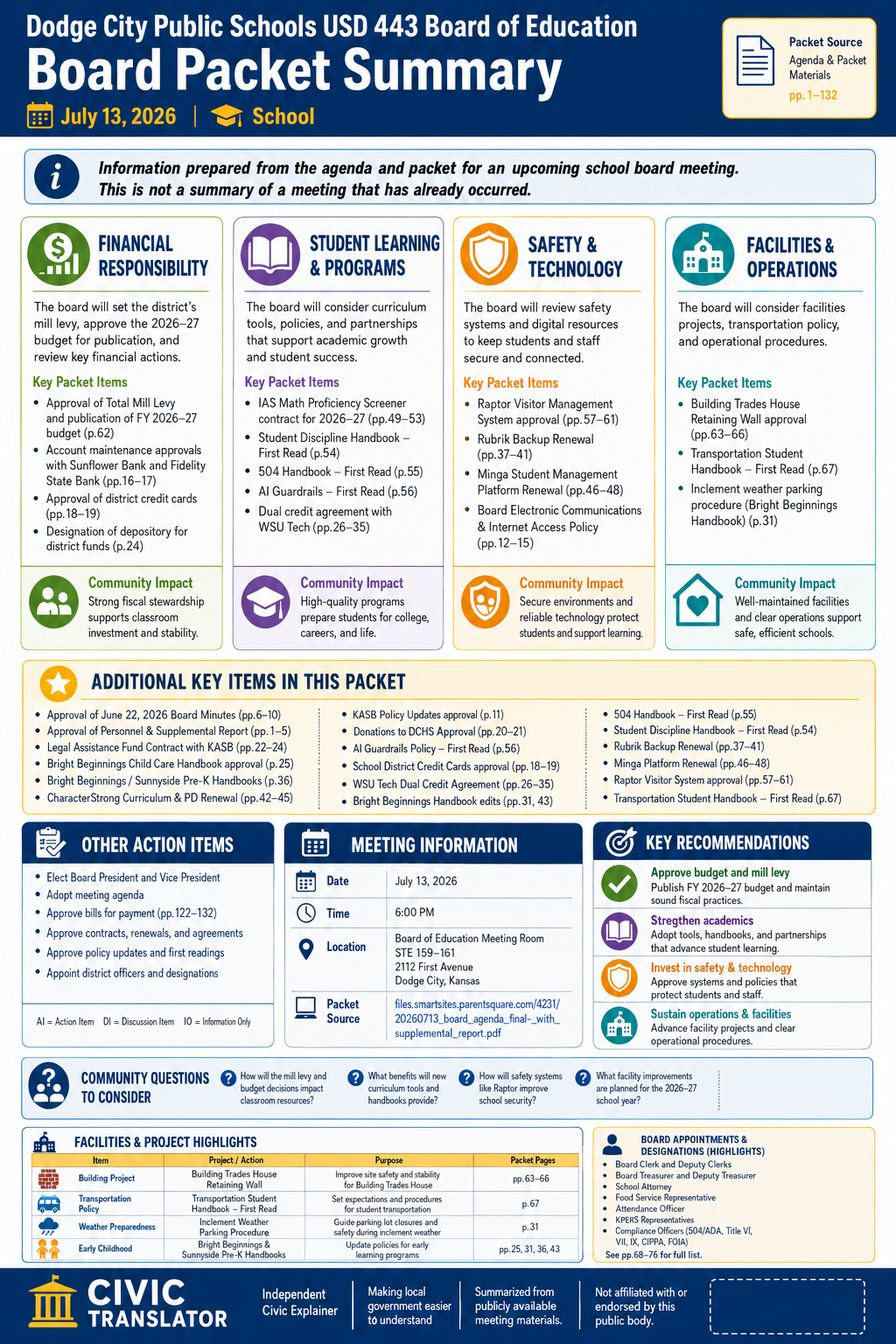
The July 13 meeting serves as both a regular business meeting and the Board of Education’s annual organizational meeting. The board is scheduled to elect a president and vice president, renew numerous official appointments, establish meeting dates, adopt the 2026-2027 school calendar and operational procedures, set meal prices and substitute-teacher rates, and approve annual resolutions governing district finances, records, activity funds, policies, and technology disposal.
Several proposed technology and instructional renewals carry significant costs. These include an $86,784.56 Rubrik data-backup and cybersecurity renewal, a $52,133.70 CharacterStrong curriculum and professional-development package, and a $29,150 Minga student-management subscription. The board will also consider continuing dual-credit opportunities with WSU Tech and approving a math proficiency screener intended to give teachers faster information about student mastery.
Business Services will ask the board to approve the district’s total mill levy and authorize publication of the proposed fiscal year 2026-2027 budget. The packet excerpt does not provide the proposed levy figure or full budget totals, but this action begins an important public-facing stage of the annual budget process. Other operational matters include a retaining wall for a Building Trades house, a Raptor visitor-management system, school credit-card limits totaling $152,000, and annual banking and financial-control authorizations.
Families will see several handbook and policy matters, including final approval of Bright Beginnings and Sunnyside Pre-K handbooks, first readings of student discipline, Section 504, transportation, and artificial-intelligence guidance, and KASB-recommended policy revisions. The board will also receive public comments, although it generally does not act immediately on issues raised during the visitor-recognition period.
Major Discussion and Action Items
Annual Board Organization and Governance
The board will elect its president and vice president and approve a long list of annual appointments and organizational procedures. Recommended continuing appointments include Patrick Crowdis’s office as board clerk, the district comptroller as treasurer, Clayton Kerbs as school attorney, the superintendent or designee as attendance and student-discipline hearing officer, and designated administrators as compliance officers for civil rights, Section 504, the ADA, Title VI, Title VII, and Title IX.
The board will also assign members to the Park and Recreation Advisory Board, Bright Beginnings/Head Start Policy Council, Special Education, and Capital Outlay Committee. These actions determine who handles statutory, financial, compliance, and liaison responsibilities during the coming school year.
Fiscal Year 2026-2027 Budget and Mill Levy
Business Services is requesting approval of the total mill levy and publication of the FY 2026-2027 budget. The source excerpt does not state the proposed tax rate, total spending plan, or publication schedule. However, approval to publish is a key step before final budget adoption and any required hearing.
This matter affects taxpayers, employees, students, and district programs because the budget determines how local, state, federal, and grant resources are allocated. Community members may wish to review the published budget for changes in property-tax support, staffing, technology, facilities, and instructional spending.
Technology, Data Protection, and Campus Management
The district proposes several technology-related purchases. The largest detailed item is a one-year Rubrik renewal from ProActive Solutions for $86,784.56, covering server and Microsoft 365 backup, hardware support, analytics, and ransomware-investigation tools from August 26, 2026, through August 25, 2027.
The board will also consider renewing Minga for $29,150. The platform serves Dodge City High School, Dodge City Middle School, Comanche Middle School, and the Alternative Education Campus. It provides digital student IDs, event passes, electronic hall passes, behavior tools, and intervention or enrichment scheduling.
A separate Raptor Visitor Management System item is scheduled for approval, though the bounded source does not include its cost or contract details. Together, these proposals reflect a continued emphasis on cybersecurity, visitor screening, student identification, and real-time campus management.
CharacterStrong Curriculum and Staff Training
Administration recommends a $52,133.70 CharacterStrong renewal for 2026-2027. Of that amount, $42,143.70 supports curriculum licenses and $9,990 pays for on-demand professional development. Funding would come from At-Risk funds and the Stronger Connections Grant.
CharacterStrong is described as the districtwide framework for social-emotional learning, behavior supports, school culture, and intervention. The renewal would maintain a consistent PreK-12 approach and provide self-paced training on student and adult learning, climate, culture, and leadership.
Dual Credit and Math Assessment
The board is expected to approve a memorandum of agreement with WSU Tech for 2026-2027. The partnership allows eligible high school students to continue taking approved concurrent-enrollment and dual-credit courses. The agreement addresses student eligibility, qualified instructors, course alignment, administration, fees, revenues, and stipends, with no additional board-approved financial obligation identified.
The district is also considering a contract with Innovative Assessment Solutions for a math proficiency screener. A pilot involved fourth-grade teachers at Northwest Elementary, seventh grade at Comanche Middle School, and two Dodge City High School math teachers. The online screening takes approximately 10 to 20 minutes, is designed for four assessment windows, and returns student-level results within 72 hours. The accessible source ends before the contract cost and full recommendation are stated.
Early Childhood Handbooks
The board is scheduled to give final approval to updated Bright Beginnings and Sunnyside Pre-K handbooks after first readings on June 22. The Bright Beginnings child-care handbook adds a breastfeeding policy intended to improve staff understanding.
The student and parent handbooks add or clarify rules concerning student electronic communication devices, inclement-weather parking at Bright Beginnings, in-kind donations, district-policy applicability, and school-meal pricing. The packet says the electronic-device language was added in response to Senate Bill 2299. The Bright Beginnings Policy Council approved the handbooks on May 7, 2026.
Student Rules, Accessibility, Transportation, and AI
The board will receive first readings of a Student Discipline Handbook, a Section 504 Handbook, a Transportation Student Handbook, and artificial-intelligence guardrails. First readings generally provide an opportunity for board review before later approval.
These documents could affect student conduct expectations, disability accommodations, bus procedures, and acceptable use of AI by students or staff. The bounded source does not include the full proposed language, so specific rule changes cannot be confirmed.
Facilities and Building Trades
Business Services is requesting approval of a retaining wall for a Building Trades house. The agenda references supporting pages, but the bounded source does not include the project’s location, contractor, price, or schedule.
The item matters because the district’s Building Trades program typically connects student learning with a real construction project. The board may need to evaluate safety, site conditions, cost, and responsibility for completing the wall.
Financial Matters
The board will review monthly bills and is scheduled to approve the total mill levy and publication of the FY 2026-2027 budget. Detailed budget totals are not included in the accessible source.
Material proposed expenditures include:
- $86,784.56 to ProActive Solutions for the one-year Rubrik backup and cybersecurity renewal.
- $52,133.70 to CharacterStrong, including $42,143.70 for curriculum and $9,990 for professional development.
- $29,150 to Minga Solutions US Inc. for four secondary sites.
- $3,100 for the Kansas Association of School Boards Legal Assistance Fund.
- Up to $75 per month per board member for home Internet used for district business.
- A districtwide credit-card limit structure totaling $152,000, with individual cards ranging from $1,500 to $40,000.
The district also proposes accepting $1,450 in donations for Dodge City High School, including boys cross-country sponsorships and a boys golf donation.
For context, the June 22 minutes record recently approved spending of $354,444.61 for custodial supplies, paper products, and trash bags; $155,825 toward YMCA pool renovations; $70,288.93 for Meraki network equipment and support; $54,968.78 for band and orchestra instruments; $41,500 for Edgenuity; and an estimated $676,000 increase to the classified salary schedule before taxes and benefits.
Policies, Ordinances, Resolutions, and Governance
The board will consider KASB policy recommendations consisting of 18 policy revisions, two revised regulations, and one reintroduced policy. Some changes are described as legally required, while others are offered for clarity or local preference.
Annual resolutions would establish board meeting dates, renew current written policies while rescinding prior-year policy actions, waive generally accepted accounting principles and fixed-asset accounting for 2025-2026, authorize record destruction, assert home-rule authority, establish petty cash and activity funds, and permit recycling of retired technology.
The board will also renew policies governing children’s Internet protection, computer use, privacy, monitoring, acceptable use, and electronic communications. District-issued devices and systems remain district property and may be monitored. Students and employees have no expectation of privacy when using district systems.
The board will receive curriculum and instruction updates from Dr. Scott Springston, Amy Loder, Matt Turner, Victor Guerrero, and Diana Mendoza, along with a safety and security report from David Miller.
The packet also references a staffing update, monthly budget information, and the continuing review of district accountability and needs-assessment information. The math-screening proposal is intended to improve progress monitoring by giving teachers rapid, standards-aligned results at the individual-student level.
Personnel, Appointments, and Organizational Matters
The consent agenda includes appointments, separations, transfers, summer and extra-duty assignments, and a supplemental personnel report. A notable administrative appointment is Violet Johnson as assistant principal at Comanche Middle School beginning July 28, 2026.
The packet lists multiple new teachers and paraprofessionals beginning in August, along with transfers into teaching, maintenance, custodial, library, and support roles. The board will also set substitute-teacher pay at $130 per day for 10 or fewer continuous days, $155 for 11-40 days, $210 for more than 41 days, and $225 for a long-term substitute designated as teacher of record.
Projects, Facilities, Infrastructure, and Operations
Operational decisions include the Building Trades retaining wall, Raptor visitor management, Rubrik backup services, Minga student-management tools, bank signature updates, meal prices, mileage reimbursement, credit-card controls, and disposal of retired technology.
The board is asked to adopt the State of Kansas mileage rate of 72.5 cents per mile beginning July 1 for the 2026-2027 school year. Meal prices range from $2.25 breakfast and $3.10 lunch for PreK to $2.60 breakfast and $3.65 lunch for grades 9-12. Adult meals are listed at $4.25 for breakfast and $6.50 for lunch, and extra milk is $0.80.
The July 13 meeting begins at 6:00 p.m. in the Board of Education Meeting Room, Suites 159-161, at 2112 First Avenue. Visitors may present ideas or concerns about district schools. The board will not take action on those comments during the visitor-recognition period, and concerns about individual employee behavior should be directed to the employee’s supervisor.
No specific budget-hearing date appears in the bounded source. Publication of the proposed FY 2026-2027 budget may lead to a later formal hearing or final adoption process.
Students and families may be affected by revised discipline, transportation, 504, preschool, technology, and AI rules. Secondary students would continue using Minga for identification, hall passes, activities, and flexible scheduling. Eligible high school students would retain access to WSU Tech dual-credit courses.
Employees may be affected by new professional-development resources, substitute rates, staffing changes, technology-monitoring policies, and annual compliance assignments. Taxpayers will be affected by the final budget and mill levy, although the precise proposed tax rate is not included in the accessible material.
The technology renewals are intended to reduce disruption from data loss, cyberattacks, unauthorized visitors, and inefficient student-management processes. Early-childhood handbook changes will clarify family expectations and program operations.
- What total mill levy is proposed, and how does it compare with 2025-2026?
- Which budget areas are increasing or decreasing most significantly?
- What results has the district measured from CharacterStrong?
- How will student data and privacy be protected within Minga and Raptor?
- What did the math-screener pilot show about student learning and teacher usefulness?
- What is the full cost of the math proficiency screener, and what funding source will pay for it?
- What specific practices would the proposed AI guardrails permit or prohibit?
- What changes are included in the Student Discipline and Section 504 handbooks?
- What is the cost, location, and construction schedule for the Building Trades retaining wall?
- How often are district credit-card transactions audited and reported to the board?
- What cybersecurity incidents or recovery needs have informed the Rubrik renewal?
- When will the public have an opportunity to comment on the proposed budget?
Important Dates, Deadlines, and Next Steps
- July 13, 2026, 6:00 p.m.: Board meeting and expected action on the listed agenda.
- July 14-15, 2026, 7:00 a.m.-7:00 p.m.: Centralized enrollment at the Civic Center.
- July 27, 2026, 6:00 p.m.: Board work session.
- July 31, 2026: CharacterStrong curriculum invoice due; Minga quote expires.
- August 6, 7, 10, 11, and 12, 2026: Educator Support Program.
- August 7, 2026, 6:00-7:30 p.m.: Student and Family Engagement Back to School Night at the Civic Center.
- August 10, 2026, 6:00 p.m.: Board meeting; board members are also invited to an Educator Support Program luncheon at 11:30 a.m.
- August 13, 2026: All Staff Breakfast at 7:15 a.m. and convocation at 8:00 a.m. at the Civic Center.
- August 18, 2026: First day of K-12 classes.
- August 21, 2026: First day for preschool students.
- August 24, 2026, noon: Board meeting.
- August 25, 2026: ProActive Solutions’ Rubrik quote expires.
- August 26, 2026-August 25, 2027: Proposed Rubrik renewal term.
Key Takeaways
- The board will elect officers and complete annual organizational appointments.
- Publication of the FY 2026-2027 budget and total mill levy is a major agenda item.
- Rubrik cybersecurity and backup services would cost $86,784.56.
- CharacterStrong curriculum and training would cost $52,133.70.
- Minga student-management services would cost $29,150 for four secondary campuses.
- WSU Tech dual-credit programming is proposed to continue for 2026-2027.
- Early-childhood handbooks include new device, breastfeeding, weather, and policy language.
- Student discipline, Section 504, transportation, and AI guidance are at the first-reading stage.
- Substitute-teacher rates would range from $130 to $225 per day.
- District meal prices and a 72.5-cent mileage rate are proposed for the new school year.
- District credit-card limits would total $152,000.
- Public comments are accepted at the meeting, but immediate board action on comments is not expected.
Official Sources
About the Public Body
- Name: Dodge City Public Schools USD 443 Board of Education
- Organization type: school-district
- Government body: school-boards
- Location: Dodge City, kansas
- County: Ford County
- Provider: smartsites-documents
Keywords
Dodge City Public Schools, USD 443, Board of Education, Ford County, 2026-2027 budget, mill levy, Rubrik, cybersecurity, ransomware protection, Minga, student management, CharacterStrong, social-emotional learning, WSU Tech, dual credit, math proficiency screener, Bright Beginnings, Sunnyside Pre-K, student discipline, Section 504, AI guardrails, Raptor visitor management, Building Trades, meal prices, substitute teachers, KASB policies, school enrollment, technology, school safety, Dodge City High School