Workshop Focus
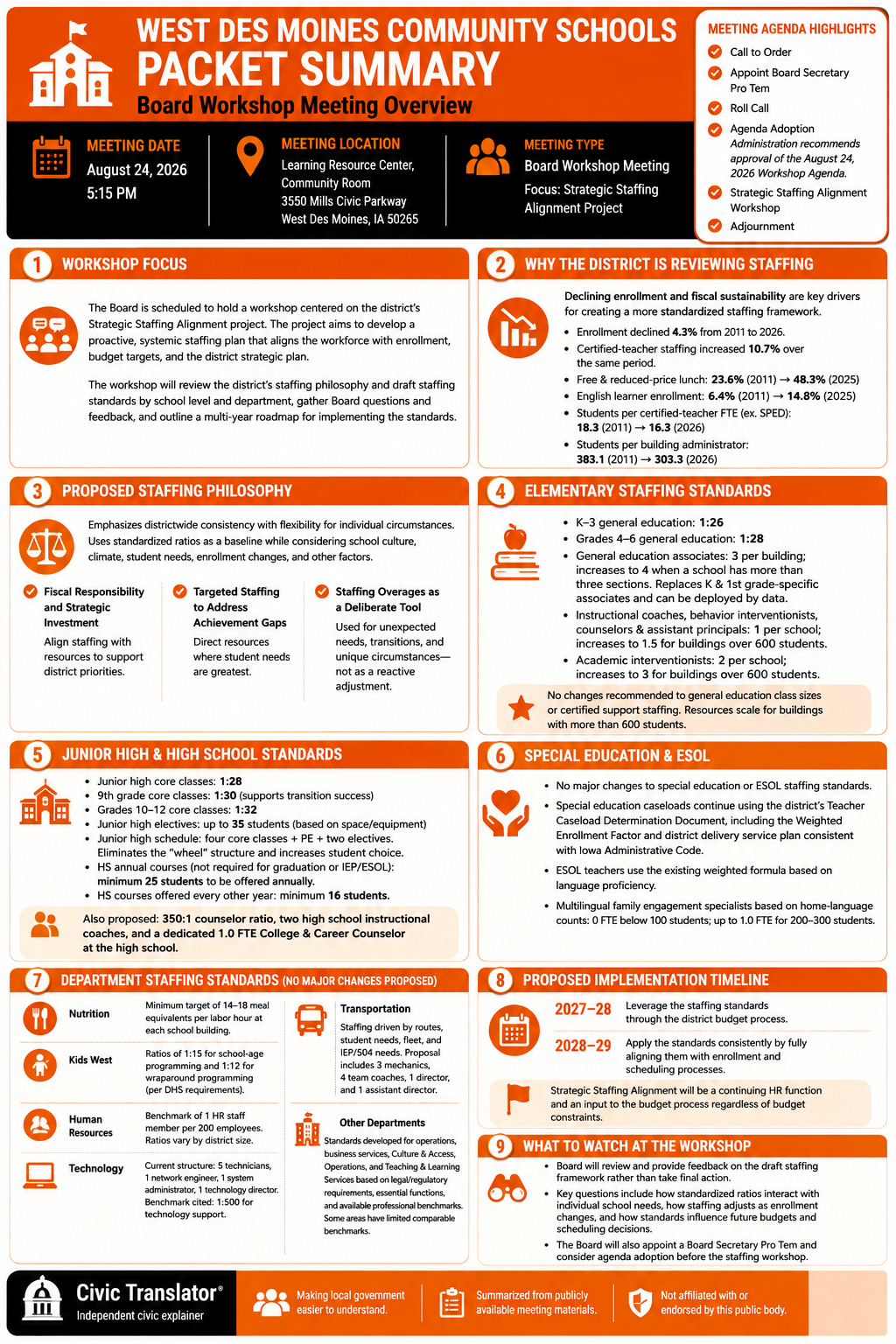
The West Des Moines Community School District Board is scheduled to hold a workshop centered on the district’s Strategic Staffing Alignment project. The packet says the project is intended to develop a proactive, systemic staffing plan that aligns the workforce with enrollment, budget targets, and the district strategic plan.
The workshop is designed to review the district’s staffing philosophy and draft staffing standards by school level and department, while gathering Board questions and additional feedback. The project also calls for a multi-year roadmap for implementing the standards.
Why the District Is Reviewing Staffing
The packet identifies declining enrollment and fiscal sustainability as central reasons for creating a more standardized staffing framework. Benchmark data shows that from 2011 to 2026, West Des Moines enrollment declined 4.3% while certified-teacher staffing increased 10.7%.
Other demographic and staffing measures also provide context:
- The district’s free and reduced-price lunch percentage increased from 23.6% in 2011 to 48.3% in 2025.
- English learner enrollment increased from 6.4% of enrollment in 2011 to 14.8% in 2025.
- Students per certified-teacher FTE, excluding special education, decreased from 18.3 in 2011 to 16.3 in 2026.
- Students per building administrator decreased from 383.1 to 303.3 over the same period.
Proposed Staffing Philosophy
The draft philosophy emphasizes districtwide consistency while retaining flexibility for individual circumstances. It proposes using standardized ratios as a baseline while considering school culture, climate, student needs, enrollment changes, and other contextual factors.
The framework also emphasizes fiscal responsibility, strategic investment, and targeted staffing to address achievement gaps. Proposed staffing overages would serve as a deliberate tool for unexpected needs, transitions, and unique school circumstances rather than as a reactive adjustment.
Elementary Staffing Standards
The elementary proposal generally retains existing class-size expectations while changing how some support positions are structured.
- K–3 general education: proposed at 1:26.
- Grades 4–6 general education: proposed at 1:28.
- General education associates: proposed at three per building, increasing to four when a school has more than three sections. These would replace kindergarten- and first-grade-specific associates and could be deployed according to building data.
- Instructional coaches, behavior interventionists, counselors and assistant principals: generally one per school, increasing to 1.5 for buildings over 600 students.
- Academic interventionists: two per school, increasing to three for buildings over 600 students.
The presentation characterizes the major elementary changes as moves toward greater flexibility, including using the broader titles “Academic Interventionists” and “General Education” associates. It states that no changes are recommended to general education class sizes or certified support staffing and proposes scaling some resources for buildings with more than 600 students.
Junior High and High School Standards
The secondary proposal introduces graduated class-size expectations and changes intended to increase student choice.
- Junior high core classes: proposed at 1:28.
- 9th-grade core classes: proposed at 1:30, with the packet linking the smaller target to ninth-grade transition success.
- Grades 10–12 core classes: proposed at 1:32.
- Junior high electives: proposed at up to 35 students, depending on available space and equipment.
- Junior high schedule: the packet recommends considering four core classes + PE + two electives, eliminating the existing “wheel” structure and allowing student choice to influence offerings.
- High school annual courses: courses not required for graduation or connected to IEP or ESOL services generally would need at least 25 students to be offered annually.
- High school courses offered every other year: proposed minimum enrollment of 16 students.
The secondary framework also proposes a 350:1 counselor ratio, two high school instructional coaches, and a dedicated 1.0 FTE College & Career Counselor at the high school.
Special Education and ESOL
The packet describes no major changes to either special education or ESOL staffing standards. Special education caseloads would continue to use the district’s Teacher Caseload Determination Document, including the Weighted Enrollment Factor and other considerations established through the district delivery service plan and Iowa Administrative Code.
For ESOL teachers, the proposed approach uses the district’s existing weighted formula based on language proficiency. The standards also provide proposed staffing levels for multilingual family engagement specialists based on home-language student counts, ranging from no FTE below 100 students to 1.0 FTE for 200–300 students.
Department Staffing Standards
The district also developed proposed standards for operational and administrative departments, including nutrition, Kids West, transportation, operations, business services, technology, Culture and Access, Human Resources, and Teaching & Learning Services.
The presentation says there are no major changes proposed for departmental staffing. Instead, the framework draws on legal and regulatory requirements, essential district functions, and professional benchmarks where available; the packet notes that some operational areas have relatively few comparable staffing benchmarks.
Examples include:
- Nutrition: a minimum target of 14–18 meal equivalents per labor hour at each school building.
- Kids West: ratios of 1:15 for school-age programming and 1:12 for wraparound programming, based on Department of Health and Human Services requirements.
- Transportation: staffing driven by routes, student transportation needs, fleet requirements, and IEP/504 needs; the proposal lists three mechanics, four team coaches, one director and one assistant director.
- Human Resources: proposed benchmark of 1 HR staff member per 200 employees, with the packet noting ratios vary by district size.
- Technology: the current structure includes five technicians, one network engineer, one system administrator and one technology director; the packet cites a 1:500 technology-support benchmark.
Proposed Implementation Timeline
The staffing standards are presented as a framework to be incorporated gradually rather than as an immediate districtwide staffing change.
- 2027–28: leverage the standards through the district budget process.
- 2028–29: apply the standards consistently by fully aligning them with enrollment and scheduling processes.
The packet describes strategic staffing alignment as a continuing HR function and says the standards would become an input to the budget process regardless of whether the district is facing budget constraints.
What to Watch at the Workshop
The Board is scheduled to review and provide feedback on the draft framework rather than take up a packet-described final adoption of the staffing standards. Key questions include how standardized ratios should interact with individual school needs, how staffing should adjust as enrollment changes, and how the proposed standards will ultimately influence future budget and scheduling decisions.
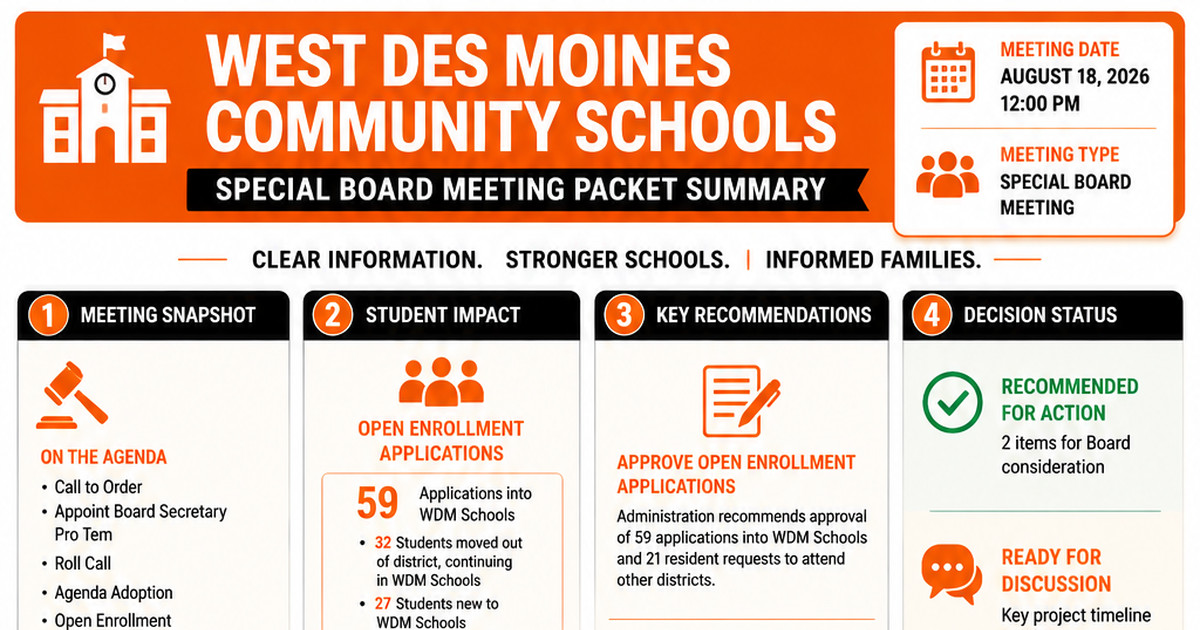
The agenda also includes appointment of a Board Secretary Pro Tem and agenda adoption. Administration recommends approval of the August 24, 2026 Workshop Agenda before the Board moves into the Strategic Staffing Alignment workshop.