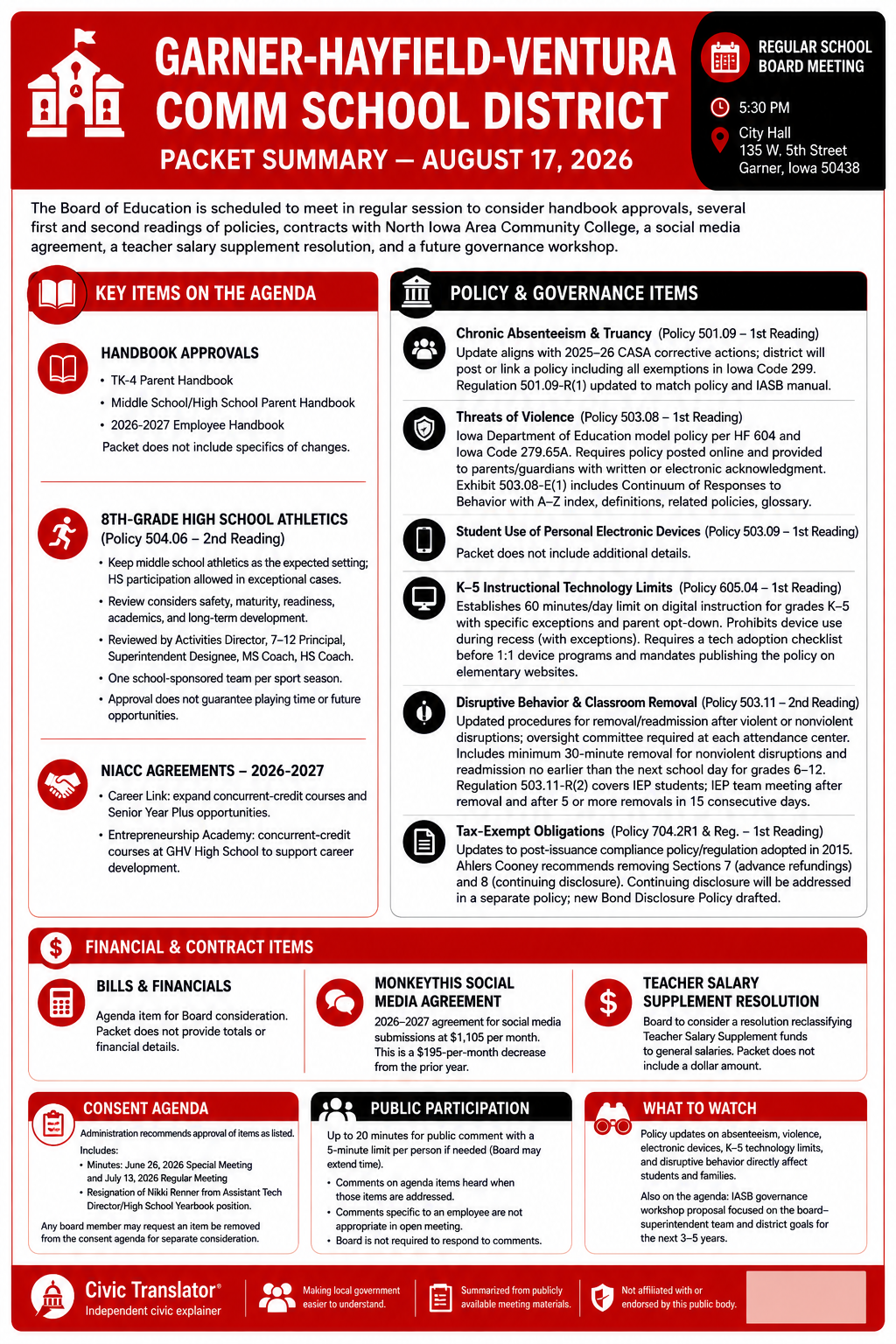
The Garner-Hayfield-Ventura Board of Education is scheduled for a regular meeting at 5:30 p.m. at City Hall in Garner. The agenda includes handbook approvals, several first and second readings of board policies, concurrent-enrollment agreements, a social media services agreement, a teacher salary supplement resolution, and discussion of a future board-superintendent governance workshop.
Key Items on the Agenda
Student and Employee Handbooks
The agenda includes consideration of the TK-4 Parent Handbook, the Middle School/High School Parent Handbook, and the 2026-2027 Employee Handbook. The packet does not provide substantive descriptions of the proposed handbook changes.
Eighth-Grade Participation in High School Athletics
Policy 504.06, Student Activity Program Policy, returns for a second reading with a proposed framework governing when eighth-grade students may participate in high school athletics. Administration recommends keeping middle school athletics as the expected setting for eighth graders while permitting high school participation in exceptional circumstances.
Under the proposed framework:
- Student safety, physical maturity, emotional readiness, academic responsibility, and long-term development would be considered.
- A legitimate high school roster or participation need could support approval.
- Participation should not significantly diminish opportunities in the middle school program.
- Requests would be reviewed by the Activities Director, 7-12 School Principal, Superintendent Designee, Middle School Coach, and High School Coach.
- An approved student could participate on only one school-sponsored team during the same sport season.
- Approval would not guarantee playing time, a particular team role, or eligibility in a future sport or school year.
The packet says recent changes to Iowa law give local districts authority to allow eighth graders to participate in high school interscholastic athletics but do not require districts to do so.
Concurrent-Enrollment and Entrepreneurship Agreements
The board is scheduled to review 2026-2027 educational-services contracts involving North Iowa Area Community College. NIACC's Director of School Partnerships is requesting board approval of contracts covering Career Link programs and courses and an Entrepreneurship Academy.
The Career Link agreement is intended to expand concurrent-credit course opportunities and participation in Iowa's Senior Year Plus program. The Entrepreneurship Academy would provide concurrent-credit opportunities through a classroom located at Garner-Hayfield-Ventura High School while supporting students' career development and decision-making.
Student Policy and Governance Items
Chronic Absenteeism and Truancy
Policy 501.09 and accompanying Regulation 501.09-R(1) are scheduled for first readings. The packet identifies the changes as part of 2025-26 CASA corrective actions and says the district will upload or link to a chronic absenteeism and truancy policy containing all exemptions listed in Iowa Code 299.
The accompanying regulation is also being updated to align with revisions to Policy 501.09 and the IASB policy manual regulation.
Threats and Incidents of Violence
Policy 503.08, Discipline of Students Who Make Threats of Violence or Cause Incidents of Violence, is scheduled for a first reading. The packet describes it as the Iowa Department of Education model policy developed in response to House File 604 and Iowa Code 279.65A.
The model establishes responses for student threats or incidents of violence resulting in injury, property damage, or assault. Among the requirements described in the packet, districts must publish their policy online and provide a copy to each parent or guardian, with written or electronic acknowledgment of receipt.
An accompanying exhibit, 503.08-E(1), is also scheduled for a first reading. The packet says the district's Continuum of Responses to Behavior Framework aligns with the policy and includes an A-Z index of behaviors, state definitions, related GHV board policies, and a glossary of working definitions.
Student Use of Personal Electronic Devices
Policy 503.09, Student Use of Personal Electronic Devices, is listed for a first reading. The packet does not provide additional substantive detail about the proposed policy.
K-5 Instructional Technology Limits
Policy 605.04, Technology and Instructional Materials, is scheduled for a first reading in response to requirements in House File 2676. The packet materials describe a 60-minute-per-school-day limit on digital instruction for students in kindergarten through fifth grade, subject to specified exceptions.
The proposed framework includes:
- Parents or guardians may request further reductions in their child's digital instruction.
- Instructional technology is intended to support, rather than supplant, foundational learning.
- K-5 students would be prohibited from using digital devices during recess except for specified needs.
- Exceptions to the 60-minute limit include IEP and Section 504 services, assistive or adaptive technology, teacher-directed demonstrations, certain assessments and screenings, and dedicated computer science or technology curriculum.
- Online learning under specified state-law provisions is excluded from the standards.
- Before adopting or renewing a one-to-one device program at any grade level, the board would review a technology adoption checklist addressing instructional purpose, age appropriateness, content-filtering limitations, and student data practices.
- The K-5 technology policy would be published on elementary school websites.
Disruptive Behavior and Classroom Removal
Policy 503.11, Disruptive Behavior, and two accompanying regulations return for second readings. The packet describes procedures governing classroom removal and readmission following violent and nonviolent disruptions, including additional requirements for students with IEPs and Section 504 plans.
An August 11 IASB update adds a requirement for each attendance center to establish an oversight committee responsible for developing building-level policy governing when students removed for disruptive behavior may return to class.
The proposed procedures distinguish between violent and nonviolent disruptions. Among the provisions described in the packet:
- A nonviolent disruption may result in removal from the classroom for at least 30 minutes.
- For students in grades 6-12, readmission following a removal cannot occur before the immediately subsequent school day at the earliest.
- A student removed for assaulting a teacher cannot be readmitted to that teacher's classroom when the teacher does not consent.
- Multiple removals can trigger additional disciplinary or behavioral-planning requirements.
- Students removed from class must receive alternative learning arrangements and make up missed work.
- Removal and discipline involving students with disabilities must comply with applicable federal and state law.
Regulation 503.11-R(2) specifically addresses students with IEPs removed for nonviolent disruptive behavior. It calls for an IEP team meeting immediately following removal and requires the team to consider the student's programming, placement, behavioral needs, accommodations, staff supports, and related factors. Five or more removals within 15 consecutive school days would trigger an IEP team meeting to discuss the student's behavior.
Tax-Exempt Obligations and Bond Disclosure
The board is scheduled for first readings of updates to the district's post-issuance compliance policy and regulation for tax-exempt obligations. The packet says the existing Policy No. 704.2R1 was adopted in 2015 and needs updating.
Ahlers Cooney proposes removing Section 7 on advance refundings because of changes under the 2017 Tax Cuts and Jobs Act and removing Section 8 on continuing disclosure. The packet says continuing disclosure should instead be addressed through a separate policy and that a new Bond Disclosure Policy has been drafted for adoption through the board's regular course of business.
Financial and Contract Items
Bills and Financials
Bills and financials are listed as a separate agenda item for board consideration. The packet text does not provide a summarized total or other substantive financial detail for this item.
The agenda includes a 2026-2027 agreement with Monkeythis for social media submissions. The packet lists the agreement at $1,105 per month, a $195-per-month decrease from the previous year.
Teacher Salary Supplement Funds
The board is scheduled to consider a resolution reclassifying Teacher Salary Supplement funds to general salaries. The packet identifies the proposed reclassification but does not provide a dollar amount in its agenda summary.
Consent Agenda
Administration recommends approval of the consent agenda as listed. The packet identifies two substantive components:
- Minutes from the June 26, 2026 Special School Board Meeting and July 13, 2026 Regular School Board Meeting.
- The resignation of Nikki Renner from the Assistant Tech Director/High School Yearbook position.
Any board member may request that an item be removed from the consent agenda and considered separately.
Public Participation
The agenda includes a public-comment period under "Welcome Visitors." The packet provides up to 20 minutes for public comments, with a five-minute limit per person if needed, although the board may choose to extend the allotted time.
Comments concerning items already on the agenda may be heard when those items are addressed. The packet also states that public comments specific to an employee are not appropriate in an open meeting and notes that the board is not required to respond to comments.
What to Watch at the Meeting
Several policy items could directly affect students and families. The board is scheduled to consider new or revised rules involving chronic absenteeism, threats and incidents of violence, personal electronic devices, K-5 instructional technology, disruptive classroom behavior, and eighth-grade participation in high school athletics.
The agenda also includes an Iowa Association of School Boards workshop proposal focused on the board-superintendent governance team. The proposed custom session would address the respective roles and responsibilities of board members and the superintendent and could also support work on district goals and priorities for the next three to five years.