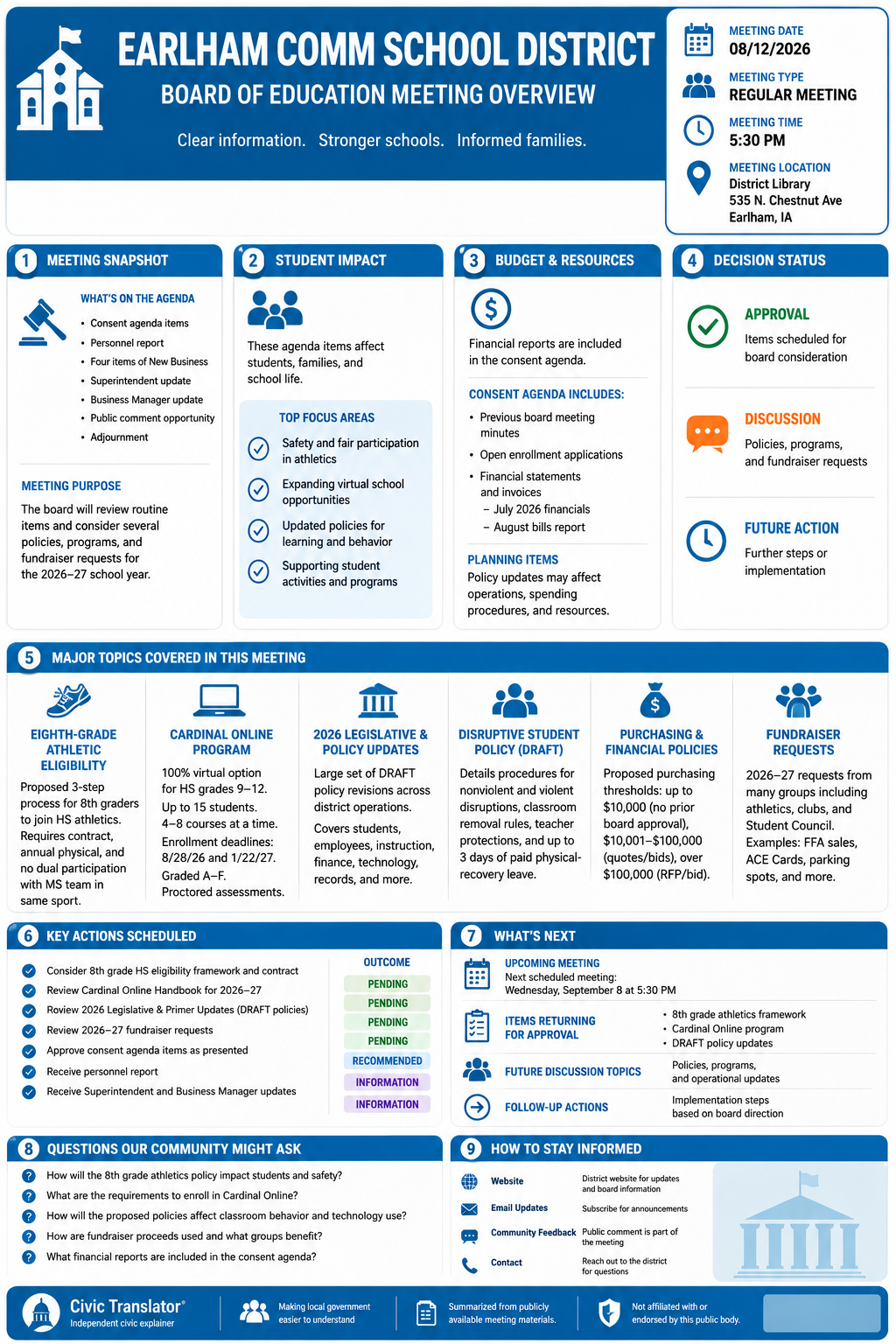
The Earlham Community School District Board of Education is scheduled to meet at 5:30 p.m. on August 12 in the district library at 535 N. Chestnut Ave. The agenda includes routine consent and personnel items along with four New Business topics: eighth-grade participation in high school athletics, a large set of draft board-policy updates, the Cardinal Online handbook, and 2026–27 fundraiser requests.
Key Items on the Agenda
Eighth-Grade High School Athletic Eligibility
The board is scheduled to consider an eighth-grade high school athletic eligibility framework following discussion of the issue at its July meeting. The packet says House File 2591 permits eighth-grade students to participate in high school interscholastic athletics beginning August 1, while local districts retain control over roster and team-selection decisions.
The proposed district framework establishes a three-step process before an eighth grader could join a high school practice, scrimmage, or contest:
- The varsity head coach would initiate the process and recommend the student based on physical maturity, psychological readiness, and athletic skill.
- The athletic director would arrange a conference involving the athletic director, varsity head coach, student, and parent or guardian to review safety, scheduling, travel, roster, and other implications.
- The student and parent or guardian would execute an Eighth Grade High School Roster Transition Contract before the student is placed on a high school roster.
A student moving to a high school roster could not also compete on the middle school team in the same sport during that season. The proposed framework also requires an annual athletic physical clearing the student for high-school-level competition and keeps eighth graders subject to local middle school academic eligibility and attendance standards.
A related draft revision to Policy 504.06, Student Activity Program, would expressly allow eighth graders to participate in high school athletics with parent or guardian permission while prohibiting participation in both eighth-grade and high school programs for the same sport during the same season.
Cardinal Online Virtual Education Program
The agenda includes the Cardinal Online Handbook for 2026–27. The packet describes Cardinal Online as a 100% virtual option for Earlham High School students in grades 9–12, with students completing coursework remotely through the district's approved online platform while remaining enrolled as Earlham students.
The proposed program would:
- Accept no more than 15 students during the 2026–27 school year.
- Require students to enroll in at least four and no more than eight online courses at one time.
- Set enrollment deadlines five school days after each semester begins: August 28, 2026, and January 22, 2027.
- Review applicants for readiness based on factors including maturity, work habits, attendance history, and academic standing rather than guaranteeing admission.
- Require students to log in every school day, make meaningful progress, and check in with the Online Coordinator at least twice each week.
- Require 100% course completion and a final grade of at least 60% to earn credit.
- Require all assessments to be proctored in person at the district's off-campus online learning center behind Bricker-Price Block.
Cardinal Online courses would use traditional A–F letter grades rather than the standards-based 1–4 system used in most on-campus Earlham High School courses. Non-credit-recovery courses would count toward the student's cumulative GPA on the district's 4.0 scale.
The handbook also establishes academic-progress rules. A student with a grade below 60% or who is more than 10% behind pace at the Friday grade check would enter academic probation; continued failure after two weeks of probation would make the student academically ineligible for activities and athletics.
Policy and Governance Items
Extensive 2026 Policy Updates
The board's New Business agenda includes "2026 Legislative & Primer Updates," supported by a draft policy manual containing revisions and new policies across district governance, students, employees, instruction, finance, technology, records, and school operations.
Among the notable draft provisions:
- Policy 503.11 — Disruptive Student: Establishes procedures surrounding violent and nonviolent classroom disruptions, teacher authority to remove students, due-process requirements, and additional requirements for students with IEPs or Section 504 plans.
- Policy 605.04 — Technology and Instructional Materials: Would limit digital instruction for kindergarten through fifth grade to no more than 60 minutes per school day, subject to listed exceptions, and would prohibit student use of digital devices during recess in those grades.
- Policy 705.01 — Purchasing–Bidding: Would authorize the superintendent to make purchases up to $10,000 without prior board approval or competitive proposals. Purchases from $10,000 through $100,000 would require proposals, quotations, or bids before board approval, while purchases exceeding $100,000 would require a formal competitive RFP or bid process.
- Policy 712 — Technology and Data Security: Addresses protection of personally identifiable information, access controls, third-party vendors, security management, and technology and data-use training.
- Policy 705.05 — Federal Awards Compliance: Establishes requirements for financial management, internal controls, procurement, reporting, record retention, and mandatory disclosures involving federal awards.
- Policy 706.04 — Time and Effort Reporting: Establishes documentation and internal-control requirements for salaries and benefits charged to federal awards.
- Policy 804.05 — Stock Prescription Medication Supply: Calls for district stock of pediatric and adult epinephrine and bronchodilator supplies, along with an opioid antagonist dose, at each attendance center.
The packet marks the included policy versions as DRAFT, so they should not be read as newly adopted policies based solely on their inclusion in the packet.
Classroom Removal Procedures
The proposed disruptive-student rules contain specific procedures that could affect students, teachers, and families. For a nonviolent disruption, a teacher could remove a student to the supervision of the principal or designee for at least 30 minutes. Students in grades 6–12 could not return to that teacher's classroom until the immediate subsequent school day at the earliest.
For violent disruptions, the draft says the teacher must remove the student. It also provides that a student could not be readmitted to a teacher's classroom when the removal resulted from an assault on that teacher and the teacher does not consent to the student's return.
The draft policy also provides up to three days of paid physical-recovery leave for a teacher injured because of a student's violent disruption, with the board able to consider a request for additional recovery time supported by a physician's note.
Student Activities and Fundraising
2026–27 Fundraiser Requests
The board is scheduled to consider 2026–27 fundraiser requests covering numerous student organizations and athletic programs. The packet lists proposals from FFA, NHS, FBLA, golf, Student Council, an international trip, boys and girls basketball, cross country, drama/speech, football, baseball, dance, and cheerleading.
Examples include:
- FFA fruit, meat, cheese, and cookie-dough sales in October, with $25,000 in sales listed as the goal and approximately 40% expected to be received.
- FFA poinsettia sales in November with a $2,000 goal for senior scholarships.
- Student Council homecoming T-shirt sales in August/September with a stated $1,000–$2,000 goal.
- A 7–12 football ACE Card fundraiser in August with a stated $7,000–$10,000 goal.
- Earlham Girls Basketball Hy-Vee fundraising cards in September–October with a $1,500 goal.
- A baseball "30 Pop" fundraiser planned for March with a $5,000 goal.
- NHS senior parking spots in August with a $1,500 goal.
Other requests include camps, clinics, team stores, business sponsorships, a 5K, trivia and movie nights, bake sales, and additional team fundraising activities.
Consent Agenda and Personnel
The consent agenda is presented with a recommendation to approve its items as presented. It includes:
- Previous board meeting minutes.
- Open enrollment applications.
- Financial statements and invoices, including July 2026 financial information and the August bills report.
The personnel report is separately listed under the board's Culture goal. The packet identifies the resignation of Kate Eckard as Assistant Middle School Softball Coach and proposed new hires Eliza Dobbins and Gloria Christensen as associates and Julie Hamilton for Title 1 Math.
These are agenda and personnel-report items for the August meeting; the packet does not establish that the board has taken action on them at this meeting.
Previously Completed Actions Providing Context
The packet includes minutes from the July 8 board meeting, which document several actions already completed at that prior meeting. The board approved Anderson Ericksen and Martin Brothers as the district's milk and bread vendors, approved district handbooks with revisions, authorized $19,949 in playground repairs, and renewed property and casualty insurance with a $25,000 deductible and an annual premium of $79,423.
Those minutes also document the board's earlier consideration of eighth-grade participation in high school athletics. No formal policy was adopted in July; instead, a policy committee was to develop a formal policy for board consideration in August. The July minutes likewise state that the proposed online-school option was expected to return to the board in August for formal approval.
What to Watch at the Meeting
The August agenda brings several items forward that could establish operating rules for the coming school year. The eighth-grade athletics framework would determine how eligible students move from middle school to high school rosters, while the Cardinal Online handbook sets detailed enrollment, attendance, pacing, assessment, grading, and eligibility expectations for the district's virtual program.
The legislative and policy update is particularly broad. The packet contains draft changes affecting classroom discipline, technology use, student activities, public records, financial controls, purchasing, federal awards, investments, medication, special education, open enrollment, and other district operations. The meeting will provide the board an opportunity to consider those materials, but their appearance in the packet should not be interpreted as evidence that the draft policies have already been adopted.