Meeting: Workshop/Business Meeting
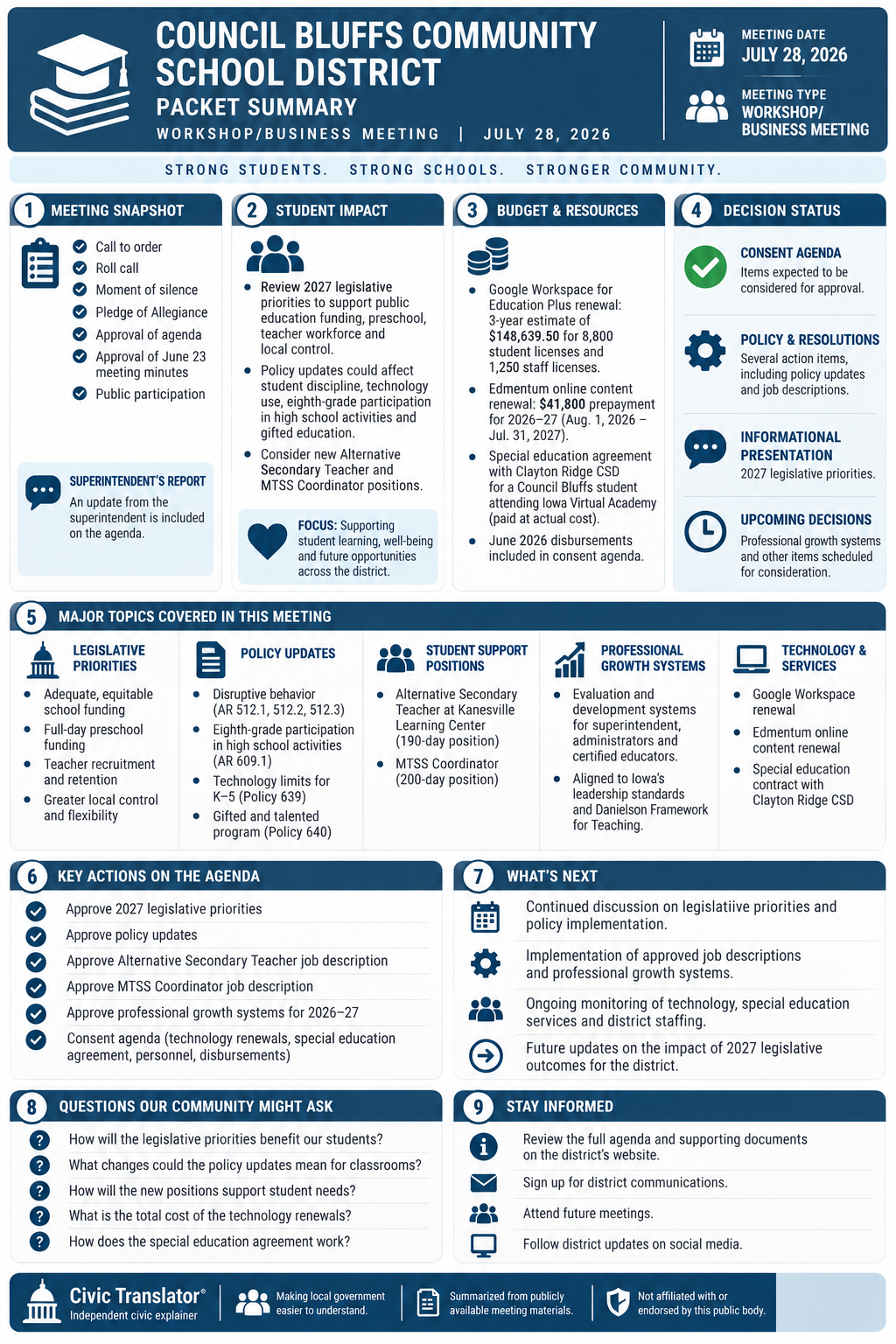
The Council Bluffs Community School District Board is scheduled to consider its 2027 legislative advocacy priorities, a package of policy updates, two student-support job descriptions, and professional growth systems for district employees and administrators. The consent agenda also includes technology renewals, online instructional services, a special education agreement, personnel actions, and June disbursements.
Key Items on the Agenda
2027 Legislative Priorities
The board is scheduled to receive an informational presentation on priorities for the 2027 Iowa legislative session and then consider a resolution approving the district's priorities. The proposed platform identifies four major areas:
- Timely, equitable and adequate state funding for public schools, along with equal accountability for all Iowa schools.
- Full-day preschool funding.
- Resources for teacher education programs, recruitment and retention.
- Increased flexibility and local control for school districts, including limits on unfunded state mandates.
The packet also reviews the district's 2026 advocacy priorities, which included state and federal funding, full-day preschool funding and limiting the impact of property-tax reform on education.
Policy and Administrative Regulation Updates
A substantial policy package is scheduled for board consideration. Several proposed changes address student discipline, instructional technology, extracurricular participation and gifted education.
Disruptive behavior — Administrative Regulations 512.1, 512.2 and 512.3: The proposed regulations establish procedures for violent and nonviolent classroom disruptions and student removal. Among the provisions, teachers could remove students for qualifying disruptions, specified readmission procedures would apply, and repeated removals could trigger behavior planning or additional disciplinary action.
For students with IEPs who are removed for nonviolent disruptive behavior outside the supports identified in their IEP or behavior intervention plan, the proposal calls for an IEP team meeting immediately after removal. An additional IEP meeting would be required when a student is removed five or more times within 15 consecutive school days.
The broader disruptive-behavior proposal also provides up to three days of paid physical-recovery leave for a teacher injured by a student's violent disruption, with the superintendent able to consider requests for additional recovery time supported by a physician's note.
Eighth-grade participation in high school activities — Administrative Regulation 609.1: The proposed regulation would establish a formal process allowing eligible eighth-grade students to participate in certain high school athletics and activities. Eligibility would depend on factors including academics, attendance, physical and emotional readiness, activity-specific ability and administrative approval.
The regulation distinguishes between "open placement" activities not offered at the middle-school level and "limited placement" activities offered at both levels. Once an eighth-grade student is placed on a high school roster for a sport, the student would be ineligible to compete at the middle-school level in that sport for the remainder of the season.
Technology and Instructional Materials — Policy 639: Recommended changes would limit digital instruction in kindergarten through fifth grade to no more than 60 minutes per school day, subject to listed exceptions. Students in those grades would not have access to digital devices during recess, and parents or guardians could request additional reductions in digital instruction.
The proposal also calls for board adoption or renewal of district one-to-one digital-device programs and completion of a technology adoption checklist before those decisions. Exceptions to the digital-instruction limits include certain special education and Section 504 uses, assistive technology, teacher demonstrations, assessments, dedicated computer science and technology curriculum, and qualifying online learning programs.
Gifted and Talented Students — Policy 640: A new policy would establish districtwide procedures for identifying and serving gifted and talented students in kindergarten through grade 12. Identification would draw from multiple sources rather than a single criterion and could include standardized testing, achievement and cognitive data, creative ability, teacher and parent input, and observations.
Student Support Positions
Alternative Secondary Teacher at Kanesville Learning Center
The board is scheduled to consider approval of an Alternative Secondary Teacher, Kanesville Learning Center position and job description. The 190-day certified position would focus on helping students transition to and from Kanesville and district middle and high schools.
Responsibilities would include monitoring academics, attendance, behavior and engagement; developing individualized transition plans; providing academic and social-emotional support; coordinating with families and home schools; and participating in the district's Multi-Tiered System of Supports. The position requires a bachelor's degree in education and a valid Iowa teaching certificate.
MTSS Coordinator
A separate resolution would consider an MTSS Coordinator job description. The 200-day position would manage and coordinate behavioral components of the Multi-Tiered System of Supports under the direction of a building principal.
Responsibilities would include Tier 2 and Tier 3 behavior plans, Functional Behavior Assessments, behavioral data analysis, staff training, intervention scheduling, crisis-response support, family engagement and compliance documentation. The job description requires a bachelor's degree in education, business, human resources or a related field and lists an educational degree and/or three to five years of business or educational management experience as preferred qualifications.
Professional Growth Systems
The board is scheduled to consider Professional Growth Systems for the 2026–27 school year. Packet materials include separate frameworks for the superintendent, building-level leaders, central-office administrators and certified educators.
The administrator systems use Iowa's 10 leadership standards as a framework for evaluation and professional development. They incorporate self-assessment, goal setting, progress reviews and Individual Administrator Professional Development Plans, with performance described along a progression from ineffective through highly effective.
The certified-educator system has been updated around the third edition of the Danielson Framework for Teaching. It establishes different evaluation cycles for educators new to the profession, career educators new to Council Bluffs and existing career educators, incorporating professional-development plans, formal and informal observations, conferences, feedback and Iowa Teaching Standards.
Major Financial and Technology Items
Google Workspace for Education Plus
The consent agenda includes renewal of Google Workspace. The packet contains a three-year Google Workspace for Education Plus estimate covering 8,800 student licenses and 1,250 staff licenses.
The estimate totals $148,639.50 across the three-year pricing schedule. The first-year student and staff pricing reflects a 10% offset, with the packet listing $40,392 for students and $5,737.50 for staff in Year 1 and higher annual amounts in Years 2 and 3.
Edmentum Online Content
The consent agenda also includes renewal of an Edmentum online content provider. The attached order form proposes an Ed Options Academy / ALVS prepayment of $41,800, with a license period from August 1, 2026 through July 31, 2027.
The agreement provides access to online enrollment products with individual course and program charges applied against the prepayment balance. Additional purchases beyond that balance would be invoiced under the order's terms.
Special Education Agreement
The board is scheduled to consider, through the consent agenda, a special education contract between Council Bluffs Community School District and Clayton Ridge Community School District for a Council Bluffs resident student attending the Iowa Virtual Academy.
Under the agreement, Clayton Ridge would provide special education and related services and Council Bluffs would pay the actual cost of those services. Payments are structured on a semiannual basis, with the June payment adjusted to reflect actual school-year costs.
Personnel and Routine Business
The consent agenda includes a July 28 personnel action report covering certified, administrative and classified staffing changes. Among the administrative entries, the report lists Dr. R. Chace Ramey as superintendent effective July 1, 2026 and records Dr. Vickie Murillo's superintendent resignation effective June 30, 2026.
The agenda also calls for approval of the minutes from the June 23 Work Session and Workshop/Business Meeting, appointment of Level-One Investigators and Complaint Officers, and consideration of June 2026 disbursements.
What to Watch at the Meeting
The most consequential board-level decisions are concentrated in the resolution section. The proposed legislative platform would establish the district's advocacy priorities for the 2027 session, while the policy package could directly affect classroom discipline procedures, elementary use of instructional technology, eighth-grade participation in high school activities and gifted-and-talented programming.
The board is also being asked to consider new or revised structures for student behavioral and alternative-education support and a broad set of professional growth systems for educators and administrators. On the consent agenda, the Google Workspace and Edmentum renewals represent two specifically documented technology and instructional-service commitments, while the special education agreement establishes service and payment responsibilities for a district student attending Iowa Virtual Academy.