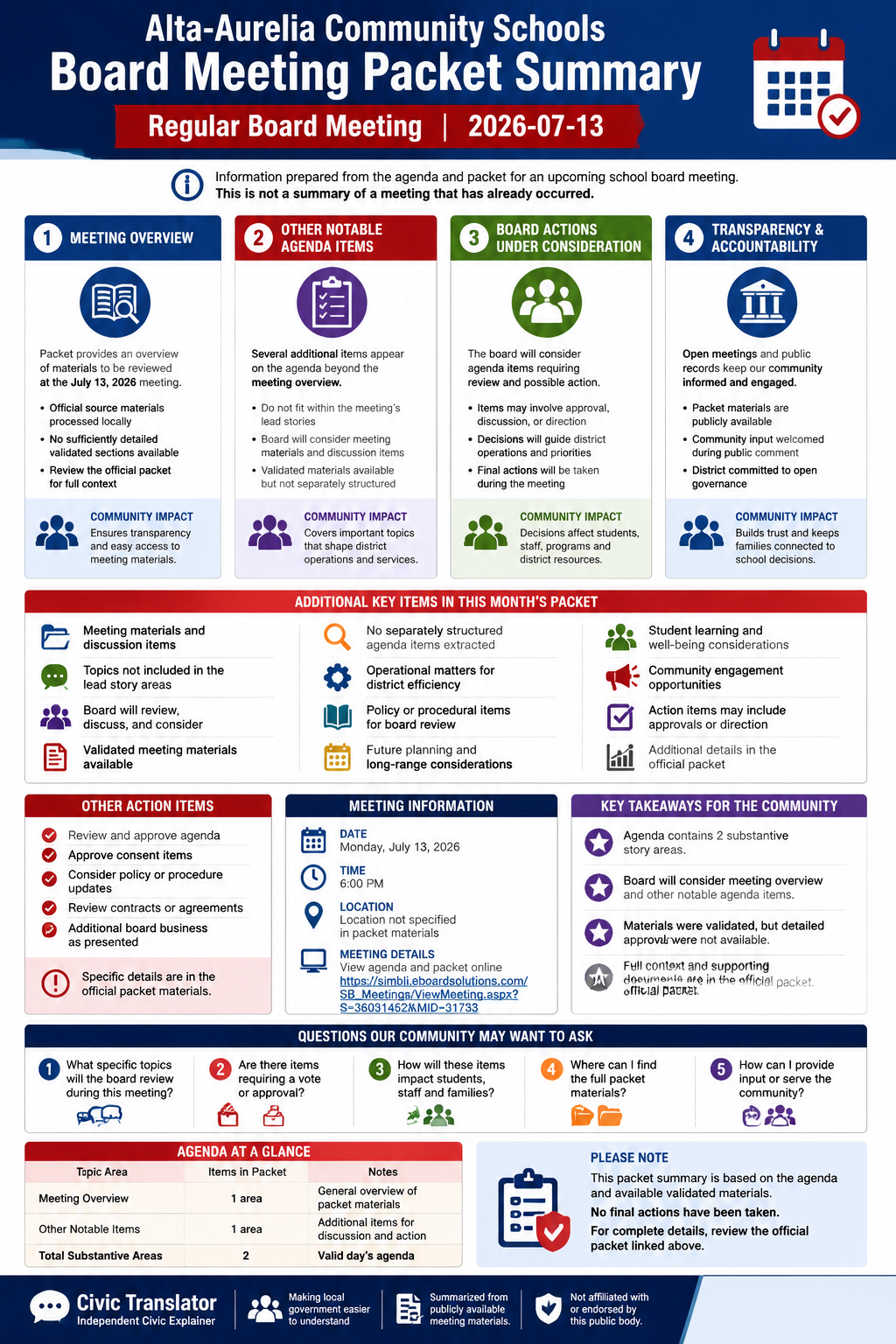
The Alta-Aurelia Community Schools Board held its Regular Board Meeting on July 13, 2026, at 6:00 PM at Alta-Aurelia Middle School in Aurelia. The packet shows a broad meeting agenda covering financial oversight, long-term funding planning, school policies, student programs, technology practices, enrollment matters, and operational items.
Several significant topics focused on long-term district planning and responsible use of school resources. The board reviewed financial materials including cash balances, revenue information, activity fund balances, bills, payment records, and long-range funding documents related to SAVE and PPEL resources. These materials provide the board with information needed to monitor current financial conditions and plan for future investments.
The packet also included policy and procedural materials affecting students and families. These included requirements for reviewing one-to-one digital device programs, student health service authorization forms, and eligibility guidelines connected to eighth-grade participation. These items reflect the district’s ongoing work to maintain compliance with state requirements while supporting student programs.
Long-term facility and funding planning were also represented through documents related to SAVE revenue projections, debt coverage updates, and future funding projections extending through 2071. These materials help establish a foundation for future decisions involving district facilities, technology, and other allowable expenditures.
Major Discussion and Action Items
Long-Term SAVE and PPEL Funding Planning
The board packet included multiple documents related to the district’s SAVE and PPEL funding resources, including future projections through 2071, SAVE revenue information, debt coverage updates, and funding summaries.
SAVE (Secure an Advanced Vision for Education) and PPEL (Physical Plant and Equipment Levy) funds are important district funding sources used for eligible long-term expenses such as facilities, equipment, technology, and other capital needs. The inclusion of long-range projections indicates that the district is reviewing future financial capacity rather than focusing only on immediate budget needs.
The board’s review of these materials provides context for future decisions about maintaining school facilities, investing in equipment, and planning capital improvements. Community members may be affected through future discussions about district priorities and how available resources are allocated.
District Financial Review and Fiscal Monitoring
The packet included several financial oversight documents, including fiscal year 2026 cash balance information, revenue reports, activity fund balances, check reconciliation materials, cleared check listings, outstanding checks, bills, and automatic payment records.
These reports support the board’s responsibility to monitor district finances and ensure that expenditures, revenues, and account balances are accurately tracked.
The financial review provides transparency regarding how district funds are managed and helps board members evaluate the district’s financial position before making future spending or investment decisions.
One-to-One Digital Device Program Review
The board packet included Code No. 605.04E1, the One-to-One Digital Device Program Technology Adoption Checklist.
The checklist requires the board to consider several factors before adopting or renewing one-to-one digital device programs. These factors include the instructional purpose of devices, age appropriateness, software considerations, content-filtering limitations, and whether student data is collected, stored, or shared.
The policy delegates responsibility to the superintendent or designee to bring forward recommendations regarding instructional technology use. The district maintains documentation for compliance with Iowa Department of Education audit requirements.
This issue matters to students, families, and educators because digital learning tools affect classroom instruction, student privacy considerations, and technology access.
Student Health Services and Medication Self-Administration Policies
The packet included updated forms and procedures related to student health services, including authorization for independent self-carry and administration of prescription medication and asthma or airway-related medication.
The forms establish requirements for students who may self-administer medication at school. Requirements include written authorization from parents or guardians and appropriate medical authorization from a licensed health care professional.
The documents also address responsibilities for safe medication handling, communication with school personnel, confidentiality requirements under applicable privacy laws, and procedures if a student improperly uses the policy.
These procedures affect students with medical needs and their families by establishing a structured process for safely managing medications during school activities.
Eighth Grade Eligibility Guidelines
The board packet included eighth-grade eligibility guidelines and frequently asked questions related to student participation requirements.
The documents indicate that the district is providing guidance regarding eligibility expectations for students. The guidelines are intended to clarify requirements and provide families with information about participation standards.
Students, families, and staff may be affected by how eligibility expectations are communicated and applied throughout the school year.
The packet included July 2026 open enrollment materials.
Open enrollment information is relevant to families who choose educational options involving attendance outside their resident district or who participate in district enrollment decisions.
The materials allow the board and community to review enrollment-related information as part of ongoing district operations.
Facility Naming Policy Review
The packet included a Board Policy document regarding naming of facilities.
Facility naming policies establish procedures and expectations for recognizing locations, spaces, or structures within the district. Such policies help provide consistency and transparency when future naming decisions are considered.
Financial Matters
The meeting packet contained several financial documents, including:
- Fiscal year 2026 cash balance information dated June 30, 2026.
- Fiscal year 2026 revenue information.
- Activity fund balance reports.
- Check reconciliation reports.
- Cleared and outstanding check listings.
- July 2026 bills and automatic payment records.
- SAVE revenue and debt coverage updates.
- Future SAVE projections through 2071.
- SAVE and PPEL funding information.
The packet did not provide a complete narrative explanation of every transaction or a detailed list of all expenditures in the accessible text. However, the financial materials show that the board reviewed routine fiscal monitoring information and long-term funding resources.
The SAVE and PPEL documents are particularly significant because they relate to future capital planning and allowable district investments.
Policies, Ordinances, Resolutions, and Governance
The packet included policy-related materials involving technology adoption and student health services.
The One-to-One Digital Device Program Technology Adoption Checklist establishes considerations the board must review when adopting or renewing instructional technology programs. The checklist emphasizes instructional purpose, student data practices, software considerations, and age appropriateness.
Health service forms establish governance procedures for student medication self-administration and participation in special health services. These procedures provide documentation requirements and outline responsibilities for families, medical providers, and school personnel.
A facility naming policy document was also included, providing a framework for future naming decisions involving district facilities.
The packet included multiple informational documents supporting board review and decision-making.
Financial reports provided information about district revenue, balances, payments, and funding projections. Long-term SAVE and PPEL documents provided information about future funding capacity.
Enrollment and eligibility documents provided information related to student participation and enrollment operations.
The accessible packet text did not include detailed superintendent reports, staff presentations, or committee reports beyond the listed supporting documents.
Personnel, Appointments, and Organizational Matters
The accessible packet materials did not include detailed information about personnel actions, employment agreements, appointments, resignations, retirements, or staffing changes.
No personnel decisions were identified in the available source material.
Projects, Facilities, Infrastructure, and Operations
The packet included long-range funding documents related to SAVE and PPEL resources, which are commonly connected to district capital needs, equipment, technology, and facility-related expenditures.
A facility naming policy was also included, indicating continued attention to governance processes involving district properties.
Specific construction projects, facility upgrades, project costs, or implementation schedules were not identified in the accessible packet text.
The available packet materials did not identify a public hearing, public forum, listening session, or special community input opportunity.
Residents interested in participating in future board discussions may consult the district’s official meeting listings for upcoming agendas and opportunities for involvement.
Residents and taxpayers may benefit from continued transparency regarding district finances, long-term funding projections, and spending oversight.
Students and families may be affected by technology policies, health service procedures, eligibility guidelines, and enrollment-related decisions.
Employees and educators may be affected by instructional technology decisions and operational planning.
Families managing student medical needs may benefit from clear procedures for medication self-administration and school-based health services.
The district’s review of long-term funding resources may influence future decisions about facilities, equipment, and other investments that support educational programs.
- What priorities will guide future use of SAVE and PPEL funding?
- How will long-term funding projections influence future facility or technology decisions?
- What instructional goals guide the district’s one-to-one digital device program?
- How does the district evaluate student data privacy risks when adopting technology?
- What future reviews are planned for district technology programs?
- How are families informed about eighth-grade eligibility requirements?
- How does the district support students who need medication access during school activities?
- Are there upcoming facility projects that may rely on SAVE or PPEL funding?
- How frequently does the board review long-term financial projections?
- What opportunities exist for community members to provide input on future district priorities?
Important Dates, Deadlines, and Next Steps
- 2026-07-13: Alta-Aurelia Community Schools Regular Board Meeting held at 6:00 PM at Alta-Aurelia Middle School in Aurelia.
- 2026 financial review period: The board reviewed fiscal year 2026 financial information, including cash balances, revenue, payments, and account reports.
- Future planning horizon: SAVE projection documents reviewed funding outlook through 2071.
- Future board action: Additional decisions regarding technology, facilities, funding priorities, or policies may occur as district planning continues.
Key Takeaways
- Alta-Aurelia Community Schools held its Regular Board Meeting on July 13, 2026.
- The meeting included review of financial, policy, student program, and operational materials.
- The board reviewed SAVE and PPEL funding information for long-term planning.
- Financial reports included cash balances, revenues, bills, payments, and account reconciliation materials.
- The district reviewed requirements for one-to-one digital device program decisions.
- Technology planning includes consideration of instructional purpose and student data practices.
- Student medication self-administration procedures were included in the packet.
- Eighth-grade eligibility guidance and frequently asked questions were provided.
- Open enrollment materials were included for board review.
- Facility naming procedures were included as part of governance materials.
- Long-term financial planning may influence future district investments and priorities.
Official Sources
About the Public Body
- Name: Alta-Aurelia Community Schools
- Organization type: school-district
- Government body: school-boards
- Location: Alta, iowa
- County: Buena Vista
- Provider: simbli
Keywords
Alta-Aurelia Community Schools, Regular Board Meeting, school board, Alta Iowa, Buena Vista County, SAVE funding, PPEL funding, school finance, fiscal year 2026, cash balance, revenue reports, technology adoption, one-to-one devices, student data privacy, medication self-administration, health services, eighth grade eligibility, open enrollment, facility naming policy, district operations, education planning, school facilities, instructional technology, community schools