Portland Curriculum and Student Success Committee Packet Summary — 08-17-2026
Meeting Overview
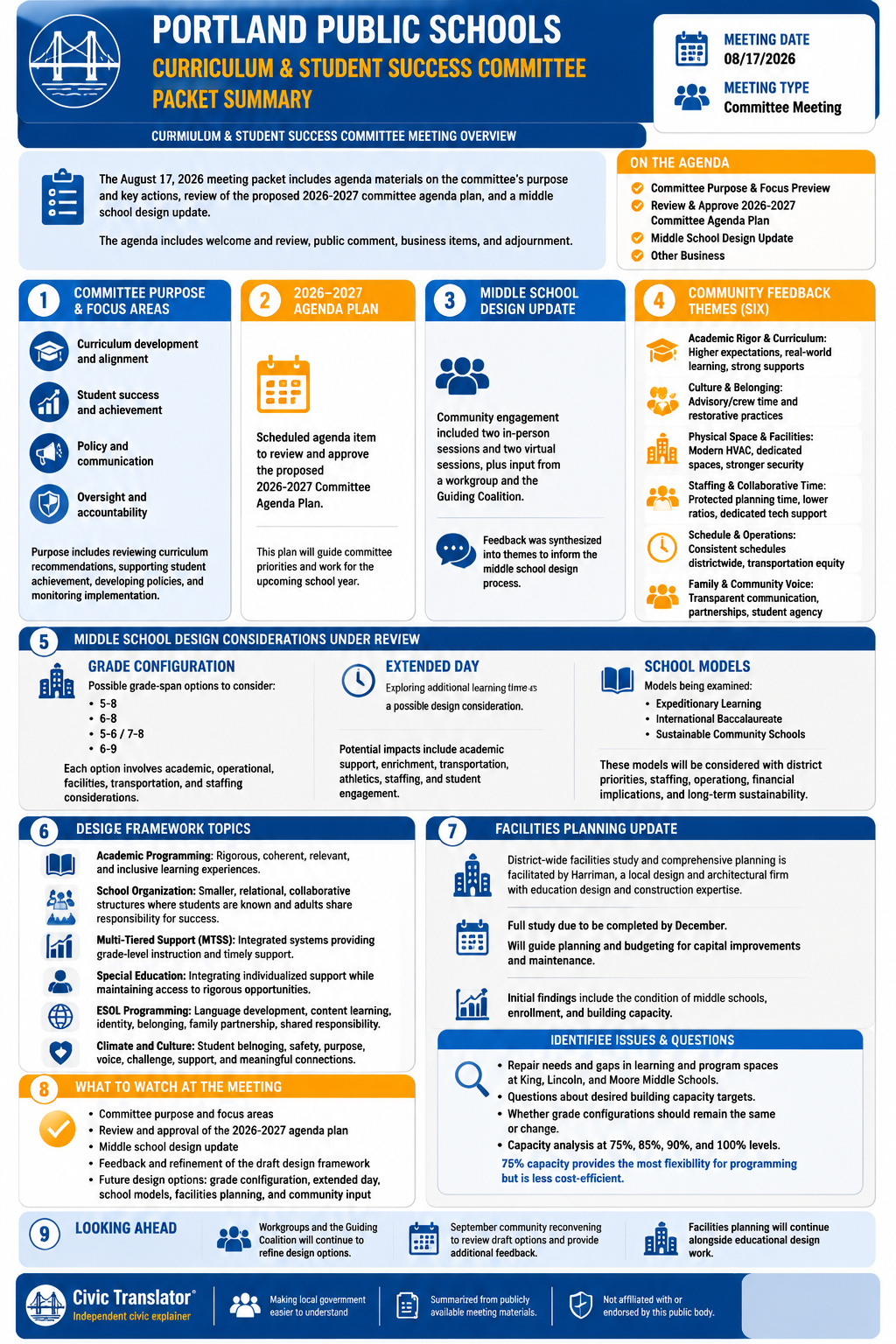
The Curriculum and Student Success Committee meeting packet for August 17, 2026 includes agenda materials covering the committee’s purpose and key actions, review of the proposed 2026-2027 committee agenda plan, and a middle school design update.
The agenda includes a welcome and agenda review, public comment, business items, and adjournment. Business items are scheduled to include a preview and discussion of the Curriculum Committee purpose and focus, review and approval of the 2026-2027 Committee Agenda Plan, and any other business.
Key Items on the Agenda
Committee Purpose and Focus
The packet outlines four focus areas for the Curriculum and Student Success Committee:
- Curriculum development and alignment.
- Student success and achievement.
- Policy and communication.
- Oversight and accountability.
The committee’s stated purpose includes reviewing curriculum recommendations, considering proposals for new courses and program revisions, supporting student achievement strategies, developing and recommending policies, and monitoring implementation of curriculum and programs.
2026-2027 Committee Agenda Plan
The packet includes a scheduled agenda item to review and approve the proposed 2026-2027 Committee Agenda Plan. The presentation identifies this as one of the main topics for the meeting.
Middle School Design Update
The packet includes an update on ongoing middle school design work, including community engagement, board updates, and development of potential design considerations.
The materials state that two in-person and two virtual engagement sessions were held, along with input gathered from a workgroup and the Guiding Coalition. The feedback was synthesized into themes intended to inform the middle school design process.
The packet identifies six recurring themes from community feedback:
- Academic Rigor and Curriculum: Interest in higher expectations, real-world and project-based learning, and appropriate student supports.
- Culture, Belonging and Social-Emotional Learning: Interest in advisory or crew time and restorative practices.
- Physical Space and Facilities: Interest in modern HVAC, dedicated spaces, and stronger building security.
- Staffing and Collaborative Time: Interest in protected planning time, lower ratios, and dedicated education technology support.
- Schedule and Operations: Interest in consistent schedules districtwide and transportation equity.
- Family and Community Voice: Interest in transparent communication, partnerships, and student agency.
Middle School Design Considerations Under Review
The packet presents several areas being explored as part of future middle school design discussions.
Grade Configuration
The materials identify possible grade-span options for consideration, including:
The packet notes that these options involve academic, operational, facilities, transportation, and staffing considerations.
Extended Day
The packet includes exploration of additional learning time as a possible design consideration. It notes potential impacts involving academic support, enrichment, transportation, athletics, staffing, and student engagement.
School Models
The packet identifies possible school models for examination, including Expeditionary Learning, International Baccalaureate, and Sustainable Community Schools. The materials note that these models will be considered alongside district priorities, staffing, operations, financial implications, and long-term sustainability.
Design Framework Topics
The packet includes a draft design framework based on community input. The framework identifies six areas:
- Academic Programming: A focus on rigorous, coherent, relevant, and inclusive learning experiences.
- School Organization: A focus on smaller, relational, and collaborative structures where students are well known and adults share responsibility for student success.
- Multi-Tiered Support (MTSS): A focus on integrated systems providing grade-level instruction and timely support.
- Special Education: A focus on integrating individualized support while maintaining access to rigorous learning opportunities.
- ESOL Programming: A focus on language development, content learning, identity, belonging, family partnership, and shared responsibility.
- Climate and Culture: A focus on student belonging, safety, purpose, voice, challenge, support, and meaningful connections.
Facilities Planning Update
The packet includes a facilities assessment update focused first on middle schools. The district-wide facilities study and comprehensive planning process is described as being facilitated by Harriman, a local design and architectural firm with education-related design and construction expertise.
The packet states that the full study is due to be completed by December and is intended to guide planning and budgeting for capital improvements and maintenance. Initial findings include information about the condition of middle schools, enrollment, and building capacity.
Facilities Issues and Questions Identified
The packet states that Harriman’s initial middle school study identified issues requiring further discussion.
The materials identify repair needs and gaps in learning and program spaces at King, Lincoln, and Moore Middle Schools. The packet also identifies questions about desired building capacity targets and whether grade configurations should remain the same or change.
The packet includes capacity analysis at 75%, 85%, 90%, and 100% levels, noting that 75% capacity provides the most flexibility for programming but is less cost-efficient.
What to Watch at the Meeting
The packet indicates that the committee is scheduled to consider:
- The committee’s purpose and focus areas.
- The proposed 2026-2027 committee agenda plan.
- Updates related to middle school design work.
- Feedback and refinement of the draft middle school design framework.
- Future design options involving grade configuration, extended day possibilities, school models, facilities planning, and community input.
Future work described in the packet includes continued refinement by workgroups and the Guiding Coalition, a September community reconvening to review draft design options and provide additional feedback, and continued facilities planning alongside educational design work.