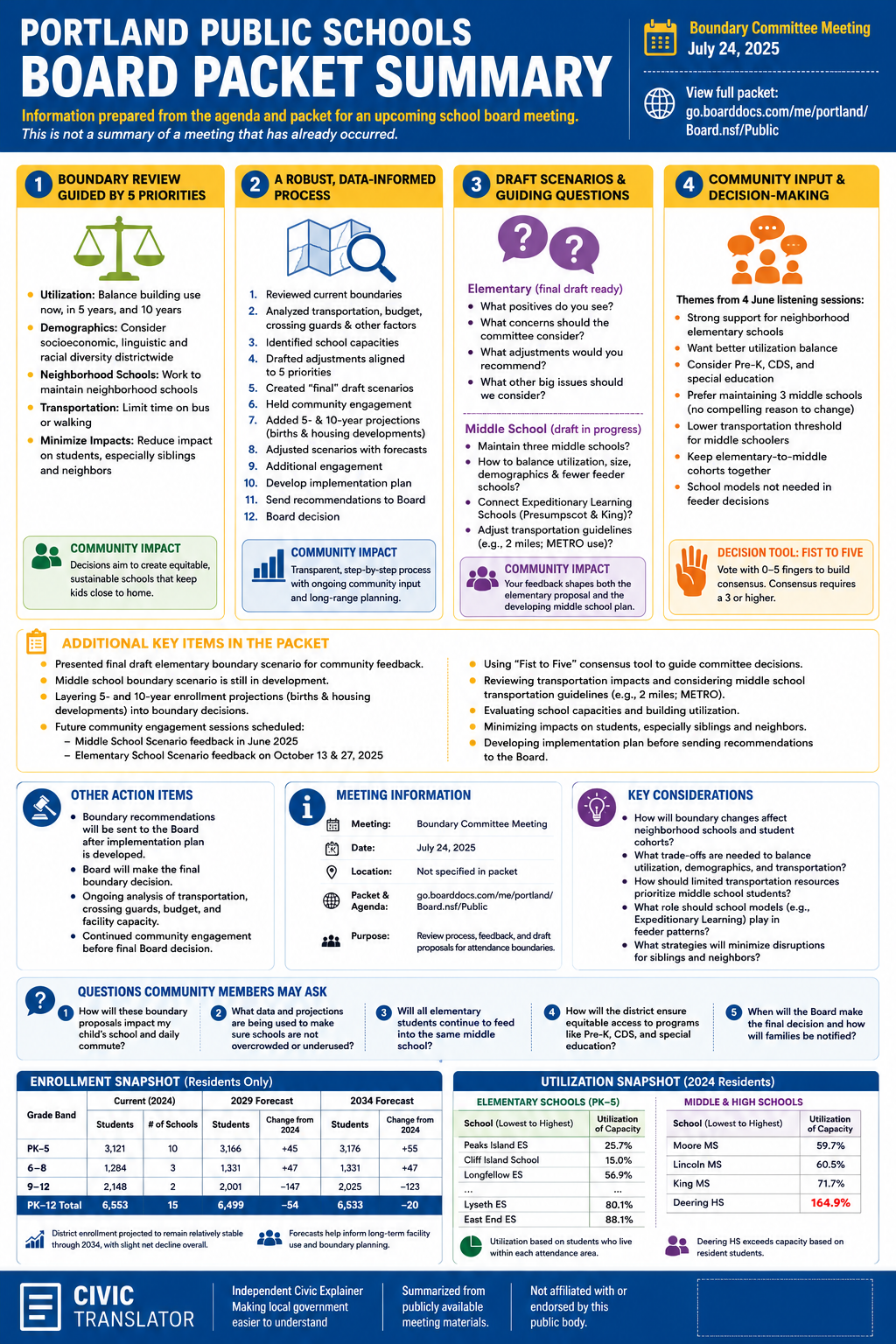
The July 24, 2025 Boundary Committee meeting focuses on one of the most significant long-term planning efforts underway in Portland Public Schools: revising elementary and middle school attendance boundaries. Rather than making final decisions, the committee is reviewing community feedback, updated enrollment forecasts, and draft attendance scenarios before forwarding recommendations to the Board of Education later in the year.
The packet shows that the committee has established five priorities that guide every proposed boundary adjustment: balancing school utilization over current, five-year, and ten-year projections; maintaining socioeconomic and racial diversity; preserving neighborhood schools whenever possible; considering transportation impacts; and minimizing disruption for students, siblings, and neighborhoods.
Community feedback gathered during multiple June listening sessions generally supports the committee's direction for elementary school boundaries while expressing greater uncertainty about middle school boundaries. Residents emphasized maintaining neighborhood elementary schools, balancing enrollment, keeping elementary cohorts together as they move into middle school, and retaining three middle schools unless a compelling reason exists for change.
The packet also includes extensive demographic and enrollment forecasting. District enrollment is projected to remain relatively stable over the next decade, but significant differences exist between individual schools. Some attendance areas are projected to grow while others remain substantially below building capacity, making boundary adjustments an important planning tool for achieving more balanced utilization without major facility expansion.
Major Discussion and Action Items
Elementary Attendance Boundary Proposal
The committee has identified what it considers a final draft elementary attendance boundary scenario for public review. Rather than presenting it as a completed plan, members are actively seeking community input before making recommendations.
Residents are specifically asked to identify strengths of the proposal, potential concerns, suggested adjustments, and any major issues the committee may have overlooked. This indicates that the committee expects meaningful public participation before final recommendations are developed.
The proposal is intended to better align attendance areas with current enrollment patterns while accounting for projected population changes over the next five and ten years. The committee is attempting to improve building utilization without unnecessarily disrupting neighborhoods or family relationships.
Middle School Boundary Planning
Unlike the elementary proposal, the committee has not yet selected a preferred middle school boundary scenario.
Instead, members are seeking guidance from the community on several major policy questions, including whether Portland should continue operating three middle schools, how to balance enrollment with school size and demographics, whether Expeditionary Learning programs should influence feeder patterns, and whether transportation eligibility should change for middle school students.
These questions suggest that middle school boundaries remain one of the most significant unresolved issues in the overall attendance review.
Community Feedback and Public Engagement
The committee reviewed themes emerging from four public listening sessions held during June 2025.
Participants generally supported maintaining neighborhood elementary schools while improving utilization across the district. Community members also encouraged the committee to consider Pre-K programming, special education services, and Child Development Services when drawing attendance boundaries.
For middle schools, feedback was more mixed. Many participants preferred retaining three middle schools unless evidence strongly supported consolidation or major restructuring. Families also expressed interest in reducing transportation thresholds for middle school students and maintaining elementary cohorts when transitioning into middle school.
Enrollment Forecasts and Future Planning
A substantial portion of the packet consists of enrollment forecasts extending through 2034.
Districtwide enrollment is projected to remain comparatively stable, fluctuating modestly rather than experiencing dramatic growth or decline. Because overall enrollment remains relatively level, the committee's work focuses less on accommodating rapid expansion and more on redistributing students among schools to better match available building capacity.
The forecasts incorporate projected births, housing developments, historical enrollment trends, and demographic analysis supplied by external consultants.
School Capacity and Utilization
Current enrollment data demonstrate considerable variation among schools.
Several elementary schools operate well below available capacity while others serve substantially larger resident populations. The packet distinguishes between utilization based on neighborhood residents and utilization based on actual enrollment, acknowledging that student transfers affect how buildings are used.
Middle schools similarly display differing utilization levels, reinforcing the committee's interest in evaluating attendance boundaries rather than relying solely on historical patterns.
Committee Decision-Making Process
The committee proposes using a "Fist to Five" consensus process for evaluating boundary scenarios.
Under this approach, members indicate support on a scale ranging from a closed fist (opposition) to five fingers (strong support). Consensus requires every participant to reach at least a three before recommendations advance.
This process emphasizes collaborative decision-making rather than simple majority voting and encourages discussion whenever members express significant concerns.
Implementation Timeline
The packet outlines a multi-step process that began with reviewing existing boundaries and school capacities before developing draft scenarios.
Following additional community engagement and incorporation of updated enrollment forecasts, the committee plans to develop an implementation strategy, submit recommendations to the Board of Education during fall 2025, and ultimately allow the Board to make the final decision on revised attendance boundaries.
Financial Matters
The packet contains no major budget appropriations, contracts, grants, bond proposals, or purchasing requests for committee action.
Instead, the principal financial considerations are indirect. Attendance boundaries affect how efficiently existing school facilities are used, transportation costs, staffing distribution, and future capital planning. By balancing enrollment across buildings, the district seeks to maximize the value of existing facilities while avoiding unnecessary future expenditures associated with overcrowding or underutilized schools.
Policies, Ordinances, Resolutions, and Governance
The committee is reviewing attendance boundary policies rather than proposing formal district policy revisions.
Its work is guided by five planning priorities:
- Balancing school utilization over current and future enrollment.
- Maintaining socioeconomic, racial, and linguistic diversity.
- Preserving neighborhood schools where practical.
- Minimizing transportation burdens.
- Reducing disruption for students, siblings, and neighborhoods.
The committee will ultimately recommend boundary changes to the Board of Education, which will make the final policy decision.
The packet includes several significant informational reports.
The attendance matrix explains where students live compared with where they attend school, helping identify transfer patterns and utilization differences across the district.
Utilization reports compare building capacities with both resident attendance-area populations and actual enrollment, illustrating how transfers influence school populations.
Districtwide enrollment forecasts project student populations through 2034 using demographic trends, births, housing development expectations, and historical enrollment data.
School-by-school forecasts estimate future enrollment within each attendance area, allowing the committee to evaluate how proposed boundary adjustments may perform over both five- and ten-year planning horizons.
Community engagement summaries compile recurring themes from June listening sessions and identify areas of broad agreement as well as unresolved questions.
Personnel, Appointments, and Organizational Matters
The packet does not identify significant personnel actions such as hiring, retirements, appointments, or employment agreements requiring committee review.
Instead, district staff and external demographic consultants continue supporting the technical analysis necessary to develop attendance boundary recommendations.
Projects, Facilities, Infrastructure, and Operations
Although no construction projects are proposed, the attendance boundary review represents a significant operational planning initiative.
The committee reviewed school capacities, transportation considerations, crossing guard needs, demographic patterns, and neighborhood characteristics while developing draft scenarios.
Operational issues receiving particular attention include:
- Balancing enrollment among elementary schools.
- Maintaining reasonable transportation times.
- Coordinating feeder patterns from elementary to middle school.
- Planning around projected housing growth.
- Reducing unnecessary student reassignment.
These operational decisions will shape school assignments for years after implementation.
Community participation remains a central feature of the process.
The committee previously conducted four community listening sessions during June 2025 and is continuing to gather feedback on the draft elementary proposal while developing middle school options.
Residents are encouraged to comment on:
- Positive aspects of the elementary proposal.
- Potential concerns.
- Suggested modifications.
- Additional issues the committee should consider.
- Preferences regarding middle school organization and transportation.
The packet indicates additional community engagement opportunities will occur before recommendations are forwarded to the Board of Education later in fall 2025.
Students and families could experience changes to school attendance areas, feeder patterns, and transportation depending on the final Board decision.
Neighborhoods may see adjustments intended to preserve neighborhood schools while improving enrollment balance across the district.
School staff could experience gradual shifts in enrollment distribution as attendance boundaries change, potentially affecting future staffing allocations and classroom organization.
Taxpayers may benefit from more efficient use of existing school facilities if improved utilization reduces long-term pressure for additional capital investments.
Community organizations serving students should monitor implementation planning because boundary changes can influence after-school programming, transportation coordination, and neighborhood partnerships.
- How were the proposed elementary boundary lines developed?
- What specific changes resulted from June community feedback?
- Which neighborhoods would experience the largest attendance changes?
- How will siblings currently attending the same school be accommodated?
- What implementation timeline is anticipated after Board approval?
- How will transportation eligibility change if attendance boundaries shift?
- How were future housing developments incorporated into enrollment forecasts?
- What criteria would justify changing the current three-middle-school model?
- How will special education and Pre-K programming be considered during implementation?
- How will the district evaluate whether the new boundaries successfully balance utilization over time?
Important Dates, Deadlines, and Next Steps
- June 2025: Community listening sessions completed and summarized for committee review.
- July 24, 2025: Boundary Committee reviews community feedback, updated forecasts, draft elementary proposal, and middle school planning.
- Summer and Fall 2025: Additional community engagement and refinement of attendance scenarios.
- Fall 2025: Committee develops implementation planning and prepares recommendations.
- October 2025: Recommendations anticipated for Board of Education consideration following committee review.
- Board Decision: Final attendance boundary approval will be made by the Portland Board of Education following completion of the committee process.
Key Takeaways
- The committee is nearing completion of its elementary attendance boundary proposal.
- Middle school boundary recommendations remain under active development.
- Five planning priorities guide every boundary recommendation.
- Community feedback generally supports neighborhood elementary schools while balancing enrollment.
- Residents expressed stronger support for maintaining three middle schools unless compelling evidence suggests otherwise.
- Enrollment forecasts project relatively stable districtwide enrollment through 2034.
- Boundary changes are intended to improve long-term facility utilization rather than respond to rapid enrollment growth.
- Transportation impacts remain a major consideration throughout the planning process.
- Additional public engagement will occur before recommendations reach the Board of Education.
- Final attendance boundary decisions will be made by the Board after committee recommendations are completed.
Official Sources
About the Public Body
- Name: Portland Public Schools
- Organization type: school-district
- Government body: school-boards
- Location: Portland, maine
- County: Cumberland
- Provider: boarddocs
Keywords
Portland Public Schools, Portland Maine, Boundary Committee, attendance boundaries, elementary schools, middle schools, enrollment forecast, student demographics, neighborhood schools, school utilization, transportation, feeder patterns, community feedback, attendance matrix, enrollment projections, school capacity, Board of Education, district planning, elementary proposal, middle school proposal, implementation plan, housing growth, school assignments, public engagement, school boundaries, Cumberland County, education planning