The Muscatine Community School District Board of Education's July 13, 2026 regular meeting focused heavily on school safety, district planning, instructional improvement, personnel, and routine operational business as the district prepared for the upcoming school year. Board members received extensive presentations rather than limiting discussion to routine approvals, with particular attention devoted to emergency preparedness and long-term instructional improvement through the district's Multi-Tiered System of Supports (MTSS).
A substantial portion of the meeting centered on a large-scale emergency response training conducted at Muscatine High School in partnership with the Muscatine Police Department, fire department personnel, emergency medical responders, and other public safety agencies. District leaders emphasized that the exercise is intended to improve coordination during critical incidents, strengthen communication among agencies, and reduce response times for providing medical care during emergencies.
Board members asked numerous questions about how the training would operate, including volunteer participation, public communication, building security, parent reunification procedures, and how realistic scenarios would be simulated without involving students. Police officials explained that the exercise would remain isolated from the public, volunteers would act as role players, emergency communications would clearly identify the event as a training exercise, and every school already maintains emergency response and family reunification plans.
District leaders also highlighted broader school safety initiatives beyond the training exercise. The district announced the addition of a third School Resource Officer through partnerships with Eastern Iowa Community College, Muscatine Community College, the Area Education Agency, and local partners. School Resource Officers identified three major priorities for the coming school year: reducing student vaping through education and intervention, improving attendance and truancy compliance, and expanding awareness of the CrisisGo emergency communication system.
Another major presentation outlined the district's strategic planning work surrounding MTSS. Staff members described how educators spent June professional development sessions evaluating current practices and identifying inconsistencies between schools. Rather than creating new instructional initiatives, the district intends to improve consistency by establishing common expectations, common data practices, and a district-level MTSS leadership team that will analyze data and support implementation across all schools.
The Board also completed routine governance and operational business through its consent agenda. Items included approval of employment recommendations, continuation of purchased services, agreements with the Area Education Agency, preschool partnerships, family support agreements, policy updates required by law or minimal revisions, and routine financial claims.
Additional business scheduled for board action included major equipment purchases for food service operations, vehicle purchases, policy changes driven by recent legislation, and approval of a district-wide bulk paper purchase. The agenda also introduced new policies for first reading, allowing board members and the public to review proposed governance changes before future action.
Overall, the meeting reflected a district preparing for the upcoming academic year through investments in safety planning, instructional systems, staffing, facilities, governance, and operational readiness while continuing partnerships with local law enforcement, educational agencies, and community organizations.
Major Discussion and Action Items
School Safety Training and Emergency Preparedness
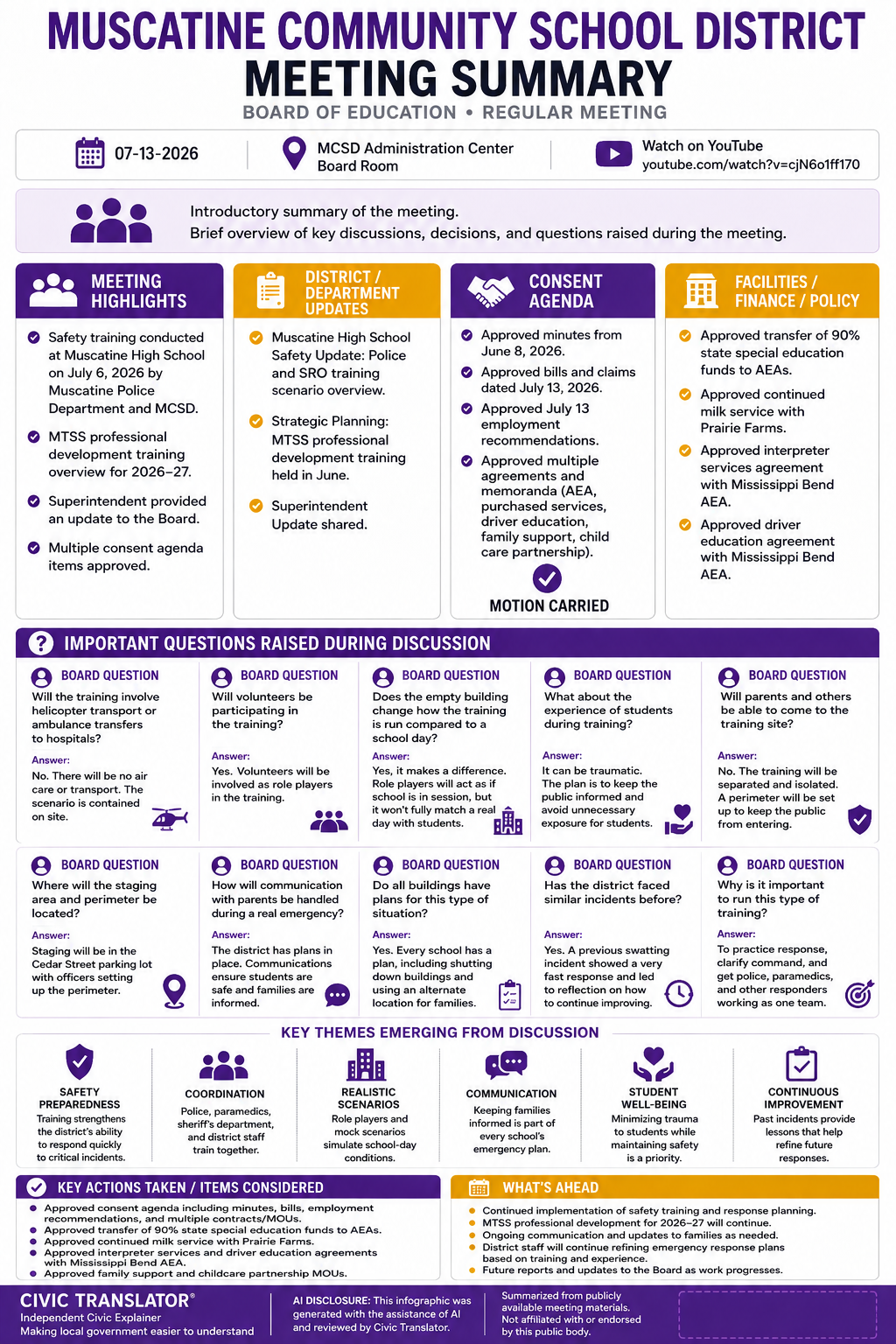
The Board received an extensive presentation regarding a large emergency response training conducted at Muscatine High School involving the Muscatine Police Department, fire department personnel, emergency medical responders, and district staff.
Presenters explained that the exercise is designed to strengthen coordinated responses during critical incidents. The training emphasizes rapid medical intervention by integrating police officers and paramedics through a rescue task force model rather than waiting until an entire building has been declared completely secure.
Board members asked questions about:
- Whether helicopters or ambulance transports would occur during the exercise.
- How realistic the simulation would be.
- Whether volunteers would participate.
- How parents and community members would be prevented from entering the training area.
- Communication procedures during an actual emergency.
- How the exercise differs from a normal school day.
Officials explained that:
- No patients would be transported during the exercise.
- Volunteer role players would participate.
- The exercise would remain isolated from the public.
- Officers would establish security perimeters.
- Existing school emergency plans include parent reunification procedures and alternate family meeting locations.
- Public communications would identify the event as a training exercise to reduce confusion.
The discussion also referenced lessons learned from a previous swatting incident and emphasized the importance of coordinated emergency response, accurate public information, and limiting misinformation during emergencies.
No formal board action was identified regarding the presentation.
School Resource Officer Program
District and police officials discussed the School Resource Officer program and priorities for the upcoming school year.
The district announced that a third School Resource Officer position had been established through partnerships with local educational institutions and community organizations. The new officer is expected to begin work around August 1.
Program priorities include:
- Student vaping prevention and education.
- Truancy reduction and attendance compliance.
- Increased use and awareness of the CrisisGo emergency communication system.
- Continued community engagement.
- Threat assessment and proactive intervention.
Officials emphasized relationship building with students, staff, and families while continuing to investigate potential threats before they become larger safety concerns.
No formal board action was identified during the presentation.
MTSS Strategic Planning and Professional Development
District educators presented the results of June strategic planning sessions focused on MTSS implementation.
Staff explained that the district has spent several years building an MTSS framework but has identified inconsistencies between schools regarding implementation, referral processes, behavioral supports, and data collection.
Major priorities moving forward include:
- Creating a district MTSS leadership team.
- Establishing district-wide expectations.
- Standardizing instructional and behavioral supports.
- Using data to guide professional development.
- Monitoring implementation fidelity across schools.
- Aligning district work with Comprehensive School Improvement Plan goals.
Presenters emphasized that the district MTSS team would analyze data rather than make instructional decisions.
Board discussion focused particularly on behavioral data collection, consistency across schools, PowerSchool documentation, and ensuring reliable reporting practices.
No formal action was identified following the presentation.
Consent Agenda
The Board considered a consent agenda containing routine business.
According to the meeting materials, the consent agenda included:
- Approval of previous meeting minutes.
- Bills and claims.
- Employment recommendations.
- Transfer of state special education funding to Area Education Agencies.
- Milk purchasing agreement with Prairie Farms.
- Hearing interpreter agreement with Mississippi Bend AEA.
- Driver education agreement with Mississippi Bend AEA.
- Family support partnership memoranda of understanding.
- Preschool partnership agreements.
- Statewide Voluntary Preschool contracts.
- Policy updates with minimal or legally required revisions.
The meeting materials identify these items as part of the consent agenda.
Equipment, Vehicle, and Operational Purchases
The action agenda included recommendations involving district operations and facilities, including:
- Dishwasher equipment purchase from Wilson Restaurant Supply.
- Purchase of two Chevrolet passenger vans from NextGen Motors.
- Bulk white paper purchase.
- Policy rescissions required by legislative changes.
These agenda items support district operations, transportation, food service, and compliance with state law.
Votes, Decisions, and Direction
The meeting materials support the following verified actions or proposed actions:
- The Board approved the consent agenda, including routine minutes, bills and claims, employment recommendations, interagency agreements, preschool agreements, policy updates, and related administrative items.
- The agenda included recommendations to purchase dishwasher equipment from Wilson Restaurant Supply.
- The agenda included recommendations to purchase two Chevrolet passenger vans from NextGen Motors.
- The agenda included consideration of rescinding Policies 603.04 and 603.10 following legislative changes.
- The agenda included approval of a bulk white paper purchase.
- New policies regarding disruptive behavior and transfer of funds were introduced for first reading rather than final adoption.
The available meeting materials do not verify:
- Motion makers.
- Seconding board members.
- Individual roll-call votes.
- Numerical vote totals.
Financial Matters
Financial business included both routine and operational expenditures.
Verified financial topics included:
- Approval of district bills and claims dated July 13, 2026.
- Transfer of 90% of state special education funding to Area Education Agencies.
- Continuation of purchased milk services with Prairie Farms.
- Hearing interpreter services agreement with Mississippi Bend AEA.
- Driver education agreement with Mississippi Bend AEA.
- Family support and preschool partnership agreements funded through state programs.
Action items also included:
- Dishwasher equipment purchase from Wilson Restaurant Supply totaling $167,584.23.
- Purchase of a 2025 Chevrolet Express 3500 Passenger Van from NextGen Motors for $43,680.00.
- Purchase of a 2025 Chevrolet Express 3500 Passenger LT Extended Van from NextGen Motors for $43,430.00.
- Bulk white paper purchase from Contract Paper Group totaling $26,292.00.
The interpreter services agreement estimates annual interpreter salary and benefit costs of approximately $268,000, with additional costs possible for substitutes, mileage, extracurricular services, and related expenses.
Policies, Ordinances, Resolutions, and Governance
The Board considered multiple governance and policy matters.
Routine policy revisions included updates involving:
- Board elections.
- Conflict of interest.
- Board officers.
- Meeting notices.
- Open enrollment.
- Good conduct.
- Gifted programming.
- Debt management.
- Purchasing.
- Records management.
The Board also reviewed first readings of:
- New Disruptive Behavior policy.
- Transfer of Funds policy.
Additional regulations and administrative exhibits related to conflict of interest disclosures, student conduct, purchasing procedures, gifted education, and disruptive behavior removal procedures were presented for review.
The agenda also recommended rescinding two curriculum-related policies following recent legislative changes.
Reports, Presentations, and Updates
Major presentations included:
- Muscatine High School safety training update.
- School Resource Officer program update.
- District strategic planning presentation.
- MTSS implementation progress.
- Professional development planning for the 2026-2027 school year.
- Superintendent update.
Presenters described efforts to improve instructional consistency, strengthen data-informed decision making, improve behavior reporting, and align professional development with district goals.
Personnel, Appointments, and Organizational Matters
The consent agenda included employment recommendations involving:
- Certified staff resignations.
- Leave of absence approval.
- Certified teaching hires.
- Instructional coach appointment.
- School nurse appointment.
- Multiple coaching appointments.
- Coaching resignations.
The district also announced selection of an additional School Resource Officer expected to begin service around August 1.
Projects, Facilities, Infrastructure, and Operations
Operational business included:
- School safety preparedness.
- Emergency response planning.
- Food service equipment replacement.
- Student transportation vehicle purchases.
- Driver education partnership.
- Interpreter services.
- Preschool partnerships.
- Family support agreements.
- Professional development planning.
- District instructional improvement systems.
These items support both daily district operations and long-term organizational improvement.
The agenda included a Citizen Speaks section.
The available meeting materials reviewed for this summary do not provide substantive details regarding any public comments or testimony delivered during that portion of the meeting.
Questions and Answers
Board members asked numerous questions during the safety presentation, including:
- Whether emergency helicopters or ambulance transport would occur during the exercise.
- Whether volunteers would participate.
- Whether an empty school changes the realism of the exercise.
- How student trauma would be minimized.
- How parents would be managed during an emergency.
- Where staging and security perimeters would be established.
- Whether all schools maintain emergency plans.
- How misinformation during emergencies should be addressed.
- Whether previous incidents influenced planning.
- How community members could support emergency preparedness.
During the MTSS presentation, board members also asked questions about:
- Behavioral data consistency.
- PowerSchool documentation.
- Administrative oversight of behavior records.
- Standardization across buildings.
- District accountability.
Staff and presenters explained current procedures, acknowledged areas needing improvement, and outlined planned implementation steps.
Students and families may benefit from improved emergency preparedness, expanded School Resource Officer staffing, more consistent instructional supports, and strengthened behavioral intervention systems.
Teachers and administrators will participate in additional professional development focused on consistent MTSS implementation, behavioral documentation, and district-wide instructional expectations.
Families of students receiving specialized educational services may be affected by continued agreements with Area Education Agencies, interpreter services, family support programs, and preschool partnerships.
District operations will benefit from updated kitchen equipment, vehicle purchases, and continued operational contracts supporting transportation and nutrition services.
- How will the district evaluate whether the emergency response training improves preparedness?
- What measures will be used to determine whether MTSS implementation becomes more consistent across schools?
- How will families receive information during an actual emergency?
- How will the district measure success in reducing student vaping?
- What role will the new School Resource Officer serve compared with existing officers?
- How will behavioral reporting be standardized across all schools?
- How will the district evaluate professional development effectiveness throughout the school year?
- What future policy changes may result from the first readings presented at this meeting?
- How will the new district MTSS leadership team share progress with the Board?
- What future reports will be provided regarding emergency preparedness initiatives?
Important Dates and Next Steps
- July 14, 2026 — Board work session at the MCSD Administration Center.
- Approximately August 1, 2026 — Anticipated start of the third School Resource Officer.
- August 10, 2026 — Regular Board of Education meeting.
- Fall 2026 — Continued implementation of MTSS professional development.
- 2026-2027 school year — Ongoing evaluation of MTSS implementation and instructional consistency.
- Future Board meetings are expected to consider final adoption of policies introduced for first reading.
Key Takeaways
- Emergency preparedness was the central topic of the meeting.
- Police and district staff completed major safety training at Muscatine High School.
- Rescue task force coordination was emphasized.
- Parent reunification planning was discussed.
- Public communication during emergencies received significant attention.
- Officials stressed avoiding misinformation during emergencies.
- A third School Resource Officer was announced.
- School Resource Officers identified vaping prevention as a major priority.
- Truancy reduction remains a district priority.
- CrisisGo emergency communications will receive additional emphasis.
- District educators reviewed MTSS implementation.
- Staff identified inconsistencies among schools.
- A district MTSS leadership team is planned.
- Professional development will become more data-driven.
- Behavioral data collection will become more standardized.
- The Board approved routine consent agenda business.
- Special education funding transfers were included.
- Prairie Farms will continue providing milk services.
- Interpreter services agreements continue with Mississippi Bend AEA.
- Preschool partnership agreements continue.
- Dishwasher equipment purchase was recommended.
- Two passenger van purchases were recommended.
- A bulk paper purchase was recommended.
- New policies received first reading.
- Additional governance updates reflected legislative changes.
Official Sources
About the Public Body
- Name: Muscatine Community School District
- Organization type: school-district
- Government body: school-boards
- Location: Muscatine, iowa
- County: Muscatine County
- Provider: simbli
Keywords
Muscatine Community School District, Board of Education, Regular Board Meeting, Muscatine Iowa, school board, school safety, emergency preparedness, police training, rescue task force, School Resource Officer, MTSS, professional development, strategic planning, student support, behavior intervention, PowerSchool, consent agenda, special education funding, Prairie Farms, Mississippi Bend AEA, preschool partnerships, employment recommendations, dishwasher purchase, passenger van purchase, board policies, disruptive behavior policy, superintendent update, truancy, vaping prevention, CrisisGo