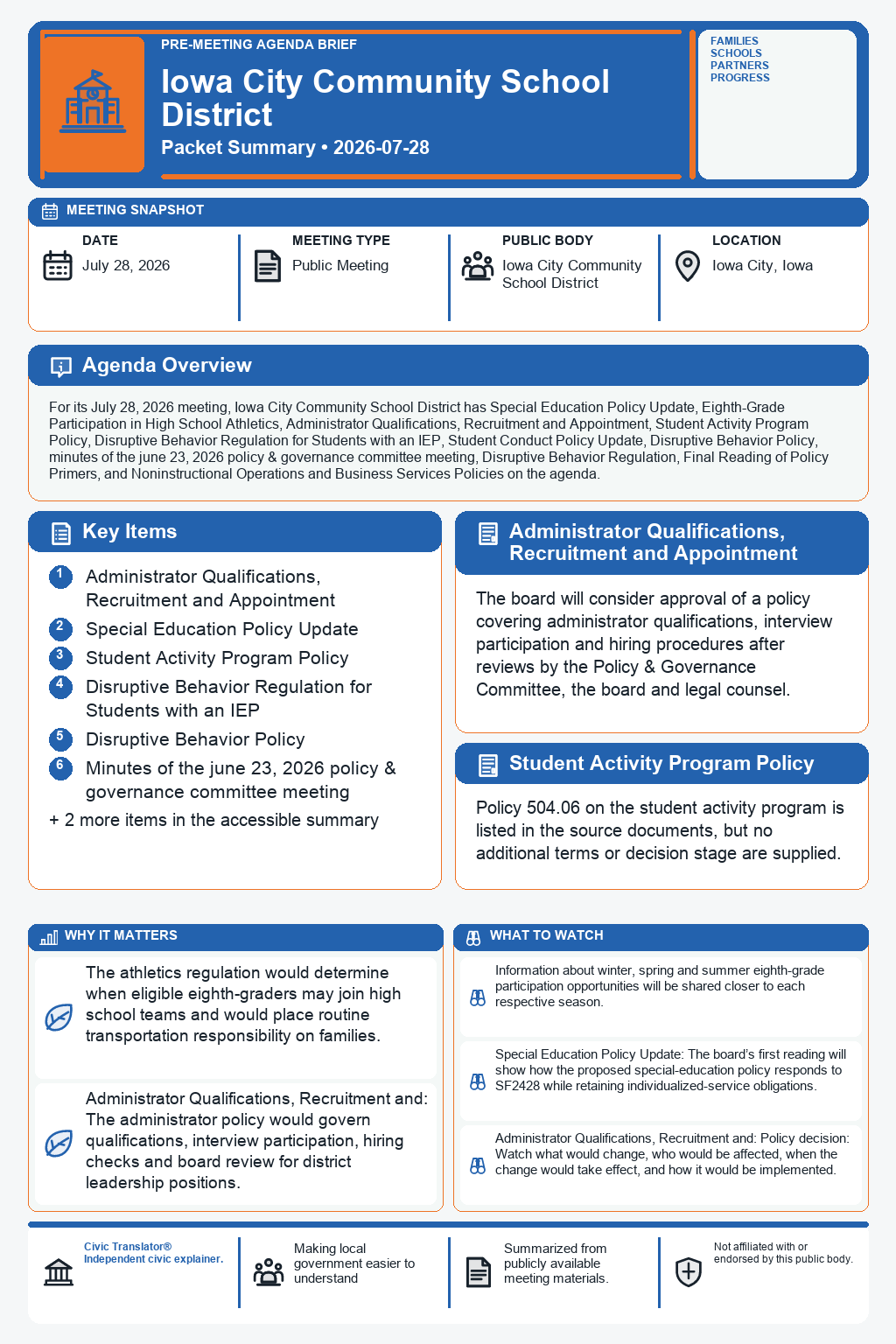
For its July 28, 2026 meeting, Iowa City Community School District has Special Education Policy Update, Eighth-Grade Participation in High School Athletics, Administrator Qualifications, Recruitment and Appointment, Student Activity Program Policy, Disruptive Behavior Regulation for Students with an IEP, Student Conduct Policy Update, Disruptive Behavior Policy, minutes of the june 23, 2026 policy & governance committee meeting, Disruptive Behavior Regulation, Final Reading of Policy Primers, and Noninstructional Operations and Business Services Policies on the agenda.
Key Takeaways
- The board will consider approval of a policy covering administrator qualifications, interview participation and hiring procedures after reviews by the Policy & Governance Committee, the board and legal counsel.
- The board will consider final-reading policy updates covering financial management, purchasing, records and other business practices. The introductory source text is incomplete, so no missing continuation is inferred.
- The board will hold a first reading of special-education policy changes related to SF2428 and disruptive student behavior. The policy retains the district’s responsibility to provide eligible students with individualized services.
- The agenda lists: 06R1 - 8th Grade Student Athlete Participation in High School Athletics Adoption Date: History: Iowa House File 2591 states that schools may allow eligible 8th-grade students to participate in high school extracurricular athletic contests, subject to school academic standards and implementation rules. The Iowa City Community School District supports appropriate opportunities for student-athletes to participate at the highest level that aligns with their abilities and the needs of th; Students who participate in high school athletics in 8th grade are still subject to all in-district transfer rules and guidelines.
- The board will hold a first reading of student-conduct changes related to SF2428. The draft addresses discipline while preserving legal protections for students receiving special-education services.
Key Items
- Special Education Policy Update
- Eighth-Grade Participation in High School Athletics
- Administrator Qualifications, Recruitment and Appointment
- Student Activity Program Policy
- Disruptive Behavior Regulation for Students with an IEP
- Student Conduct Policy Update
- Disruptive Behavior Policy
- minutes of the june 23, 2026 policy & governance committee meeting
Packet and Meeting Details
Meeting: Meeting 2026-07-28
Date: 2026-07-28
This summary highlights 10 source-supported agenda items included in the reviewed packet.
Special Education Policy Update
The board will hold a first reading of special-education policy changes related to SF2428 and disruptive student behavior. The policy retains the district’s responsibility to provide eligible students with individualized services.
- Decision stage: First reading
- Legislative basis: SF2428 following the 2026 Iowa legislative session
Eighth-Grade Participation in High School Athletics
A proposed regulation would permit eligible eighth-graders to join high school athletics case by case based on exceptional ability or roster needs. Families would provide transportation for daily participation activities.
- Decision makers: Building principal, athletic director and head varsity coach
- Transportation: Parents and guardians are responsible for transportation to daily participation activities
- Transfer rules: In-district transfer rules and guidelines still apply
Administrator Qualifications, Recruitment and Appointment
The board will consider approval of a policy covering administrator qualifications, interview participation and hiring procedures after reviews by the Policy & Governance Committee, the board and legal counsel.
Status: Recommended
- Decision stage: Recommended for approval
- Board review period: At least 48 hours for questions about recommended candidates for specified leadership positions
Student Activity Program Policy
Policy 504.06 on the student activity program is listed in the source documents, but no additional terms or decision stage are supplied.
Disruptive Behavior Regulation for Students with an IEP
Policy 503.11R2 concerning disruptive behavior regulation for students with an IEP is listed, but no additional terms or decision stage are supplied.
Student Conduct Policy Update
The board will hold a first reading of student-conduct changes related to SF2428. The draft addresses discipline while preserving legal protections for students receiving special-education services.
- Decision stage: First reading
- Suspension limit: No more than 10 consecutive school days unless required due process is provided
Disruptive Behavior Policy
Policy 503.11 on disruptive behavior is listed in the source documents, but no additional terms or decision stage are supplied.
Disruptive Behavior Regulation
Policy 503.11R1 on disruptive behavior regulation is listed in the source documents, but no additional terms or decision stage are supplied.
Final Reading of Policy Primers
The board will consider final-reading policy updates covering financial management, purchasing, records and other business practices. The introductory source text is incomplete, so no missing continuation is inferred.
- Decision stage: Final reading; recommended for approval
- Topics: Financial records, fiscal management, debt management, purchasing and related policies
Noninstructional Operations and Business Services Policies
The 700-series policies for noninstructional operations and business services are listed in the source documents, but no additional terms or decision stage are supplied.
Other agenda listings
The agenda also lists:
- minutes of the june 23, 2026 policy & governance committee meeting
Why It Matters
- The athletics regulation would determine when eligible eighth-graders may join high school teams and would place routine transportation responsibility on families. This occurs because A proposed regulation would permit eligible eighth-graders to join high school athletics case by case based on exceptional ability or roster needs. Families would provide transportation for daily participation activities.
- The administrator policy would govern qualifications, interview participation, hiring checks and board review for district leadership positions. This occurs because The board will consider approval of a policy covering administrator qualifications, interview participation and hiring procedures after reviews by the Policy & Governance Committee, the board and legal counsel.
- What specific practices would Administrator Qualifications, Recruitment and Appointment change, permit, or prohibit?
- What specific practices would Final Reading of Policy Primers change, permit, or prohibit?
- What are the cost, location, schedule, and accountability measures for Special Education Policy Update?
- What specific practices would Eighth-Grade Participation in High School Athletics change, permit, or prohibit?
- What specific practices would Student Conduct Policy Update change, permit, or prohibit?
What to Watch at the Meeting
- Information about winter, spring and summer eighth-grade participation opportunities will be shared closer to each respective season.
- The board’s first reading will show how the proposed special-education policy responds to SF2428 while retaining individualized-service obligations.
- Policy decision: Watch what would change, who would be affected, when the change would take effect, and how it would be implemented.
Important Dates, Deadlines, and Next Steps
- 2026-07-28: Meeting 2026-07-28; the listed recommendations and other agenda matters are scheduled for consideration.
Official Sources
About the Public Body
- Name: Iowa City Community School District
- Organization type: school-district
- Government body: school-boards
- Location: Iowa City, iowa
- County: Johnson
- Provider: simbli
Keywords
Iowa City Community School District, school-district, school-boards, Iowa City, iowa, Johnson, transportation, policy, Administrator Qualifications, Recruitment and Appointment, Decision stage: Recommended for approval, Final Reading of Policy Primers, Decision stage: Final reading; recommended for approval, Special Education Policy Update, Decision stage: First reading, Eighth-Grade Participation in High School Athletics, Student Conduct Policy Update, Student Activity Program Policy, Disruptive Behavior Regulation for Students with an IEP, Disruptive Behavior Policy, Disruptive Behavior Regulation, Noninstructional Operations and Business Services Policies, iowa legislative, student conduct policy, education policy update, behavior regulation students, school athletics decision