Gilbert Comm School District School Board Agenda Explained — July 14, 2026. Civic Translator infographic generated from public meeting materials.
About this summary
Generated from official public meeting materials.
This summary was created from publicly available agenda, supporting documents, reports, attachments, packets, and other official pre-meeting materials published for the Gilbert Comm School District School Board meeting.
Civic Translator uses automated and AI-assisted publishing workflows. Official government records, agendas, packets, minutes, recordings, and notices remain the authoritative source.
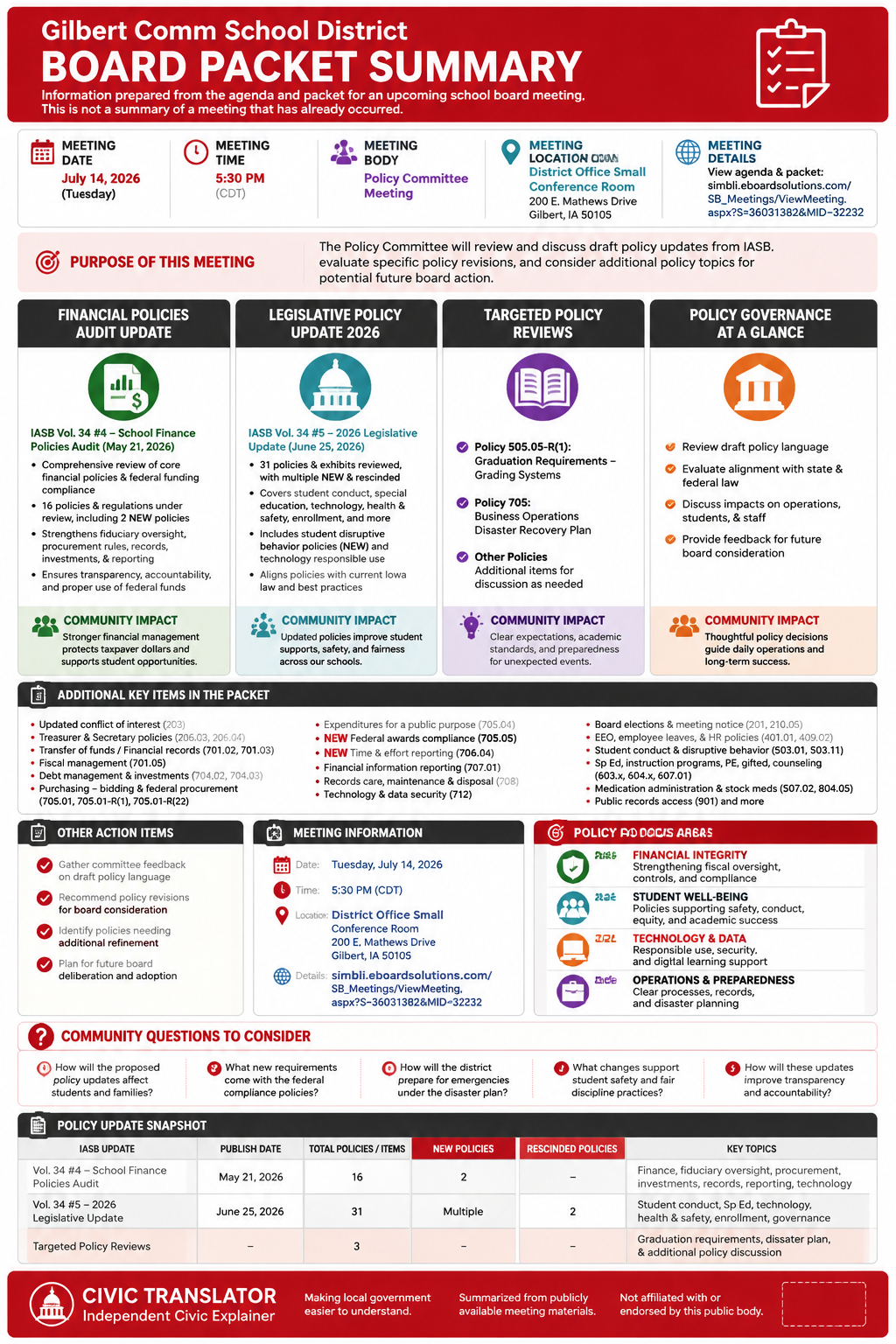
The Gilbert Community School District Policy Committee Meeting on July 14, 2026 focused primarily on reviewing proposed updates to the district’s board policy manual. The committee reviewed Iowa Association of School Boards (IASB) policy updates related to school finance, legislative changes, student programs, employment matters, technology, records, and governance. The packet identifies the meeting location as the District Office Small Conference Room, 200 E. Mathews Drive, Gilbert, Iowa.
The largest area of discussion involved updates to financial governance policies. These changes are intended to align district procedures with current Iowa law, federal requirements, and recommended financial practices. Topics included financial records, fund transfers, purchasing, debt management, investments, federal awards compliance, and documentation requirements.
The committee also reviewed a broad set of policy updates connected to a 2026 legislative update from IASB. These included policies affecting board elections, meeting notices, employee leave, student conduct, disruptive behavior procedures, student medication, curriculum programs, special education, technology use, public records, and other operational areas.
This meeting appears to have been a policy review and preparation step rather than a meeting focused on immediate spending approvals or operational decisions. The committee’s work helps prepare updated policies for possible future consideration by the full school board.
Major Discussion and Action Items
IASB Vol. 34 #4 School Finance Policy Updates
The committee reviewed a package of finance-related policy updates from IASB titled “Vol. 34 #4 Policy Updates - School Finance Policies Audit.” The review covered policies involving board conflicts of interest, secretary and treasurer responsibilities, transfer of funds, financial records, fiscal management, debt management, investments, purchasing, federal awards, time and effort reporting, financial reporting, records retention, and technology/data security.
The reason for the review was to update district policy language based on current state and federal requirements and financial best practices. IASB noted that the update involved a comprehensive evaluation of financial policies, including policies connected to federal funding expectations.
Community significance: These policies establish the framework for how public funds are managed, documented, reported, and protected. Updated policies can affect transparency, accountability, purchasing procedures, and oversight of taxpayer-funded resources.
Federal Funding Compliance and Financial Documentation
New proposed policies included Policy 705.05 on Federal Awards Compliance and Policy 706.04 on Time and Effort Reporting. The federal awards policy outlines responsibilities for managing federal funds, maintaining internal controls, following procurement standards, documenting activities, reporting concerns, and retaining records.
The time and effort reporting policy addresses documentation requirements for employee salaries and benefits charged to federal programs. It emphasizes maintaining records that support the allocation of federally funded work.
These updates matter because federal education funding often requires detailed documentation. Clear procedures help demonstrate that funds are used for approved purposes and that the district can meet audit and reporting expectations.
Financial Management, Fund Transfers, and Public Accountability
The committee reviewed updates to policies governing financial records, fiscal management, and fund transfers. The proposed fund transfer policy explains circumstances in which district funds may be moved between accounts, including situations involving completed purposes, flexibility accounts, approved transfers, and temporary fund loans that must be repaid with interest.
The fiscal management policy emphasizes board oversight, annual financial goals, financial reporting, and monitoring of district financial trends. It states that the superintendent, working with financial officials, should provide reports showing receipts, expenditures, fund balances, cash flow needs, and investment information.
For residents and taxpayers, these policies define how the district plans, monitors, and explains the use of public resources.
Debt Management and Investment Policies
The committee reviewed proposed updates to debt management and investment policies. The debt management policy describes standards for issuing and managing school district debt, including maintaining strong credit practices, evaluating financial impacts, and following state and federal requirements.
The policy states that debt decisions should consider debt capacity, financial trends, administrative structure, and economic conditions. It also addresses bond counsel, financial advisors, disclosure requirements, investment of debt proceeds, and compliance responsibilities.
The investment policy establishes priorities of safety, liquidity, and return when managing district funds. It identifies allowable investments, internal controls, reporting expectations, and responsibilities of the treasurer.
IASB Vol. 34 #5 Legislative Policy Updates
The committee reviewed a second large group of proposed policy changes based on the 2026 legislative update. Topics included board elections, meeting notice requirements, equal employment opportunity, employee leave, open enrollment procedures, student expression, student conduct, disruptive behavior, medication administration, curriculum programs, technology, counseling, records access, and public examination of school records.
These updates represent a broad review of district policies to ensure they reflect current legal requirements and operational practices.
Review of Graduation Requirements and Grading Policy
The committee reviewed proposed Regulation 505.05-R(1), concerning graduation requirements and grading systems. The packet lists this as a separate policy review item.
The available materials do not provide detailed proposed wording changes, so the specific impact on graduation standards or grading practices cannot be determined from the accessible packet information.
Business Operations Disaster Recovery Plan
The committee also reviewed Board Policy 705, identified as a draft Business Operations Disaster Recovery Plan.
The available packet information confirms the policy review but does not provide the full proposed text. The policy area generally concerns organizational readiness and continuity of district operations during disruptions.
Financial Matters
No specific purchases, contracts, bids, grant awards, tax requests, or dollar-value spending decisions were identified in the accessible meeting packet. The financial focus was policy governance rather than approval of a particular expenditure.
The most financially significant topics were updates to policies governing fund transfers, financial records, fiscal management, debt, investments, purchasing, and federal funding compliance. These policies establish controls over how district funds are managed and reported.
Policies, Ordinances, Resolutions, and Governance
The meeting centered on reviewing draft policy changes. Major governance topics included board conflict-of-interest requirements, secretary and treasurer duties, financial oversight responsibilities, public records, technology security, purchasing procedures, and student-related policies.
The conflict-of-interest update explains board member responsibilities to avoid improper financial interests and identifies circumstances where disclosure or removal from decision-making may be required.
The financial officer policies clarify responsibilities for maintaining records, reporting financial information, managing investments, and coordinating district financial activities.
Reports, Presentations, and Informational Updates
The primary informational materials were IASB policy update documents. The finance policy update explained that IASB conducted a comprehensive review of financial policies and revised language to reflect current law, guidance, and best practices.
The legislative update materials identified changes across multiple educational and operational policy areas, including student services, employment, governance, and technology.
Personnel, Appointments, and Organizational Matters
No hiring decisions, resignations, retirements, appointments, or personnel actions were identified in the accessible packet.
The reviewed policies did address organizational responsibilities, including duties of the board secretary, treasurer, superintendent, and other district officials involved in financial management and compliance.
Projects, Facilities, Infrastructure, and Operations
No specific construction projects, facility improvements, transportation changes, or infrastructure investments were identified.
Operational topics included policy frameworks for technology and data security, records management, disaster recovery planning, and financial systems.
Public Hearings and Opportunities for Community Input
No public hearings, public forums, or formal public comment opportunities were identified in the accessible packet materials.
Community members may participate through normal district board processes when reviewed policies advance to future board meetings or formal consideration.
Community Impact
Residents: Policy updates affect how the district manages public resources, maintains transparency, and communicates financial information.
Students and families: Policies related to student conduct, medication, curriculum, technology, and educational programs may influence school procedures.
Taxpayers: Financial management, debt, purchasing, and investment policies provide the framework for responsible use of district funds.
Employees and staff: Updates involving employment practices, federal program documentation, and technology procedures may affect administrative processes.
Community organizations: Public records and governance policies establish expectations for access, accountability, and district operations.
The packet directly supports that these changes are intended to align district policies with legal requirements and recommended practices. Specific operational impacts will depend on future adoption decisions and implementation.
Questions Community Members May Want to Ask
Which policy updates require changes to current district procedures?
When will the reviewed policies be presented to the full school board for consideration?
Are any financial policies changing the way residents can review district financial information?
What internal controls are currently used to monitor federal funding compliance?
Will any student or family procedures change because of the legislative policy updates?
How will staff be informed about policy changes that affect daily operations?
Are additional policy reviews expected during the upcoming school year?
How will the district measure whether updated policies improve accountability or efficiency?
Important Dates, Deadlines, and Next Steps
July 14, 2026: Policy Committee Meeting held to review policy updates.
Future board consideration: The reviewed draft policies may proceed to later school board review and possible adoption. The accessible packet does not provide adoption dates.
Key Takeaways
Gilbert’s Policy Committee reviewed a large package of proposed board policy updates on July 14, 2026.
The meeting focused primarily on governance, financial controls, and compliance requirements.
IASB finance policy updates addressed purchasing, federal funds, financial records, debt, investments, and reporting.
New proposed policies included Federal Awards Compliance and Time and Effort Reporting.
Financial policies emphasize transparency, documentation, and oversight of public funds.
The committee reviewed updates connected to the 2026 legislative session.
Student conduct, medication, technology, curriculum, and records policies were among the reviewed areas.
No major spending approvals or contracts were identified in the accessible packet.
No personnel actions or facility projects were identified.
Future action is expected through additional school board review and possible policy adoption.