City Council Agenda & Packet Summary – Grimes City Council – May 27, 2026

Meeting date: May 27, 2026

Summary type: Packet Summary

Use the direct share buttons for a link preview, or copy the ChatGPT prompt to create a longer platform-specific post.

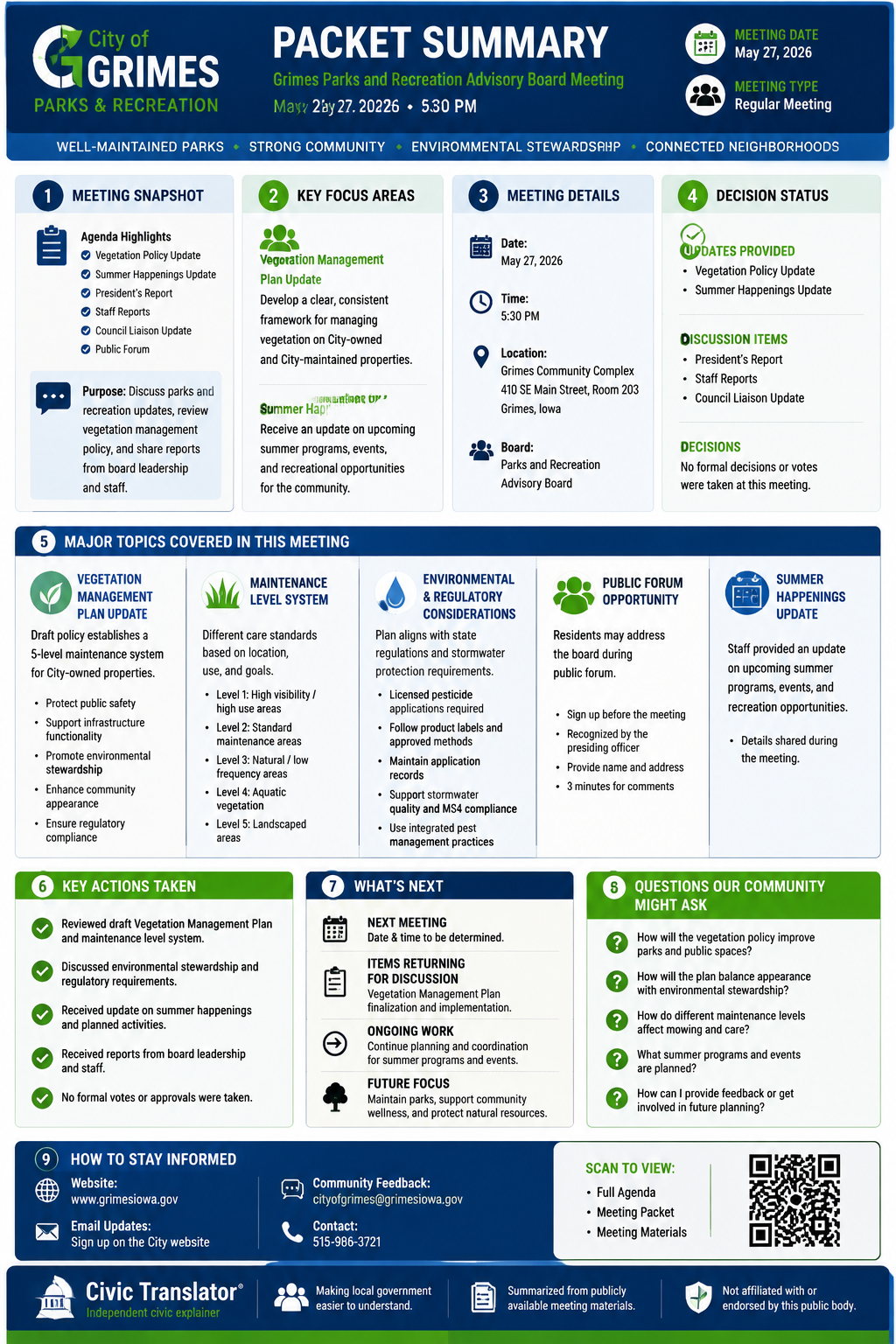
City Council Agenda & Packet Summary – Grimes City Council – May 27, 2026 infographic

About this summary

Generated from official public meeting materials.

This summary was created from publicly available agenda, packet, minutes, reports, and other official materials published for the Grimes City Council City Council meeting.

Civic Translator uses automated and AI-assisted publishing workflows. Official government records, agendas, packets, minutes, recordings, and notices remain the authoritative source.

Last updated
July 24, 2026
Public body
Grimes City Council
Meeting date
May 27, 2026

Meeting Information

  • Public Body: City of Grimes
  • Organization Type: municipality
  • Government Body: city-council
  • Meeting Title: Wednesday May 27, 2026 5:30 PM CDT Parks & Recreation Advisory Board Meeting Agenda Posted on: May 26, 2026 4:17 PM Grimes Community Center, 410 SE Main Street, Grimes, IA 50111 Parks & Recreation Advisory Board
  • Meeting Date: 2026-05-27
  • City: Grimes
  • County: Polk
  • State: iowa
  • Meeting Source URL: https://grimesia.portal.civicclerk.com/event/457/files
  • Meeting Listing URL: https://grimesia.portal.civicclerk.com/
  • Public Body Website: Not available
  • Meeting Video URL: Not available
  • Video Channel URL: Not available

What Community Members Should Know

The City of Grimes Parks and Recreation Advisory Board meeting on May 27, 2026 focuses on two major community topics: an update to the City’s Vegetation Management Plan and a summer programming update. The meeting is intended to provide board discussion, public input opportunities, and staff updates regarding parks and recreation operations.

The most significant policy discussion involves a draft Vegetation Management Plan designed to create consistent standards for maintaining City-owned and City-maintained properties. The plan treats vegetation as functional infrastructure that supports stormwater management, erosion control, public safety, habitat preservation, infrastructure protection, and community appearance.

The proposed approach divides City-maintained areas into five maintenance levels, ranging from highly maintained athletic fields and public spaces to natural areas with reduced mowing and increased emphasis on native vegetation. The plan would use GIS mapping to identify maintenance responsibilities and boundaries, helping clarify where City maintenance applies and where adjacent property owners remain responsible.

The board will also receive a Summer Happenings Update, along with routine reports from the board president, City staff, and council liaison. Earlier board discussions included an outdoor sports facilities optimization study intended to improve use of existing fields, support tournaments, protect turf quality, and align operations with community demand.

Major Discussion and Action Items

Vegetation Management Policy Update

The board is expected to review an update to the City of Grimes Vegetation Management Plan. The draft plan establishes a consistent framework for maintaining vegetation on parks, greenways, rights-of-way, stormwater facilities, athletic fields, and municipal properties.

The purpose is to balance several priorities: keeping public areas safe and attractive, protecting infrastructure, meeting environmental requirements, and using City resources effectively. The plan identifies vegetation management as more than landscaping, recognizing its role in drainage, erosion control, urban canopy growth, and habitat preservation.

The plan references City Code requirements regarding terrace and parking area maintenance. It states that abutting property owners are responsible for certain areas outside property lines and inside curb lines, while the City maintains defined public areas according to its mapping system.

Maintenance Level System for City Properties

A major component of the proposed plan is a five-level classification system.

Level 1 applies to high-use, high-visibility areas such as irrigated sports turf. These areas receive the most intensive maintenance, including more frequent mowing and inspections, with sports turf maintained at a target height of 2.5 inches.

Level 2 provides standard maintenance for many City properties, including parks, facilities, greenways, urban rights-of-way, vacant lots, and some stormwater areas. These areas generally target a 3.5-inch turf height with routine vegetation care.

Level 3 applies to natural or lower-frequency maintenance areas such as native greenways, rural rights-of-way, and natural stormwater facilities. These areas emphasize reduced mowing, native vegetation, and habitat benefits.

Level 4 addresses aquatic vegetation in publicly owned retention ponds, with management goals based on stormwater function and Department of Natural Resources guidance.

Level 5 covers landscaped areas containing shrubs, trees, signage, perennial plantings, and hardscape features. Some landscaped areas would be maintained through contracts from April through October, while others would remain City-maintained.

Environmental Compliance and Integrated Pest Management

The vegetation plan includes requirements for responsible pesticide and herbicide use. City applications must be performed by properly licensed applicators through the Iowa Department of Agriculture and Land Stewardship.

The plan also addresses the City’s responsibilities as a permitted Municipal Separate Storm Sewer System community under Iowa Department of Natural Resources regulations. It calls for best management practices to reduce runoff, drift, and impacts to non-target areas.

Integrated Pest Management principles would be used throughout maintenance levels to balance effective vegetation control with environmental protection.

Parks, Athletic Fields, and Recreation Operations

The plan identifies parks and athletic fields as areas where vegetation management directly supports recreation. Athletic fields require higher maintenance because they must provide safe, predictable playing surfaces under heavy use.

The stated goals for athletic field management include reducing injury risk, maintaining turf durability, and providing quality playing conditions for organized recreation and competitive activities.

Previous Parks and Recreation Advisory Board discussion included an Outdoor Sports Facilities Optimization Study request for proposals. The study was intended to maximize use of existing outdoor sports facilities, balance local league access with tournament opportunities, improve turf conditions, align staffing and funding with demand, and expand sports tourism opportunities.

Summer Happenings Update

The agenda includes a Summer Happenings Update as a public and board agenda item. The packet identifies the update but does not provide detailed program schedules, costs, or specific event information in the accessible materials reviewed.

The discussion is expected to provide information about seasonal Parks and Recreation activities and upcoming community programming.

Board and Staff Reports

The meeting agenda includes a President’s Report, staff reports, and a Council Liaison Update. These items provide an opportunity for board members and City representatives to discuss ongoing recreation operations, priorities, and coordination with the City.

Financial Matters

The packet does not identify specific dollar amounts, contracts, bids, grants, purchases, or budget requests associated with the May 27, 2026 meeting.

The Vegetation Management Plan may have future operational and contracting implications, particularly because the plan identifies contracted maintenance for certain landscaped areas from April through October. However, no contract values or funding recommendations are provided in the available materials.

Policies, Ordinances, Resolutions, and Governance

The primary policy matter is the draft Vegetation Management Plan. The proposal establishes maintenance standards, responsibility boundaries, environmental practices, and mapping procedures.

The plan would use City GIS mapping to define maintenance classifications and responsibilities. It also notes that maintenance boundaries may be adjusted by the department director when changes align with the plan’s objectives.

The plan references existing City Code provisions concerning maintenance responsibilities for terraces and public areas.

Reports, Presentations, and Informational Updates

The meeting packet includes the Vegetation Management Plan draft and presentation materials explaining the purpose, goals, maintenance classifications, property categories, and next steps.

The plan identifies five primary goals:

  • Protect public safety
  • Support infrastructure functionality
  • Promote environmental stewardship
  • Enhance community appearance and pride
  • Ensure regulatory compliance

The board will also receive a Summer Happenings Update and regular staff, president, and council liaison reports.

Personnel, Appointments, and Organizational Matters

The packet does not identify personnel changes, appointments, resignations, employment agreements, or staffing actions for this meeting.

Staff involvement is referenced through Parks and Recreation operations and future implementation steps, including training for applicators on integrated pest management practices, regulatory compliance, and stormwater best practices.

Projects, Facilities, Infrastructure, and Operations

The Vegetation Management Plan affects many categories of City property, including rights-of-way, greenways, parks, athletic fields, retention ponds, and City facilities.

The plan’s next steps include finalizing the plan, presenting it for City Council approval, completing GIS mapping of maintenance boundaries, training staff, soliciting landscaping contracts where appropriate, and conducting annual reviews.

Retention ponds and stormwater facilities are included because vegetation management supports drainage, erosion control, water quality, and safe maintenance access. The plan also recognizes that some retention facilities provide recreational fishing opportunities.

Public Hearings and Opportunities for Community Input

The meeting includes a public comment period. Residents wishing to address the Parks and Recreation Advisory Board must sign up upon entering the meeting, be recognized by the presiding officer, provide their name and address, and are limited to three minutes of comment.

The meeting is scheduled for May 27, 2026, at 5:30 PM at the Grimes Community Complex, 410 SE Main Street, Room 203.

Community Impact

Residents may be affected by clearer expectations for vegetation maintenance on public spaces, rights-of-way, parks, and stormwater areas.

Property owners may benefit from clearer mapping of City responsibilities and areas where adjacent property maintenance obligations apply.

Park users, athletes, and recreation participants may see impacts from improved maintenance standards for fields and public recreation spaces.

Environmental impacts may include increased use of native vegetation practices, pollinator habitat protection, and improved stormwater management.

Taxpayers may want to understand future costs associated with staffing, maintenance schedules, GIS mapping, and contracted landscaping services.

Questions Community Members May Want to Ask

  1. How will residents be able to view the GIS maps showing City maintenance responsibilities?
  2. What areas will receive increased or reduced maintenance under the new classification system?
  3. How will the City communicate changes to property owners affected by maintenance boundary decisions?
  4. What costs are expected to implement the Vegetation Management Plan?
  5. Which landscaped areas may require outside contracts, and how will contractors be selected?
  6. How will the City measure whether the plan improves safety, appearance, and environmental outcomes?
  7. What community programs are included in the Summer Happenings Update?
  8. How will athletic field maintenance improvements affect recreational users and tournaments?
  9. How often will the vegetation plan and maintenance classifications be reviewed?
  10. How can residents provide feedback after the plan is presented?

Important Dates, Deadlines, and Next Steps

  • May 27, 2026: Parks and Recreation Advisory Board meeting at 5:30 PM at the Grimes Community Complex.
  • April 9, 2026: Draft Vegetation Management Plan date identified in packet materials.
  • Future step: Finalize the Vegetation Management Plan and present it for City Council approval.
  • Future step: Complete GIS mapping of maintenance level boundaries.
  • Future step: Train staff on integrated pest management practices, IDALS requirements, and stormwater best management practices.
  • Future step: Solicit bids for Level 5 landscaping contracts covering April through October.
  • Annual review: Update maintenance boundaries and practices as needed.

Key Takeaways

  • The Parks and Recreation Advisory Board will review a draft Vegetation Management Plan for City properties.
  • The plan creates five maintenance levels based on use, visibility, environmental function, and operational needs.
  • Athletic fields receive the highest maintenance classification because of recreation demands.
  • The City plans to use GIS mapping to clarify vegetation maintenance responsibilities.
  • The plan addresses stormwater protection, erosion control, habitat preservation, and public safety.
  • Licensed applicators and environmental best practices are required for City vegetation management activities.
  • Some landscaped areas may continue to rely on contracted maintenance services.
  • The plan includes future staff training and annual review procedures.
  • The meeting includes a public comment opportunity with three-minute speaking limits.
  • Summer recreation programming updates are also scheduled for discussion.

Official Sources

About the Public Body

  • Name: City of Grimes
  • Organization type: municipality
  • Government body: city-council
  • Location: Grimes, iowa
  • County: Polk
  • Provider: civicclerk

Keywords

City of Grimes, Parks and Recreation Advisory Board, Grimes Community Complex, vegetation management plan, parks, athletic fields, greenways, stormwater management, GIS mapping, integrated pest management, IDALS, Iowa DNR, MS4 regulations, public safety, landscaping, retention ponds, recreation programming, summer happenings, turf management, native vegetation, pollinator habitat, municipal operations, right-of-way maintenance, environmental stewardship, City facilities, Grimes parks

Continue exploring this meeting

More summaries from Grimes City Council

Recent City Councils across Iowa