Jeffco Public Schools Board of Education Packet Summary — 2026-09-02
Meeting: Executive Session & Study Session - Sep 02 2026
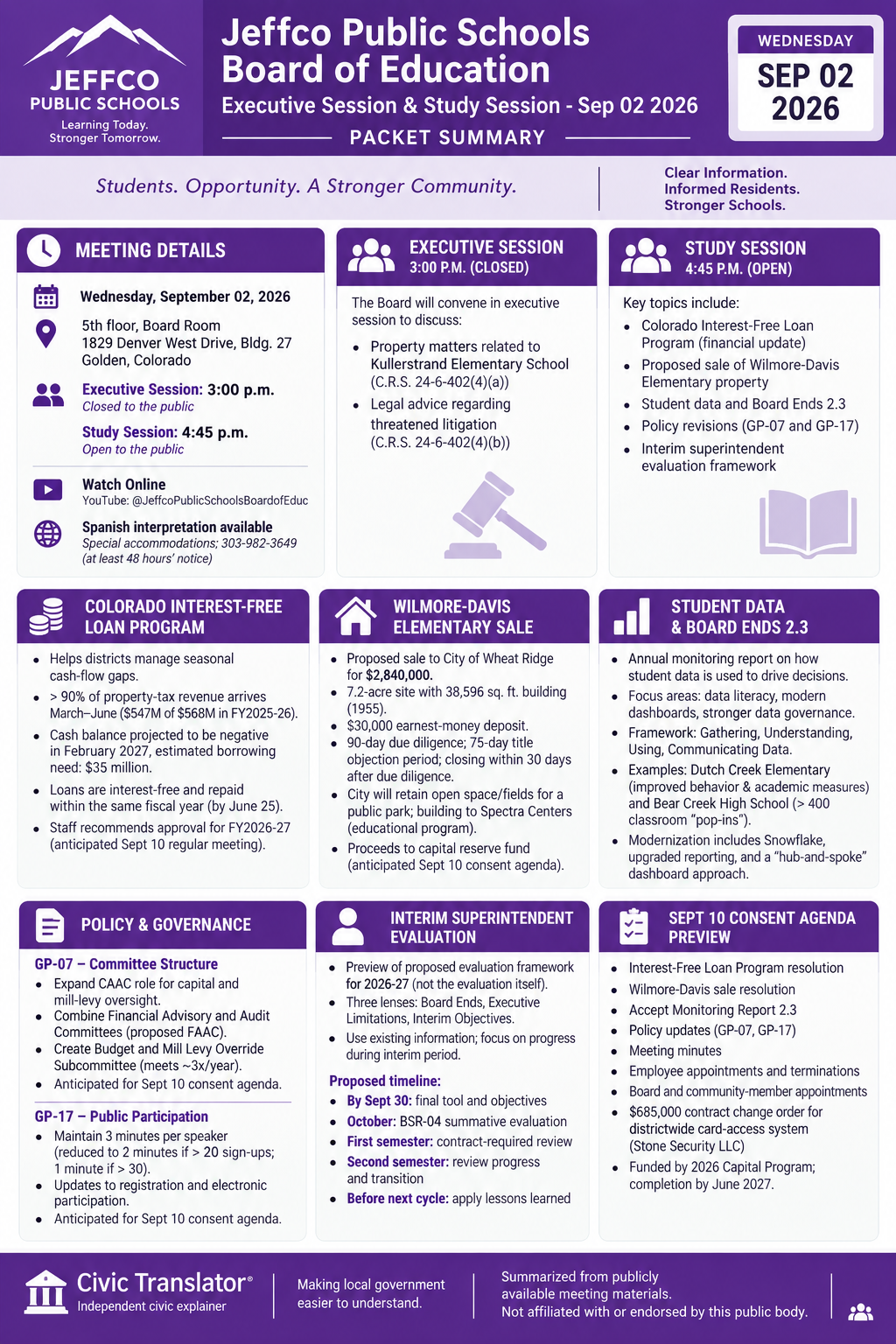
The Jeffco Public Schools Board of Education is scheduled for an executive session beginning at 3:00 p.m., followed by a public study session beginning at 4:45 p.m. at the Education Center in Golden. The packet includes updates and proposed actions involving short-term district financing, the proposed sale of the former Wilmore-Davis Elementary property, student-data governance and use, Board policy revisions, and the interim superintendent evaluation process.
The executive session is scheduled to address property matters involving Kullerstrand Elementary School and legal advice regarding threatened litigation. Because this is a packet summary, proposed actions and recommendations described below should not be read as completed Board decisions unless the packet identifies them as prior actions.
Key Items on the Agenda
Colorado Interest-Free Loan Program
District financial staff are scheduled to update the Board on Colorado's interest-free loan program for school districts. The program is intended to bridge seasonal cash-flow gaps caused by the timing difference between district expenditures and property-tax collections.
Jeffco's packet projects that:
- More than 90% of district property-tax distributions arrive from March through June. In FY2025-26, that represented $547 million of $568 million.
- The district's FY2026-27 cash balance, excluding cash held for charter schools and TABOR reserves, is projected to become negative in February 2027, before significant property-tax receipts arrive in mid-March.
- The projected February borrowing need is approximately $35 million.
- District staff characterize the projected need as a revenue-timing issue rather than a shortage of annual revenue.
- Loans are interest-free and are to be repaid within the same fiscal year.
- Beginning in March, participating districts must remit property-tax revenues to the State Treasury until their loan balances are repaid.
- All loans must be repaid by June 25.
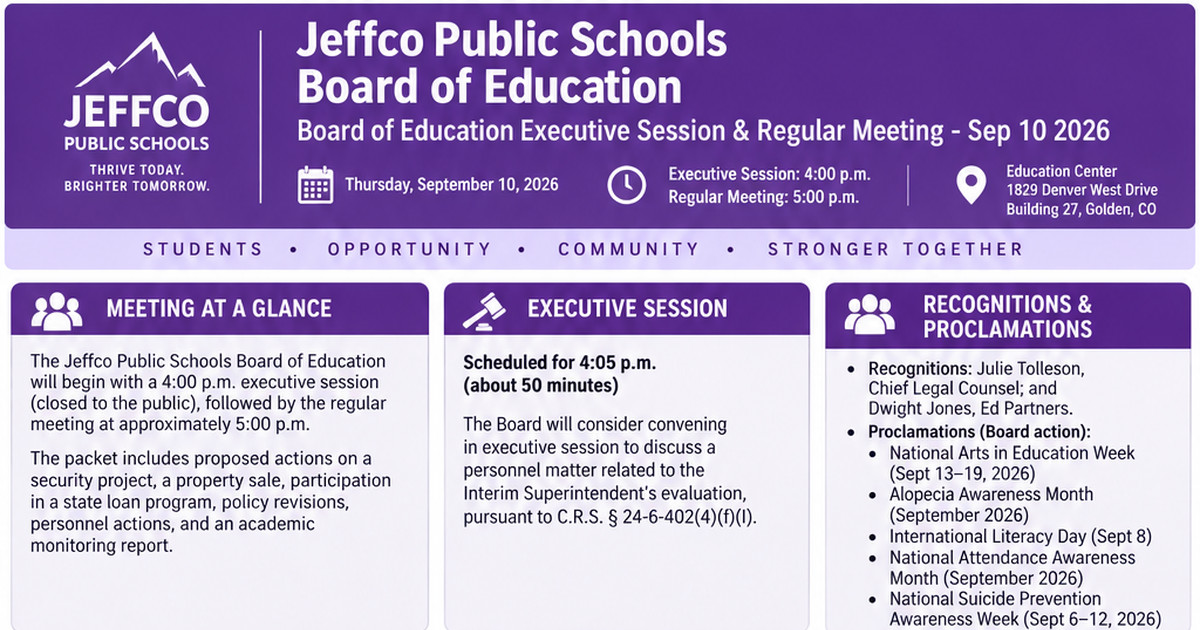
The packet recommends approval of a resolution authorizing Jeffco's participation in the Colorado Interest-Free Loan Program, also described as the ETRAN program, for FY2026-27 and authorizing administration to execute required program documents. That approval is anticipated for the September 10, 2026 regular meeting, rather than the September 2 study session.
Proposed $2.84 Million Wilmore-Davis Elementary Sale
The Board is scheduled to review a proposed sale of the former Wilmore-Davis Elementary School property to the City of Wheat Ridge. The approximately 7.2-acre site includes a 38,596-square-foot building constructed in 1955.
The district previously declared the property surplus, along with other properties, through a Board resolution passed on February 12, 2026. The current disposition process is guided by Board Policy DN.
The proposed transaction calls for:
- Purchase price: $2,840,000.
- Earnest-money deposit: $30,000.
- Due-diligence period: 90 days after contract execution.
- Title-objection period: 75 days after contract execution.
- Survey and land division: within 60 days after contract execution.
- Closing: no more than 30 days after expiration of the due-diligence period, unless the parties agree otherwise.
- Sale proceeds: credited to the district's capital reserve fund for capital investments.
Under the proposed arrangement, Wheat Ridge would replat the property into two parcels. The city would retain the open-space and athletic-fields portion for development and maintenance as a public park, while the school building and part of the property would be conveyed to Spectra Centers, which operates a Colorado-approved facility school and day-treatment program.
The packet states that Spectra currently serves students from multiple Colorado districts, including Jeffco, and that 24 Jeffco students are currently placed out of district with Spectra. District materials say a Wheat Ridge location would provide a closer option for Jeffco students and could reduce transportation time and costs.
Community and Advisory Committee Feedback on Wilmore-Davis
The packet summarizes community input as generally favoring continued public and community-oriented use of the Wilmore-Davis site. Themes identified in the materials include:
- Preserving publicly accessible green space.
- Maintaining or improving fields, playgrounds, and courts.
- Limiting dense residential redevelopment.
- Considering educational, cultural, library, or other community uses.
- Recognizing the long-term recreational and community value of the site.
The district's Property Disposition Advisory Committee (PDAC) gave unanimous support to the proposal. The packet says committee members cited the city's approach, potential savings from avoiding prolonged property-holding costs, community benefits, and adaptive reuse of the school building for an educational purpose serving Jeffco students.
The packet anticipates that a resolution authorizing execution of the purchase-and-sale agreement will be placed on the September 10 regular meeting consent agenda.
Student Data and Board Ends 2.3
Monitoring How the District Uses Student Data
The Board is scheduled to receive and discuss its annual monitoring report for Board Ends 2.3, which states that district employees will use formal and informal student data to drive decision-making.
The report describes district work in three broad areas:
- Building data-literacy skills among educators and administrators.
- Expanding and modernizing data dashboards and reporting systems.
- Developing stronger data governance and infrastructure.
The district reports that its data-literacy framework includes four competency domains: Gathering Data, Understanding Data, Using Data, and Communicating Data. It also emphasizes data privacy, challenging bias and assumptions, continuous improvement, and an asset-based approach to interpreting student information.
School-Level Examples
The monitoring materials use Dutch Creek Elementary and Bear Creek High School to illustrate how schools are using data.
At Dutch Creek Elementary, the packet connects efforts to align Multi-Tiered Systems of Supports, professional development, work planning, resource allocation, and data use with changes in school climate, behavior, and academic measures. The presentation reports fewer behavioral incidents and suspensions over the periods shown and improved CMAS math and literacy achievement measures.
At Bear Creek High School, the presentation describes a focus on student belonging and failure rates. It also reports more than 400 informal classroom "pop-ins" used to generate biweekly information for staff without personally identifying data or singling out individual employees.
Data Systems and Governance
The monitoring report says Jeffco has operationalized an enterprise Business Intelligence service and expanded its data-governance work. It describes a modernization effort involving Snowflake, upgraded ERP reporting capabilities, automated data movement, and an enterprise data warehouse intended to create more standardized and traceable data workflows.
Among the data products described in the packet are dashboards addressing:
- College and Career Readiness.
- Student success.
- School and student progress monitoring.
- Food and Nutrition Services.
- District administration discipline.
- Title I disproportionality.
- Athletics and activities.
The report identifies dashboard organization as an ongoing challenge. A cross-departmental team is pursuing a "hub-and-spoke" approach intended to give users a central set of key performance indicators linked to more specialized dashboards.
The report describes instructional-coach data-literacy work as "on track." It reports that 100% of reviewed coaching artifacts aligned with school goals, 45% showed shifts in teacher understanding, actions, and behavior, and 30% showed shifts in student understanding, actions, and behavior. More than 90% of participants reported applying key professional-learning takeaways at their schools.
Policy and Governance Items
GP-07 — Board Committee Structure and Financial Oversight
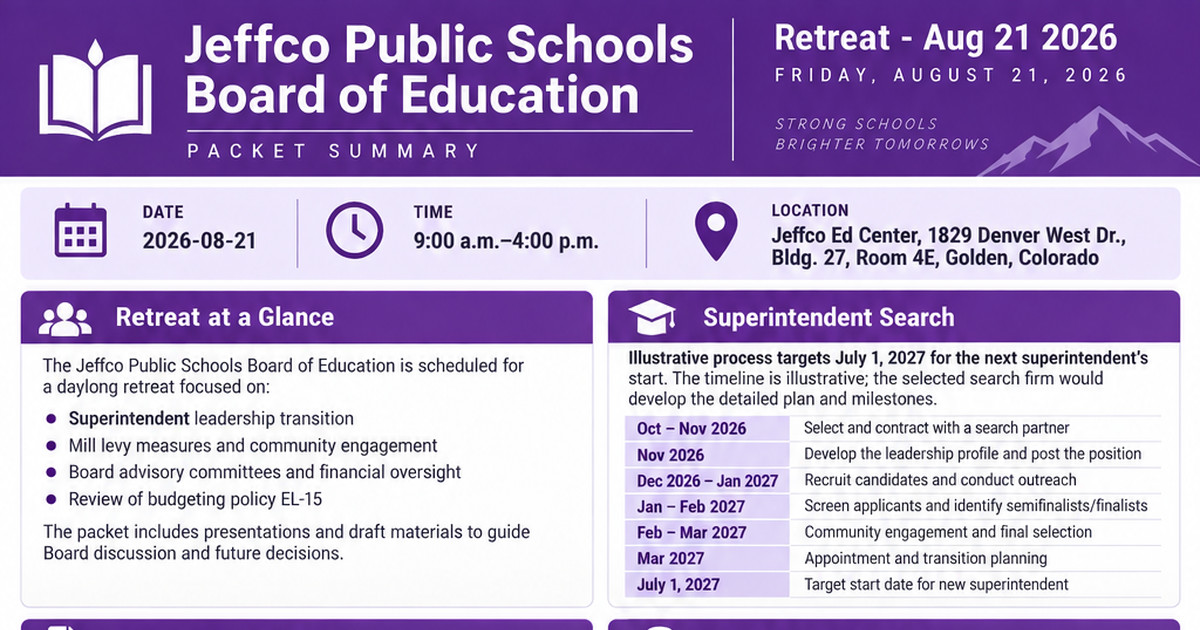
The Board is scheduled to review proposed revisions to GP-07, Committee Structure, following a request at the August 21 Board retreat to revisit the policy.
The proposed revisions are intended to strengthen and clarify citizen financial oversight. Major recommendations in the packet include:
- Expanding the Capital Asset Advisory Committee (CAAC) role to include monitoring special-purpose mill levy funding used for capital projects and its alignment with commitments made to voters.
- Combining the existing Financial Advisory Committee and Audit Committee into a proposed Finance and Audit Advisory Committee (FAAC).
- Formalizing a Budget and Mill Levy Override Subcommittee within the District Accountability Committee.
- Assigning that subcommittee responsibility for reviewing both general-fund spending and spending connected with the 2018 and future mill levy override measures.
- Discontinuing the current district-level Mill Levy Override Committee in favor of the proposed formal Board advisory structure within the District Accountability Committee.
The proposed Budget and Mill Levy Override Subcommittee would meet approximately three times per year, review district financial reports, and develop advice for the Board regarding spending priorities and alignment with voter-approved purposes.
The packet anticipates that updated GP-07 language could appear for approval on the September 10 consent agenda.
GP-17 — Public Participation at Meetings
The Board is also scheduled to review proposed revisions to GP-17, Public Participation at Meetings.
The redlined policy addresses who may speak, registration for public comment, time limits, orderly conduct, and electronic participation. Proposed language would continue to provide three minutes for individual speakers under ordinary circumstances while reducing speaking time when participation is high:
- More than 20 individuals signed up: two minutes per individual and five minutes per group.
- More than 30 individuals signed up: one minute per individual and three minutes per group.
The proposed revisions also address registration through a public-comment sign-up form and procedures for electronic participation. Updated GP-17 is included among the policies anticipated for the September 10 consent agenda.
Interim Superintendent Evaluation Framework
The Board is scheduled to preview a proposed evaluation process for the 2026-27 interim superintendent assignment. The packet emphasizes that the September 2 discussion concerns the framework and direction of the evaluation process, not the evaluation itself.
The proposed approach uses three existing or contractually required accountability lenses:
- Board Ends — organizational progress toward Board-adopted Ends.
- Executive Limitations — operation within boundaries established by the Board.
- Interim Objectives — progress toward a limited set of mutually agreeable objectives for the interim assignment.
The proposed framework seeks to rely primarily on information the Board already receives rather than create a separate reporting system solely for the evaluation. It also proposes distinguishing between results attributable to the interim superintendent's period of service and pre-existing conditions or data.
Under the proposed framework, the Board would determine whether reasonable progress toward Board Ends has been demonstrated, whether operations remain within Executive Limitations, and whether interim objectives are achieved, on track, or not on track. Those components would inform an overall determination of whether performance meets expectations.
Proposed Evaluation Timeline
The packet proposes:
- By September 30: Agree on the evaluation tool and mutually agreeable interim objectives.
- October: Complete the annual BSR-04 summative evaluation unless Board policy is changed.
- First semester: Conduct the contract-required semester review covering Board Ends, Executive Limitations, and interim objectives.
- Second semester: Conduct a second semester review addressing progress, areas needing attention, and transition considerations.
- Before the next superintendent cycle: Use lessons from the interim process to design a longer-term framework with the permanent superintendent.
The materials ask the Board for feedback on whether the proposed structure provides an appropriate balance of accountability, usefulness, and simplicity. The stated next step is to incorporate Board feedback and finalize the framework and objectives by September 30.
September 10 Consent Agenda Preview
The study session concludes with a preview of items anticipated for the September 10, 2026 regular meeting. The packet explicitly labels this preview as a draft and notes that content and budgets may change before the regular-meeting agenda is posted.
Anticipated consent items include:
- District participation in the Colorado State Treasurer's Interest-Free Loan Program.
- A resolution authorizing the Wilmore-Davis sale to Wheat Ridge.
- Acceptance of Monitoring Report 2.3.
- Updates to policies GP-07 and GP-17.
- Meeting minutes and employee appointments and terminations.
- Board and community-member appointments.
- A proposed $685,000 contract change order for the districtwide card-access system replacement.
The card-access change order involves Stone Security LLC, A Bearcom Company. The packet says an earlier $358,786.10 contract was awarded in June 2026 and that the proposed additional work would include door-health evaluations, upgraded card readers, and higher-security credentials for Jeffco employees. Funding is identified as coming from the 2026 Capital Program, with completion scheduled for June 2027; the packet describes it as a one-time capital investment without ongoing costs.
No separate action-agenda items were listed in the September 10 preview at the time these packet materials were prepared.
What to Watch at the Meeting
Several study-session topics are positioned to shape subsequent Board action rather than produce final decisions on September 2:
- Whether the Board supports moving forward with the proposed $2.84 million Wilmore-Davis transaction before anticipated September 10 action.
- How the Board responds to the projected approximately $35 million February 2027 cash-flow need and proposed participation in Colorado's interest-free loan program.
- Whether proposed GP-07 revisions provide the desired structure for financial and mill-levy oversight.
- What revisions the Board requests to GP-17 regarding public participation.
- Whether the proposed three-part interim superintendent evaluation framework and semester-review process meet the Board's expectations before the September 30 target for finalization.
- How the Board assesses the district's progress and next steps under Board Ends 2.3, particularly data literacy, governance, dashboard coherence, and practical use of student data.
Meeting Access
The executive session is scheduled to begin at 3:00 p.m. and is closed to the public. The public study session is scheduled to begin at 4:45 p.m.
The meeting location listed in the packet is the 5th-floor Board Room, 1829 Denver West Drive, Building 27, Golden, Colorado. The packet states that Board meetings are available by streaming video and that simultaneous Spanish interpretation is provided. Special accommodations and translation services may be requested through the Board of Education Office, with the packet requesting at least 48 hours' notice when possible.
Civic Translator summarized publicly available meeting materials provided by the Jeffco Public Schools Board of Education.