Jeffco Public Schools Board of Education Packet Summary — 2026-08-21
Meeting: Retreat - Aug 21 2026
Scheduled time: 9:00 a.m.–4:00 p.m.
Location: Jeffco Ed Center, 1829 Denver West Dr., Bldg. 27, Room 4E, Golden, Colorado
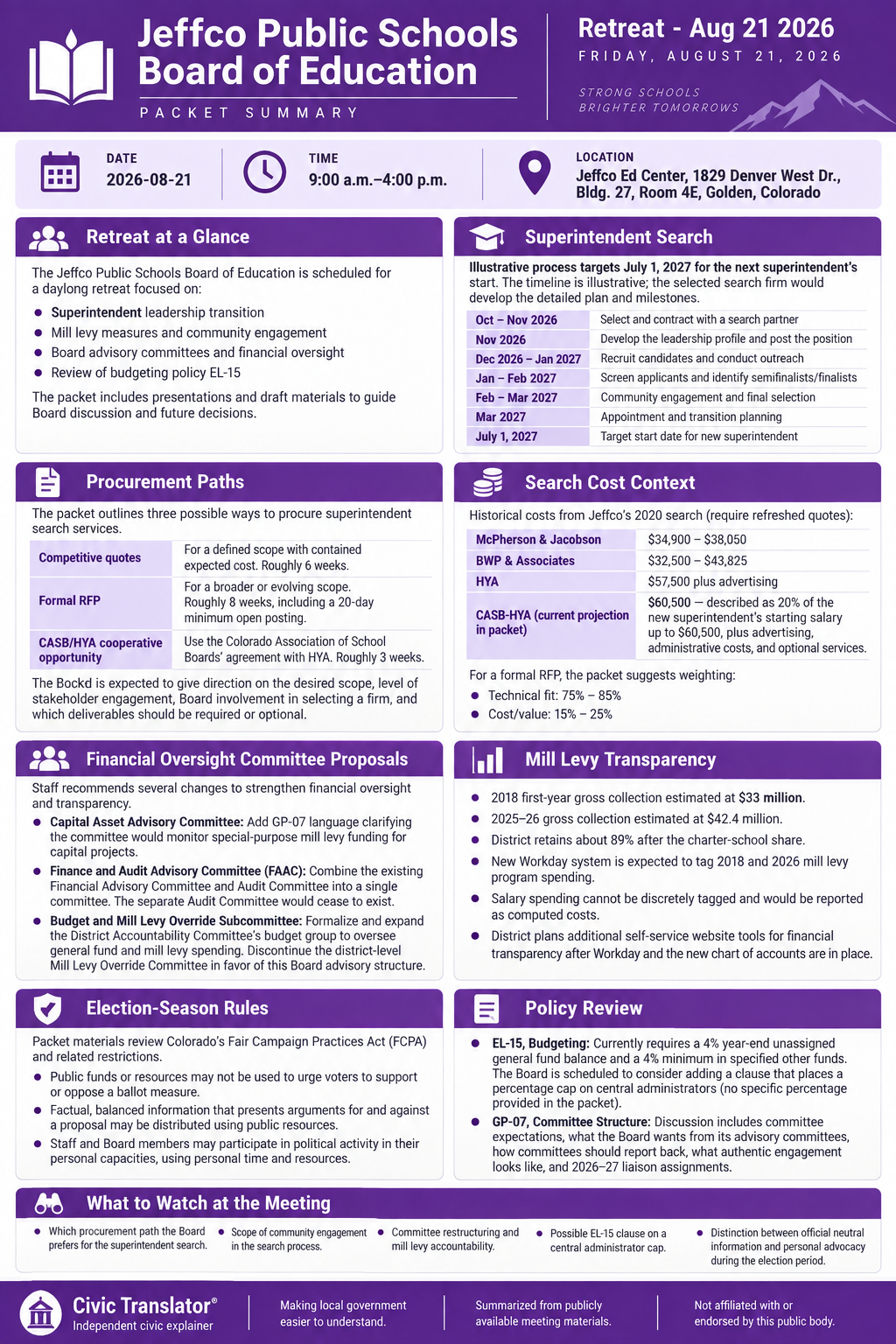
The Jeffco Public Schools Board of Education is scheduled for a daylong retreat focused on the superintendent leadership transition, mill levy measures and community engagement, Board advisory committees and financial oversight, and a review of budgeting policy EL-15. The packet includes presentations and draft materials intended to guide Board discussion and future decisions rather than document completed actions.
Key Items on the Agenda
Superintendent Search and Procurement Strategy
A major portion of the retreat is devoted to planning the search for Jeffco's next superintendent. The packet presents an illustrative search timeline with a target start date of July 1, 2027, while noting that the selected search firm would develop the detailed project plan and milestones.
The illustrative sequence is:
- October–November 2026: Select and contract with a search partner.
- November 2026: Develop the leadership profile and post the position.
- December 2026–January 2027: Recruit candidates and conduct outreach.
- January–February 2027: Screen applicants and identify semifinalists/finalists.
- February–March 2027: Conduct community engagement and final selection.
- March 2027: Appoint the superintendent and begin transition planning.
- July 1, 2027: Target start date.
The Board is expected to consider how much of the search should be handled by district staff versus an outside firm. Two potential scopes are presented: a split-responsibility model in which district staff handles engagement and communications, and a fuller-service model in which the contractor also leads community engagement, finalist activities and transition planning.
Three Procurement Options
The packet lays out three possible ways to procure superintendent search services.
- Competitive quotes: Intended for a clearly defined scope with a contained expected cost. The packet estimates a roughly six-week process.
- Formal RFP: Designed for a broader or still-developing scope where firms may propose different approaches. The packet estimates roughly eight weeks, including a 20-day minimum open posting.
- CASB/HYA cooperative opportunity: Would use the Colorado Association of School Boards' Master Service Agreement with Hazard, Young, Attea & Associates (HYA). The packet describes an approximately three-week procurement path.
The Board is being asked to provide direction on the desired scope, level of stakeholder engagement, Board involvement in selecting a firm, and which deliverables should be required or optional.
Search Firm Costs and Evaluation
The packet provides historical and current cost information to inform the procurement discussion. Historical figures are from Jeffco's 2020 executive-search procurement and would require refreshed quotes for a new search:
- McPherson & Jacobson: $34,900–$38,050 historical range.
- BWP & Associates: $32,500–$43,825 historical range.
- HYA: $57,500 plus advertising in the historical comparison.
- CASB-HYA partnership: Current projected cost listed as $60,500, described as 20% of the new superintendent's starting salary up to $60,500, plus advertising, administrative costs and any additional services selected by the Board.
For a formal RFP, the packet suggests weighting technical fit at 75%–85% and cost/value at 15%–25%. Proposed evaluation factors include experience with large public-school districts, Colorado legal knowledge, community engagement and recruitment capabilities, cost and value, and performance during interviews and presentations.
Board Advisory Committees and Financial Oversight
Another major retreat topic concerns changes to Board advisory committees, particularly those responsible for financial oversight. Staff materials identify goals of strengthening oversight, increasing transparency, expanding participation while respecting conflict-of-interest policies, and building voter trust.
The packet connects this work to past and future mill levy oversight and proposes several changes to the existing committee structure.
Capital Asset Advisory Committee
The Capital Asset Advisory Committee currently provides oversight related to capital projects, budgeting, spending, facilities and long-term capital planning.
Staff recommends adding language to GP-07, Committee Structure, clarifying that the committee would also monitor special-purpose mill levy funding used for capital projects to ensure that spending aligns with promises made to voters.
Finance and Audit Advisory Committee
Staff recommends combining the existing Financial Advisory Committee and Audit Committee into a single Finance and Audit Advisory Committee (FAAC).
The proposed change is intended to:
- Give all FAC members greater visibility into the annual comprehensive financial report and audit process.
- Reduce time spent coordinating between separate committees.
- Preserve focused time with auditors.
- Incorporate financial reporting, audit review and internal-control oversight within one advisory structure.
Under the proposal, the separate Audit Committee would cease to exist.
Budget and Mill Levy Override Subcommittee
The District Accountability Committee already has a budget subcommittee addressing spending priorities, budget development, long-term financial sustainability, enrollment and revenue, transparency and fiscal controls.
Staff recommends formalizing and expanding that group as the Budget and Mill Levy Override Subcommittee. Its responsibilities would include reviewing general fund spending as well as mill levy override spending and assessing whether expenditures align with commitments made in tax measures, particularly the 2018 mill levy override and subsequent overrides.
Staff also recommends discontinuing the district-level Mill Levy Override Committee created in April 2026 in favor of placing this oversight function within the formal Board advisory structure associated with the District Accountability Committee.
Mill Levy Spending and Transparency
The packet provides background on the district's 2018 mill levy override and financial oversight commitments. It reports that the first-year gross collection was estimated at $33 million, while the 2025–26 gross collection was estimated at $42.4 million. Those figures include the charter-school share; the packet states that the district retains about 89%.
For mill levy spending and reporting, the packet notes that:
- Salary and benefit increases represent recurring spending after the initial increase.
- Career and technical education spending is expected to occur largely at the school level, with some central coordination.
- The new Workday system is expected to allow program spending associated with the 2018 and 2026 mill levy overrides to be tagged.
- Salary spending cannot be discretely tagged, so reports would instead show computed costs.
- The district plans additional self-service website tools for financial transparency after Workday and the new chart of accounts are in place.
The packet also states that universal pre-K funding changes have affected the deployment of previous mill levy funds. State and tuition funding now cover core pre-K costs, while pre-K-related mill levy funds are being used to support special education services and assessment for three- and four-year-olds.
Mill Levy Community Engagement and Election Rules
The retreat includes separate sessions on Board roles, community engagement and participation related to mill levy measures. Supporting materials review Colorado's Fair Campaign Practices Act (FCPA) and the restrictions on using public resources in connection with ballot measures.
The packet emphasizes that the district, as a political subdivision, may not use public funds or resources to urge voters to support or oppose a ballot measure. It may use public money to distribute a factual summary that presents arguments for and against a proposal without reaching a conclusion or expressing an opinion favoring either outcome.
Examples of district resources identified in the packet include:
- District budgets and funds.
- Copiers, printers and telephone systems.
- District email accounts, staff and family lists, and official communication channels.
- District property and facilities.
- Paid employee work time.
The materials identify advocacy emails from district accounts, district social media posts supporting passage, one-sided informational meetings, campaign meetings during work hours and campaigning in an apparent official capacity as prohibited conduct.
Board members and staff may participate in political activity in their personal capacities, including voting, contributing personal time or money, attending political events and discussing issues with others. The packet stresses that such activity should occur on personal time, without district supplies, technology or funds, and with a clear distinction between personal advocacy and official duties.
Policy and Governance Review
EL-15 — Budgeting
The Board is scheduled to review and discuss EL-15, Budgeting, an Executive Limitations policy governing the superintendent's recommended budget and the district's financial planning.
Existing EL-15 requirements include multi-year financial planning, understandable budget reporting, school- and fund-level expenditure information, credible revenue and expense projections, contingency planning, and controls on the use of reserves.
The policy currently calls for a year-end unassigned general fund balance of 4% of annual operating expenditures, along with a 4% minimum in specified other funds.
For the retreat, the agenda specifically states that the Board will consider adding a clause to EL-15 that places a percentage cap on central administrators. The packet does not state the proposed percentage in the agenda materials provided.
GP-07 — Committee Structure
GP-07 defines the structure and responsibilities of Board committees, including Board liaison roles and the advisory authority of individual committees.
The retreat discussion is expected to address:
- What the Board wants from its advisory committees.
- What authentic engagement should look like.
- How committees should report to the Board.
- Board liaison assignments for 2026–27.
- Proposed changes to committee responsibilities and financial oversight.
The packet's proposed changes involving the CAAC, the new Finance and Audit Advisory Committee, and the DAC's Budget and Mill Levy Override Subcommittee would require corresponding changes to GP-07 language.
What to Watch at the Meeting
Several retreat discussions could shape later Board actions and district processes:
- Superintendent search procurement: Whether the Board favors competitive quotes, a formal RFP or the CASB/HYA cooperative option, and how extensive the search firm's responsibilities should be.
- Community involvement in the superintendent search: The Board is being asked to consider whether engagement should include surveys, focus groups, public forums or a broader engagement program.
- Financial oversight structure: Staff is proposing consolidation and reassignment of responsibilities among several advisory committees.
- Mill levy accountability: Proposed committee changes would formalize oversight of both existing and future mill levy spending within Board advisory structures.
- EL-15: The Board is scheduled to consider whether its budgeting policy should establish a percentage cap on central administrators.
- Election-season boundaries: The packet emphasizes the distinction between neutral, publicly funded information and advocacy undertaken in a personal capacity.
Because this is a retreat packet, these materials primarily frame issues for Board review, discussion and direction. Proposed policy language, committee changes, procurement approaches and search timelines should not be treated as final Board decisions unless subsequently acted upon.
Civic Translator summarized publicly available meeting materials from the official public-body source identified above.