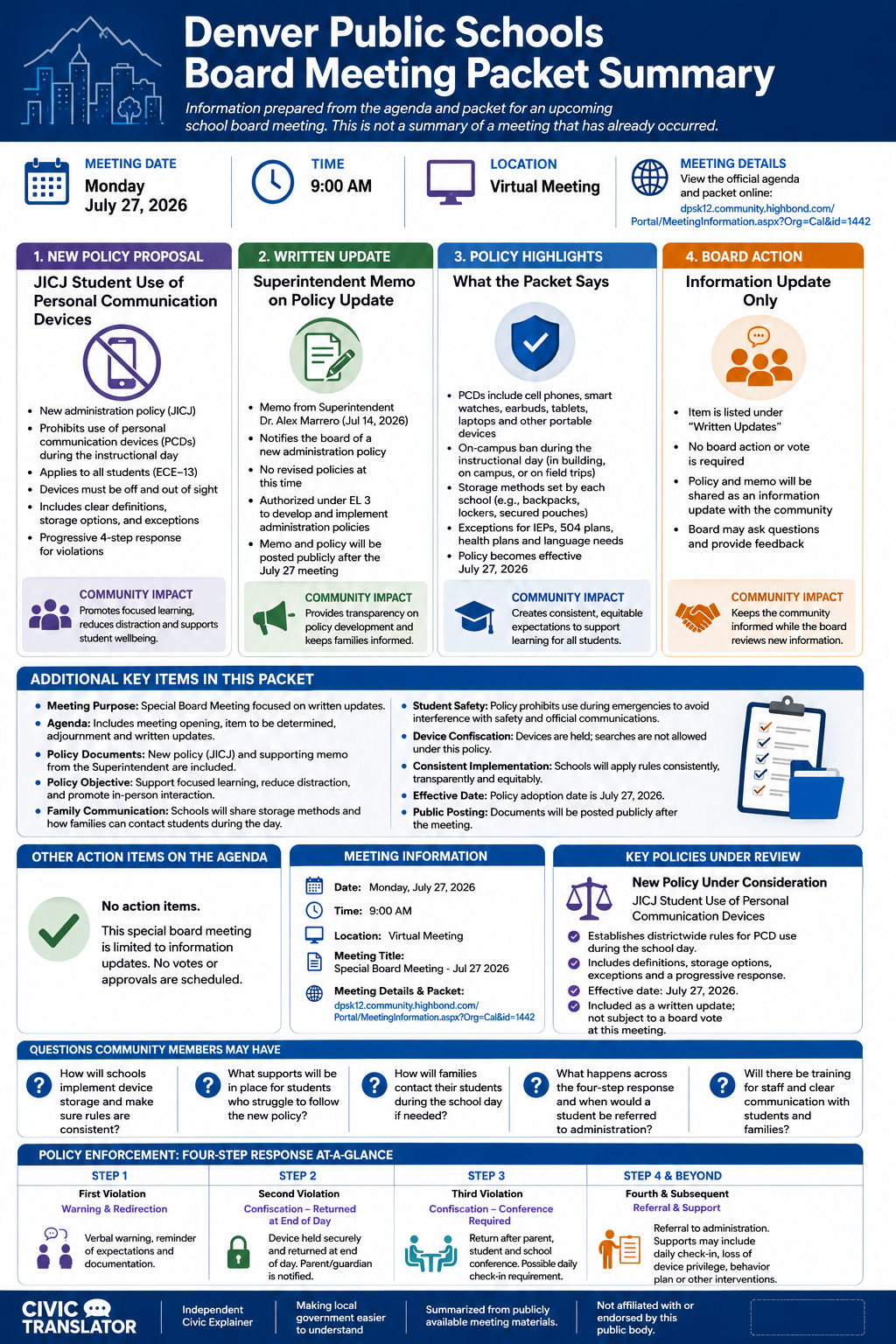
This special virtual meeting of the Denver Public Schools Board of Education is unusually focused. Rather than a full agenda with multiple action items, the packet centers on a single written administrative update introducing a new districtwide policy governing student use of personal communication devices during the school day.
The proposed Administration Policy JICJ would establish a districtwide expectation that personal communication devices—including cell phones, smart watches, earbuds, personally owned laptops and tablets, and similar devices—remain turned off and out of sight throughout the instructional day for students in all grade levels from ECE through grade 13. The stated goals are to improve student focus, reduce classroom distractions, encourage in-person interaction, and support student wellbeing through consistent expectations rather than punitive discipline.
Families, students, teachers, and school administrators would all be affected. Although every school would be allowed to choose its own storage method, each campus would be required to communicate those procedures before the school year begins and apply them consistently. The policy also establishes accommodations for students with disabilities, multilingual learners, and students with documented health needs while emphasizing equitable enforcement across schools.
The packet contains no major financial approvals, construction projects, contracts, or budget actions. Instead, it represents an operational and governance update that could substantially change daily school routines across Denver Public Schools beginning with adoption of the new administrative policy.
Major Discussion and Action Items
Student Personal Communication Device Policy
The primary purpose of the meeting packet is presentation of Administration Policy JICJ governing student use of personal communication devices.
The policy prohibits student use of personal communication devices throughout the instructional school day while students are in school buildings, on campus, or participating in school field trips. Covered devices include cell phones, smart wearables, wireless earbuds, personally owned laptops and tablets, non-District-issued computing devices, and other portable electronic communication devices.
Rather than emphasizing punishment, the policy states its goals are focused learning, reduced distractions, improved face-to-face interaction, and student wellbeing. Families are specifically identified as partners in implementation.
Districtwide Device Storage Requirements
Instead of prescribing one storage system for every campus, the proposal allows principals to determine the most appropriate local approach.
Possible storage methods include:
- Keeping devices turned off in backpacks, lockers, or personal storage.
- School-managed systems such as secure pouches, lockboxes, caddies, or centralized check-in/check-out procedures.
Each school must communicate its chosen process before the first day of classes, and implementation must be simple, transparent, consistent, and equitable across students.
Student Exceptions and Accessibility
The policy recognizes that some students require access to communication technology.
Exceptions are provided for students whose use is authorized through:
- Individualized Education Programs (IEPs)
- Section 504 Plans
- Individual Health Plans
- Supports for Multilingual Learners
Students may also wear prescription smart glasses provided communication features are disabled. Information regarding approved accommodations is to be shared only with staff who have a legitimate educational interest, consistent with FERPA privacy protections.
Progressive Enforcement Instead of Automatic Punishment
Rather than imposing immediate suspension, the proposal creates a four-step progressive response system.
The progression begins with verbal warning and redirection, advances to temporary confiscation with parent notification, then to a required parent conference, and finally to administrative interventions such as behavioral contracts, detention, continued device check-in requirements, or loss of the privilege to bring devices to school.
The policy specifically states students should not be suspended solely because they possessed or accessed a personal communication device in violation of this policy, although separate violations of the Student Code of Conduct may still result in discipline. Every violation is expected to be documented.
Privacy, Emergency Communication, and Safety
Several provisions address safety concerns beyond ordinary classroom use.
The proposal prohibits photographing or recording students or staff in ways that invade privacy or cause harm and bans recording devices in locker rooms, restrooms, and similar locations.
During emergencies—including lockdowns and active-threat situations—students are not authorized to use personal communication devices because personal communications may interfere with emergency response or spread misinformation. Instead, schools and the district are responsible for communicating with families through official channels.
Confiscated devices are not to be searched under this policy because its purpose is enforcing a device-free school day rather than conducting investigations.
Superintendent Administrative Update
A memorandum from Superintendent Dr. Alex Marrero explains that Administration Policy JICJ is a new administrative policy developed under Executive Limitation 3 authority, which authorizes the Superintendent to establish operational policies needed for district administration.
The memo notes there are no revised administrative policies accompanying this update—only the new personal communication device policy. The written update was approved for public posting as part of the July 27, 2026 special board meeting. Deborah Staten, Chief of Staff, is identified as the contact for questions.
Financial Matters
The packet does not include significant financial actions.
No contracts, grants, bond measures, capital expenditures, vendor agreements, budget amendments, tax matters, or funding requests are presented in the accessible materials. The principal focus is administrative policy rather than fiscal decision-making.
Policies, Ordinances, Resolutions, and Governance
The central governance item is Administration Policy JICJ.
The proposed policy would:
- Establish districtwide restrictions on student personal communication device use.
- Apply to students across all grade levels.
- Require devices to remain turned off and out of sight during the instructional day.
- Allow school-specific storage procedures within district standards.
- Require equitable and transparent enforcement.
- Create standardized exceptions for disability accommodations, health needs, and multilingual supports.
- Implement a progressive discipline model rather than exclusionary punishment.
- Clarify emergency communication expectations.
- State that grades cannot be reduced solely because of policy violations.
The superintendent's memo indicates this is a new administrative policy rather than a revision of an existing policy.
The written update consists primarily of:
- A superintendent memorandum introducing the new administrative policy.
- The complete text of Administration Policy JICJ.
The policy explains the educational rationale for limiting personal communication devices, emphasizing improved instructional focus, stronger student engagement, reduced distractions, equitable implementation, and restorative responses to violations instead of punitive discipline whenever appropriate.
Personnel, Appointments, and Organizational Matters
The packet contains no hiring recommendations, employment agreements, resignations, retirements, board appointments, committee assignments, recognitions, or organizational restructuring.
Personnel references are limited to Superintendent Dr. Alex Marrero, who transmitted the policy update, and Chief of Staff Deborah Staten, who is identified as the contact for additional information.
Projects, Facilities, Infrastructure, and Operations
Although no construction or capital projects are included, the proposed policy would require operational planning throughout Denver Public Schools.
Each school will need to determine:
- How devices will be stored during the school day.
- How parents and students will be informed before implementation.
- How violations will be documented.
- How confiscated devices will be securely handled.
- How parent conferences and progressive interventions will be managed.
- How families can communicate with students during emergencies through school procedures.
These operational decisions would occur at the building level within district policy requirements.
The packet identifies the Special Board Meeting as a virtual meeting scheduled for July 27, 2026, at 9:00 a.m.
The accessible materials do not identify a separate public hearing, formal public comment period, survey, or additional community engagement opportunity related to the proposed policy.
Students would experience the largest day-to-day changes because personal communication devices would generally no longer be available during the instructional day.
Families would need to communicate with students through school offices during the school day rather than by direct messaging or phone calls except where approved accommodations apply.
Teachers and administrators would receive a districtwide framework intended to create more consistent expectations across schools while emphasizing restorative responses instead of immediate exclusion from instruction.
School leaders would retain flexibility in choosing storage systems that fit their campuses while remaining responsible for communicating procedures clearly and enforcing them consistently.
Students with disabilities, health needs, and qualifying educational plans would continue receiving authorized accommodations under the policy.
- How will each school determine its device storage method?
- How will implementation remain consistent across schools with different storage systems?
- What training will staff receive before enforcement begins?
- How will parents be notified if a student's device is confiscated?
- What metrics will the district use to evaluate whether the policy improves learning or school climate?
- How will schools support students with legitimate communication needs beyond the listed exceptions?
- How will emergency family communication procedures be communicated before implementation?
- How will repeated violations be tracked while ensuring equitable treatment across schools?
- What additional campus rules may principals establish under the policy?
- When will families receive detailed implementation guidance before the school year?
Important Dates, Deadlines, and Next Steps
- July 7, 2026: Meeting agenda published.
- July 14, 2026: Superintendent memorandum issued introducing Administration Policy JICJ.
- July 27, 2026, 9:00 a.m.: Virtual Special Board Meeting.
- July 27, 2026: Policy lists an adoption date of July 27, 2026.
- Before the first day of school: Each school is expected to communicate its chosen device storage procedures and family communication processes before implementation.
Key Takeaways
- The meeting packet is almost entirely devoted to a new student personal communication device policy.
- The proposal applies districtwide from ECE through grade 13.
- Cell phones, smart watches, earbuds, and other personal communication devices are covered.
- Devices would generally remain turned off and out of sight during the instructional day.
- Schools may choose their own storage systems within district guidelines.
- Students with IEPs, Section 504 Plans, health plans, and multilingual learner needs may qualify for exceptions.
- The policy establishes a four-step progressive response rather than automatic suspension.
- Confiscated devices are not to be searched under this policy.
- Schools remain responsible for emergency communication with families.
- No major budget, contract, construction, or financial actions appear in the accessible meeting materials.
Official Sources
About the Public Body
- Name: Denver Public Schools
- Organization type: school-district
- Government body: school-boards
- Location: Denver, colorado
- County: Denver
- Provider: diligent-community
Keywords
Denver Public Schools, DPS Board of Education, Special Board Meeting, July 27 2026, Administration Policy JICJ, student cell phones, personal communication devices, classroom technology, instructional day, school discipline, restorative practices, equitable enforcement, device storage, backpacks, secure pouches, lockers, parent communication, emergency notifications, IEP accommodations, Section 504, multilingual learners, FERPA, Superintendent Alex Marrero, Deborah Staten, school operations, virtual meeting, student wellbeing, classroom focus