San Ramon Valley Unified School District Meeting Summary — August 18, 2026
Key Actions
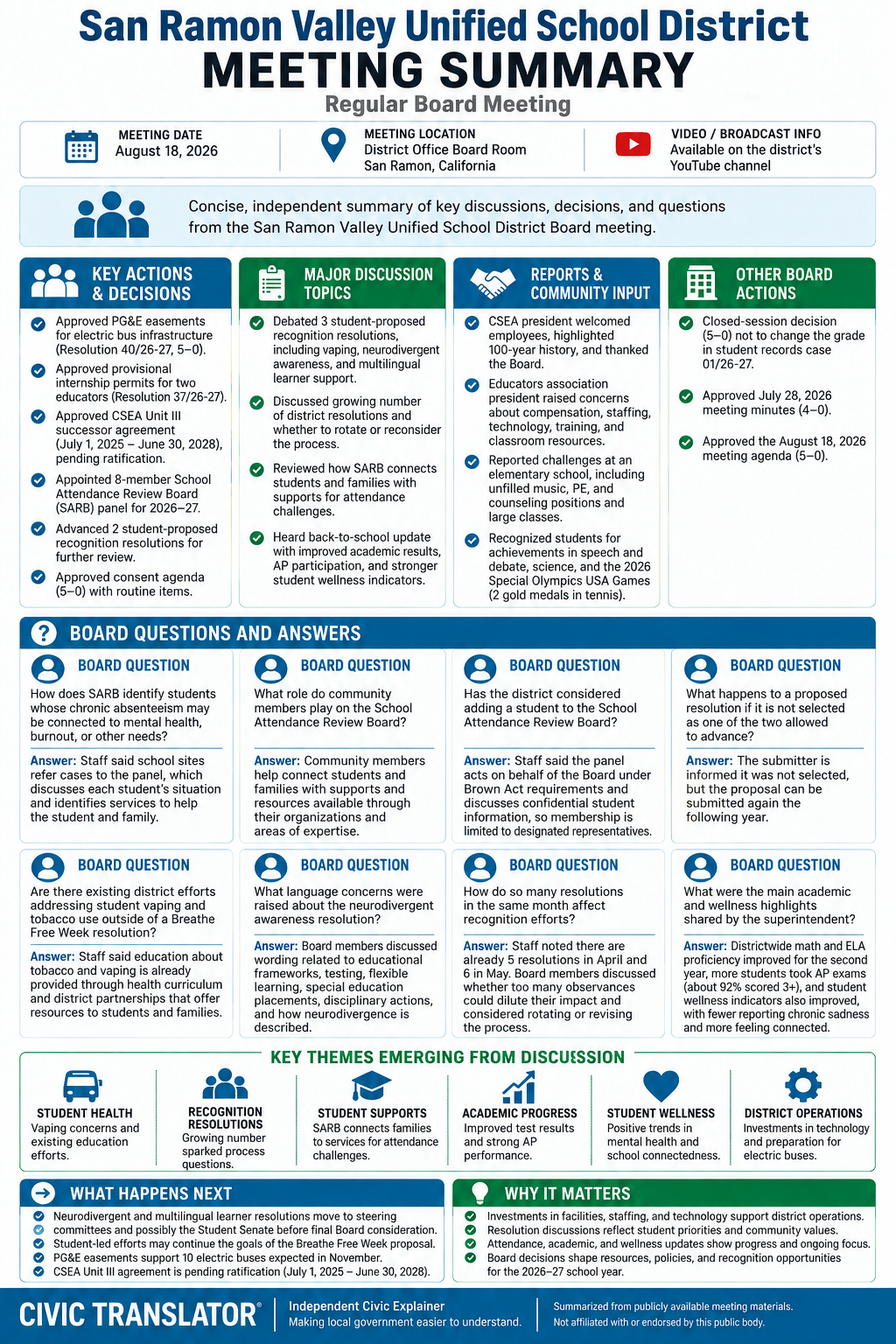
PG&E Easement Approved for Electric Bus Infrastructure
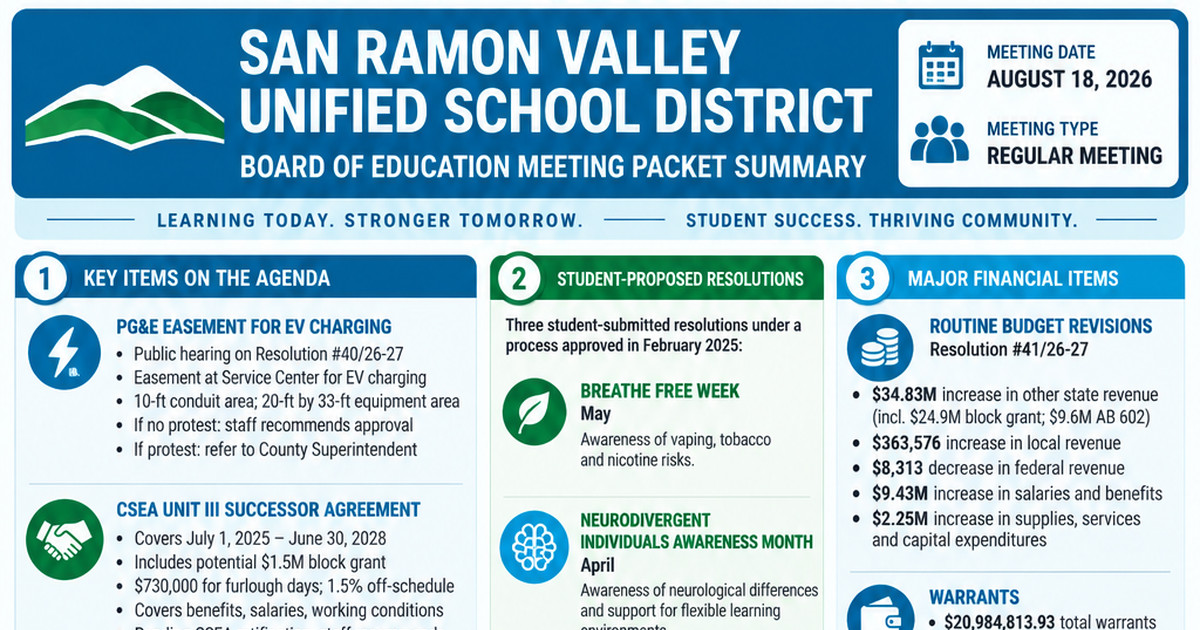
The Board approved Resolution 40/26-27 authorizing easements to PG&E as the district prepares for 10 electric buses expected in November. District staff said PG&E needs a 10-foot-wide easement across the service and parking lot for underground conduit lines and a 20-by-33-foot easement for transformer-related equipment.
The Board had previously declared its intent to convey the easements. A required public hearing was opened and closed without public comment before the Board approved the resolution 5–0.
Provisional Internship Permits Approved
The Board approved Resolution 37/26-27 covering provisional internship permits for two district educators. Staff said the permits will give the educators additional time to meet subject-matter competency requirements so they can enter internship programs and continue working toward their credentials.
CSEA Unit III Successor Agreement Approved
The Board approved a successor agreement with California School Employees Association Chapter 65, Unit III, covering July 1, 2025 through June 30, 2028, pending CSEA ratification.
Staff said the negotiated agreements and required AB 1200 disclosure had previously been presented to the Board, but the Unit III agreement needed additional time to finalize minor details.
School Attendance Review Board Panel Appointed
The Board approved an eight-member School Attendance Review Board, or SARB, panel for 2026–27. The panel includes district and community representatives who meet monthly to review student attendance cases and recommend supports.
Staff said many members are returning and the panel includes a new nurse. Discussion focused on how SARB connects students and families with services when attendance problems are related to individual needs.
Two Student-Proposed Resolutions Advance for Further Review
The Board considered three student-proposed recognition resolutions:
- Breathe Free Week in May
- Neurodivergent Individuals Awareness Month in April
- National Multilingual/Bilingual Learner Advocacy Month in April
Under the district's process, the Board may advance up to two proposals for additional review before they return for possible final approval.
An initial motion to advance Breathe Free Week and Neurodivergent Individuals Awareness Month did not pass. A subsequent motion advanced Neurodivergent Individuals Awareness Month and National Multilingual/Bilingual Learner Advocacy Month.
The two proposals will proceed to review by district steering committees and potentially the Student Senate before returning to the Board for final consideration.
Consent Agenda Approved
The Board approved the consent agenda 5–0. The agenda included personnel changes, credential assignments, policy and administrative regulation revisions, 2026–27 salary schedules, warrants, surplus property, claims, a grocery bid award, contracts and purchases over $50,000, purchase orders, and routine budget revisions.
Major Discussion Topics
Debate Over New Recognition Resolutions
The Board spent substantial time discussing how to choose among three student-proposed resolutions when district policy permits no more than two to advance.
Breathe Free Week prompted discussion about vaping and nicotine use among students. Board members described vaping as an ongoing concern at secondary schools and considered whether a formal resolution would strengthen the district's message or whether existing health curriculum, partnerships, Red Ribbon Week activities, and other student initiatives could address the issue.
Staff said the district already provides education about tobacco and vaping through existing programs, including health curriculum and partnerships that provide resources to students and families.
The Neurodivergent Individuals Awareness Month proposal prompted detailed discussion about wording. Board members supported the proposal's overall intent but raised questions about language concerning traditional educational frameworks, testing, flexible learning, special education placements, disciplinary actions, and how neurodivergence was described. The discussion contemplated refining language as the proposal moves through the review process rather than treating the current version as final.
Board members also discussed National Multilingual/Bilingual Learner Advocacy Month in relation to the district's strategic priorities and achievement gaps. Ultimately, that proposal and the neurodivergence proposal were selected to move forward.
Managing a Growing Number of District Resolutions
The resolution discussion also raised a broader question about how many recognition resolutions the district can meaningfully support. Staff reported that the district already has five resolutions in April and six in May.
Board members discussed whether too many observances in the same month could dilute their impact and whether the district might eventually need to rotate resolutions or reconsider its process. They also emphasized that school sites vary in how extensively they implement recognition activities, while the district provides resources such as videos, presentations, and suggested activities.
Student Attendance Supports
During consideration of the SARB appointments, the Board discussed how the attendance review process addresses underlying causes of chronic absenteeism.
Staff explained that the panel reviews referrals from school sites and works with students and families to identify specific barriers to attendance. The goal is to connect them with appropriate services and determine what could make attending school more successful and sustainable.
Back-to-School Academic and Student Wellness Indicators
The superintendent reported improved districtwide proficiency in both mathematics and English language arts for the second consecutive year.
Despite declining enrollment, more students took Advanced Placement exams during the previous spring, and approximately 92% of tested students earned a score of 3 or higher, up slightly from the prior year.
The superintendent also reported improvements in student social-emotional indicators, including fewer students reporting chronic sadness and hopelessness or suicidal ideation and more reporting a sense of school connectedness.
The superintendent credited staff, students, families, and community partners for the results and also highlighted summer work by classified employees and technology staff. The district spent nearly $1.8 million on additional Chromebooks and work to repair and improve servers ahead of the new school year.
Board / Council Questions
- Question: How does the School Attendance Review Board identify students whose chronic absenteeism may be connected to mental health, academic burnout, or other individual needs, and connect them with support?
Answer: Staff said school sites refer attendance cases to the panel, which then discusses each student's circumstances and identifies services that could help the student and family. The panel considers what would help the student get to school and what could make school a more successful or positive environment.
- Question: What role do community members play on the School Attendance Review Board?
Answer: Staff said community members help connect students and families with supports and resources available through their organizations and areas of expertise.
- Question: Has the district considered adding a student to the School Attendance Review Board?
Answer: Staff said the panel acts on behalf of the Board of Education under Brown Act requirements and discusses highly confidential student information, so its membership is kept to the designated representatives.
- Question: What happens to a proposed recognition resolution if the Board does not select it as one of the two proposals allowed to advance?
Answer: Staff said the person who submitted the proposal is informed that it was not selected for the next stage, but the proposal can be submitted again the following year.
- Question: Are there existing district efforts addressing student vaping and tobacco use outside of adopting a Breathe Free Week resolution?
Answer: Staff said tobacco and vaping education is already incorporated into existing efforts, including portions of ninth-grade health curriculum and district partnerships that provide education and resources to students and families facing substance-related challenges.
Reports and Community Perspectives
Employee Association Reports
The CSEA president welcomed employees back for the school year, highlighted the organization's 100-year history, and expressed appreciation for the Board's consideration of the Unit III successor agreement.
The educators association president raised concerns about employee compensation, staffing, technology, training, and classroom resources. She said educators were beginning a third consecutive school year without an increase to the salary schedule and were continuing to work under an agreement that expired in June 2025.
She also described challenges at an elementary school involving unfilled music, physical education, and counseling positions, large classes, technology problems, and implementation of new curriculum.
Student Recognition
The Board recognized students for achievements including national speech and debate competition, science-related accomplishments, and participation in the 2026 Special Olympics USA Games.
Among the accomplishments highlighted was a national Congressional Debate championship earned against a field of 456 students and two Special Olympics gold medals in tennis, covering singles and doubles competition.
Other Board Actions
The Board reported a 5–0 closed-session decision not to change the grade involved in student records case 01/26-27.
The Board also approved the July 28, 2026 meeting minutes by a 4–0 vote and approved the August 18 meeting agenda 5–0.
What Happens Next
- Neurodivergent Individuals Awareness Month and National Multilingual/Bilingual Learner Advocacy Month will move into the district's next review stage, including review by steering committees and potentially the Student Senate, before returning to the Board for possible final approval.
- Board members suggested that the Student Senate or another student-led effort could consider taking up the goals behind the Breathe Free Week proposal even though it was not selected to advance through the resolution process.
- The approved PG&E easements support infrastructure work connected with 10 electric buses that district staff said are expected in November.
- The CSEA Unit III successor agreement covers July 1, 2025 through June 30, 2028 and was approved pending CSEA ratification.