Elk Grove Unified School District Packet Summary — 2026-08-18
Meeting: 08/18/2026 - 09:00 AM Special Board Meeting Board Meeting
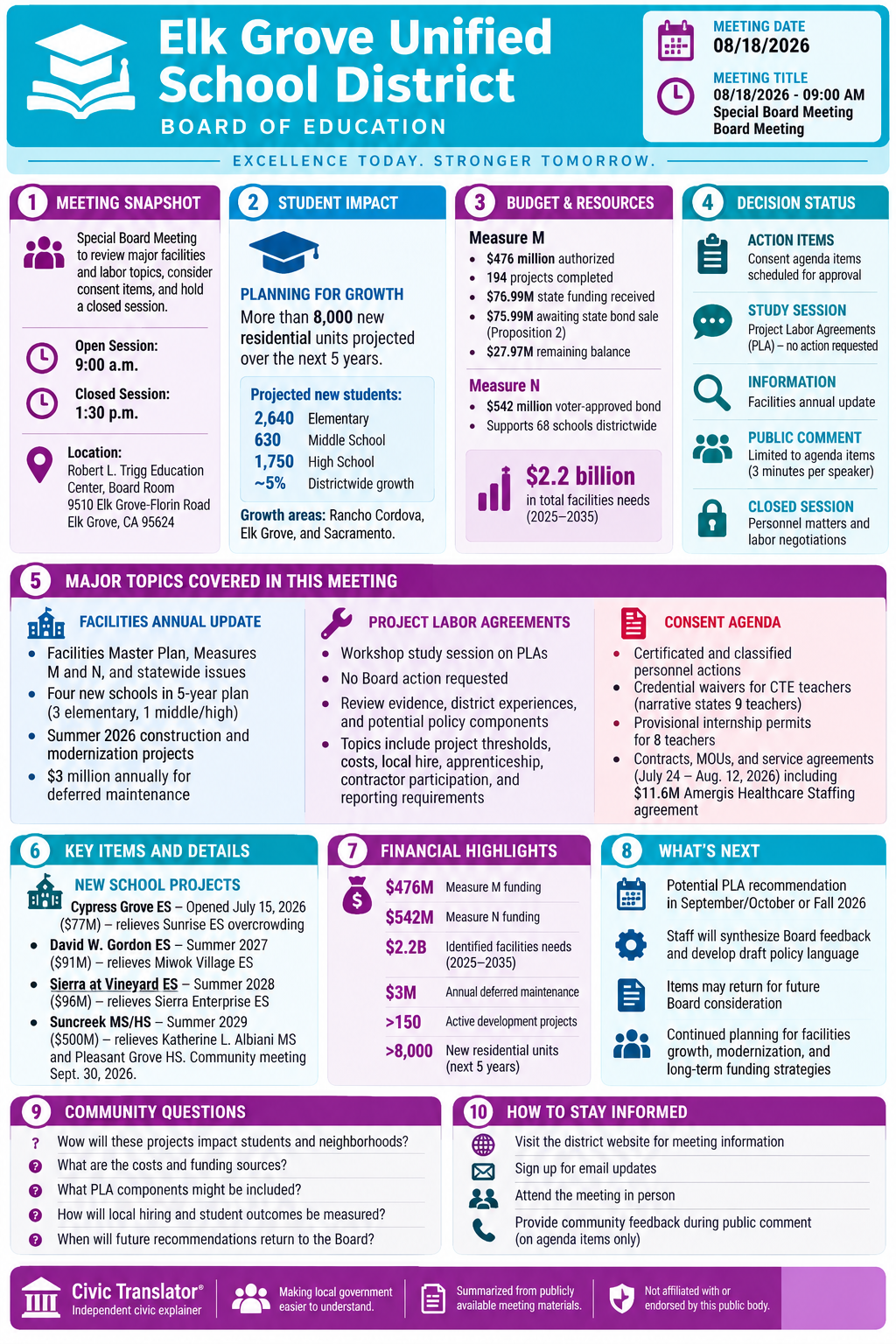
Open Session: 9:00 a.m.
Closed Session: 1:30 p.m.
The Elk Grove Unified School District Board of Education is scheduled for a special meeting centered on two substantial study topics: the district’s annual facilities update and a workshop on Project Labor Agreements. The agenda also includes consent items covering personnel, credentialing, and contracts, followed by a closed session on personnel and labor negotiations.
Key Items on the Agenda
Facilities Annual Update
Staff will present an annual update on the Facilities Master Plan, Measures M and N, school facilities and operations, and related local and statewide facilities issues. The presentation outlines significant enrollment growth, new-school construction, modernization projects, bond funding, and a long-term facilities need estimated at $2.2 billion.
The district reports that it is monitoring more than 150 active development projects and projects more than 8,000 new residential units over the next five years. Over that period, projections include approximately:
- 2,640 new elementary students
- 630 new middle school students
- 1,750 new high school students
- Approximately 5% districtwide enrollment growth
Growth is concentrated in Rancho Cordova, Elk Grove, and Sacramento development areas. Facilities planning identifies four new schools within the five-year horizon: three elementary schools and one combined middle/high school campus.
New Schools and Growth
The facilities presentation provides updates on four major school projects:
- Cypress Grove Elementary School: Opened July 15, 2026, in Rancho Cordova. The presentation lists $77 million in hard costs and says the school is intended to relieve overcrowding at Sunrise Elementary while serving residential growth.
- David W. Gordon Elementary School: Under construction with an anticipated Summer 2027 opening. The project has $91 million in hard costs and is intended to relieve overcrowding at Miwok Village Elementary. Boundary information is expected in September.
- Sierra at Vineyard Elementary School: Under development for a Summer 2028 opening, with estimated hard costs of $96 million. The school is planned to relieve overcrowding at Sierra Enterprise Elementary and serve Sacramento-area growth.
- Suncreek Middle/High School: Under development for a Summer 2029 opening, with estimated hard costs of $500 million. The planned joint-use campus is intended to relieve overcrowding at Katherine L. Albiani Middle School and Pleasant Grove High School. A community meeting is listed for September 30, 2026.
The Suncreek project is moving through schematic design toward design development, with the district exploring shared administration, library, and kitchen facilities to improve long-term efficiency.
Major Financial and Facilities Items
Measure M and Measure N
The district’s facilities program continues to draw on voter-approved bond funding, state matching funds, and developer-generated school impact fees.
For Measure M, the presentation reports:
- $476 million in voter-authorized funding
- 194 projects completed
- $76.99 million in state funding received
- $75.99 million approved and awaiting a state bond sale through Proposition 2
- $17.28 million identified as pending future state bond funding
- $27.97 million remaining balance
Measure N is a $542 million voter-approved bond covering 68 schools districtwide. The presentation says the measure supports modern labs and career technical education facilities, safety and security improvements, new schools for residential growth, aging HVAC and electrical infrastructure, classroom technology, clean water, pavement, playgrounds, and projects eligible for state modernization matching funds.
$2.2 Billion in Identified Facilities Needs
The district’s 2025–2035 Facilities Master Plan identifies approximately $2.2 billion in total facilities needs involving modernization, expansion, and structural upgrades. The presentation also identifies $3 million annually for deferred maintenance and lists a possible general obligation bond in 2028 or 2030 among future considerations.
The district says its strategy is to combine community bond proceeds, developer fees, and state matching funds while prioritizing safety, student impact, enrollment capacity, and available funding.
Summer Construction and Modernization
A broad slate of projects is underway or in design across the district. Work identified for Summer 2026 includes modernization or facility improvements at T.R. Smedberg Middle School, Jessie Baker School, Florin High School, Sheldon High School, Cosumnes Oaks High School, Irene B. West Elementary, Valley High School, and other campuses.
Projects under design include Suncreek Middle/High School, Sierra at Vineyard Elementary, a new multipurpose room/classroom project at Elk Grove Charter School, kitchen HVAC additions at Valley and Florin high schools, electronic access-control upgrades, and additional modernization work.
Project Labor Agreements Workshop
No PLA Adoption Decision Scheduled
The Board is scheduled for an extended workshop and study session on Project Labor Agreements (PLAs). The packet explicitly states that no Board action is requested and that no decision on adopting or implementing a PLA is scheduled for this meeting.
PLAs are described as pre-hire collective bargaining agreements between a public entity and construction trade unions. They can establish uniform employment conditions for covered construction projects and address matters including wages, benefits, work rules, dispute resolution, apprenticeships, local hiring, contractor participation, and other workforce provisions.
The August 18 workshop follows several months of study, stakeholder engagement, public comment, and prior Board discussion. Board feedback from this session is intended to help staff determine whether and how to develop a future recommendation.
Evidence and Tradeoffs Under Review
The packet identifies several issues for Board consideration, including:
- Project-size thresholds for PLA applicability
- Contractor and bidder participation
- Cost and construction schedules
- Apprenticeship requirements
- Student and career-pathway outcomes
- Local hiring
- Small-contractor access
- Reporting and data ownership
- Board oversight and transparency
- Exclusions for particular project types
- Potential sunset or review provisions
Information collected from other districts indicates that lower project thresholds may create administrative and bidder-participation concerns. The presentation specifically notes a recommendation from implementation feedback that a $1 million threshold may not be sufficient under current cost conditions.
The materials also report lower bid participation in one district compared with neighboring districts, particularly for low-voltage-only projects. Smaller projects were described as potentially somewhat more expensive, while larger projects were not clearly affected and negative schedule impacts were not reported in that feedback.
Student Outcomes and Workforce Development
The packet emphasizes that a PLA alone would not constitute a complete workforce-development system. While agreement language could establish apprenticeship or workforce expectations, the presentation says student outcomes would require district-owned tracking, reporting, and accountability.
Existing data can show apprenticeship participation, program capacity, trade participation, and the number of apprentices or members living in EGUSD-area ZIP codes. The packet cautions that the available data cannot establish whether participants graduated from EGUSD, entered through district career technical education pathways, or achieved an outcome because of a PLA.
Board members are being asked to consider what student metrics, local-hire measures, reporting cycles, and accountability mechanisms should accompany any future framework.
Potential Fall 2026 Recommendation
Following the workshop, staff plans to synthesize Board feedback, annotations, evidence, and implementation considerations. Potential future materials could include:
- Draft PLA framework language
- Board Policy language
- Administrative Regulation language
- Reporting requirements
- Project thresholds
- Project or scope exclusions
The packet anticipates a possible return to the Board with a recommendation and draft language options in September/October or Fall 2026. Any such proposal would come back for future Board consideration rather than being decided at the August 18 study session.
Consent Agenda
The consent agenda is designated for action and is structured so that its items may be considered through a single motion unless an item is pulled for separate discussion or action.
Personnel and Credentialing
The Board is asked to approve a list of certificated and classified personnel actions covering hires, leaves, resignations, promotions, retirements, returns from leave, and status changes. The agenda reports no fiscal impact.
The Board is also asked to consider Variable Term Credential Waivers for Career Technical Education teachers who need additional time to complete credential requirements for the 2026–27 school year. The packet's narrative states that nine teachers need waivers, while the accompanying agenda text lists more individual teachers than that stated total; the packet therefore does not provide a consistent count.
A separate consent item asks the Board to approve Provisional Internship Permits for eight teachers working toward the credentials or permits required for their assignments. The packet reports no fiscal impact for either credentialing item.
Contracts and Agreements
The Board is asked to approve and/or ratify contracts, MOUs, and service agreements signed by authorized district staff under Board Policy 3312. The contract schedule covers agreements authorized between July 24 and August 12, 2026 and includes services across special education, expanded learning, arts education, student support, facilities-related compliance, career programs, transportation, and family engagement.
Among the larger or notable listed items:
- Amergis Healthcare Staffing — $11,604,480: Behavioral paraeducators, BCBAs, academic paraeducators, supervisory support, and speech-language pathologists for students with disabilities during the 2026–27 school year.
- PRO Youth — $509,000: MindOneSix mentorship programming intended to support mental wellness, social-emotional learning, resilience, self-awareness, and coping skills through Expanded Learning.
- Ascend Rehab Services — $335,110: School-based speech therapy services for students whose IEPs identify a need for those services.
- Discovery Ranch — $331,200: Residential treatment and educational services for a student placed through an IEP.
- Amergis Healthcare Staffing — $200,000: Paraeducator and related support for students with disabilities in the Summer 2026 Extended School Year program.
- Patriot Environmental Services — $114,000: Environmental services that may include chemical and biological waste handling, consulting, transportation, and disposal.
- CASC Engineering & Consulting — $90,000: Consulting and management services related to the district's stormwater pollution compliance requirements.
- California Charter Authorizing Professionals — $75,000 annually: An amended agreement supporting charter-school authorization systems and two charter renewal petitions.
- Jennifer Neufeld — $56,240: Push-in K–6 music classes, choir, and ukulele programming at Raymond Case Elementary.
- Sacramento County Office of Education — $45,199: College tutors supporting AVID elective classes at Valley High School.
- All Things Pretty — $39,600: Social-emotional learning, leadership development, and college and career guidance at Calvine High School.
- NewSongs Music School — $30,265: Music programming at Mary Tsukamoto Elementary funded through Proposition 28.
- HopSkipDrive — $25,000 increase: Expansion of transportation services to include students experiencing homelessness, bringing the referenced contract total to $80,000.
The schedule also includes smaller agreements for arts programming, anti-bullying assemblies, student mentorship, family engagement, outdoor education, clinical externships, teacher residency placements, facility rentals, and other district services.
Public Participation and Closed Session
Because this is a special meeting, public comment is limited to items appearing on the agenda. The packet states that requests to comment are accepted until the Board President introduces the applicable item. Speakers generally receive three minutes, with individual time reduced when 15 or more people seek to speak on a specific item.
After the open-session agenda, the Board is scheduled to recess into closed session for:
- Government Code Section 54957: Public employee discipline, dismissal, release, or complaint.
- Government Code Section 54957.6: Conference with labor negotiators concerning Elk Grove Unified School District bargaining units and unrepresented employees.
The agenda provides for the Board to return to open session for any required report-out before adjournment.
What to Watch at the Meeting
The Project Labor Agreement workshop is the principal governance issue to watch. No PLA decision is scheduled, but Board feedback could determine the thresholds, exclusions, workforce requirements, contractor protections, student-outcome measures, and reporting expectations that staff incorporates into a potential Fall 2026 proposal.
The facilities presentation provides the broader financial backdrop. EGUSD is simultaneously planning for enrollment growth, four new schools, extensive modernization work, and approximately $2.2 billion in identified facilities needs, while combining Measure M and Measure N proceeds with developer fees and state matching funds.
The consent agenda also contains substantial service commitments, most notably the proposed $11.6 million Amergis Healthcare Staffing agreement supporting students with disabilities. Together, the packet frames the special meeting around two long-term questions: how the district will build and modernize facilities for continued growth, and what labor, workforce, accountability, and procurement framework should govern future construction work.