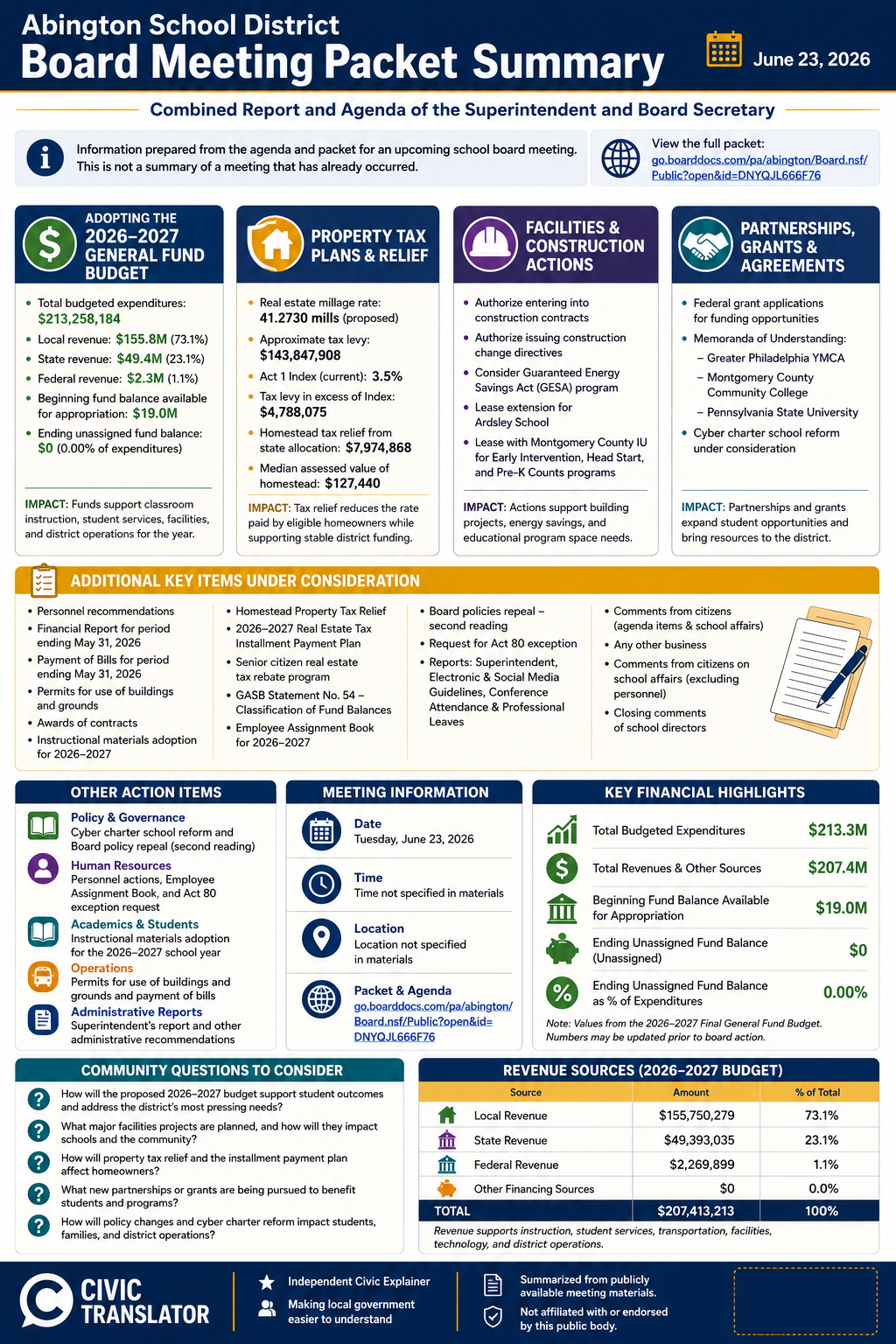
The June 23, 2026 meeting centers on adoption of the Abington School District's 2026-2027 final general fund budget and several related tax, financial, and operational actions. The proposed budget totals approximately $213.3 million in expenditures supported primarily by local property taxes, state aid, and federal grants. The budget also addresses capital planning, debt obligations, instructional programs, and mandated educational services.
One of the most consequential issues is the proposed property tax structure. The district's budget materials include adoption of the final budget, homestead property tax relief, a real estate tax installment payment plan, and continuation of the senior citizen real estate tax rebate program. Budget documents indicate an estimated $207.4 million in revenues and approximately $213.3 million in expenditures, with planned use of existing fund balance to balance operations.
The board is also considering a formal resolution urging Pennsylvania lawmakers to reform cyber charter school funding. District materials argue that current state funding formulas require traditional public schools to make tuition payments that exceed the actual cost of cyber education, placing growing pressure on local taxpayers and district budgets.
Beyond finances, the agenda includes instructional materials adoption, federal grant applications, employee assignments, construction authorizations, energy conservation planning, facility lease agreements, memoranda of understanding with educational and community partners, administrative reports, and opportunities for public comment.
Major Discussion and Action Items
2026-2027 Final General Fund Budget
The board is scheduled to adopt the district's final operating budget for fiscal year 2026-2027. Budget documents project approximately $207.4 million in revenue against approximately $213.3 million in expenditures, with fund balance supporting the difference. The budget funds instructional programs, transportation, facilities, student services, administration, debt service, and other district operations.
The budget package also includes required state reporting documents, tax resolutions, homestead tax relief, and implementation of the annual real estate tax structure. Adoption represents one of the board's most significant annual financial decisions.
Property Taxes and Homestead Relief
Several agenda items relate directly to property taxation. The board will consider homestead property tax relief and continuation of installment payment options for real estate taxes.
Budget documents project approximately $135.2 million in net current real estate tax revenue after homestead exclusions, while nearly $8.0 million in state property tax reduction funding supports homestead relief for eligible homeowners. District materials also describe the estimated tax effect on a median homestead property.
The district proposes adopting a resolution calling on the Governor, General Assembly, and Pennsylvania Department of Education to substantially reform cyber charter school funding.
According to the resolution, Abington paid approximately $6.6 million during one three-year period and approximately $7.3 million during the most recent three-year period in mandatory cyber charter tuition. The district argues current formulas produce inconsistent tuition rates among districts, fail to reflect actual educational costs, and contribute to higher local taxes.
The resolution requests establishment of statewide tuition rates based on actual costs, improved special education funding formulas, stronger financial transparency requirements, expanded public reporting, stronger oversight, and changes that would reduce duplication when districts already operate their own cyber programs.
Construction and Capital Projects
The board is scheduled to authorize construction contracts and issue construction change directives as needed for district capital work.
Separate agenda items also address the Guaranteed Energy Savings Act (GESA), which typically supports energy-efficiency improvements intended to reduce long-term operating costs through facility upgrades.
These actions are important because they allow ongoing capital projects to proceed while maintaining board oversight of major construction activity.
Educational Partnerships and Facility Agreements
Several proposed memoranda of understanding expand or continue partnerships with outside organizations, including:
- Greater Philadelphia YMCA
- Montgomery County Community College
- Pennsylvania State University
The board will also consider a lease agreement involving Montgomery County Intermediate Unit Early Intervention, Head Start, and Pre-K Counts programs, along with a lease extension involving Ardsley School. These agreements support educational programming, community partnerships, and use of district facilities.
Academic and Operational Planning
Additional significant agenda items include adoption of instructional materials for the 2026-2027 school year, submission of federal grant applications, requests for an Act 80 exception, and approval of the employee assignment book. Administrative reports include updates from the superintendent, social media guidance, and conference attendance.
Financial Matters
The budget projects approximately:
- Total expenditures: $213.3 million
- Estimated revenues: $207.4 million
- Local revenue: approximately $155.8 million
- State revenue: approximately $49.4 million
- Federal revenue: approximately $2.3 million
Major expenditure categories include approximately:
- Instruction: $117.8 million
- Support services: $75.3 million
- Student activities: $2.5 million
- Debt service and other financing uses: $17.6 million
Major local revenue sources include property taxes, earned income taxes, real estate transfer taxes, delinquent taxes, investment earnings, rental income, and miscellaneous revenues.
State funding includes basic education, special education, transportation subsidies, Ready to Learn funding, Safe Schools funding, retirement reimbursement, Social Security reimbursement, and property tax reduction allocations.
Federal revenues include Title I, Title II, Title III, Title IV, and Medicaid school-based reimbursement.
Budget schedules project approximately $68 million in cash and investments at the close of fiscal year 2025-2026, declining to an estimated $56 million one year later as capital and operating resources are utilized. Long-term indebtedness is projected to increase as planned borrowing supports district capital needs.
Policies, Ordinances, Resolutions, and Governance
Governance actions include:
- Second reading of board policy repeals.
- Adoption of Governmental Accounting Standards Board (GASB) Statement No. 54 fund balance classifications.
- Adoption of the cyber charter reform resolution.
- Approval of tax-related resolutions supporting homestead relief and payment options.
- Consideration of administrative procedures addressing electronic and social media guidance.
Several actions represent final approval stages rather than initial discussion.
The superintendent's report provides administrative updates to the board.
Budget presentations explain:
- Revenue assumptions.
- Property assessment changes.
- Historical tax rates.
- Fund balance trends.
- State and federal revenue.
- Mandated expenditures.
- Pension obligations.
- Charter school costs.
- Overall financial outlook.
Additional informational reports address conference attendance, professional leave requests, and updated administrative procedures governing electronic and social media use.
Personnel, Appointments, and Organizational Matters
Personnel matters include approval of the employee assignment book along with the regular personnel agenda.
The packet does not provide detailed public summaries of individual employment actions within the extracted text, but these agenda items typically include appointments, transfers, resignations, retirements, leaves, and related staffing actions requiring board approval.
Projects, Facilities, Infrastructure, and Operations
Facilities and operational items include:
- Authorization for construction contracts.
- Authority to issue construction change directives.
- Guaranteed Energy Savings Act planning.
- Lease agreement with Montgomery County Intermediate Unit programs.
- Ardsley School lease extension.
- Building and grounds use permits.
These actions support facility maintenance, educational programming, community use of district property, and long-term capital planning.
Residents have two opportunities to address the board.
An initial public comment period allows approximately 40 minutes, divided between agenda items and other school affairs. Speakers are generally limited to three minutes and must identify themselves for the public record.
A second public comment period near the end of the meeting allows additional comments regarding school affairs, excluding personnel matters, with a scheduled 20-minute overall limit.
Students and families are directly affected through adoption of instructional materials, staffing decisions, educational partnerships, and continued funding for instructional and support services.
Taxpayers should pay close attention to the final budget, property tax actions, homestead relief, and the district's discussion of cyber charter costs, which officials identify as a significant contributor to long-term financial pressure.
District employees are affected through personnel actions, employee assignments, conference approvals, and funding for salaries, benefits, and retirement obligations.
Community organizations benefit from building use permits, partnerships with outside educational institutions, and facility lease agreements supporting early childhood and community-based programming.
- How will the adopted budget affect educational programming over the next several years?
- What long-term capital projects are supported by the planned increase in district debt?
- How much of the budget gap is being covered through existing fund balance?
- What measurable savings are expected through the Guaranteed Energy Savings Act projects?
- How will proposed cyber charter funding reforms affect local taxpayers if enacted?
- What outcomes are expected from the partnerships with the YMCA, Montgomery County Community College, and Penn State?
- What instructional materials are being adopted and how were they evaluated?
- How will the employee assignment plan address enrollment and staffing needs?
- What construction projects are expected to begin following contract authorization?
- How will the homestead relief program affect eligible homeowners this year?
Important Dates, Deadlines, and Next Steps
- June 23, 2026: Board considers adoption of the final general fund budget and associated tax resolutions.
- 2026-2027 Fiscal Year: Budget implementation begins following board approval.
- Following board action, approved federal grant applications may proceed through required state and federal processes.
- Construction contracts and change directives may be executed after board authorization.
- Approved memoranda of understanding and lease agreements move into implementation according to their respective terms.
- Administrative procedures and policy actions become effective following board approval where applicable.
Key Takeaways
- The board is considering a $213.3 million operating budget.
- Local property taxes remain the district's largest revenue source.
- Nearly $8 million supports homestead property tax relief.
- The district is seeking statewide cyber charter funding reform.
- Construction contracts and energy-saving projects remain active priorities.
- Multiple educational partnership agreements are scheduled for approval.
- Federal grant applications support continued educational programming.
- Employee assignments and personnel actions are on the agenda.
- Public comment opportunities are available at both the beginning and end of the meeting.
- The meeting combines financial, operational, policy, facilities, and educational decisions that will shape the 2026-2027 school year.
Official Sources
About the Public Body
- Name: Abington School District
- Organization type: school-district
- Government body: school-boards
- Location: Abington, pennsylvania
- County: Montgomery
- Provider: boarddocs
Keywords
Abington School District, Combined Report and Agenda, June 23 2026, school board, final general fund budget, property taxes, homestead tax relief, cyber charter reform, instructional materials, federal grants, personnel, employee assignments, construction contracts, Guaranteed Energy Savings Act, GESA, Montgomery County Intermediate Unit, Head Start, Pre-K Counts, Greater Philadelphia YMCA, Montgomery County Community College, Pennsylvania State University, Ardsley School, Act 80 exception, GASB 54, facilities, capital projects, public comment, Pennsylvania education, Galloping Ghosts