Cabarrus County Board of Education Packet Summary — 2026-03-30
Meeting: Cabarrus County Board of Education Budget Work Session
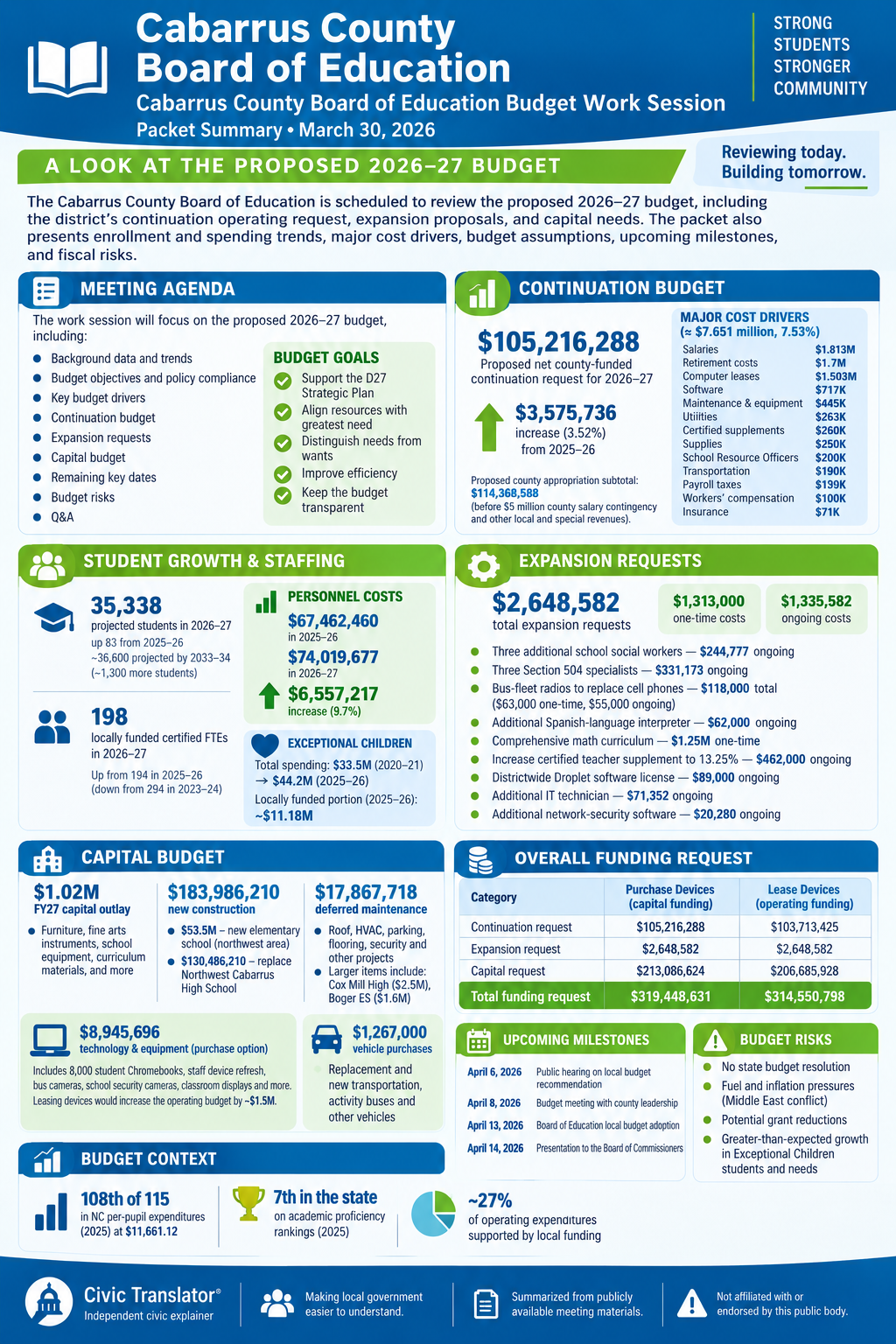
The Cabarrus County Board of Education is scheduled to review the proposed 2026–27 budget, including the district's continuation operating request, expansion proposals, and capital needs. The packet also presents enrollment and spending trends, major cost drivers, budget assumptions, upcoming milestones, and fiscal risks.
Key Items on the Agenda
Proposed 2026–27 Budget
The work session centers on the district's proposed 2026–27 budget. The presentation is organized around background data and trends, budget objectives and policy requirements, key budget drivers, the continuation budget, expansion requests, capital needs, remaining budget-development dates, and identified risks.
The district describes several objectives for the budget process, including supporting the D27 Strategic Plan, aligning resources with areas of greatest need, distinguishing needs from wants, avoiding long-term sacrifices to address short-term pressures, improving efficiency, and making the budget accessible and transparent.
Local Continuation Budget
The proposed net county-funded continuation request is $105,216,288, compared with a 2025–26 appropriation of $101,640,552. That represents an increase of $3,575,736, or 3.52%.
The packet shows a proposed county appropriation subtotal of $114,368,588 before accounting for a $5 million county salary contingency and other local and special revenues. The continuation request reflects higher personnel, technology, facilities, utilities, transportation, insurance, and other operating costs.
Major 2026–27 Cost Drivers
The packet identifies approximately $7.651 million in key expense increases, equal to about 7.53% of the referenced budget base. Major drivers include:
- Salaries: $1.813 million.
- Retirement costs: $1.7 million.
- Computer leases: $1.503 million.
- Software: $717,000.
- Maintenance and maintenance equipment: $445,000.
- Utilities: $263,000.
- Certified supplements: $260,000.
- Supplies: $250,000.
- School Resource Officers: $200,000.
- Transportation: $190,000.
- Payroll taxes: $139,000.
- Workers' compensation: $100,000.
- Insurance: $71,000.
The budget assumes a 3% increase for legislative increases above amounts already embedded in the 2025–26 budget, higher pension and health-care costs, and approximately 2.4% inflation. Staffing projections also incorporate anticipated enrollment growth.
Staffing and Student Growth
Enrollment Projections
The packet projects enrollment of 35,338 students in 2026–27, an increase of 83 from the 2025–26 figure presented. Longer-term projections show enrollment reaching approximately 36,600 by 2033–34, with the district describing expected growth of roughly 1,300 students over that period.
The district notes that enrollment growth can increase local costs even when additional teachers receive state funding. Local expenses include the district's certified-staff supplement, transportation needs, supplies and materials, and positions that may need to be funded locally.
Personnel Costs
Projected locally funded personnel costs rise from $67,462,460 in 2025–26 to $74,019,677 in 2026–27, an increase of $6,557,217, or 9.7%.
The district projects 198 locally funded certified FTEs for 2026–27. The packet says the district reduced locally funded certified staffing from 294 FTEs in 2023–24 to 194 in 2025–26 through measures including more consistent secondary-school scheduling and changes to the allotment process. The projected increase to 198 reflects anticipated enrollment growth and technical corrections to the allotment model.
Exceptional Children Services
The packet highlights increasing costs associated with Exceptional Children services. Estimated total spending rises from $33.5 million in 2020–21 to $44.2 million in 2025–26, while the locally funded portion is estimated at approximately $11.18 million in 2025–26.
The district attributes the pressure to growth in the population served and a higher concentration of student needs, while stating that state and federal funding has not fully covered those costs.
Expansion Requests
The proposed budget includes $2,648,582 in expansion requests, consisting of $1,313,000 in one-time costs and $1,335,582 in ongoing costs.
Proposals include:
- Three additional school social workers — $244,777 ongoing.
- Three Section 504 specialists — $331,173 ongoing.
- Bus-fleet radios to replace cell phones — $118,000 total, including $63,000 one-time and $55,000 ongoing.
- An additional Spanish-language interpreter — $62,000 ongoing.
- Comprehensive math curriculum — $1.25 million one-time.
- Increasing the certified teacher supplement to 13.25% — $462,000 ongoing.
- A districtwide Droplet software license — $89,000 ongoing.
- An additional IT technician — $71,352 ongoing.
- Additional network-security software — $20,280 ongoing.
These requests are presented as proposed additions rather than existing commitments.
Capital Budget
Capital Outlay
The packet proposes $1.02 million in FY27 capital outlay. Items include:
- Furniture — $260,000.
- Fine arts instruments — $165,000.
- School-level equipment requests — $121,620.
- Pre-K curriculum and materials — $114,000.
- Marching band uniform replacements at two schools — $110,000.
- Media center core collections — $98,007.
- Exceptional Children adaptive core curriculum — $81,673.
- Kindergarten play-based materials — $69,700.
The marching-band proposal would replace uniforms at Northwest Cabarrus High School and Hickory Ridge High School.
New Construction
The proposed long-term capital plan identifies $183,986,210 in remaining new-construction costs:
- New elementary school in the northwest area — $53.5 million.
- Replacement of Northwest Cabarrus High School — $130,486,210.
Deferred Maintenance
The proposed deferred-maintenance list totals $17,867,718. It includes roof, HVAC, parking and roadway, flooring, playground, generator, access-control, security, and other facility projects.
Among the larger individual requests are:
- Cox Mill High roof replacement — $2.5 million.
- Charles E. Boger Elementary roof replacement — $1.6 million.
- W.R. Odell Primary roof replacement — $1.6 million.
- Concord High parking and drive replacement — $1.248 million.
- Northwest Cabarrus Middle parking and drive replacement — $1 million.
- Several HVAC replacements — generally $750,000 or less per project.
- Central Cabarrus High turf-field replacement — $750,000.
Technology and Equipment
The equipment list totals $8,945,696 under the purchase alternative. Major proposed items include:
- 8,000 student Chromebooks — $4,042,695.
- Remaining staff-device refresh — $1,950,001.
- Bus camera system upgrades — $850,000.
- School security cameras — $800,000.
- Classroom TVs and interactive displays — $470,000.
- Paging/intercom systems at approximately eight schools — $425,000.
- End-of-life iPad replacements — $408,000.
The packet says shifting replacement devices to leasing would increase the local operating budget by approximately $1.5 million, while purchasing the referenced devices would require capital funding.
Vehicles
Proposed vehicle purchases total $1,267,000. Requests include replacement transportation and facilities vehicles, three McKinney-Vento vans with camera systems, two mini activity buses, two replacement activity buses, and a technology vehicle.
Overall Funding Request
The packet presents two scenarios depending on whether devices are purchased or leased.
- Continuation request: $105,216,288 under the purchasing scenario and $103,713,425 under the leasing scenario.
- Expansion request: $2,648,582 under either scenario.
- Capital request: $206,685,928 if devices are leased and $213,086,624 if devices are purchased.
- Total funding request: $314,550,798 if devices are leased and $319,448,631 if devices are purchased.
The difference primarily reflects whether device replacement is treated through operating leases or capital purchases.
Budget Context
The packet reports that Cabarrus County Schools ranked 108th of 115 North Carolina districts in total per-pupil expenditures for 2025, at $11,661.12 per pupil. It also reports that approximately 27% of district operating expenditures are supported by local funding.
At the same time, the presentation reports improvement in academic proficiency rankings, with Cabarrus County Schools moving to 7th in the state in 2025 on the proficiency ranking measure presented in the packet.
Budget Risks
The packet identifies several uncertainties that could affect the proposed 2026–27 budget:
- Continued absence of a state budget resolution.
- Fuel-price and broader inflation effects associated with a prolonged Middle East conflict.
- Further reductions in available grant resources.
- Greater-than-expected growth in the number of Exceptional Children students, increased severity of student needs, or both.
The lack of a state budget is particularly relevant to salary and benefit assumptions, which the district identifies as its largest cost driver.
What to Watch
The March 30 work session is one step in a multi-stage budget process. The packet identifies the following upcoming milestones:
- April 6, 2026: Public hearing on the local budget recommendation.
- April 8, 2026: Budget meeting with county leadership.
- April 13, 2026: Board of Education local budget adoption.
- April 14, 2026: Presentation to the Board of Commissioners.
The packet indicates that the Board is expected to consider the proposed budget before final adoption and submission to county officials. Key choices presented for review include the size of the local continuation request, proposed expansion items, capital priorities, and the purchase-versus-lease approach for technology devices.
This packet summary is based on publicly available meeting materials from the Cabarrus County Board of Education.
Civic Translator summarized publicly available meeting materials.