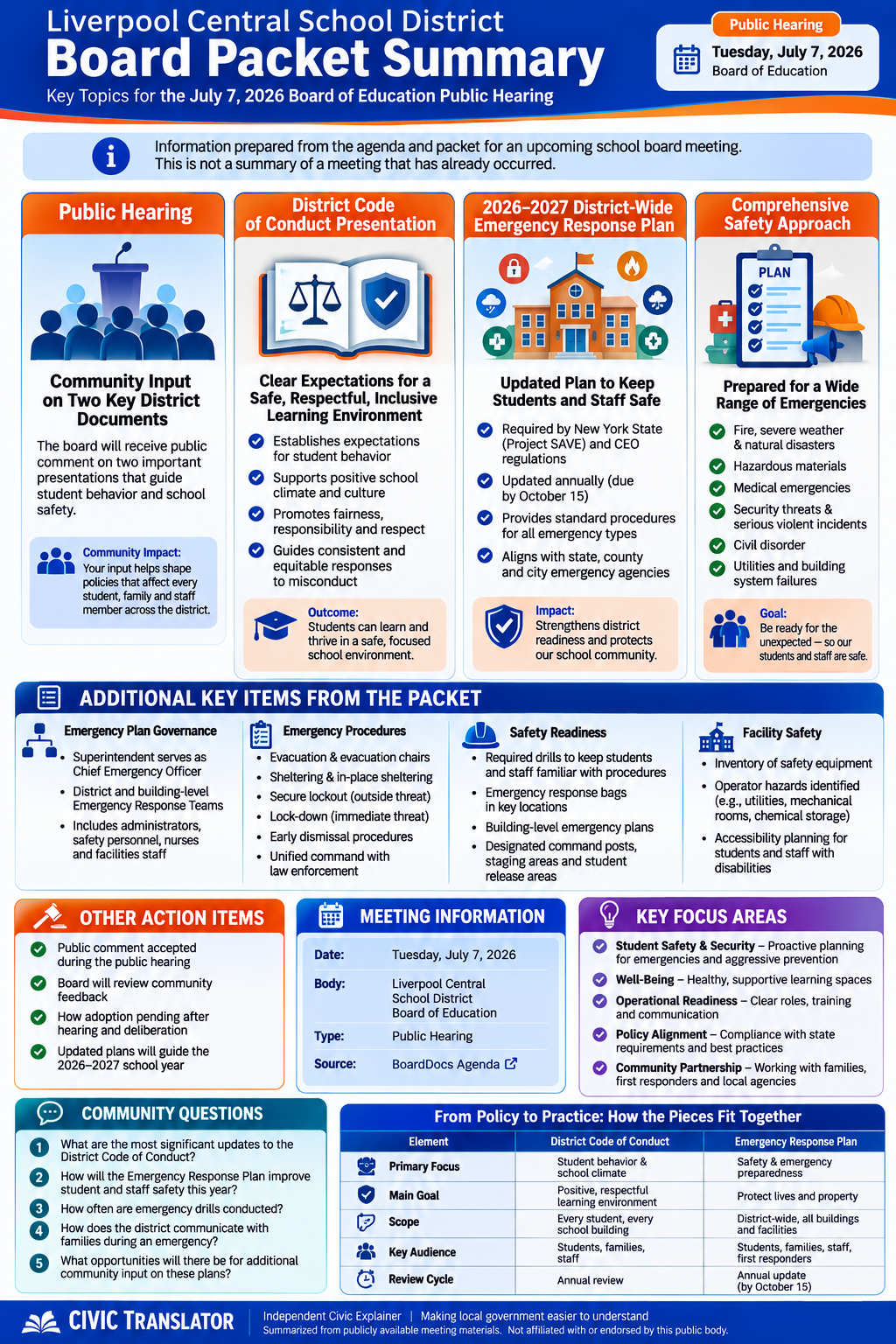
The July 7, 2026 Board of Education Public Hearing centers on two foundational district safety and student conduct documents: the proposed 2026-2027 District Code of Conduct and the draft 2026-2027 District-Wide Emergency Response Plan. Rather than focusing on budgets or construction projects, the meeting gives the public an opportunity to review and comment on policies governing school safety, emergency preparedness, student behavior, and district response procedures before formal adoption.
The emergency plan reflects annual updates required under New York's Project SAVE requirements and Education Law. It outlines how the district prepares for emergencies ranging from severe weather and fires to intruders, hazardous materials, medical emergencies, transportation incidents, and other major crises. The plan also incorporates more recent state requirements, including cardiac emergency response planning and updated procedures governing interactions between schools and law enforcement.
Families will likely be most interested in the procedures governing lockdowns, evacuations, parent notification, reunification of students, remote learning during emergency closures, visitor management, and annual emergency drills. The packet emphasizes coordination with local police, fire departments, emergency medical services, and county emergency management while clarifying district responsibilities before, during, and after emergencies.
Although the packet contains little discussion of new spending, it establishes operational expectations that affect every school, employee, student, and family throughout the district during the upcoming school year.
Major Discussion and Action Items
District-Wide Emergency Response Plan
The primary subject of the public hearing is review of the proposed 2026-2027 District-Wide Emergency Response Plan. State law requires the district to update this plan annually. The document establishes districtwide emergency management policies, defines emergency response procedures, identifies command responsibilities, and describes coordination with local emergency responders. The plan is intended to guide responses to emergencies affecting individual schools or multiple district facilities.
District Code of Conduct
The agenda also includes a public hearing regarding the District Code of Conduct. While detailed Code of Conduct language is not included in the accessible packet text, the hearing provides an opportunity for public review and comment before implementation for the upcoming school year. The code establishes expectations for student behavior, disciplinary procedures, and school climate.
Updated Emergency Response Procedures
The draft plan details standardized responses including evacuation, sheltering, hold, secure lockout, lockdown, early dismissal, relocation, and student reunification. It clarifies when each response should be used and assigns responsibilities to administrators, teachers, transportation staff, facilities personnel, nurses, and emergency responders. The document emphasizes accountability for every student during emergencies through attendance verification and controlled release procedures.
Law Enforcement Interaction Protocol
One significant addition establishes procedures whenever law enforcement seeks to interview, detain, or remove a student from school property. Administrators are instructed to immediately notify district leadership, consult legal counsel, document officer identification and legal authority, determine whether judicial warrants exist, and generally avoid releasing students until legal review is completed unless immediate safety circumstances require otherwise. Parent notification is addressed unless prohibited by an active criminal investigation.
Cardiac Emergency Response Requirements
The plan incorporates New York's recently enacted cardiac emergency response requirements. Staff are to receive annual training on recognizing sudden cardiac arrest, using automated external defibrillators (AEDs), activating emergency medical services, documenting incidents, and conducting post-event reviews. The annex also reinforces maintaining AED equipment and ensuring trained personnel are available.
Remote Learning During Emergency Closures
The district outlines procedures for one-day emergency closures and limited long-term remote instruction. During emergency closures, students would receive instruction through ParentSquare, Google Classroom, and Google Meet depending upon grade level. Attendance would continue to be recorded, and instruction would generally begin within one hour of the normal school start time. Long-term remote instruction remains limited to medically approved exemptions.
School Security and Visitor Management
The emergency plan reinforces building access controls, requiring visitors to report to the main office, present government-issued identification, use the district's electronic visitor management system, and wear visitor badges while inside school buildings. Employees are also expected to wear identification and promptly report suspicious activity.
Financial Matters
The accessible packet does not present significant budget actions, contracts, grants, tax matters, capital expenditures, or purchasing decisions for this public hearing.
Instead, the meeting focuses primarily on district policy and operational planning. The emergency response plan identifies existing district administrative positions responsible for implementation but does not authorize new appropriations or identify material new expenditures in the readable packet.
Policies, Ordinances, Resolutions, and Governance
The hearing concerns review of two major governance documents before implementation for the 2026-2027 school year.
The District-Wide Emergency Response Plan fulfills annual state requirements under Project SAVE, New York Education Law, and Commissioner regulations. The plan establishes districtwide emergency procedures, annual training expectations, required emergency drills, emergency command structures, communication protocols, and responsibilities across district departments.
The packet also includes revisions incorporating current legal requirements for cardiac emergency response planning and procedures governing law enforcement interaction with students while on school property. These additions reflect evolving state legal requirements and emergency preparedness standards.
The emergency response plan serves as the primary informational document presented during the hearing.
It explains how district emergency teams are organized, identifies coordination with Onondaga County emergency agencies, describes emergency command procedures, specifies required annual drills, outlines staff training expectations, and details responses to numerous emergency scenarios including severe weather, hazardous materials, bomb threats, fires, intruders, transportation incidents, epidemics, and medical emergencies.
The plan also includes guidance for communications with parents, the media, and emergency responders, emphasizing centralized communication through district leadership during major incidents.
Personnel, Appointments, and Organizational Matters
No personnel appointments, hiring actions, resignations, retirements, or employment agreements are identified in the accessible packet.
The emergency plan instead assigns operational responsibilities to existing district leadership, including the Superintendent serving as Chief Emergency Officer, along with directors overseeing security, facilities, transportation, food service, technology, athletics, special education, and school administrators. These roles coordinate district preparedness and emergency response responsibilities.
Projects, Facilities, Infrastructure, and Operations
Operational planning is the primary emphasis of the packet.
The emergency plan addresses emergency command posts, evacuation routes, safety zones, relocation centers, parent reunification areas, helicopter landing zones, treatment areas, utility shutdown procedures, emergency communication systems, classroom emergency bags, transportation coordination, and continuity of instruction during school closures.
The plan also requires annual staff training, multiple evacuation drills, lockdown drills, early dismissal exercises, and emergency preparedness education for students and staff to maintain readiness throughout the district.
The July 7, 2026 meeting is itself a public hearing.
Community members have the opportunity to review and comment on:
- The proposed District Code of Conduct.
- The proposed 2026-2027 District-Wide Emergency Response Plan.
Public feedback provides the Board of Education with community input before adoption and implementation of these documents for the upcoming school year.
Students and families are directly affected through updated emergency procedures, reunification processes, remote learning expectations during emergency closures, visitor management practices, and student conduct policies.
Employees receive defined emergency responsibilities, annual training requirements, and guidance for responding to emergencies, communicating with administrators, supervising students, and coordinating with first responders.
Parents benefit from clearer notification procedures, structured student release processes, and more detailed emergency communication expectations.
The broader community benefits from coordination between the district and local police, fire departments, EMS providers, county emergency management, and other public safety agencies designed to improve emergency preparedness and response.
- What significant changes were made to the District Code of Conduct for 2026-2027?
- Which portions of the emergency plan changed compared with last year's version?
- How frequently will students practice the various emergency response procedures?
- How will families be notified during different types of emergencies?
- How are students with disabilities accommodated during evacuations?
- What training do teachers and other staff receive each year?
- How will the district evaluate the effectiveness of emergency drills?
- How are remote learning expectations communicated during emergency closures?
- How are AED locations maintained and staff kept current on cardiac emergency training?
- What additional public input will be considered before final adoption of the updated plans?
Important Dates, Deadlines, and Next Steps
- July 7, 2026: Public hearing on the District Code of Conduct and the proposed District-Wide Emergency Response Plan.
- 2026-2027 School Year: Updated emergency procedures and Code of Conduct are intended to guide district operations following board approval.
- By October 15 each year: State regulations require annual updating of the District-Wide Emergency Response Plan.
- Throughout the school year: Required evacuation drills, lockdown drills, early dismissal exercises, and annual emergency preparedness training are scheduled under the district plan.
Key Takeaways
- The meeting focuses primarily on school safety and emergency preparedness.
- A public hearing is held on both the District Code of Conduct and the emergency response plan.
- The emergency plan fulfills annual New York Project SAVE requirements.
- The Superintendent serves as the district's Chief Emergency Officer.
- The plan standardizes responses for lockdowns, evacuations, sheltering, reunification, and early dismissal.
- Updated procedures address law enforcement requests involving students.
- The district incorporates new cardiac emergency response requirements into its safety planning.
- Remote instruction procedures remain available for emergency closures and approved medical situations.
- Visitor identification and electronic visitor management remain central security measures.
- Coordination with local emergency responders is emphasized throughout the district's planning.
Official Sources
About the Public Body
- Name: Liverpool Central School District
- Organization type: school-district
- Government body: school-boards
- Location: Liverpool, new-york
- County: Onondaga
- Provider: boarddocs
Keywords
Liverpool Central School District, Liverpool Board of Education, Board of Education Public Hearing, District Code of Conduct, District-Wide Emergency Response Plan, Project SAVE, school safety, emergency preparedness, lockdown, evacuation, shelter in place, secure lockout, early dismissal, reunification, visitor management, ParentSquare, Google Classroom, cardiac emergency response, AED, law enforcement protocol, Onondaga County, emergency drills, student safety, emergency management, public hearing, school security, remote learning, emergency communications