East Windsor Regional School District Board of Education Packet Summary — August 10, 2026
Key Items on the Agenda
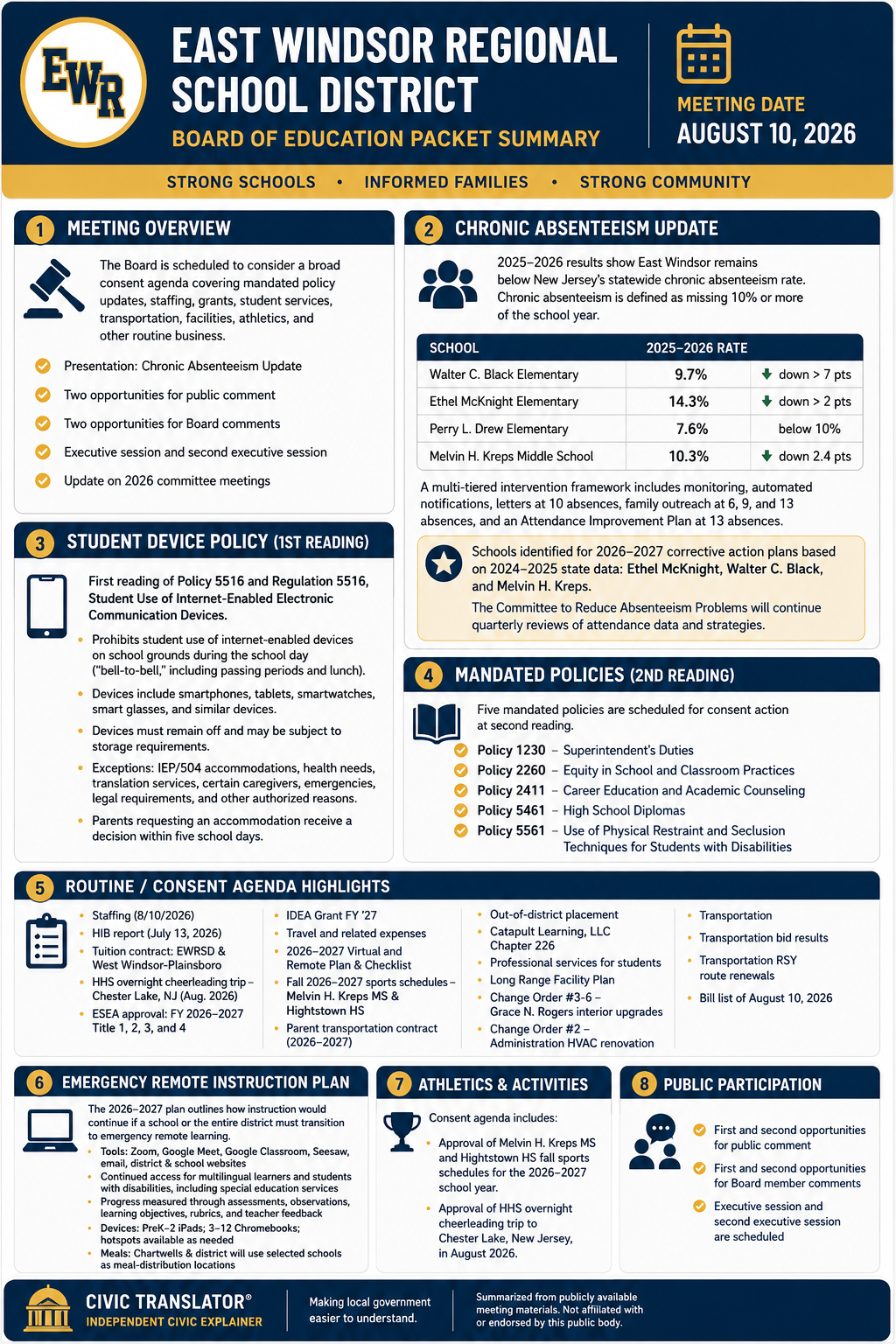
The East Windsor Regional School District Board of Education is scheduled to consider a broad consent agenda covering mandated policy updates, staffing, grants, student services, transportation, facilities, athletics, and other routine business. The agenda also includes a presentation on chronic absenteeism, two opportunities for public comment, executive sessions, and an update on 2026 committee meetings.
Chronic Absenteeism Update
The Board is expected to receive a presentation on the district's 2025–2026 chronic absenteeism results and corrective action plans. The presentation defines chronic absenteeism as missing 10% or more of the school year and reports that East Windsor has remained below New Jersey's statewide chronic absenteeism rate.
The district describes a common intervention framework that includes daily attendance monitoring, automated notifications for unexplained absences, formal letters at 10 absences, direct family outreach at 6, 9, and 13 absences, and an Attendance Improvement Plan at 13 absences. Persistent cases may be referred to the truancy officer, while a district committee reviews attendance data quarterly.
For 2025–2026, the presentation reports:
- Walter C. Black Elementary at 9.7%, down more than 7 percentage points from 2023–2024.
- Ethel McKnight Elementary at 14.3%, down more than 2 percentage points but still above the 10% threshold.
- Perry L. Drew Elementary at 7.6%, below 10% for a second consecutive year.
- Melvin H. Kreps Middle School at 10.3%, down 2.4 percentage points but still just above the threshold.
Looking ahead, the presentation identifies Ethel McKnight, Walter C. Black, and Melvin H. Kreps for 2026–2027 corrective action plans based on 2024–2025 state data. The district's Committee to Reduce Absenteeism Problems is expected to continue quarterly reviews of attendance data and strategies.
Student Device Rules
First Reading of Policy and Regulation 5516
The agenda includes the first reading of Policy 5516 and Regulation 5516, Student Use of Internet-Enabled Electronic Communication Devices. The proposed policy establishes a prohibition on student use of internet-enabled devices on school grounds during the school day in accordance with New Jersey law.
The policy defines the school day as "bell-to-bell," including passing periods and lunch. Personal internet-enabled devices include smartphones, tablets, smartwatches, smart glasses, and similar devices, while district-provided technology used for educational purposes is excluded from that definition.
Under the proposed framework:
- Personal internet-enabled devices brought to school must remain off and may be subject to district storage requirements.
- Teachers would not incorporate students' personal technology into lesson plans; digital classroom activities would instead use district-managed tools and devices.
- The district could use technology systems and device-management software to restrict or monitor browsing on school-issued devices or devices connected to district Wi-Fi.
- Students and families would receive communication about device expectations throughout the school year.
- Exceptions would be available for IEP and Section 504 accommodations, documented health needs, translation services, certain student caregivers, emergencies, legal requirements, and other authorized circumstances.
- Parents seeking an accommodation would submit a written request, with the principal or designee expected to approve or deny it within five school days.
Policy and Governance Items
Five Mandated Policies at Second Reading
Five mandated policies are scheduled for consent action at second reading.
- Policy 1230 — Superintendent's Duties: Defines the Superintendent as the district's Chief Executive and Administrative Officer and principal adviser to the Board, with responsibilities spanning instruction, personnel, facilities, finances, public communication, legal compliance, and recommendations to the Board.
- Policy 2260 — Equity in School and Classroom Practices: Addresses equitable and bias-free access to facilities, courses, programs, services, counseling, curriculum, physical education, and athletics. It also addresses multilingual learners, students with disabilities, multicultural curriculum, and required state curricular content.
- Policy 2411 — Career Education and Academic Counseling: Establishes a comprehensive guidance and counseling system covering career awareness, academic counseling, work-based learning, college coursework, technological and information literacy, and annual program evaluation.
- Policy 5461 — High School Diplomas: Sets requirements for State-endorsed diplomas and addresses continued enrollment, alternative pathways for demonstrating proficiency, early diploma awards based on college credits and other requirements, and annual graduation reporting.
- Policy 5561 — Use of Physical Restraint and Seclusion Techniques for Students with Disabilities: Limits restraint and seclusion to emergency circumstances involving immediate physical danger and establishes training, monitoring, documentation, parent-notification, reporting, and review requirements.
Routine and Consent Agenda
The Board is scheduled to consider numerous items together under its routine-agenda-by-exception process. The packet identifies these as proposed consent actions rather than completed Board decisions.
Items include:
- Staffing dated August 10, 2026.
- The July 13, 2026 HIB report.
- A tuition contract agreement between EWRSD and West Windsor-Plainsboro.
- An Hightstown High School overnight cheerleading trip to Chester Lake, New Jersey, in August 2026.
- Submission of FY 2026–2027 ESEA Title 1, 2, 3, and 4 materials and an IDEA Grant FY '27 item.
- Travel and related expenses.
- The district's 2026–2027 Virtual and Remote Plan and Checklist.
- Fall 2026–2027 sports schedules for Melvin H. Kreps Middle School and Hightstown High School.
- A parent transportation contract for the 2026–2027 school year.
- An out-of-district placement.
- Catapult Learning, LLC Chapter 226 and professional services for students.
- Approval of the Long Range Facility Plan.
- Change Order #3-6 for Grace N. Rogers interior upgrades and Change Order #2 for the Administration HVAC renovation.
- Transportation items, including bid results and route renewals.
- The August 10, 2026 bill list.
Emergency Virtual and Remote Instruction
The proposed 2026–2027 Emergency Virtual or Remote Instruction Plan describes how the district would maintain instruction if a school or the entire district had to transition to emergency remote learning. Planned instructional and communication tools include Zoom, Google Meet, Google Classroom, Seesaw, email, and district and school websites.
The plan calls for continued access to instruction for multilingual learners and students with disabilities, including special education and related services to the greatest extent practicable. Student progress would continue to be measured through assessments, classroom observations, learning objectives, rubrics, and teacher feedback.
The plan also describes technology access and meal continuity. Students in preschool through grade 2 are assigned iPads, students in grades 3–12 are assigned Chromebooks, and internet hotspots may be provided to families as needed. Chartwells and the district would use selected schools as meal-distribution locations during emergency remote instruction.
Athletics and Student Activities
The consent agenda includes approval of Melvin H. Kreps Middle School and Hightstown High School fall sports schedules for the 2026–2027 school year. The packet contains detailed schedules covering multiple sports, opponents, home and away contests, and competition dates during the fall season.
The Board is also scheduled to consider an HHS overnight cheerleading trip to Chester Lake, New Jersey, in August 2026 as a consent item.
What to Watch at the Meeting
The most consequential items for students and families include the first reading of the new internet-enabled device policy and regulation, the district's chronic absenteeism results and corrective-action strategy, and five mandated policies reaching second reading. The consent agenda also packages a substantial set of operational decisions involving staffing, grants, transportation, facilities, student services, athletics, and emergency remote instruction.
The agenda provides two opportunities for public comment as well as two opportunities for Board member comments. It also schedules an executive session and a second executive session, while the public agenda identifies those sessions as informational items rather than documenting their substance or any resulting action.