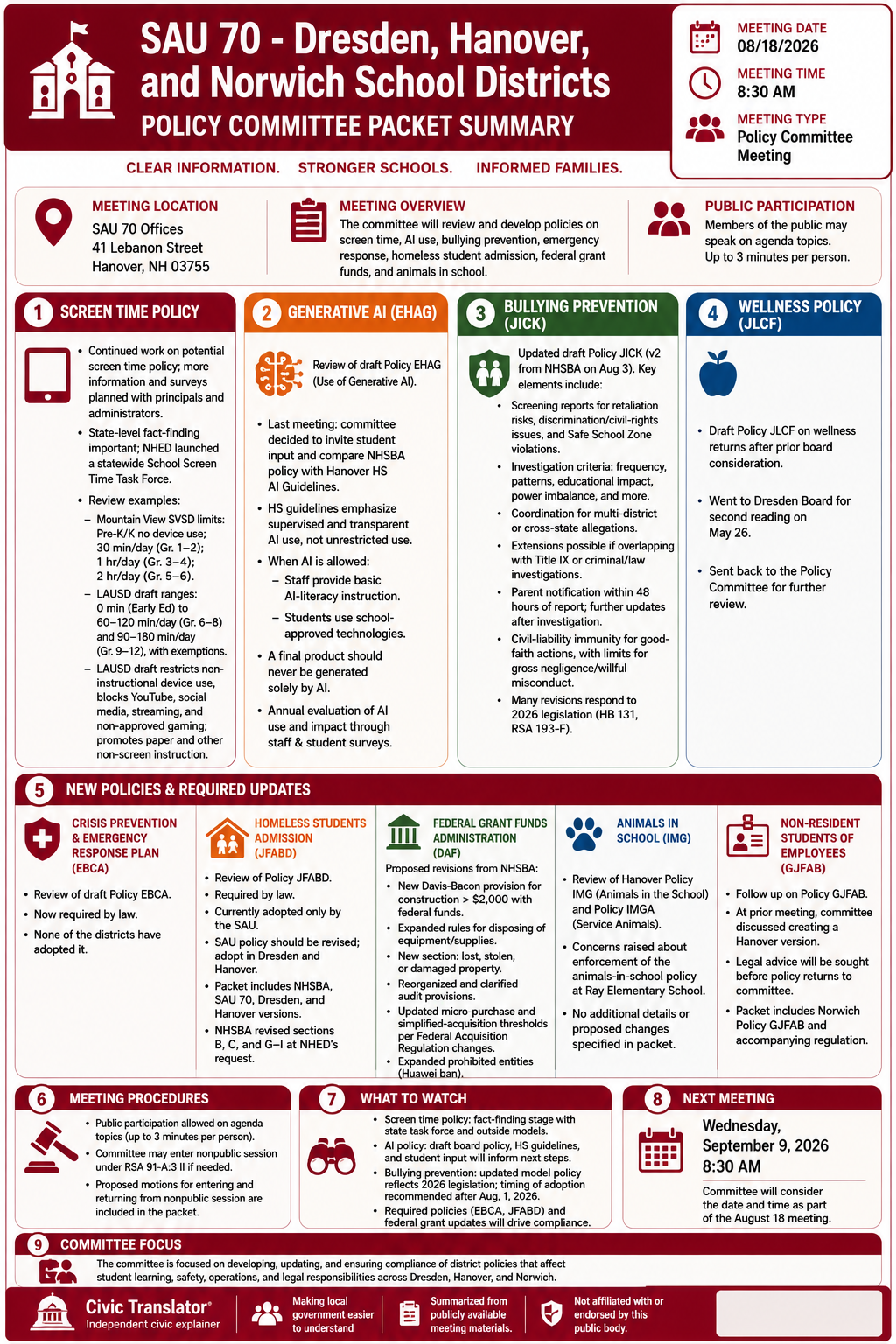
SAU 70 Policy Committee Packet Summary — August 18, 2026
The SAU 70 Policy Committee is scheduled to meet at 8:30 a.m. on August 18 at the SAU 70 Offices in Hanover. The agenda centers on policy development and revision, including student screen time, generative artificial intelligence, bullying prevention, emergency response, admission of homeless students, federal grant administration, and concerns about enforcement of the district's animals-in-school policy.
Key Items on the Agenda
Screen Time Policy
The committee is expected to continue work on a potential screen time policy after determining at its previous meeting that more information was needed before proceeding with a draft. The packet says possible survey questions were to be discussed with principals and administrators, while state-level fact-finding was identified as an important part of developing the policy.
The packet also notes that the New Hampshire Department of Education launched a statewide School Screen Time Task Force to examine technology's role in student learning and develop practical, age-appropriate recommendations.
Several outside policy examples are included for comparison. Among them:
- Mountain View Supervisory District considerations call for developmentally appropriate limits, greater use of paper and other off-screen materials, restrictions on non-instructional gaming, and professional development on technology and generative AI.
- Its Faculty Advisory Council recommendations include no individual electronic-device use for Pre-K and kindergarten, a maximum of 30 minutes per day for grades 1–2, one hour for grades 3–4, and two hours for grades 5–6.
- A draft Los Angeles Unified School District policy proposes phased screen-time guidance ranging from zero minutes per day for Early Education to recommended ranges of 60–120 minutes for grades 6–8 and 90–180 minutes for grades 9–12, subject to specified exemptions.
- The Los Angeles draft would also restrict non-instructional device use, block student-led access to YouTube, social media, streaming platforms, and non-approved gaming platforms, and encourage paper-and-pencil assignments and other non-screen instruction.
These materials are examples provided for the committee's policy work; the packet does not indicate that SAU 70 has adopted those limits or restrictions.
EHAG — Use of Generative Artificial Intelligence
The committee is scheduled to continue its review of draft Policy EHAG on generative artificial intelligence. At the previous meeting, the committee decided to invite students to share their perspectives and to compare the New Hampshire School Boards Association policy with Hanover High School's AI guidelines.
The high school guidelines included in the packet emphasize supervised and transparent AI use rather than unrestricted use. They state that when AI is permitted on an assignment, staff should provide basic AI-literacy instruction and students should use school-approved technologies. The guidelines also state that a final product should never be generated solely by AI and call for annual evaluation of AI's use and impact through staff and student surveys.
JICK — Bullying Prevention and Pupil Safety
An updated draft of Policy JICK is back before the committee. The packet says the committee previously requested feedback on the draft and current policies, and NHSBA supplied another updated version on August 3.
The materials identify several substantive areas in the revised model policy, including:
- Screening incoming bullying reports for retaliation risks, possible discrimination or civil-rights issues, and potential Safe School Zone violations.
- Investigation criteria addressing factors such as frequency, historical patterns, educational impact, and perceived power imbalance.
- Coordination when alleged bullying involves students from multiple districts or crosses state lines.
- Potential extensions when a bullying investigation overlaps with proceedings such as Title IX or criminal investigations.
- Parent notification requirements, including notification within 48 hours after a bullying report and additional communication following an investigation.
- Civil-liability immunity for good-faith conduct related to reporting, investigating, or responding to bullying, subject to limitations involving gross negligence or willful misconduct.
The NHSBA materials say many 2026 revisions respond to HB 131 and amendments to RSA 193-F. NHSBA recommends adoption of required provisions at the earliest meeting after August 1, 2026, followed by broader stakeholder involvement in considering additional changes.
JLCF — Wellness
Draft Policy JLCF on wellness returns to the committee after prior board consideration. According to the packet, the policy went to the Dresden Board for a second reading on May 26 and was sent back to the Policy Committee.
New Policies and Required Updates
EBCA — Crisis Prevention and Emergency Response Plan
The committee is scheduled to review draft Policy EBCA on crisis prevention and emergency response plans. The packet states that the policy is now required by law and that none of the districts have adopted it.
JFABD — Admission of Homeless Children and Unaccompanied Youth
Policy JFABD is also scheduled for review. The packet states that the policy is required by law but currently is adopted only by the SAU, and says the SAU policy should be revised and the policy adopted in Dresden and Hanover.
The packet includes NHSBA, SAU 70, Dresden, and Hanover versions for review. It also notes that NHSBA recently revised sections B, C, and G–I at the request of the New Hampshire Department of Education.
DAF — Administration of Federal Grant Funds
The committee will review proposed revisions to Policy DAF governing federal grant funds. The packet identifies several changes from NHSBA, including:
- A new Davis-Bacon provision for construction projects over $2,000 that are funded wholly or partly with federal grants.
- Expanded rules for disposing of equipment and supplies purchased with federal grant money.
- A new section addressing property that is lost, stolen, or damaged.
- Reorganization and clarification of audit provisions.
- Changes to micro-purchase and simplified-acquisition thresholds permitted by adjustments to the Federal Acquisition Regulation.
- Expansion of prohibited entities under provisions addressing the Huawei ban.
The packet presents these as proposed policy revisions for committee review, not as changes already adopted by the district.
IMG — Animals in the School
The committee's new-business agenda also includes Hanover Policy IMG, Animals in the School, along with Policy IMGA concerning service animals. The packet states that concerns have been raised about enforcement of the animals-in-school policy at Ray Elementary School, but it does not provide further detail about those concerns or specify a proposed policy change.
Other Continuing Policy Work
GJFAB — Non-Resident Students of District Employees
The committee is expected to follow up on Policy GJFAB governing admission of non-resident students whose parents or guardians are district employees. At the previous meeting, the committee discussed creating a Hanover version of the policy and determined that legal advice would be sought before the matter returned to the committee.
The packet includes Norwich's Policy GJFAB and its accompanying regulation as reference materials.
Public Participation and Meeting Procedures
The agenda provides for public participation, with members of the public given up to three minutes to speak on agenda topics.
The committee may also enter a nonpublic session if needed under RSA 91-A:3 II. The packet contains proposed procedural motions for entering and returning from nonpublic session but does not state that such a session will necessarily occur.
The agenda lists the next meeting as Wednesday, September 9 at 8:30 a.m., with the committee scheduled to consider the date and time as part of the August 18 meeting.
What to Watch at the Meeting
The packet points to several policy questions that could shape future district rules. The screen-time discussion remains in an information-gathering stage, with outside models and state-level work available to inform a possible local policy. The AI item similarly brings together a draft board policy, existing high-school guidance, and planned student input.
The bullying-prevention policy carries a more immediate statutory dimension because the NHSBA materials identify changes tied to 2026 legislation. The committee is also scheduled to consider other policies described in the packet as legally required, including crisis prevention and emergency response and admission of homeless students, while reviewing detailed updates to federal-grant administration requirements.