School Board Agenda & Packet Summary – SAU 70 – July 21, 2026
Meeting date: July 21, 2026
Summary type: Packet Summary
Meeting Details
- Date and time
- July 21, 2026 at 9:15 AM
- Status
- Scheduled
- Location
- SAU 70 Offices, |, 41 Lebanon Street, |, Hanover, NH 03755
- Official meeting page
- View official meeting details
Use the direct share buttons for a link preview, or copy the ChatGPT prompt to create a longer platform-specific post.
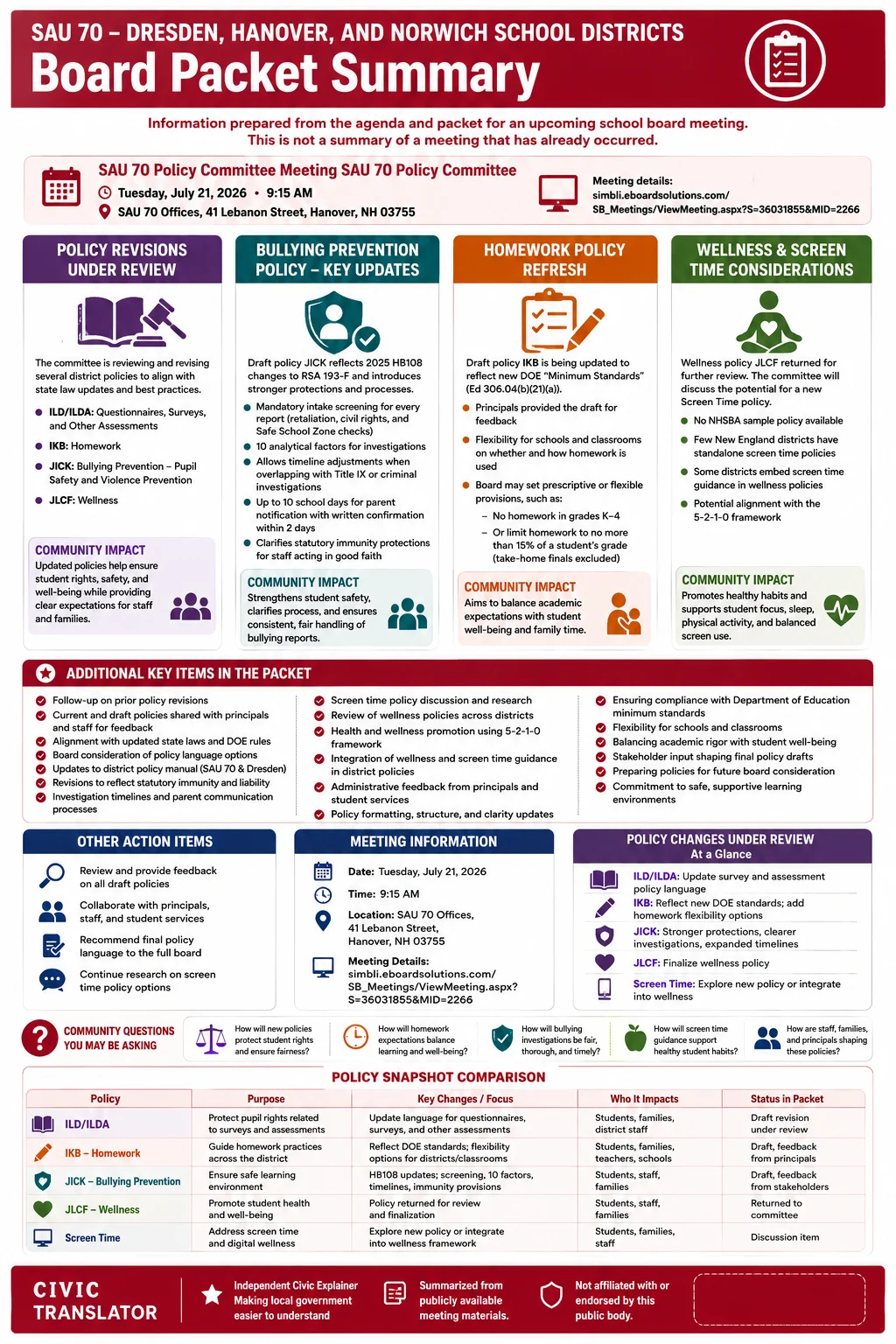
View full-resolution imageLarge PNG download
About this summary
Generated from official public meeting materials.
This summary was created from publicly available agenda, packet, minutes, reports, and other official materials published for the SAU 70 - Dresden, Hanover, and Norwich School Districts School Board meeting.
Civic Translator uses automated and AI-assisted publishing workflows. Official government records, agendas, packets, minutes, recordings, and notices remain the authoritative source.
- Last updated
- July 24, 2026
- Public body
- SAU 70 - Dresden, Hanover, and Norwich School Districts
- Meeting date
- July 21, 2026
Meeting Information
- Public Body: SAU 70 - Dresden, Hanover, and Norwich School Districts
- Organization Type: school-district
- Government Body: school-boards
- Meeting Title: SAU 70 Policy Committee Meeting SAU 70 Policy Committee
- Meeting Date: 2026-07-21
- City: Hanover
- County: Grafton
- State: new-hampshire
- Meeting Source URL: https://simbli.eboardsolutions.com/SB_Meetings/ViewMeeting.aspx?S=36031855&MID=2266
- Meeting Listing URL: https://simbli.eboardsolutions.com/SB_Meetings/SB_MeetingListing.aspx?S=36031855
- Public Body Website: https://www.sau70.org/school-boards
- Meeting Video URL: https://www.youtube.com/@sau70media81/streams
- Video Channel URL: https://www.youtube.com/@sau70media81
What Community Members Should Know
The July 21, 2026 SAU 70 Policy Committee meeting is almost entirely devoted to reviewing and updating district policies rather than routine administrative business. The agenda reflects an extensive effort to bring district policies into alignment with recent New Hampshire law, updated guidance from the New Hampshire School Boards Association (NHSBA), and evolving issues involving student privacy, artificial intelligence, digital technology, school safety, and student wellness.
Several long-standing policies are returning for additional review after prior committee discussions. These include revisions governing student surveys, homework, bullying prevention, and district wellness. Committee members will also begin work on several new or substantially revised policies covering screen time, generative artificial intelligence, homeless student enrollment, crisis planning, federal grant administration, employee enrollment preferences, and animals in schools.
The most consequential discussions for students and families are likely to center on technology use in schools. Supporting documents include extensive research and example policies from other school systems regarding screen time, digital device use, student privacy, and artificial intelligence. Rather than simply regulating technology, the committee appears to be considering a broader framework balancing instructional technology with student well-being, teacher flexibility, and family involvement.
No significant spending proposals, contracts, or construction projects appear in this packet. Instead, the committee's work will shape policies that eventually govern instructional practices, student protections, federal compliance, and district operations across the Dresden, Hanover, Norwich, and SAU 70 school systems.
Major Discussion and Action Items
Student Survey and Questionnaire Policy
The committee will revisit Policy ILD/ILDA governing surveys and questionnaires after requesting revised language at an earlier meeting.
The proposed replacement policy substantially expands district expectations regarding privacy, transparency, approval procedures, voluntary participation, data security, and public reporting. The draft establishes definitions for anonymous and confidential surveys, limits collection of personally identifiable information whenever possible, requires administrative approval before district-wide surveys, and incorporates federal FERPA and Protection of Pupil Rights Amendment (PPRA) protections.
The proposal also establishes annual reporting to the school board summarizing surveys administered, participation rates, major findings, actions taken, and any significant privacy incidents. Aggregate survey results would generally be available publicly while protecting personally identifiable information.
Homework Policy Modernization
The committee will continue reviewing revisions to Policy IKB after principals were asked to provide feedback.
The packet explains that revisions are necessary because of changes to New Hampshire Department of Education Minimum Standards. Rather than prescribing a uniform amount of homework, the proposed language emphasizes flexibility, allowing homework expectations to vary by school, classroom, and course while still meeting state requirements.
The packet notes that the school board could adopt either more restrictive or more flexible provisions if desired, including examples such as prohibiting homework in elementary grades or limiting homework's contribution to quarterly grades.
Bullying Prevention Policy Update
One of the meeting's largest policy revisions concerns Policy JICK on bullying prevention.
NHSBA recommends comprehensive revisions following passage of HB108 in 2025, which amended RSA 193-F. The proposed revisions include mandatory intake screening for every bullying complaint, standardized investigative criteria, coordination with Title IX or criminal investigations when necessary, revised timelines for notifying parents, and explicit statutory immunity protections for employees acting in good faith.
The packet also includes administrator feedback indicating that the revised NHSBA sample appears appropriate while suggesting that aligning district language with the updated model would represent good practice.
Student Wellness, Screen Time, and Digital Learning
Technology and student wellness form a major theme throughout the meeting.
The committee will continue work on the Wellness Policy after the Dresden Board returned the proposal following its second reading. It will also begin discussing a completely new screen time policy.
Supporting materials summarize examples from other districts emphasizing age-appropriate technology use, limiting excessive screen exposure, encouraging paper-and-pencil instruction where appropriate, promoting physical activity, restricting non-instructional device use, and strengthening family engagement.
Several reference documents recommend developmentally appropriate screen time limits, blocking entertainment platforms on district devices, encouraging offline homework, expanding digital citizenship instruction, and balancing technology with teacher-led instruction.
Artificial Intelligence Policy
The committee will begin considering Policy EHAG governing generative artificial intelligence.
Although the packet does not include detailed policy language in the agenda summary, the inclusion of a dedicated AI policy reflects growing district attention to appropriate educational uses of AI technology, likely addressing responsible use, instructional expectations, and governance of emerging technologies.
Required Legal Compliance Policies
Several agenda items focus primarily on ensuring compliance with state or federal requirements.
These include:
- Crisis Prevention and Emergency Response Plans (Policy EBCA), now required by law.
- Admission of Homeless Students (Policy JFABD), including NHSBA revisions requested by the New Hampshire Department of Education.
- Administration of Federal Grant Funds (Policy DAF), reflecting updated federal procurement thresholds, Davis-Bacon construction requirements, equipment disposition rules, property loss procedures, audit language, and federal purchasing restrictions.
These updates primarily ensure district policies remain consistent with changing legal requirements.
Additional Governance Topics
The committee will also discuss:
- Whether Hanover should adopt a policy allowing enrollment of district employees' non-resident children.
- Concerns regarding implementation and enforcement of the Animals in the School policy at Ray Elementary School.
- Public comment related to distraction-free schools.
Financial Matters
The packet contains very little direct financial business.
The principal financial discussion involves revisions to Policy DAF governing administration of federal grant funds. Proposed revisions address:
- Updated federal procurement thresholds.
- Davis-Bacon wage requirements for federally funded construction projects exceeding $2,000.
- Disposal of equipment purchased with federal grants.
- Procedures for lost, stolen, or damaged grant-funded property.
- Updated audit provisions.
- Expanded restrictions involving prohibited vendors.
No major budget amendments, contracts, capital expenditures, grants, bids, or purchasing approvals are identified elsewhere in the meeting materials.
Policies, Ordinances, Resolutions, and Governance
Policy review is the central purpose of this meeting.
Policies under discussion include:
- ILD/ILDA – Student surveys and questionnaires.
- IKB – Homework.
- JICK – Bullying prevention.
- JLCF – Wellness.
- New Screen Time Policy.
- EHAG – Use of Generative Artificial Intelligence.
- GJFAB – Admission of district employees' non-resident students.
- EBCA – Crisis Prevention and Emergency Response.
- JFABD – Admission of homeless students.
- DAF – Administration of Federal Grant Funds.
- IMG – Animals in the School.
Many revisions are prompted by changes in state law, updated NHSBA model policies, Department of Education requirements, or evolving educational practices.
Reports, Presentations, and Informational Updates
Rather than traditional administrative reports, the packet provides extensive background materials supporting policy development.
These include:
- A comprehensive draft survey policy emphasizing privacy, transparency, informed participation, and annual reporting.
- Research and sample policies regarding school screen time.
- Technology guidance from another supervisory district recommending age-based limits on student device use.
- A large reference document advocating distraction-free schools and stronger protections for student privacy and technology safety.
- Sample instructional technology policies emphasizing balanced technology integration and teacher-led instruction.
These materials provide committee members with examples and research rather than formal recommendations for immediate adoption.
Personnel, Appointments, and Organizational Matters
The packet contains no significant personnel actions such as hiring, resignations, retirements, or employment agreements.
The only staffing-related discussion involves administrator feedback on proposed bullying policy revisions and consideration of a policy concerning admission of district employees' non-resident children.
Projects, Facilities, Infrastructure, and Operations
No major construction or capital improvement projects appear in this packet.
Operational topics include:
- Development of district crisis prevention and emergency response procedures.
- Technology governance.
- Student device management.
- School wellness implementation.
- Enforcement questions involving animals at Ray Elementary School.
- Operational compliance for federal grant administration.
Public Hearings and Opportunities for Community Input
Public participation is scheduled during the meeting.
Members of the public will generally receive up to three minutes to speak on agenda topics.
Supporting materials reference "Distraction Free Schools," suggesting technology use and student screen exposure may be a topic of community discussion.
The next scheduled Policy Committee meeting is identified as Tuesday, August 11, at 8:30 a.m.
Community Impact
Students and families may eventually experience changes in homework expectations, student surveys, bullying investigations, technology use, AI guidance, wellness initiatives, and enrollment policies.
Teachers and administrators could receive clearer expectations regarding homework discretion, technology integration, survey administration, bullying investigations, emergency planning, and federal grant compliance.
District leadership would benefit from updated policies aligned with current state law and NHSBA recommendations, reducing legal risk while providing clearer governance.
Parents may receive additional notification rights, greater transparency regarding surveys and technology, improved privacy protections, and opportunities to better understand district practices involving digital learning.
Questions Community Members May Want to Ask
- How will the district balance educational technology with concerns about excessive student screen time?
- What changes will families notice if the revised survey policy is adopted?
- How will the proposed bullying investigation procedures affect reporting timelines?
- Will homework expectations differ among schools or grade levels?
- How will any future AI policy distinguish appropriate educational use from misuse?
- What emergency planning requirements are newly required by state law?
- How will updated homeless student policies improve enrollment consistency across districts?
- Will technology policies include opportunities for continued public feedback?
- How will staff receive training on revised policies?
- Which policies are expected to move to the full board next?
Important Dates, Deadlines, and Next Steps
- July 21, 2026: Policy Committee reviews multiple draft and revised district policies.
- Public Comment: Community members may speak for approximately three minutes on agenda topics during the meeting.
- Following Committee Review: Policies may continue through additional revisions before recommendation to the appropriate school boards.
- August 11, 2026 (8:30 a.m.): Next scheduled Policy Committee meeting.
Key Takeaways
- The meeting focuses almost entirely on policy development rather than budgets or contracts.
- Student privacy protections for surveys receive substantial attention.
- Homework policy revisions emphasize local flexibility.
- Bullying policies are being updated to reflect recent New Hampshire legislation.
- Technology, screen time, and AI represent major emerging policy priorities.
- Multiple legally required policies are being updated for compliance.
- Federal grant administration policies are being modernized.
- Families may eventually see new expectations regarding student technology use.
- Public comment is available for agenda topics.
- Additional policy work is expected at the August meeting.
Official Sources
- Meeting source: https://simbli.eboardsolutions.com/SB_Meetings/ViewMeeting.aspx?S=36031855&MID=2266
- Meeting listing: https://simbli.eboardsolutions.com/SB_Meetings/SB_MeetingListing.aspx?S=36031855
- Public body website: https://www.sau70.org/school-boards
- Meeting video: https://www.youtube.com/@sau70media81/streams
- Video channel: https://www.youtube.com/@sau70media81
About the Public Body
- Name: SAU 70 - Dresden, Hanover, and Norwich School Districts
- Organization type: school-district
- Government body: school-boards
- Location: Hanover, new-hampshire
- County: Grafton
- Provider: simbli
Keywords
SAU 70, Dresden School District, Hanover School District, Norwich School District, Policy Committee, July 21 2026, student surveys, FERPA, PPRA, homework policy, bullying prevention, HB108, wellness policy, screen time, artificial intelligence, AI policy, crisis prevention, homeless students, federal grant administration, NHSBA, student privacy, Ray Elementary School, technology policy, emergency response, digital learning, school governance
Continue exploring this meeting
More summaries from SAU 70 - Dresden, Hanover, and Norwich School Districts
SAU 70 - Dresden, Hanover, and Norwich School Districts — School Board Meeting Packet Summary — July 29, 2026
July 29, 2026 · Packet Summary