Key Items on the Agenda
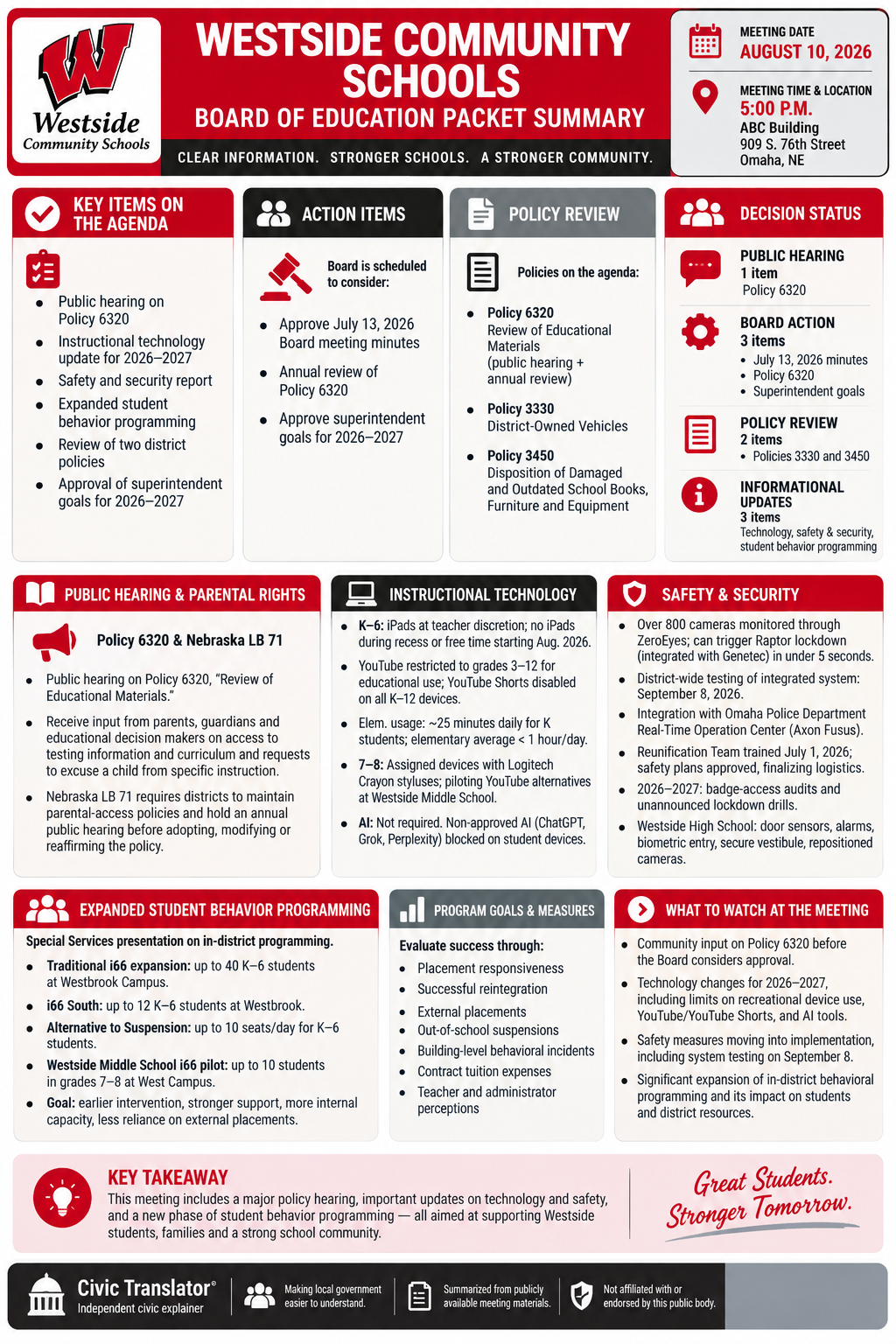
The Westside Community Schools Board of Education is scheduled to meet at 5:00 p.m. on August 10, 2026, at the ABC Building, 909 S. 76th Street in Omaha. The agenda includes a public hearing on Policy 6320, updates on instructional technology and district safety, a report on expanded student behavior programming, review of two district policies, and proposed approval of superintendent goals for the 2026–2027 school year.
Action items identified on the agenda include approval of the July 13, 2026 Board meeting minutes, the annual review of Policy 6320, and approval of the superintendent's 2026–2027 goals.
Public Hearing and Parental Rights Policy
Policy 6320 and Nebraska LB 71
The Board is scheduled to hold a public hearing on Policy 6320, "Review of Educational Materials." The hearing is intended to receive input from parents, guardians, and educational decision makers on how they may access testing information and curriculum and request that a child be excused from specific instruction or activities.
The packet includes Nebraska Legislative Bill 71, which requires public school districts to maintain policies addressing parental access and involvement. Among other requirements, district policies must address access to textbooks, tests, digital materials, websites or learning applications, staff training materials, student records, and other curriculum materials, as well as procedures for requests to monitor or excuse students from certain instructional activities.
LB 71 requires these policies to be reviewed annually. Before a district adopts, modifies, or reaffirms the policy, the Board must hold a public hearing that provides a reasonable opportunity for public comment.
Following the hearing, the agenda lists the annual review of Policy 6320 as an action item, with the Board scheduled to consider approving the policy as modified or reaffirming it without changes.
Instructional Technology for 2026–2027
The Board is scheduled to receive an update on instructional technology for the new school year. Family guides in the packet describe changes intended to make school-device use more intentional while limiting access to non-instructional content.
Elementary Technology Changes
For grades K–6, the district says students have access to iPads at teacher discretion. Beginning in August 2026:
- iPads will no longer be used during indoor or outdoor recess or other free time during the school day.
- YouTube access will be restricted to grades 3–12 and used for teacher-directed educational purposes.
- YouTube Shorts will be disabled on all K–12 devices.
- District internet filtering and Apple Classroom will continue to provide content restrictions and teacher oversight.
The packet reports approximately 25 minutes of daily iPad use for the average Westside kindergarten student and says elementary students average less than one hour per school day.
Middle School Technology and AI
Students in grades 7–8 have assigned devices that may be used at teacher discretion, along with Logitech Crayon styluses. The district plans to disable YouTube Shorts on all K–12 devices and begin piloting alternatives to direct YouTube access at Westside Middle School while maintaining access to teacher-approved instructional videos.
The packet also outlines the district's approach to artificial intelligence. Westside says students and staff are not required to use AI, and non-approved AI services including ChatGPT, Grok, and Perplexity are blocked on K–12 student devices.
The district's stated AI goals include building AI literacy, maintaining safety and security, improving staff AI literacy and efficiency, supporting teaching and learning, and increasing transparency and community awareness.
District Safety and Security
The Board is scheduled to receive its annual safety and security report. The executive summary identifies this as an informational report with no recommendation for Board action at this time.
Emergency Technology and Law-Enforcement Integration
The district reports that more than 800 cameras are monitored through the ZeroEyes visual gun-detection system. According to the packet, a detection can trigger a Raptor lockdown that integrates with Genetec systems to lock doors, drop fire doors, initiate announcements, and issue emergency panic alarms in under five seconds.
District-wide testing of this integrated system is scheduled for September 8, 2026.
Westside also reports integration with the Omaha Police Department Real-Time Operation Center through Axon Fusus. The packet describes the system as providing law enforcement with immediate camera access and live situational awareness during an emergency and allowing ROC operators to guide responding officers toward an active threat.
Reunification and 2026–2027 Safety Measures
A district Reunification Team completed initial training on Raptor Emergency Management Reunification software on July 1, 2026. Site plans and safety protocols have been vetted and approved by the District Safety & Health Steering Committee, while notification workflows and transportation logistics are still being finalized.
For 2026–2027, the district plans to introduce badge-access audits and unannounced lockdown drills. Existing measures include door-propping protocols and district-wide A.L.I.C.E. principles.
At Westside High School, the packet reports additional door-position sensors, alarms at high-violation access points, biometric fingerprint entry for students during before- and after-school activities, student-ID entry through the secure main vestibule, and repositioned cameras intended to reduce surveillance blind spots.
Expanded Student Behavior Programming
The Board is scheduled to receive a Special Services presentation on expanding in-district behavioral programming. The packet describes the presentation as an overview of efforts to intervene earlier, strengthen student support, increase internal capacity, and reduce reliance on external placements and associated Level 3 school-tuition costs.
The proposed program structure includes:
- Traditional i66 expansion: Up to 40 K–6 students with social, emotional, and behavioral challenges at the Westbrook Campus.
- i66 South: Up to 12 K–6 students with behavioral challenges and complex learning needs, also at Westbrook.
- Alternative to Suspension Program: Up to 10 seats per day for K–6 students referred because of Code of Conduct violations or out-of-school suspension.
- Westside Middle School i66 pilot: Up to 10 students in grades 7–8 with social, emotional, and behavioral challenges at West Campus.
Across the programs, the district plans to provide direct instruction in behavior and self-regulation while continuing academic instruction using Westside curriculum. The model is designed to move students toward reintegration into general education and, ultimately, their home schools when goals are met.
The district identifies several measures for evaluating the initiative, including placement responsiveness, successful reintegration, external placements, out-of-school suspensions, building-level behavioral incidents, contract tuition expenses, and teacher and administrator perceptions.
Policy and Governance Items
In addition to the Policy 6320 action item, the agenda includes two policies for Board review:
- Policy 3330 — District-Owned Vehicles
- Policy 3450 — Disposition of Damaged and Outdated School Books, Furniture and Equipment
The packet identifies these policies for review but does not provide enough substantive detail in the supplied text to characterize proposed changes.
The agenda also lists approval of superintendent goals for the 2026–2027 school year as an action item. The supplied packet text does not provide the substance of those goals, so no specific proposed goals can be established from the packet.
What to Watch at the Meeting
The Policy 6320 public hearing gives parents, guardians, and educational decision makers an opportunity to comment before the Board considers whether to modify or reaffirm the district's parental-access policy.
The instructional technology update provides concrete changes families may notice immediately in 2026–2027, particularly tighter restrictions on recreational device use, YouTube and YouTube Shorts, and non-approved AI tools. The safety presentation similarly identifies measures moving into implementation, including badge-access audits, unannounced lockdown drills, continued reunification preparation, and district-wide testing of integrated emergency technology on September 8.
The student behavior presentation outlines a significant expansion of specialized in-district capacity across elementary and middle school grades. Key measures identified by the district for tracking the initiative include whether students can be served internally, successfully return to their regular schools, and reduce the need for external placements, suspensions, and contract tuition expenses.