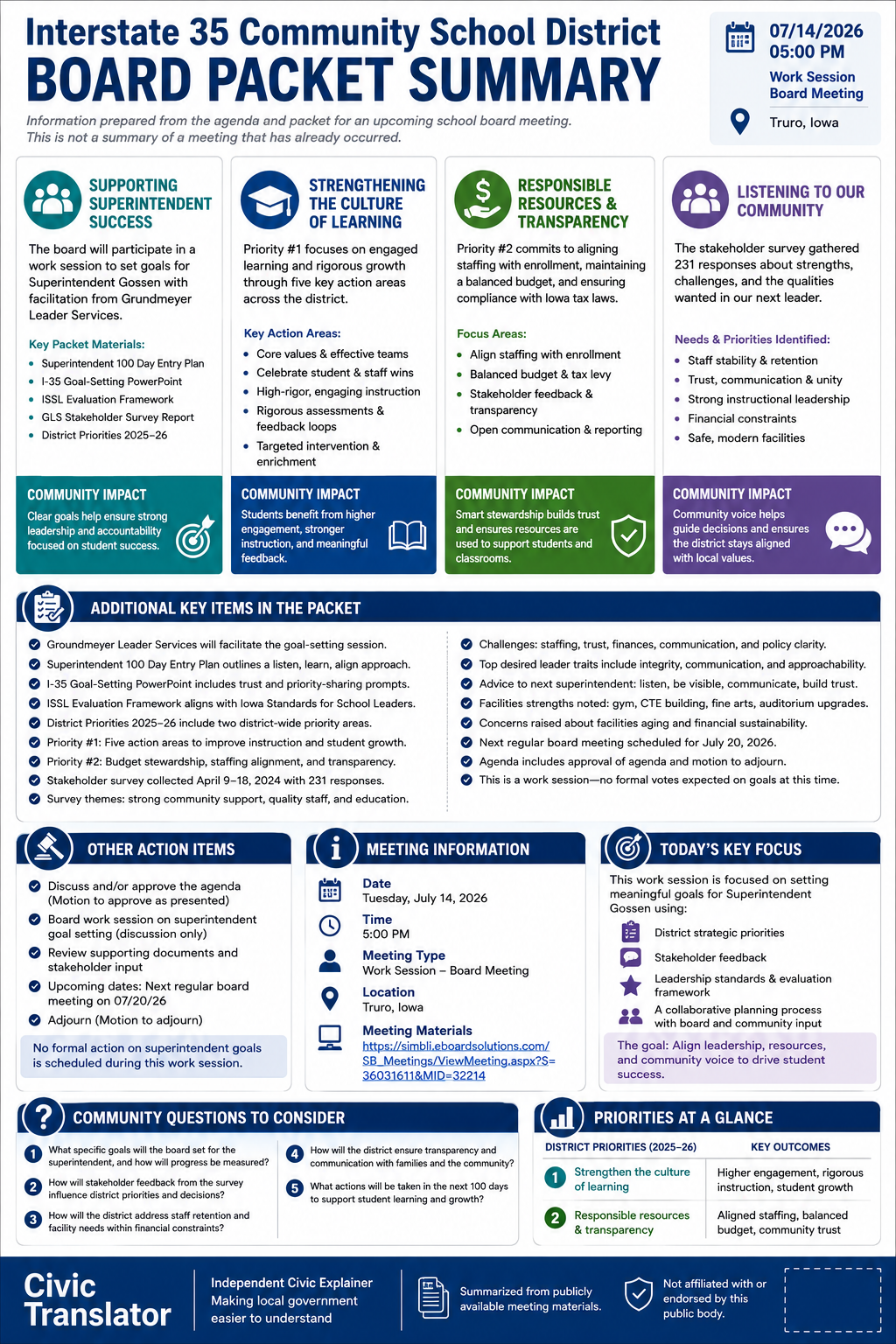
The July 14 work session is dedicated almost entirely to helping the Interstate 35 Community School District Board establish goals and evaluation expectations for new Superintendent Dr. Michael Gossen. Rather than focusing on routine district business, contracts, or policy approvals, the meeting is designed as a strategic planning workshop facilitated by Grundmeyer Leader Services. The discussion will help define how the board will evaluate the superintendent's first year and align leadership priorities with the district's long-term strategic direction.
Several supporting documents indicate that the district is entering a period of organizational transition. The packet includes Dr. Gossen's 100-Day Entry Plan, district strategic priorities, a statewide superintendent evaluation framework based on Iowa Standards for School Leaders, and stakeholder survey results collected during the superintendent search process. Together, these materials provide the board with a roadmap for establishing measurable expectations while responding to concerns raised by staff, parents, students, and community members.
The district's strategic priorities focus heavily on strengthening classroom instruction and organizational effectiveness. Academic goals emphasize rigorous instruction, professional development, meaningful student engagement, improved assessment practices, stronger intervention and enrichment systems, collaborative teacher teams, and recognition of student and staff accomplishments. Operational priorities emphasize aligning staffing with enrollment, maintaining balanced budgets, complying with Iowa tax requirements, improving transparency, and building community trust.
Community feedback gathered during the superintendent search reveals both optimism and concern. Respondents consistently praised Interstate 35's supportive community, dedicated staff, personalized educational environment, improving academic culture, and recent facility investments. At the same time, many expressed concerns about leadership turnover, financial pressures, declining enrollment, staffing retention, communication challenges, community division following board elections, and rebuilding trust between district leadership and stakeholders.
The superintendent's proposed 100-day plan reflects many of these concerns. The first month emphasizes listening, relationship building, and understanding district operations before establishing strategic priorities. The following months focus on collaborative planning, implementation of initial improvements, regular communication with the public, town hall meetings, and development of systems for continuous improvement.
Although no major financial approvals or construction decisions appear on this work session agenda, the discussion is likely to influence future district budgeting, staffing, governance, communication practices, and strategic planning. The goals established during this session are expected to guide superintendent performance throughout the coming school year and shape future board evaluations.
Major Discussion and Action Items
Superintendent Goal-Setting Work Session
The primary purpose of the meeting is a facilitated board work session led by Grundmeyer Leader Services to establish performance goals for Superintendent Dr. Michael Gossen.
The workshop is expected to align board expectations with district strategic priorities, the superintendent's entry plan, and Iowa's superintendent evaluation framework. Rather than making immediate operational decisions, the board will discuss what successful leadership should look like during Dr. Gossen's first year and how progress will be measured.
The meeting appears intended to establish shared expectations early in the superintendent's tenure while promoting consistent communication between the board and district administration.
Superintendent 100-Day Entry Plan
Dr. Gossen's entry plan outlines three phases.
During Days 1 through 30, priorities include listening to stakeholders, reviewing academic, financial, and operational data, learning district culture, and identifying immediate opportunities.
Days 31 through 60 focus on developing strategic priorities, collaborative planning, establishing short-term goals, strengthening relationships with district leadership, and identifying opportunities for innovation.
Days 61 through 100 emphasize implementation, communicating priorities publicly, establishing systems for monitoring progress, and building a foundation for long-term district improvement.
The plan also commits to weekly updates with the board, monthly newsletters, town hall meetings, website communication, social media updates, and an open-door policy for community accessibility.
District Strategic Priorities
The district's instructional priorities center on strengthening a culture of learning.
Major initiatives include:
- Establishing and reinforcing team core values.
- Increasing visibility of student and staff accomplishments.
- Expanding rigorous instructional practices.
- Strengthening professional development.
- Using DigiCoach walkthrough data to improve instruction.
- Increasing peer observations among teachers.
- Improving assessment practices.
- Strengthening intervention and enrichment opportunities.
- Supporting differentiated instruction for diverse student needs.
These priorities are intended to improve instructional quality while building collaborative professional learning communities.
Resource Management and Organizational Transparency
The district's operational priorities focus on responsible management of resources.
The district plans to:
- Align staffing with changing enrollment.
- Improve enrollment forecasting.
- Maintain balanced budgets.
- Prioritize instructional spending.
- Seek cost-saving opportunities.
- Ensure compliance with Iowa taxation laws.
- Increase stakeholder participation in budgeting discussions.
- Conduct surveys and community forums.
- Explain the rationale behind district decisions.
- Keep communication open throughout the school year.
Core organizational values identified in the plan include transparent communication, fostering student growth, innovative solutions, and protecting trust among stakeholders.
Stakeholder Survey Findings
Grundmeyer Leader Services summarized feedback from 231 survey responses gathered during the superintendent search.
Frequently identified district strengths include:
- Strong community support.
- High-quality teachers and staff.
- Small-school advantages.
- Improved academic culture.
- Positive teacher-family communication.
- Individualized attention for students.
- Recent facility improvements.
- Curriculum development.
- Student achievement growth.
Frequently identified challenges include:
- Leadership turnover.
- Staffing shortages and retention.
- Financial uncertainty.
- Community division.
- Standards-referenced grading concerns.
- Communication with families.
- Trust between the board and administration.
- Maintaining educational rigor.
- Long-term facilities funding.
Superintendent Evaluation Framework
The packet includes Iowa's superintendent evaluation framework based on the Iowa Standards for School Leaders.
The evaluation process emphasizes:
- Continuous improvement.
- Goal setting.
- Self-reflection.
- Collaboration between the board and superintendent.
- Professional growth.
- Evidence-based performance reviews.
- Alignment with district strategic goals.
- Multiple progress meetings throughout the school year.
The framework recommends ongoing dialogue rather than a single annual evaluation and encourages SMARTIE goal development that is strategic, measurable, attainable, relevant, time-bound, inclusive, and equitable.
Financial Matters
No contracts, bids, purchases, grants, transfers, or appropriations requiring board approval appear in the work session agenda.
However, district strategic planning identifies several financial priorities:
- Maintaining a balanced district budget.
- Aligning staffing with enrollment trends.
- Using enrollment projections for budget forecasting.
- Prioritizing expenditures that directly support student learning.
- Implementing cost-saving measures where appropriate.
- Working with financial institutions and legal experts to maintain compliance with Iowa taxation laws.
- Increasing transparency by involving staff, parents, and community members in budget discussions.
Stakeholder survey responses also identify financial management, declining enrollment, facility maintenance costs, and proposed tax levy reductions as areas of community concern that future district leadership will need to address.
Policies, Ordinances, Resolutions, and Governance
No new board policies, resolutions, or ordinances are scheduled for formal action during this work session.
Instead, governance discussions focus on:
- Establishing superintendent performance expectations.
- Aligning evaluation procedures with Iowa Standards for School Leaders.
- Building stronger board-superintendent collaboration.
- Creating ongoing performance review processes.
- Aligning superintendent goals with district strategic priorities.
- Strengthening transparency and accountability.
Superintendent Entry Plan
The board will review Dr. Gossen's proposed 100-day implementation plan, emphasizing listening, relationship building, strategic planning, communication, and continuous improvement.
District Strategic Priorities
District leadership priorities include instructional excellence, organizational culture, transparency, balanced budgeting, enrollment-driven staffing decisions, professional development, assessment improvement, and differentiated instruction.
Stakeholder Survey Report
Grundmeyer Leader Services presents community feedback collected from 231 respondents during the superintendent search process. The report identifies community strengths, major challenges, desired leadership characteristics, and recommendations for the new superintendent.
Goal-Setting Presentation
The presentation references district priorities, superintendent evaluation reminders, organizational trust, Patrick Lencioni's leadership principles, and collaborative goal sharing.
Iowa Superintendent Evaluation Framework
The packet provides a comprehensive overview of Iowa's evaluation standards, leadership expectations, annual evaluation timeline, professional development planning, coaching process, and performance review framework.
Personnel, Appointments, and Organizational Matters
The meeting focuses on establishing expectations for Superintendent Dr. Michael Gossen's first year.
Community feedback identifies leadership stability, staff retention, recruiting qualified teachers, strengthening relationships between administration and the board, and improving communication as organizational priorities.
The packet emphasizes professional growth rather than disciplinary evaluation and recommends ongoing collaboration between the board and superintendent.
No personnel appointments, resignations, retirements, or employment agreements are listed for action.
Projects, Facilities, Infrastructure, and Operations
Although no capital projects are scheduled for approval, facilities remain an important topic throughout the supporting documents.
Survey participants cite recent improvements to athletic facilities, fine arts spaces, career and technical education facilities, gyms, weight rooms, and the auditorium as district strengths.
At the same time, respondents express concern about aging facilities, deferred maintenance, increasing construction costs, and the financial challenges of maintaining district infrastructure.
Operational priorities also include improving staffing alignment, instructional coaching, assessment systems, communication practices, and district-wide planning processes.
The packet does not schedule a formal public hearing during this work session.
However, the superintendent's entry plan commits to:
- Town hall meetings.
- Open-door accessibility.
- Monthly newsletters.
- Regular website and social media communication.
- Ongoing stakeholder engagement.
The district's strategic priorities also call for surveys, community forums, polls, and continuous opportunities for public feedback regarding district decisions.
Residents can expect the board to focus on long-term district leadership rather than immediate operational decisions.
Students and families may benefit from stronger instructional priorities, improved communication, enhanced intervention strategies, and greater emphasis on student engagement.
Teachers and staff may experience expanded professional development, increased collaboration, peer review opportunities, and stronger instructional coaching.
Taxpayers may see greater emphasis on financial transparency, balanced budgeting, enrollment-based staffing decisions, and public explanations for district financial choices.
Community organizations and local residents may have additional opportunities to participate in surveys, forums, and town hall meetings as district leadership works to rebuild trust and strengthen community relationships.
- How will the board measure success during the superintendent's first year?
- Which district priorities will receive the greatest attention during the superintendent's first 100 days?
- How will community feedback continue to shape district decision-making after this work session?
- What specific actions will improve transparency between the board, administration, and the public?
- How will declining enrollment affect future staffing and budgeting decisions?
- What measurable indicators will demonstrate improved student engagement and instructional rigor?
- How will the district address concerns about leadership stability and staff retention?
- What opportunities will residents have to participate in future town halls or surveys?
- How will progress toward superintendent goals be communicated throughout the year?
- What long-term financial strategies are being considered to maintain facilities while preserving educational programs?
Important Dates, Deadlines, and Next Steps
- July 14, 2026: Board work session devoted to superintendent goal setting and strategic planning.
- July 20, 2026: Next scheduled regular Board of Education meeting.
- Days 1–30 of Superintendent Tenure: Listening sessions, stakeholder meetings, operational review, and identification of immediate priorities.
- Days 31–60: Development of strategic priorities, collaborative planning, and establishment of short-term goals.
- Days 61–100: Implementation of initial priorities, communication with stakeholders, and creation of long-term monitoring systems.
- Throughout the School Year: Weekly board updates, monthly newsletters, town hall meetings, and continued community engagement.
- During the School Year: Superintendent performance discussions and progress reviews following Iowa's recommended evaluation timeline.
Key Takeaways
- The meeting is a strategic work session rather than a routine business meeting.
- The primary focus is setting goals for Superintendent Dr. Michael Gossen.
- Grundmeyer Leader Services will facilitate the board workshop.
- The superintendent's 100-day plan emphasizes listening before implementing change.
- Community engagement is a central theme throughout the packet.
- The district prioritizes rigorous instruction and student engagement.
- Professional development remains a major instructional strategy.
- Balanced budgeting and enrollment-based staffing are organizational priorities.
- Transparency and communication are recurring goals.
- Stakeholder feedback identified strong community support as a major district strength.
- Leadership stability emerged as one of the community's largest concerns.
- Financial management and enrollment trends remain important long-term issues.
- The district intends to increase opportunities for public feedback.
- Iowa's superintendent evaluation framework emphasizes continuous improvement instead of annual checklists.
- The board will use strategic priorities to guide superintendent evaluation.
- Future communication will include newsletters, town halls, website updates, and social media.
- The next regular board meeting is scheduled for July 20, 2026.
Official Sources
About the Public Body
- Name: Interstate 35 Community School District
- Organization type: school-district
- Government body: school-boards
- Location: Truro, iowa
- County: Madison
- Provider: simbli
Keywords
Interstate 35 Community School District, Truro Iowa, Madison County, school board, board work session, superintendent goals, Dr. Michael Gossen, Grundmeyer Leader Services, superintendent evaluation, Iowa Standards for School Leaders, 100-day entry plan, district priorities, strategic planning, instructional rigor, student engagement, balanced budget, staffing, enrollment, transparency, community engagement, stakeholder survey, teacher retention, communication, facilities, leadership transition, board governance, professional development, school improvement, Iowa education