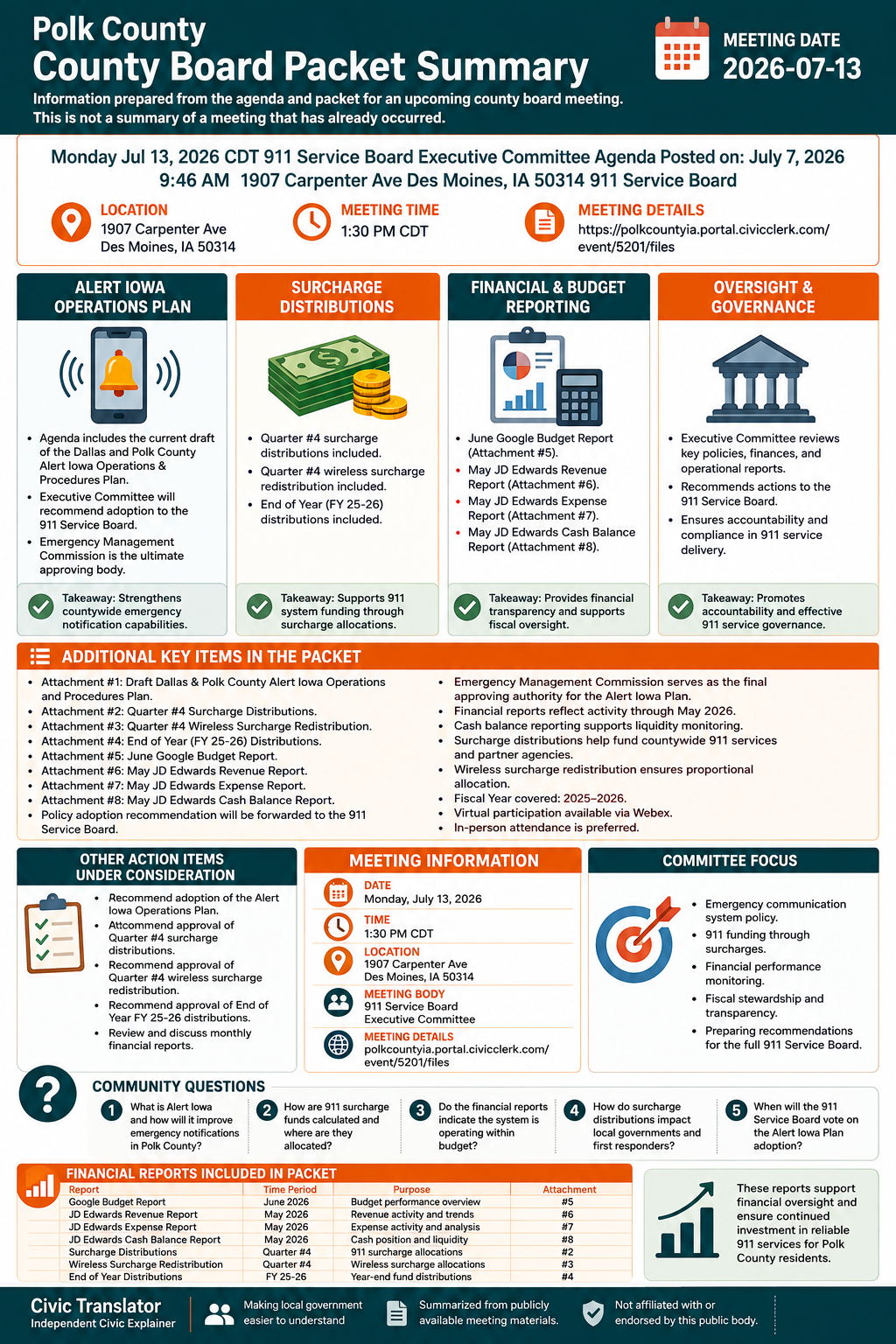
The primary focus of this Executive Committee meeting is a recommendation on a new draft Dallas and Polk County Alert Iowa Operations and Procedures Plan. According to the packet, the Executive Committee is being asked to recommend adoption of the policy to the full 911 Service Board, after which the Emergency Management Commission would serve as the final approving authority.
The proposed operations plan establishes how Dallas and Polk County Emergency Management Agencies will manage the Alert Iowa emergency notification system, including Wireless Emergency Alerts (WEA), the Emergency Alert System (EAS), and other public warning tools. The document emphasizes consistent standards for emergency messaging, authorization, training, security, and coordination between agencies during incidents affecting public safety.
The packet also includes fourth-quarter surcharge distribution reports, year-end FY 2025-26 distribution information, budget reports, revenue and expense reports, and cash balance reports. While these financial attachments are included for committee review, the extracted text primarily identifies them as supporting reports rather than detailing specific dollar figures in the accessible text. The committee therefore appears to be reviewing both operational policy and the financial status of the regional 911 system.
Overall, the meeting centers on improving emergency communications, ensuring emergency alerts are accurate and timely, strengthening coordination among emergency response agencies, and reviewing the fiscal condition of the 911 program.
Major Discussion and Action Items
Adoption of the Alert Iowa Operations and Procedures Plan
The most significant item is consideration of the draft Dallas and Polk County Alert Iowa Operations and Procedures Plan (Version 2026.02). The Executive Committee is expected to recommend whether the plan should be adopted by the full 911 Service Board before final approval by the Emergency Management Commission.
The plan establishes policies governing emergency alerts, public warnings, notifications, user responsibilities, system administration, security requirements, training, and coordination between Dallas and Polk Counties.
Standardizing Emergency Public Alerts
A major objective of the draft policy is standardizing how emergency alerts are issued so residents receive timely, consistent, and actionable information during emergencies.
The plan distinguishes among:
- Alerts for immediate threats
- Warnings before anticipated hazards
- Notifications providing protective instructions or recovery information
It also identifies when Wireless Emergency Alerts, Emergency Alert System broadcasts, or subscriber notifications should be used.
Clarifying Roles and Responsibilities
The packet clearly assigns responsibilities among:
- Emergency Management Commissions
- Emergency Management Agencies
- Emergency Communications Centers
- Iowa Homeland Security and Emergency Management
- Iowa Department of Public Safety
- Iowa Department of Transportation
- FEMA
- FCC
- National Weather Service
The intent is to eliminate uncertainty over who can authorize and distribute emergency communications.
Improving Message Quality
The proposed operating procedures emphasize evidence-based warning practices.
Emergency messages should:
- identify the official source;
- clearly describe the hazard;
- identify affected locations;
- explain protective actions;
- specify timing;
- use plain language;
- avoid unnecessary jargon; and
- provide links to additional official information whenever possible.
These standards are intended to improve public understanding and reduce confusion during emergencies.
Cross-Jurisdiction Coordination
The plan documents agreements allowing neighboring counties to support one another when emergencies cross county lines or when backup alerting is required.
The proposal recognizes that emergencies frequently extend beyond a single jurisdiction and therefore establishes procedures for coordinated regional messaging.
Financial Oversight
The committee packet includes quarter-four surcharge distributions, wireless surcharge redistribution, fiscal year-end distributions, budget reports, revenue reports, expense reports, and cash balance reports for review. These materials provide oversight of the finances supporting regional 911 operations, although the accessible extracted text does not include detailed financial totals.
Financial Matters
The packet includes several financial reports for committee review:
- Quarter #4 surcharge distributions
- Quarter #4 wireless surcharge redistribution
- End-of-year FY 2025-26 distributions
- June budget report
- May revenue report
- May expense report
- May cash balance report
These reports support financial oversight of the regional emergency communications system. The accessible packet text identifies the reports but does not provide complete numerical detail for all attachments, so specific balances or expenditures cannot be confirmed from the extracted text alone.
Policies, Ordinances, Resolutions, and Governance
The proposed Alert Iowa Operations and Procedures Plan represents the principal governance item.
Among its policy provisions, the draft:
- establishes authority for emergency messaging;
- defines approval procedures;
- establishes user qualifications;
- requires recurring training;
- establishes security standards;
- outlines password and account management requirements;
- establishes procedures for updating or cancelling erroneous alerts;
- documents cross-jurisdictional cooperation; and
- establishes change-management procedures for future revisions.
The packet notes that Version 2026.02 updates portions of Addendum D while continuing the broader policy framework adopted earlier in 2026.
The packet contains a comprehensive operational manual explaining how Alert Iowa functions throughout Dallas and Polk Counties.
Topics include:
- emergency communication procedures;
- Wireless Emergency Alerts;
- Emergency Alert System messaging;
- subscriber notifications;
- message templates;
- training expectations;
- testing requirements;
- geographic targeting;
- follow-up notifications;
- incident documentation;
- public communication standards; and
- security practices.
Rather than introducing a new emergency notification system, the document formalizes operating procedures intended to improve consistency across participating agencies.
Personnel, Appointments, and Organizational Matters
The policy outlines personnel expectations for individuals authorized to use Alert Iowa.
Among the organizational requirements:
- users must complete required FEMA and local training;
- credentials are assigned individually;
- agencies must maintain current authorized-user lists;
- users must complete periodic proficiency testing;
- accounts may be suspended if testing requirements are missed; and
- agencies are expected to notify Emergency Management when authorized users separate from service.
No significant hiring, resignations, appointments, or employment agreements are identified in the accessible packet text.
Projects, Facilities, Infrastructure, and Operations
The operational focus is improving regional emergency communications infrastructure rather than constructing physical facilities.
Key operational elements include:
- Wireless Emergency Alerts;
- Emergency Alert System broadcasts;
- Alert Iowa subscriber messaging;
- geographic targeting;
- emergency message templates;
- backup alerting procedures;
- interoperability between counties;
- monthly and quarterly testing;
- cybersecurity practices; and
- operational continuity during emergencies.
The meeting location is Polk County Emergency Management at 1907 Carpenter Avenue in Des Moines, with a Webex option also provided.
The accessible packet does not identify a formal public hearing related to the proposed policy.
The Executive Committee will consider recommending adoption of the operating procedures, with subsequent consideration by the 911 Service Board and final approval by the Emergency Management Commission.
Residents may attend the meeting in person or participate through the listed virtual meeting option.
If adopted, the operating procedures are intended to improve how residents receive emergency information.
Potential community impacts supported by the packet include:
- more consistent emergency notifications;
- clearer protective instructions;
- improved coordination among emergency agencies;
- stronger regional cooperation across county boundaries;
- improved training for authorized alerting personnel;
- greater accountability through standardized procedures; and
- enhanced reliability of emergency communications during major incidents.
Because emergency messaging affects nearly every resident during disasters or public safety events, consistent procedures may improve public understanding and response during emergencies.
- How will adoption of the new operating procedures change current emergency notification practices?
- What public education will accompany implementation of the updated Alert Iowa procedures?
- How are residents encouraged to subscribe to Alert Iowa notifications?
- How often are emergency alert procedures tested under the proposed policy?
- What safeguards exist to prevent erroneous emergency alerts?
- How will Dallas and Polk Counties coordinate alerts affecting multiple jurisdictions?
- What oversight will the 911 Service Board retain after the Emergency Management Commission approves the policy?
- What trends are reflected in the quarter-four surcharge and year-end financial reports?
- Are current 911 revenues sufficient to support long-term operations?
- What future revisions are anticipated as emergency alert technology evolves?
Important Dates, Deadlines, and Next Steps
- July 13, 2026: Executive Committee reviews the Alert Iowa Operations and Procedures Plan and supporting financial reports.
- Following Executive Committee recommendation: Proposal advances to the full 911 Service Board.
- Final approval: Emergency Management Commission considers adoption of the operating procedures.
- After adoption: Updated operational standards, training, testing, and governance procedures would guide future Alert Iowa operations.
Key Takeaways
- The primary action item is recommending adoption of the Alert Iowa Operations and Procedures Plan.
- The Emergency Management Commission serves as the final approving authority.
- The proposal standardizes emergency alerting across Dallas and Polk Counties.
- The policy covers Wireless Emergency Alerts, Emergency Alert System messaging, and subscriber notifications.
- Clear message standards are intended to improve public response during emergencies.
- Training and recurring proficiency testing are required for authorized users.
- Security requirements govern accounts, passwords, and system access.
- Regional backup agreements strengthen cross-county emergency communications.
- Financial reports covering surcharge distributions and FY 2025-26 operations are included for committee oversight.
- The meeting emphasizes operational readiness rather than major capital projects.
Official Sources
About the Public Body
- Name: Polk County
- Organization type: county
- Government body: county-boards
- Location: Des Moines, iowa
- County: Polk County
- Provider: civicclerk
Keywords
Polk County, 911 Service Board, Executive Committee, Alert Iowa, Emergency Management, Dallas County, Wireless Emergency Alerts, WEA, Emergency Alert System, EAS, IPAWS, Rave Alert, emergency communications, public safety, operations plan, emergency notifications, surcharge distributions, FY 2025-26, budget report, revenue report, expense report, cash balance, Emergency Management Commission, FEMA, Homeland Security, interoperability, regional coordination, public warning, Des Moines, Iowa