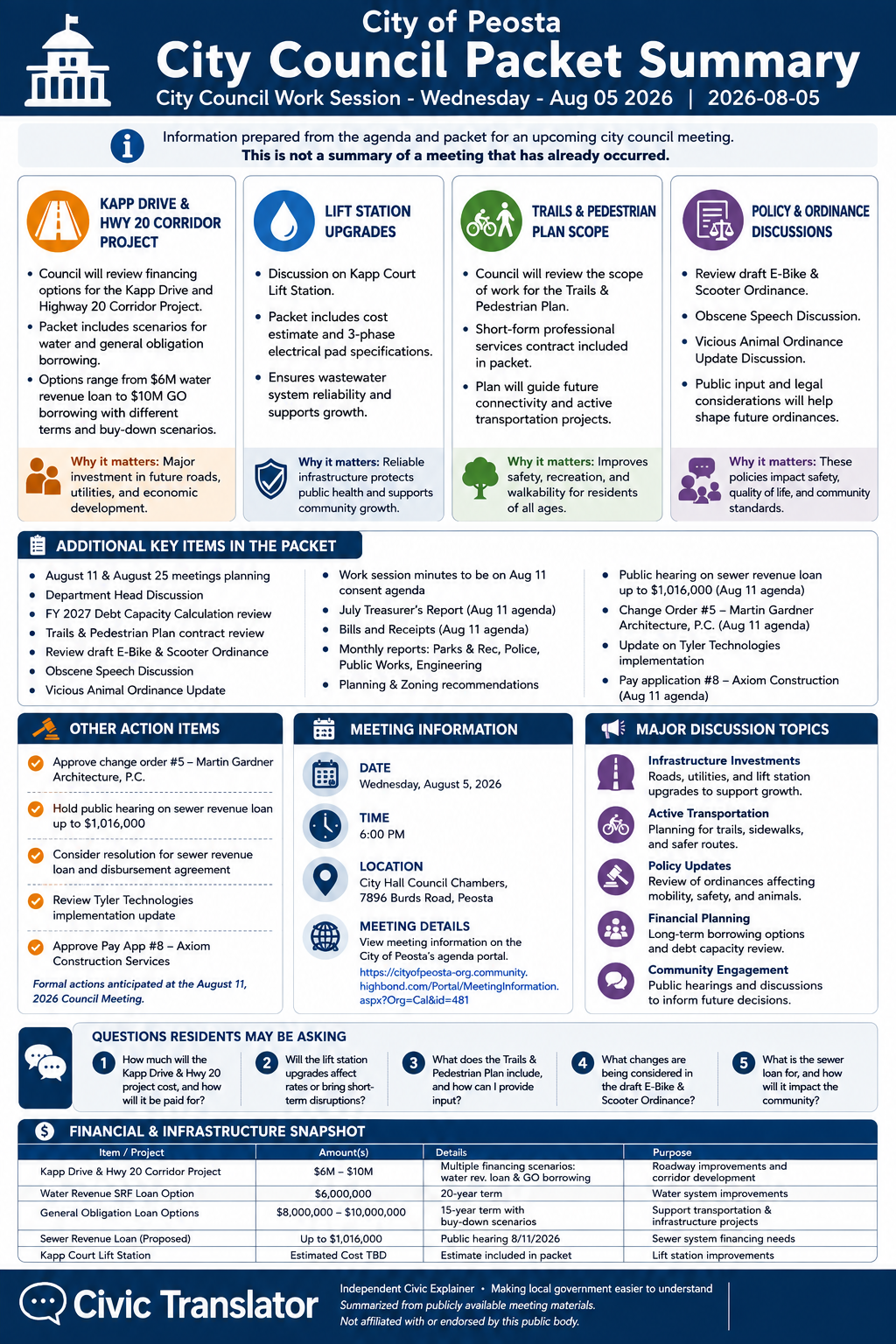
The Peosta City Council’s August 5 work session was structured as a planning and policy discussion rather than a regular voting meeting. The agenda focused on major infrastructure financing, the Highway 20 and Kapp Drive corridor, electrical service for the Kapp Court lift station, an update to the city’s trail and pedestrian plan, and proposed rules for electric bicycles, scooters, and other micromobility devices.
The largest financial issue was how Peosta could fund major water and transportation improvements. Preliminary financing models included a $6 million Water Revenue State Revolving Fund loan and possible $8 million, $9 million, or $10 million general obligation bond issues. The city’s preliminary legal debt limit for fiscal year 2026-2027 was calculated at about $22.9 million, with approximately $15.5 million in remaining debt margin after existing applicable debt.
The council also reviewed a detailed draft ordinance regulating e-bikes, electric scooters, hoverboards, motorized skateboards, and similar devices. The draft would limit where certain devices could be operated, impose speed and safety rules, authorize fines and impoundment, and make parents or guardians responsible for violations by minors.
Other significant matters included a proposed $4,000 contract with the East Central Intergovernmental Association to update Peosta’s trail plan and a roughly $58,750 electrical-service estimate for the Kapp Court lift station. Several subjects discussed at the work session were expected to return for possible formal action at regular meetings on August 11 or August 25.
Major Discussion and Action Items
Kapp Drive and Highway 20 Corridor Financing
The council reviewed long-range financing scenarios connected to Kapp Drive and the Highway 20 corridor project. Supporting materials modeled an $8 million general obligation bond issue in 2027 with a 15-year repayment period and an assumed 4% interest rate.
That model showed approximately $10.79 million in total principal and interest. Annual debt service was projected near $718,000 to $722,000. Depending on whether annual revenues or “buydowns” of $100,000 or $250,000 were applied, the estimated property-tax impact varied substantially. The preliminary models ranged from roughly $75 to $116 annually for property with $100,000 of taxable value.
The packet also examined possible $8 million, $9 million, and $10 million bond issues beginning in 2036. Those later scenarios projected total principal and interest costs of approximately $11.42 million, $12.87 million, and $14.32 million, respectively, before accounting for other debt, revenues, and tax-supported obligations.
These were preliminary planning illustrations, not final bond authorizations. The work session allowed council members to compare project scale, timing, repayment structure, available revenue, and taxpayer effects before future formal decisions.
Water Infrastructure and State Revolving Fund Loan
A separate preliminary schedule modeled a $6 million Water Revenue State Revolving Fund loan, Series 2026. The assumed interest rate was 3.25%, with repayment extending through June 2047.
The schedule projected about $2.25 million in interest and approximately $8.25 million in total principal and interest. Fiscal-year debt service was generally estimated at about $412,000 to $413,000 annually.
Because this would be a water-revenue obligation, repayment would generally be tied to utility-system revenues rather than being presented solely as a general property-tax issue. The packet did not include a final rate plan, so the exact effect on customer bills was not established.
The August 11 agenda also anticipated a public hearing and possible additional action on a separate Sewer Revenue Loan and Disbursement Agreement for borrowing not to exceed $1,016,000.
City Debt Capacity
A preliminary legal debt-limit calculation showed Peosta’s actual valuation for debt-limit purposes at $458,244,228. Iowa’s 5% constitutional formula produced a legal debt limit of $22,912,211 for fiscal year 2026-2027.
Existing general obligation debt applicable to the limit totaled approximately $7,405,000, including bonds issued in 2017, 2021A, and 2023A. That left a preliminary remaining debt margin of $15,507,211.
This figure is important because proposed Kapp Drive, Highway 20, and other capital borrowing would consume part of that capacity. Remaining below the legal limit does not by itself determine affordability; the city must also consider annual repayment obligations, competing projects, utility revenues, tax effects, and future borrowing needs.
Kapp Court Lift Station Electrical Service
The council discussed extending three-phase underground electric service to the Kapp Court lift station. Maquoketa Valley Electric Cooperative estimated the city’s cost at approximately $58,750.
The estimate included a $6,000 underground construction crew base cost, $48,675 for 1,475 feet of underground primary line at $33 per foot, and $4,000 for a three-phase pad-mounted transformer.
The city would be responsible for providing the trench or bore and a compliant concrete transformer pad, as well as locating privately owned underground facilities. MVEC required payment and a signed easement before work could begin. Construction was estimated to require four to six weeks after payment, subject to scheduling and seasonal limits.
The estimate was dated July 23, 2026 and generally valid for 90 days, with underground-work restrictions approaching winter.
Trail and Pedestrian Plan Update
The city considered hiring the East Central Intergovernmental Association to update Peosta’s trail plan. ECIA proposed billing at $106 per hour, with total planning costs capped at $4,000.
The work would include an updated inventory of trails, bike lanes, and signed on-street routes; development and prioritization of a project list; a future trail-network map; and a written summary of recommendations. Sidewalks would not be included in the existing-facilities inventory.
ECIA would work with city staff and a city-designated committee. Dan Fox, senior planner, would lead the project. Completion was anticipated within approximately three months after contract execution, depending on participant availability.
The proposal was an update to earlier planning work, not a complete rewrite of the city’s vision, goals, or guiding principles.
Draft E-Bike and Scooter Ordinance
The council reviewed a comprehensive draft ordinance covering low-speed electric bicycles, electric personal assistive mobility devices, scooters, hoverboards, electric unicycles, motorized skateboards, and similar devices.
The draft would prohibit careless or reckless operation, racing, weaving through traffic, wheelies, towing, distracted riding, and operation while impaired. Devices used at night or during limited visibility would need compliant lights and reflectors.
A maximum speed of 10 miles per hour would apply on sidewalks and trails. Riders would be required to yield to pedestrians and provide an audible warning before passing. Class 3 e-bikes could be operated on trails only within applicable limits, with a maximum of 20 miles per hour where no lower limit applied.
Electric personal mobility and micromobility devices would be prohibited on the roadways and adjacent sidewalks of Peosta Street, Burds Road, Cox Springs Road, Deerwood Street, Enterprise Drive, Kapp Drive, Kapp Court, Thunder Valley Drive, and Thunder Hills Road. Restrictions would also apply in certain school-related parking areas during child drop-off and pick-up times.
Nonconforming devices, such as high-powered electric dirt bikes or modified devices exceeding legal e-bike limits, generally could not be used on sidewalks, trails, parks, or other public property.
Proposed penalties were $125 for a first offense and between $250 and $750 for subsequent offenses within two years. An operator could consent to temporary impoundment instead of a fine: at least five days for a first offense, 10 days for a second, and 30 days for later offenses.
Other Ordinance and Conduct Discussions
The work-session agenda also included discussions about obscene speech and an update to the city’s vicious-animal ordinance. The bounded source did not include draft language or specific proposed changes for either subject.
These discussions may lead to later ordinance revisions, enforcement guidance, or legal review. Any eventual proposal would require clearer definitions, procedural protections, and formal council action before changing city law.
Financial Matters
The most consequential financial materials involved preliminary capital borrowing. The $6 million water-revenue loan model projected total repayment of about $8.25 million over 20 years. The $8 million 2027 general obligation model projected total repayment of about $10.79 million over 15 years.
Alternative long-term general obligation scenarios modeled borrowing of $8 million, $9 million, or $10 million, with estimated total bond principal and interest of approximately $11.42 million, $12.87 million, and $14.32 million.
The city’s preliminary remaining legal debt capacity was approximately $15.5 million, although annual affordability and taxpayer impact remain separate considerations.
Smaller project costs included the proposed ECIA trail-plan contract, capped at $4,000, and the approximately $58,750 MVEC electrical-service extension for the Kapp Court lift station. The lift-station estimate did not appear to include all city-side trenching, boring, pad construction, backfill, or related site expenses.
The August 11 agenda also listed a proposed sewer-revenue borrowing of up to $1,016,000 and a change order submitted by Martin Gardner Architecture, P.C., although the source did not provide the change-order amount.
Policies, Ordinances, Resolutions, and Governance
The e-bike and scooter ordinance remained in draft form, with ordinance number and reading dates left blank. It would require formal introduction, readings, approval, publication, and an effective date before enforcement.
The August 11 agenda anticipated the third reading of Ordinance 2026-02 concerning the responsibility of legal guardians. It also listed Resolution 2026-71 regarding a change order and Resolution 2026-72 concerning a sewer-revenue loan.
The council’s discussions about obscene speech and vicious animals may also result in future code amendments, but no specific text was included in the accessible material.
Department-head discussion was scheduled, but no individual departmental reports were included in the work-session materials.
The financing schedules prepared by Speer Financial were expressly preliminary and subject to change. They functioned as planning tools showing possible debt-service, revenue-offset, and property-tax outcomes rather than final borrowing terms.
Regular departmental reports from parks and recreation, police, public works, engineering, planning and zoning, and the mayor were scheduled for the August 11 meeting.
Personnel, Appointments, and Organizational Matters
No specific hiring, resignation, retirement, appointment, or employment agreement was detailed in the work-session source.
A city-designated committee would participate in refining and prioritizing projects under the proposed trail-plan update. Committee composition and appointment procedures were not provided.
Projects, Facilities, Infrastructure, and Operations
The Kapp Drive and Highway 20 corridor work represents the largest anticipated capital undertaking discussed. The council was reviewing both immediate and long-range borrowing structures before the Highway 20 Access Improvements Project moved toward a public hearing and potential award.
The Kapp Court lift-station electrical extension is an operational utility project requiring underground three-phase service, a transformer pad, easement documentation, trench coordination, and compliance with MVEC construction standards.
The trail-plan update would establish a prioritized future bicycle and pedestrian network, helping guide later capital planning, grant applications, and route selection.
The August 5 work session began at 6:00 p.m. in the City Hall Council Chambers, 7896 Burds Road, with Zoom access provided.
The August 11 regular meeting was scheduled to include citizen comment and two public hearings: one on a Sewer Revenue Loan and Disbursement Agreement for borrowing up to $1,016,000, and another on the drawings, specifications, budget, and contract form for the Highway 20 Access Improvements Project.
The August 25 meeting was also scheduled for 6:00 p.m. at City Hall and included citizen-comment opportunities. The agenda anticipated awarding the Highway 20 project.
Residents and taxpayers may be affected by future debt issued for Kapp Drive, Highway 20, and utility improvements. Preliminary estimates show that revenue offsets or buydowns could materially reduce the property-tax burden of an $8 million bond issue.
Water and sewer customers could be affected by revenue-backed borrowing, although no final utility-rate impacts were included.
Families, young riders, pedestrians, and motorists would be directly affected by the proposed e-bike and scooter rules. The ordinance would establish clearer expectations for speed, equipment, street access, parking, and parental responsibility.
Trail users and neighborhoods could benefit from a more coordinated future network, but individual route recommendations would not be known until the planning process and committee prioritization were completed.
- What is the current estimated total cost of the Kapp Drive and Highway 20 corridor project?
- Which revenues could be used to reduce the property-tax-supported portion of the proposed bonds?
- How would borrowing affect the city’s capacity for other future projects?
- What utility-rate effects are anticipated from the water and sewer revenue loans?
- Does the lift-station estimate include trenching, boring, concrete-pad work, engineering, and restoration?
- Which streets or trails have produced the greatest safety concerns involving e-bikes and scooters?
- How would the city educate riders and families before enforcing the proposed ordinance?
- How will police distinguish legal e-bikes from modified or nonconforming devices?
- Who will serve on the trail-plan committee, and how can residents contribute route suggestions?
- What project criteria will be used to prioritize future bicycle and pedestrian improvements?
- What changes are being considered for the vicious-animal ordinance?
- What safeguards will guide any city policy concerning obscene speech?
Important Dates, Deadlines, and Next Steps
- August 5, 2026: City Council work session on infrastructure financing, lift-station power, trail planning, micromobility rules, speech, and animal regulations.
- August 11, 2026: Regular council meeting with public hearings on sewer borrowing and Highway 20 project plans and specifications.
- August 25, 2026: Regular council meeting expected to include consideration of awarding the Highway 20 project.
- Approximately three months after contract execution: Anticipated completion period for the ECIA trail-plan update.
- Within the MVEC estimate period: The city would need to finalize payment, easement, trenching, and pad arrangements for the lift-station electrical extension.
- Four to six weeks after payment: Approximate MVEC construction lead time, subject to coordination and seasonal restrictions.
- Future council meetings: Formal introduction and readings would be required before the e-bike and scooter ordinance could take effect.
Key Takeaways
- The work session centered on major infrastructure, financing, transportation, and safety policies.
- Peosta’s preliminary legal debt limit was about $22.9 million.
- Approximately $15.5 million in legal debt margin remained after applicable existing debt.
- A $6 million water loan could require about $8.25 million in total repayment.
- An $8 million 2027 general obligation bond model projected about $10.79 million in repayment.
- Revenue offsets could significantly reduce estimated property-tax impacts.
- Three-phase electrical service for the Kapp Court lift station was estimated at about $58,750.
- ECIA proposed updating Peosta’s trail plan for no more than $4,000.
- The trail update would produce facility maps, prioritized projects, a future network map, and recommendations.
- The draft micromobility ordinance would impose location, speed, equipment, conduct, fine, and impoundment rules.
- Highway 20 project hearings were scheduled for August 11, with a possible award on August 25.
- Most work-session subjects required later formal action before becoming binding.
Official Sources
About the Public Body
- Name: City of Peosta
- Organization type: municipality
- Government body: city-council
- Location: Peosta, iowa
- County: Dubuque County
- Provider: diligent-community
Keywords
City of Peosta, Peosta City Council, work session, Kapp Drive, Highway 20, Highway 20 Access Improvements, general obligation bonds, water revenue loan, sewer revenue loan, State Revolving Fund, debt capacity, property taxes, Speer Financial, Kapp Court lift station, Maquoketa Valley Electric Cooperative, three-phase power, ECIA, trail plan, bicycle network, pedestrian planning, e-bikes, electric scooters, micromobility, public safety, municipal ordinance, impoundment, Dubuque County, infrastructure financing, public hearing, City Hall