Hawaii State Board of Education Packet Summary — 2026-08-13
Finance and Infrastructure Committee
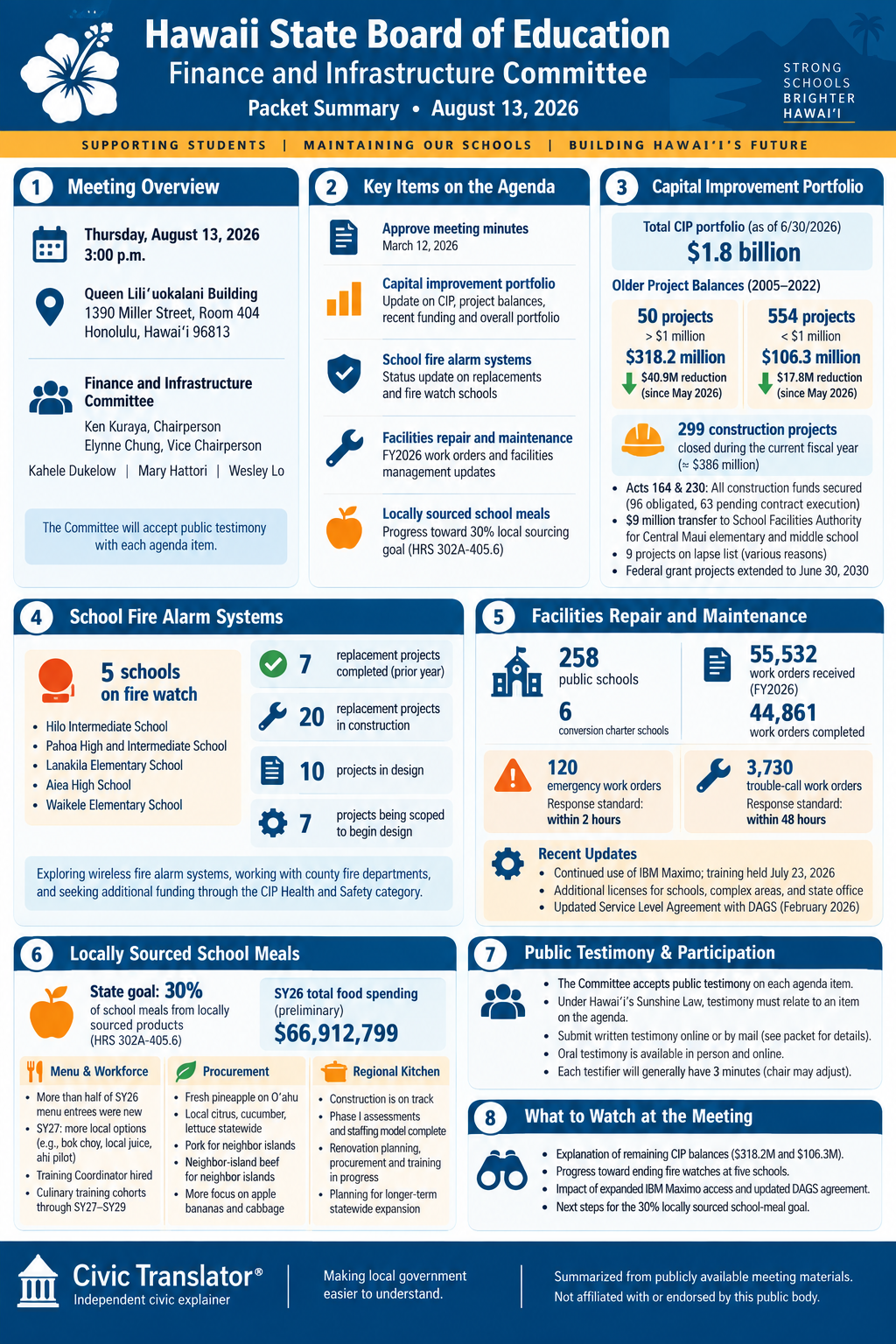
The Finance and Infrastructure Committee is scheduled to meet at 3:00 p.m. on August 13, 2026, at the Queen Liliʻuokalani Building in Honolulu. The agenda centers on the Department of Education’s capital improvement portfolio, school fire alarm systems, facilities repair and maintenance, and progress toward increasing locally sourced products in school meals.
Key Items on the Agenda
- Consider approval of the minutes from the March 12, 2026, Finance and Infrastructure Committee meeting.
- Receive an update on the Department of Education’s capital improvement program (CIP), including older project balances, recently closed fiscal-biennium funding, appropriations under Acts 250 and 175, and the overall project portfolio.
- Review the status of school fire alarm systems, including five schools currently operating under fire watch and dozens of replacement projects in construction, design, or scoping.
- Receive an update on statewide school facilities repair and maintenance, including FY2026 work-order activity, emergency and trouble-call response standards, and changes to facilities management procedures.
- Review progress toward the State’s goal of having 30% of school meals consist of locally sourced products under section 302A-405.6, Hawaii Revised Statutes, including menu, procurement, training, and regional-kitchen initiatives.
Capital Improvement Portfolio
The Department is scheduled to present a broad update on its CIP portfolio, currently valued at approximately $1.8 billion based on previous appropriations and current financial information from Act 175 as of June 30, 2026.
Older Project Balances
The Department has continued assessing projects dating from 2005 through 2022 that retain balances:
- 50 projects have balances greater than $1 million, totaling approximately $318.2 million. Since the May 2026 update, this represents four fewer projects and a $40.9 million reduction.
- 554 projects have balances below $1 million, totaling approximately $106.3 million. This represents 28 fewer projects and an approximately $17.8 million reduction.
The packet also reports that the Department closed 299 construction projects valued at approximately $386 million during the current fiscal year.
Act 164 and Act 230 Funding
For construction funding appropriated under Acts 164 and 230, the Department reports that all construction funds were secured by June 30, 2026. That includes 96 projects with funds obligated and 63 projects with funds pending contract execution.
For design funding, all funds have been encumbered except those for the Lincoln Elementary School Master Plan and Campus Improvements project. Those funds were secured through a blanket purchase order, with the contract described as being in the final stages of execution.
The Department also explains that some entries categorized as “lapsed funding” are administrative reclassifications associated with year-end financial-system procedures rather than actual loss of project funding.
Transfers and Projects Not Obligated
The transfer-fund category includes the Works of Art one-percent transfer to the State Foundation on Culture and the Arts and a $9 million transfer to the School Facilities Authority for the Central Maui elementary and middle school appropriation.
The packet identifies nine projects on the lapse list as of June 30, 2026. Reasons vary by project and include schools declining funds, bids exceeding available budgets, completed work, unneeded design balances, site constraints, and work completed through prior projects.
Federal grant-funded projects under Acts 164 and 230 have an extended funding deadline of June 30, 2030.
School Fire Alarm Systems
The Department is scheduled to update the Committee on efforts to restore and upgrade school fire alarm systems and reduce reliance on manual fire watches.
As of July 22, 2026:
- 5 schools are on the fire watch list.
- 7 fire alarm replacement projects were completed during the prior year.
- 20 replacement projects are in various stages of construction.
- 10 projects are in design.
- 7 projects are being scoped to begin design.
The five schools identified as being on fire watch are Hilo Intermediate School, Pahoa High and Intermediate School, Lanakila Elementary School, Aiea High School, and Waikele Elementary School. The packet describes different repair, investigation, permitting, construction, or equipment issues at each location.
The Department is also exploring wireless fire alarm systems for rapid deployment at schools on fire watch, working with county fire departments on mitigation strategies, and continuing to seek funding through the CIP Health and Safety lump-sum category.
School Facilities Repair and Maintenance
The Department reports that its facilities responsibilities cover 258 public schools and six conversion charter schools. For FY2026, it received 55,532 work orders statewide and completed 44,861.
Of the work orders received:
- 120 were classified as emergency work orders.
- 3,730 were classified as trouble-call work orders.
Emergency work orders involve hazardous situations requiring immediate attention, with a stated response standard of within two hours. Trouble calls involve conditions needing expedited attention to prevent additional damage or significant disruption, with a stated response standard of within 48 hours.
Facilities Management Changes
The Department continues to use IBM Maximo for creating, submitting, and monitoring facilities work orders. A virtual training session was held July 23, 2026, to help licensed users create work orders, monitor requests, and generate basic reports.
Additional licenses were purchased to expand access at schools, complex areas, and the state office. Schools are allocated two licenses each—one for the principal and another for a designated staff member.
The Department also updated its Service Level Agreement with the Department of Accounting and General Services in February 2026, the first update identified in the packet since August 2015. The revised agreement was shared with Complex Area Superintendents, principals, and DAGS in June and is intended to clarify responsibilities, response expectations, performance indicators, and repair and maintenance processes.
Locally Sourced School Meals
The Committee is scheduled to receive an update on the State’s statutory goal for 30% of school meals to consist of locally sourced products. The Department describes a three-part strategy focused on menu development and training, procurement, and regional kitchens.
The presentation lists preliminary SY26 total food spending of $66,912,799, while noting that the figures are preliminary and subject to change.
Menu and Workforce Initiatives
For SY26, the Department reports that more than half of menu entrees were new. Its SY27 plans include offering animal- and plant-protein entree choices, daily salads, replacing imported broccoli with bok choy, a local juice pilot, and an ahi pilot on Maui and in the Farrington, Kaiser, and Kalani complex areas from January through June.
A Training Coordinator has been hired for the School Food Services Branch. The Culinary Institute of America provided culinary training to a second cohort in spring 2026, with a third cohort that includes neighbor islands planned for SY27 and additional cohorts being planned for SY28 and SY29.
Local Procurement
The Department’s procurement strategy includes purchasing by product and strengthening connections with producers and distributors. SY27 plans identified in the packet include:
- Fresh pineapple on Oʻahu.
- Local citrus, cucumber, and lettuce statewide.
- Pork for neighbor islands.
- Neighbor-island beef for use on neighbor islands.
- Additional focus on apple bananas and cabbage.
Regional Kitchen
The Department reports that regional-kitchen construction is on track. Phase I finishing-kitchen assessments and the Phase I staffing model and organizational structure are complete, while renovation planning, commissioning coordination, position development, and the training plan remain in progress.
Menu frameworks, commodity forecasting, equipment procurement, and standard operating procedures are also listed as in progress. Upcoming work includes completing equipment and supply procurement, finalizing menus and production schedules, integrating local products, developing staff training and campus communications, and continuing planning for longer-term statewide expansion of the regional-kitchen model.
Public Testimony and Participation
The Committee accepts public testimony on each agenda item. Under Hawaiʻi’s Sunshine Law, testimony must relate to an item listed on the agenda.
Written testimony can be submitted before the meeting, and oral testimony is available in person and, as a courtesy, online. The meeting notice generally provides each oral testifier three minutes, although the chairperson may adjust the time.
The packet includes written testimony submitted before the meeting, including comments regarding the CIP portfolio, school fire alarm information, facilities repair and maintenance, and the locally sourced school-meal initiative.
What to Watch at the Meeting
Several updates provide benchmarks that could shape the Committee’s review:
- How the Department explains the remaining $318.2 million in balances above $1 million and $106.3 million in balances below $1 million among projects dating from 2005 through 2022.
- The status and expected path toward ending fire watches at the five identified schools.
- How expanded IBM Maximo access and the updated DAGS service agreement affect work-order tracking, accountability, and repair response.
- Progress toward the 30% locally sourced school-meal goal, particularly through procurement changes and development of the regional-kitchen model.
The official public-body source for this packet is the Hawaii State Board of Education.
Civic Translator summarized publicly available meeting materials.