Savannah-Chatham County Board of Public Education Audit Committee Packet Summary — June 25, 2026
Key Items on the Agenda
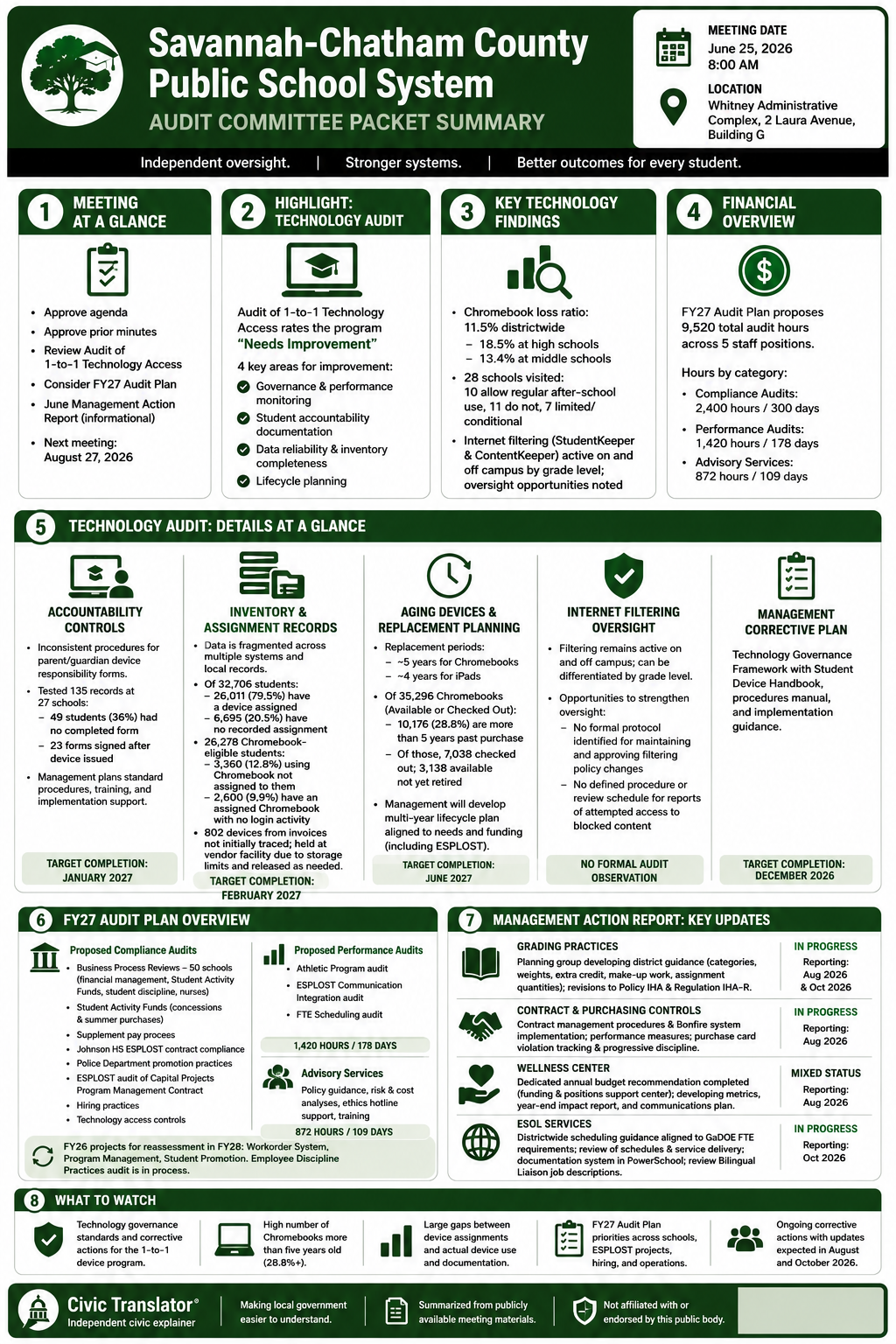
The Audit Committee is scheduled to meet at 8:00 a.m. on June 25 at the Whitney Administrative Complex. The agenda includes approval of the agenda and prior meeting minutes, review of the completed Audit of 1-to-1 Technology Access, consideration of the FY27 Audit Plan, and the June Management Action Report as an informational item.
1-to-1 Technology Access Audit
Internal Audit completed a performance audit of the district’s student-device program covering governance, compliance, data reliability, and operational effectiveness. The report gives the program an overall “Needs Improvement” rating and identifies four areas requiring improvement: governance and performance monitoring, student accountability documentation, data reliability and inventory completeness, and lifecycle planning.
The audit found that the district has operational processes for purchasing, deploying, and supporting student devices, but does not have a single, formally documented districtwide framework governing how the 1-to-1 program should operate. Among 28 schools visited, 10 allowed after-school device use as a regular practice, 11 did not, and seven used limited or conditional approaches.
The audit also reports a districtwide Chromebook loss ratio of 11.5%, including 18.5% at high schools and 13.4% at middle schools. Internal Audit recommends a districtwide framework defining governance, operating expectations, performance measures, reporting responsibilities, and procedures for addressing negative trends or other outliers. Management’s corrective-action plan calls for a Technology Governance Framework supported by a Student Device Handbook, procedures manual, and implementation guidance, with anticipated completion in December 2026.
Student Device Accountability Controls
The audit found inconsistent procedures for documenting parent or guardian acknowledgment of responsibility for district-issued devices. Schools use several methods to collect and track documentation, and Resource Manager does not contain a dedicated control preventing a device from being assigned before the required documentation is completed.
Testing of 135 student records across 27 schools found that 49 students, or 36%, had no evidence of a completed Student Device Loan Form despite having an assigned device. Another 23 forms were signed after devices had already been issued.
Internal Audit recommends a standardized districtwide process for completing, verifying, retaining, and monitoring accountability documentation before or at the time devices are issued. Management plans standardized procedures, training, and implementation support, with an anticipated completion date of January 2027.
Device Inventory and Assignment Records
Internal Audit found that student-device information is fragmented among Resource Manager, PowerSchool, SchoolCash, paper forms, spreadsheets, and locally maintained records. The audit concludes that the district does not currently have a sufficiently integrated and authoritative record structure to provide a complete picture of device inventory, assignment, and utilization.
Among 32,706 students included in the analysis, 26,011, or 79.5%, had a district-issued device formally assigned, leaving 6,695 students, or 20.5%, without a recorded assignment. Separate testing of 26,278 Chromebook-eligible students found 3,360 students, or 12.8%, using a Chromebook not assigned to them, while 2,600, or 9.9%, had an assigned Chromebook with no login activity on that device.
The initial inventory reconciliation also identified 802 devices reflected in vendor invoices and district receipt records that could not initially be traced in Resource Manager using available purchase-order information. Management subsequently reported that the devices were not missing but had been retained at a vendor facility because of district storage limitations and were being released to schools as needed. Internal Audit nevertheless recommends stronger reconciliation and record-management controls; management’s anticipated completion date is February 2027.
Aging Chromebooks and Replacement Planning
The audit also raises concerns about long-term device replacement planning. Management has communicated expected replacement periods of approximately five years for Chromebooks and four years for iPads, but Internal Audit found that the existing funding framework does not provide a sufficiently detailed and current multi-year replacement plan tied to device age, inventory status, and funding.
Of 35,296 Chromebooks listed as Available or Checked Out, 10,176, or 28.8%, were more than five years past purchase. Of those older devices, 7,038 remained checked out and 3,138 remained available without having been retired.
Internal Audit recommends a detailed multi-year lifecycle plan that connects replacement schedules with inventory conditions, enrollment, instructional needs, and funding sources including ESPLOST. Management proposes to update and implement such a plan by June 2027.
Internet Filtering Oversight
The technology audit separately reviews the district’s StudentKeeper and ContentKeeper internet-filtering controls. The report says filtering remains active on district-issued devices both on and off campus and can be differentiated by grade level.
This issue did not rise to the level of a formal audit observation, but Internal Audit found opportunities to strengthen oversight. The report says there was no formally established protocol identified for maintaining and approving filtering-policy changes and no defined procedure or review schedule for reports of attempted access to blocked content.
FY27 Audit Plan
The committee is also scheduled to consider the Internal Audit Department’s proposed work plan for July 1, 2026 through June 30, 2027. The packet explains that the Audit Committee approves the annual audit plan before it is presented to the Board for final approval.
The plan identifies 9,520 total annual audit hours across five staff positions. Proposed work includes compliance audits, performance audits, advisory services, and follow-up work.
Proposed Compliance Audits
The FY27 plan schedules compliance work including:
- Business Process Reviews covering 50 schools in areas including financial management, Student Activity Funds, student discipline, and nurses.
- Student Activity Funds reviews covering concessions and summer purchases.
- An audit of the supplement pay process.
- Johnson High School ESPLOST contract-compliance work.
- An audit of promotion practices within the Board of Education Police Department.
- An ESPLOST audit of the Capital Projects Program Management Contract.
- An audit of hiring practices.
- An audit of technology access controls.
The plan allocates 2,400 hours / 300 days to compliance audits.
The FY27 plan allocates 1,420 hours / 178 days to performance audits. Proposed projects include:
- An Athletic Program audit examining management, compliance, financial controls, and protections and development for student-athletes.
- An ESPLOST Communication Integration audit examining how funds were planned, spent, monitored, and connected to intended operational benefits.
- An FTE Scheduling audit examining whether schedules are accurate, supported, approved, and consistent with budgeted staffing levels, including controls intended to prevent staffing, payroll, and budget errors.
The plan also identifies 872 hours / 109 days for advisory services requested by management, including potential policy guidance, risk and cost analyses, ethics hotline support, and training.
Several FY26 projects are proposed for reassessment rather than immediate continuation. The Workorder System, Program Management, and Student Promotion audits are listed for reassessment in FY28, while the Audit of Employee Discipline Practices is listed as in process.
Management Action Report
The June Management Action Report is listed as an informational item and tracks management responses to earlier audit recommendations. It distinguishes completed work from actions that remain in progress rather than presenting those items as new committee decisions.
Grading Practices
Several grading-related actions remain in progress. The packet says a cross-functional Grading Practices Planning Group is working on district guidance involving grading categories and weights, extra credit, make-up work, assignment quantities, and related revisions involving Policy IHA and Regulation IHA-R.
Work on written grading guidance and monitoring of extra credit, make-up work, and credit recovery is listed as in progress, with reporting expected in August 2026. Additional work involving Brightspace, Learning Management System expectations, supplemental instructional resources, and possible grade pass-back functionality is listed for reporting in October 2026.
Contract and Purchasing Controls
Contract-management recommendations remain in progress. Planned work includes performance measures for approval times, contract renewals, vendor evaluations, and staff workload; comprehensive written procedures; and continued implementation of the Bonfire Contract Management System as the district’s centralized contract-management platform.
These actions are listed for reporting in August 2026. Purchase-card oversight work is also in progress, including a proposed violation-tracking framework and a progressive disciplinary structure tied to noncompliance, with August reporting identified in the packet.
Wellness Center
The Management Action Report lists several Wellness Center recommendations. A recommendation addressing a dedicated annual budget is marked completed, while the management response says funding and positions support the center even though the current budget is not explicitly itemized as a separate “Wellness Center” line.
Other work remains in progress, including development of measurable accountability metrics, a year-end impact report, and a communications plan intended to increase awareness of Wellness Center services. Those items are scheduled for reporting in August 2026.
ESOL Services
Several actions arising from the ESOL audit are listed as in progress, with reporting planned for October 2026. Management plans districtwide scheduling guidance aligned with Georgia Department of Education FTE requirements and a review of ESOL schedules and service delivery intended to maximize allowable funding while maintaining compliance.
The packet also describes plans to review ESOL paperwork and compliance responsibilities, streamline documentation, develop a centralized digital documentation system in PowerSchool, and review Bilingual Liaison job descriptions and duties.
What to Watch at the Meeting
- Technology governance: The committee is scheduled to review an audit that rates the 1-to-1 Technology Access program “Needs Improvement” and recommends districtwide standards for device governance, accountability, inventory, and replacement.
- Aging devices: Nearly three in 10 Chromebooks included in the audit’s Available and Checked Out population were more than five years past purchase, making lifecycle planning a significant issue in the report.
- Record accuracy: The audit identifies substantial gaps between formal device assignments and actual device use, along with inconsistent student accountability documentation.
- FY27 priorities: The proposed audit plan would direct substantial staff time toward school business processes, ESPLOST contracts and projects, hiring, technology access, athletics, and FTE scheduling.
- Outstanding corrective actions: The June Management Action Report shows continuing work on grading practices, contract management, purchasing-card controls, Wellness Center accountability, and ESOL operations, with several updates scheduled for August or October 2026.