Source basis: This briefing is based on the extracted meeting packet materials for the Finance Advisory Committee meeting held May 6, 2026.
The Savannah-Chatham County Public School System Finance Advisory Committee met to review the developing FY27 budget, including projected expenses, employee compensation costs, strategic investments, revenue assumptions, and possible millage rate scenarios. The meeting focused on the district’s Strategic Priority 4: Fiscal Responsibility and Resource Stewardship.
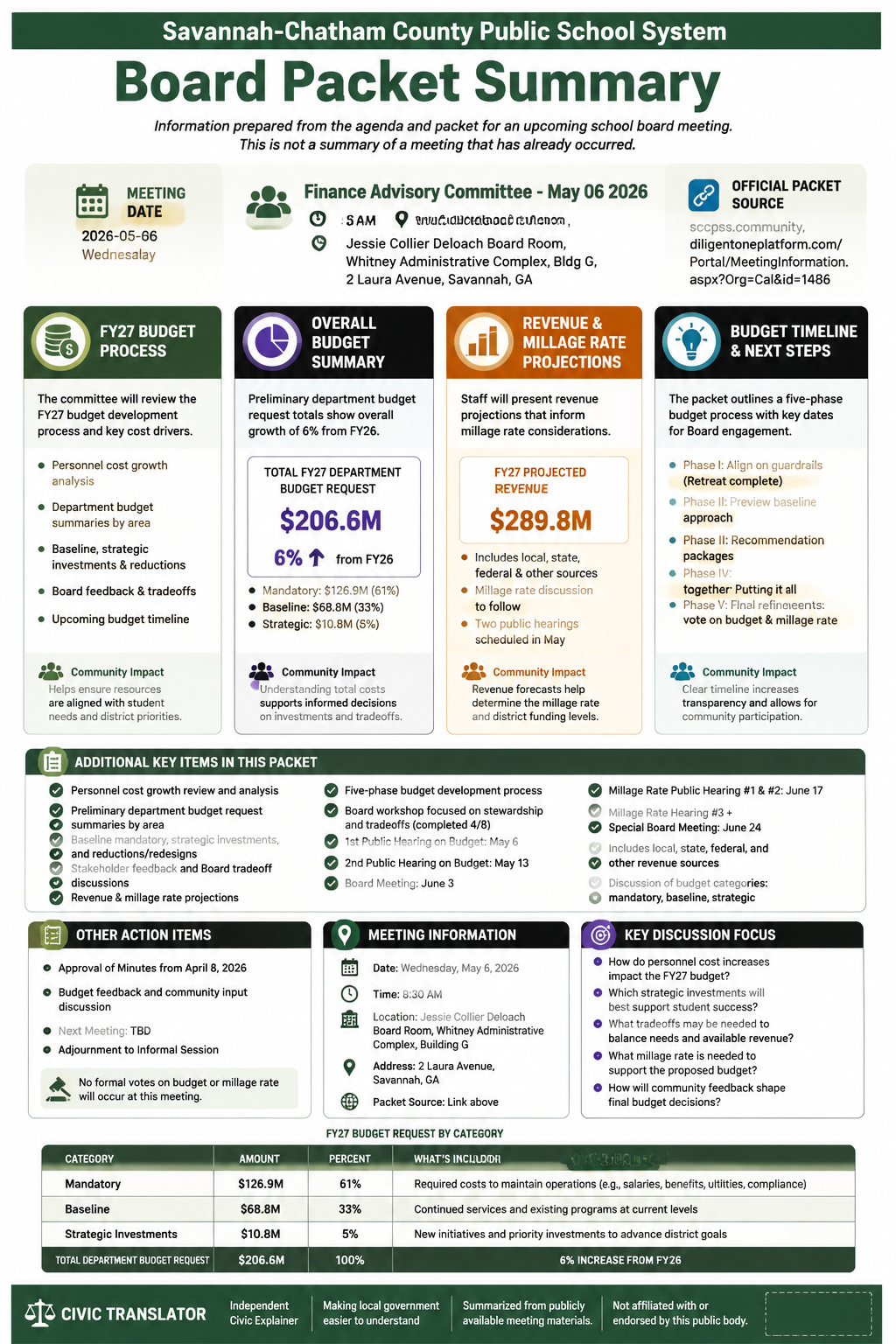
The preliminary FY27 General Fund budget proposal presented for discussion totals approximately $708.8 million, compared with the FY26 revised General Fund budget of approximately $669 million. The proposed increase is about 6%, driven by employee cost increases, baseline operational needs, and proposed strategic investments. The figures remain preliminary and subject to validation and final decisions.
A major issue discussed was the cost of maintaining the current workforce. Mandatory personnel cost growth, including teacher retirement contributions, state health benefits, and salary step increases, is estimated at $12.4 million. The committee also reviewed possible cost-of-living adjustment (COLA) options for employees, including a 3% COLA scenario that would add approximately $12.7 million.
The committee also reviewed how different revenue assumptions could affect taxpayers and district decisions. Current projections assume maintaining a 17.331 millage rate, with estimated revenue of approximately $711.9 million and an estimated $3.1 million surplus under current assumptions. Future decisions will depend on the final budget, tax digest information, state funding decisions, and board action.
Major Discussion and Action Items
FY27 Budget Development Process
The committee reviewed the district’s phased budget development process. The process includes establishing budget priorities, reviewing baseline needs, evaluating strategic investments, considering reductions or redesigns, and preparing for final refinements and a budget vote. The district emphasized balancing mandatory expenses with investments that support academic, operational, and community goals.
Upcoming budget milestones discussed included public hearings and board meetings leading toward final approval. The process is designed to provide opportunities for board review, stakeholder engagement, and public input before final budget adoption.
Preliminary FY27 Budget Request
The preliminary budget request totals $683.7 million before annual adjustments. After adding estimated mandatory personnel cost growth and a proposed 3% COLA, the preliminary proposed General Fund budget increases to $708.8 million.
The request includes:
- $510.6 million in mandatory and baseline costs before annual adjustments
- $162.3 million in baseline investments
- $10.8 million in strategic investments
- $12.4 million for mandatory salary and benefit cost growth
- $12.7 million for the proposed COLA starting point
The district noted that these numbers are discussion figures and may change as budget reviews continue.
Strategic Investments and Program Priorities
The committee reviewed several proposed FY27 strategic investments.
Academic priorities include:
- A $6.5 million School Transformation initiative focused on closing performance gaps through expanded tutoring, differentiated staffing, leadership compensation, and professional development.
- A $2.5 million mathematics textbook adoption initiative to support a standards-aligned K–12 mathematics instructional system.
- A $150,000 expansion of mental health programming through additional telehealth partnerships.
- A $100,000 Early Childhood Mixed-Age Montessori Program expansion at Charles Ellis Montessori Academy.
Operational and accountability investments include:
- $50,000 for district-wide artificial intelligence readiness training.
- $250,000 for a formative assessment platform supporting instructional data and feedback.
- $250,000 for a district data dashboard.
- $1.6 million for a Choice Shuttle Pilot to improve access to specialized programs and choice schools.
Community engagement investments include enrollment retention strategies, partnership tracking tools, and new engagement-related positions.
Employee Compensation and Personnel Costs
Personnel expenses were a significant part of the budget discussion. The district reported that total personnel costs would increase from approximately $556.5 million in FY26 to approximately $568.9 million after mandatory FY27 adjustments.
The increases include:
- $1.4 million from increased Teacher Retirement System contributions, moving from 21.91% to 22.32%.
- $3 million from increased state health benefit costs.
- $8 million for a service step increase for eligible employees.
The committee also reviewed possible COLA scenarios:
- No COLA: approximately $568.9 million personnel cost.
- 1% COLA: approximately $573.2 million.
- 2% COLA: approximately $577.4 million.
- 3% COLA: approximately $581.7 million.
The discussion centered on balancing employee compensation, retention, and affordability.
Revenue and Millage Rate Projections
The district reviewed revenue assumptions used to estimate whether the proposed budget could be supported.
Key assumptions included:
- 5% growth in non-residential property values.
- 5% growth in non-homestead eligible home taxable values.
- A projected enrollment decline of 1.2%.
- A 6.3% increase assumption for Quality Basic Education (QBE) earnings per student.
- A current millage assumption of 17.331.
The district noted that actual revenue will depend on the final tax digest and state funding decisions.
Financial Matters
The most significant financial issue was the FY27 General Fund budget proposal.
The FY26 revised General Fund budget is approximately $669 million. The FY27 preliminary proposed budget is approximately $708.8 million, representing an increase of about $40 million.
Major cost drivers include:
- Mandatory personnel increases: $12.4 million.
- Proposed 3% COLA: $12.7 million.
- Strategic investments: $10.8 million.
- Other uncontrollable cost growth: approximately $16 million, including health insurance, retirement contributions, employee steps, utilities, and insurance costs.
Revenue modeling showed that maintaining the current 17.331 millage rate could produce approximately $711.9 million in revenue, creating an estimated $3.1 million surplus.
Policies, Ordinances, Resolutions, and Governance
No new ordinances, policy revisions, or resolutions were identified as major action items in the packet. The meeting focused primarily on budget development, financial planning, and advisory discussion.
The committee’s role was to review information and provide input as the district moves toward future budget decisions.
The committee received a budget update presentation covering:
- Department budget requests.
- Strategic investment priorities.
- Personnel cost growth.
- Budget growth history.
- Revenue forecasting.
- Millage rate scenarios.
The district presented a financial model developed with A&M to improve revenue forecasting and support informed budget decisions.
Personnel, Appointments, and Organizational Matters
The packet did not identify personnel appointments, resignations, or employment actions requiring committee action. Personnel discussion focused on compensation costs, staffing-related expenses, and maintaining workforce priorities within the FY27 budget.
Projects, Facilities, Infrastructure, and Operations
Operational investments reviewed included transportation improvements, technology initiatives, and district support systems.
The proposed Choice Shuttle Pilot would provide centralized transportation routes from designated hubs to expand access to specialized academic programs and choice schools. A separate Chatham Area Transit transportation proposal would expand transportation options for students with access or scheduling challenges.
The budget timeline included:
- May 6, 2026: First public hearing on the budget.
- May 13, 2026: Second public hearing on the budget.
- June 17, 2026: Millage Rate Public Hearings 1 and 2.
- June 24, 2026: Millage Rate Hearing #3 and Special Board Meeting.
Residents may participate through these scheduled budget and millage discussions.
Residents and taxpayers will be most directly affected by decisions involving the final budget amount and millage rate.
Students and families may be affected by proposed investments in tutoring, instructional materials, transportation access, mental health services, and early childhood programming.
Employees may be affected by decisions regarding COLA levels, salary steps, retirement costs, and health benefit expenses.
Schools and district departments may see changes depending on which strategic investments are approved, reduced, or modified during the final budget process.
- Which proposed strategic investments provide the greatest expected benefit for students?
- How will the district evaluate whether new programs achieve intended results?
- What factors could cause the final FY27 budget to change from the current proposal?
- How will employee compensation decisions affect recruitment and retention?
- What alternatives were considered before proposing the current budget increase?
- How will changes in enrollment affect future staffing and financial planning?
- What assumptions about state funding remain uncertain?
- How will the district prioritize investments if revenue projections decrease?
- What impact would a lower millage rate have on programs and services?
- How will community feedback influence final budget decisions?
Important Dates, Deadlines, and Next Steps
- May 6, 2026: Finance Advisory Committee budget update and first budget public hearing.
- May 13, 2026: Second public hearing on the budget.
- June 3, 2026: Board meeting during the budget approval timeline.
- June 17, 2026: Millage Rate Public Hearings 1 and 2.
- June 24, 2026: Millage Rate Hearing #3 and Special Board Meeting.
Final budget and millage decisions are expected after continued review, stakeholder input, and board consideration.
Key Takeaways
- The FY27 preliminary General Fund budget proposal is approximately $708.8 million.
- The proposed budget is about 6% higher than the FY26 revised budget of approximately $669 million.
- Mandatory personnel cost growth accounts for approximately $12.4 million.
- A proposed 3% COLA would add approximately $12.7 million.
- Current revenue assumptions estimate approximately $711.9 million at a 17.331 millage rate.
- The district is considering more than $10 million in strategic investments.
- Major proposed investments include tutoring, transportation, technology, mental health, and instructional resources.
- Revenue projections depend on the final tax digest and state funding decisions.
- Multiple public hearings are scheduled before final budget approval.
- The committee is focused on balancing fiscal responsibility with student and workforce priorities.
Official Sources
About the Public Body
- Name: Savannah-Chatham County Public School System
- Organization type: school-district
- Government body: school-boards
- Location: Savannah, georgia
- County: Chatham County
- Provider: diligent-community
Keywords
Savannah-Chatham County Public School System, SCCPSS, Finance Advisory Committee, FY27 budget, General Fund budget, millage rate, property taxes, fiscal responsibility, resource stewardship, employee compensation, COLA, teacher retirement system, health benefits, strategic investments, school transformation, mathematics curriculum, mental health services, Montessori program, AI readiness training, transportation, Choice Shuttle Pilot, enrollment retention, revenue projections, QBE funding, public hearings, budget planning, school finance, Savannah schools