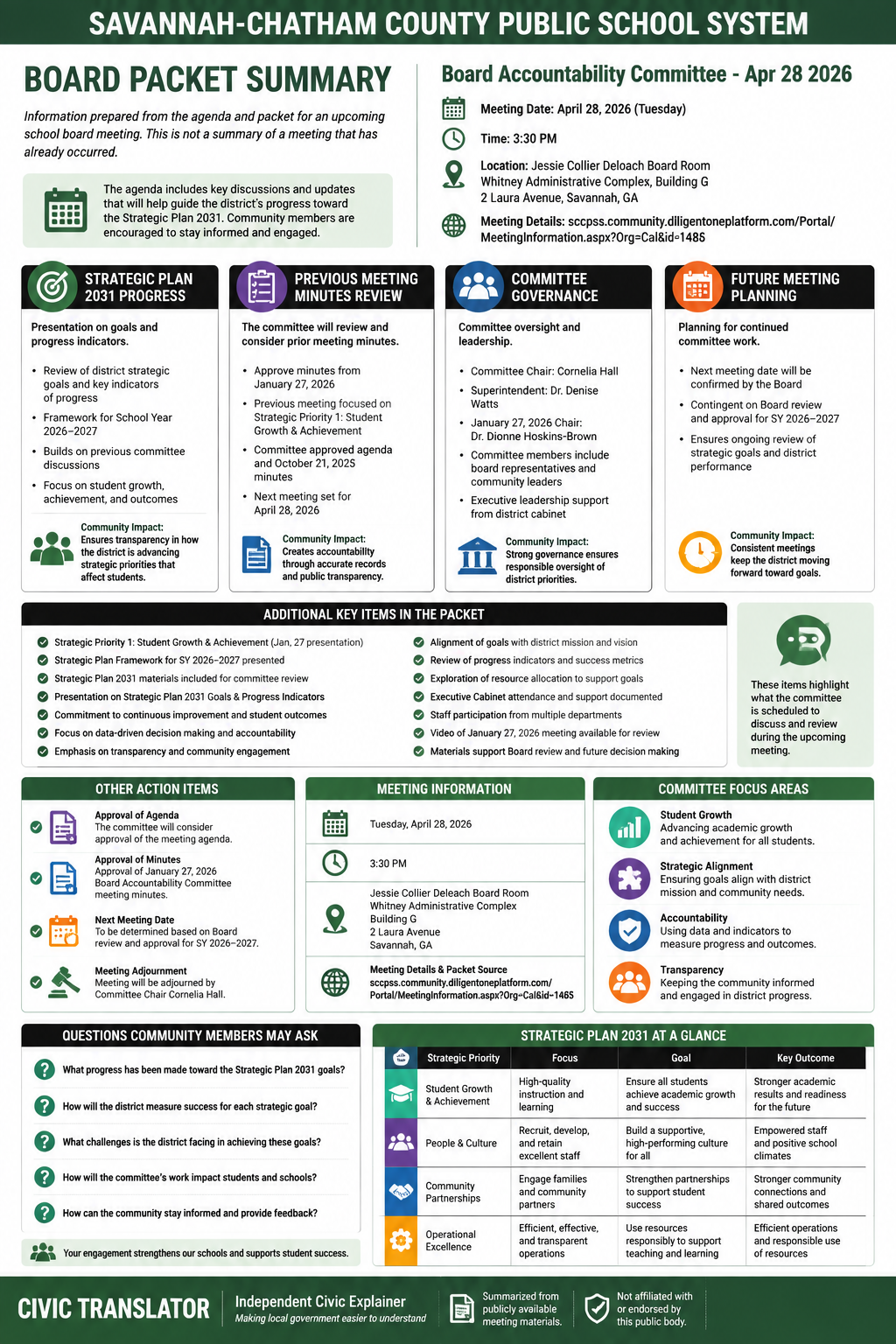
The Savannah-Chatham County Public School System Board Accountability Committee met on April 28, 2026, to review progress on the district’s Strategic Plan 2031 goals and accountability framework. The meeting focused primarily on how the district will measure student success, monitor progress, and connect daily operations to long-term student outcomes. The packet included the meeting agenda, prior committee minutes, the Strategic Plan 2031 presentation, and the April 28 meeting minutes.
The committee’s central discussion involved a redesigned strategic planning structure intended to place student outcomes at the center of district decision-making. Rather than focusing primarily on activities or programs, the proposed framework organizes accountability around measurable student results, progress indicators, and internal execution measures.
The Strategic Plan 2031 framework identifies six major goals: early literacy readiness, third-grade reading achievement, English language arts and mathematics achievement, student attendance, student engagement and belonging, and future-ready milestone experiences. These goals are intended to provide public-facing measures of whether students are progressing toward desired outcomes.
The meeting also reinforced how different levels of the district organization will participate in accountability efforts. The Superintendent and Cabinet will monitor overall progress, division leaders will review progress indicators, departments will track implementation, and the Board of Education will provide governance oversight.
Major Discussion and Action Items
Strategic Plan 2031 Goals and Accountability Framework
The primary substantive item discussed was a presentation on Strategic Plan 2031 goals and progress indicators. The district described two major changes in the plan design: reorganizing strategic priorities around student outcomes and creating a three-tier measurement framework.
The district stated that the redesigned structure is intended to make goals clearer for families, community partners, and stakeholders by connecting every strategy, indicator, and department measure back to student outcomes. The framework places “Future-Ready Students” as the central objective, with supporting pillars and operational measures designed to create conditions for student success.
The three-tier model includes:
- Tier 1: Public-facing student outcome goals.
- Tier 2: Progress indicators that provide early signals about whether the district is on track.
- Tier 3: Internal performance measures used by departments and program leaders to monitor execution.
The committee’s review focused on how this system can improve accountability by identifying problems earlier and allowing district leaders to adjust strategies before final outcomes are measured.
Early Literacy Readiness
The first strategic goal focuses on early literacy readiness for students in kindergarten through second grade. The district identified reading progress monitoring as a key indicator and plans to use Amira Reading Mastery (ARM) percentile rankings to track student performance.
Progress indicators include monthly monitoring of the percentage of K-2 students on track for reading at grade level and measuring growth from beginning of year to middle of year and end of year assessments.
The district’s stated growth targets include a typical growth measure where 60% of K-2 students are on track and a high-growth measure where 40% of students not initially on track demonstrate significant progress.
This goal is important because early reading skills are foundational to later academic achievement, and the district intends to use ongoing data monitoring rather than waiting for end-of-year results.
Third Grade Reading Achievement
The second goal focuses specifically on third-grade reading performance. The district identified third-grade reading level achievement as a major student outcome measure and will monitor progress using Amira Reading Mastery data.
The district plans to review whether students are meeting annual targets and whether growth rates between beginning-of-year, middle-of-year, and end-of-year assessments indicate progress toward grade-level reading.
The committee reviewed this as part of a broader accountability approach designed to identify whether students are progressing early enough for interventions or adjustments to occur.
English Language Arts and Mathematics Achievement
The third strategic goal addresses overall academic achievement in English language arts and mathematics. The district identified projected Georgia Milestones Assessment System (GMAS) content mastery performance using NWEA MAP assessments as a progress indicator.
The district will monitor student growth throughout the year, including fall-to-winter and fall-to-spring MAP performance. One stated target is that at least 40% of students will exceed expected growth as measured through these progress cycles.
This approach is intended to provide earlier information about academic progress before final state assessment results are available.
Student Attendance, Engagement, and Belonging
The Strategic Plan 2031 framework also identifies student attendance and student experience as major accountability priorities.
For attendance, the district plans to monitor the percentage of K-12 students absent fewer than 10% of enrolled days. Attendance trends will be reviewed through the student information system and analyzed by school, grade level, and student group.
The engagement and belonging goal includes monitoring weighted suspension rates and collecting student feedback through locally administered belonging and engagement surveys. The district stated that suspension rates should remain lower than the same period in the previous school year.
These measures reflect the district’s stated goal of evaluating not only academic outcomes but also whether students experience supportive and engaging learning environments.
Future-Ready Milestone Experiences
The sixth goal focuses on preparing students for life after graduation through milestone experiences. The district identified examples including work-based learning, apprenticeships, internships, dual enrollment, field experiences, and grade-level signature experiences.
Progress indicators include monitoring the percentage of students on track for completion based on participation in district-defined milestone experiences and conducting annual graduate completion verification.
The goal is designed to measure whether students have meaningful opportunities that support college, career, and future readiness.
Financial Matters
The packet did not include significant budget actions, contracts, bids, purchasing decisions, grants, tax matters, or funding requests for the April 28, 2026 Board Accountability Committee meeting.
The discussion centered on strategic planning, measurement systems, and accountability processes rather than financial approvals. No specific dollar amounts or funding allocations were presented in the available meeting materials.
Policies, Ordinances, Resolutions, and Governance
No new policies, ordinances, resolutions, or formal governance changes were presented in the available packet materials.
The governance focus of the meeting was accountability oversight. The Strategic Plan 2031 framework describes the Board of Education’s role as providing governance oversight and holding the Superintendent accountable for results.
The meeting minutes indicate that no official action was taken on agenda approval or minutes approval because a quorum was not present. The committee continued with the strategic plan presentation and discussion.
The major informational update was the Strategic Plan 2031 presentation led through the Board Accountability Committee process.
The presentation explained that the district is moving toward a measurement structure designed to show whether strategies are producing improved student outcomes. The district emphasized alignment between goals, progress indicators, and department-level execution.
The accountability process includes:
- Superintendent and Cabinet review of overall progress and organizational health.
- Division leader review of progress indicators and conditions affecting outcomes.
- Department and project team monitoring of implementation quality.
- Board oversight of whether strategic goals are producing improved student outcomes.
Personnel, Appointments, and Organizational Matters
The packet did not include personnel actions, employment agreements, appointments, resignations, retirements, or staffing changes.
The presentation did identify organizational roles in accountability implementation, including responsibilities for district leadership, division leaders, departments, and the Board of Education.
Projects, Facilities, Infrastructure, and Operations
No major construction, facilities, transportation, technology, infrastructure, or capital improvement projects were presented in the available materials.
The operational focus was on implementing the Strategic Plan 2031 measurement framework and creating consistent processes for tracking progress across the district.
The packet did not identify a public hearing, formal public comment session, application deadline, or community input opportunity associated with this committee meeting.
The Strategic Plan 2031 presentation identifies families, community partners, and stakeholders as audiences for public-facing goals and progress reporting.
For residents and taxpayers, the meeting provides insight into how the district plans to measure whether strategic investments and programs are improving student outcomes.
For students and families, the most direct impacts involve increased attention to literacy, academic achievement, attendance, engagement, belonging, and preparation for future opportunities.
For teachers and employees, the accountability framework may influence how departments track progress, evaluate implementation, and adjust strategies based on performance data.
For community organizations and partners, the future-ready milestone goal highlights opportunities connected to work-based learning, internships, apprenticeships, dual enrollment, and other student experiences.
The packet does not identify immediate changes to student services, staffing, schedules, or programs. The focus is on measurement, monitoring, and long-term strategic alignment.
- How will families and community members be able to view progress toward the six Strategic Plan 2031 goals?
- What actions will the district take when progress indicators show students are not on track?
- How frequently will the Board receive updates on strategic goal performance?
- How will schools receive support when attendance, literacy, or achievement indicators show challenges?
- How will student engagement and belonging survey results influence district decisions?
- How will the district ensure future-ready milestone opportunities are available to students across schools?
- What additional resources, if any, will be needed to implement the Strategic Plan 2031 framework?
- How will progress indicators be adjusted if they do not accurately predict student outcomes?
Important Dates, Deadlines, and Next Steps
- January 27, 2026: Previous Board Accountability Committee meeting where the Strategic Plan framework was introduced.
- April 28, 2026: Board Accountability Committee meeting reviewing Strategic Plan 2031 goals and progress indicators.
- Future School Year 2026-2027 Meeting Schedule: The next committee meeting date is contingent upon Board review and approval for the 2026-2027 school year.
- Ongoing: The district plans continued monitoring of strategic goals, progress indicators, and implementation measures.
Key Takeaways
- The April 28, 2026 meeting focused primarily on Strategic Plan 2031 accountability measures.
- The district is organizing its plan around student outcomes rather than only programs or activities.
- The new framework uses three measurement tiers: student outcomes, progress indicators, and internal performance measures.
- Six strategic goals were presented covering literacy, academic achievement, attendance, engagement, belonging, and future readiness.
- Early literacy progress will be monitored through Amira Reading Mastery data.
- Academic achievement progress will use NWEA MAP growth information and projected GMAS performance indicators.
- Attendance monitoring will track students missing fewer than 10% of enrolled days.
- Student engagement measures include suspension trends and belonging surveys.
- Future-ready measures include experiences such as internships, apprenticeships, dual enrollment, and field experiences.
- The Board’s role is to provide oversight and hold district leadership accountable for results.
- No major financial approvals or policy changes were presented in the available packet.
- No official agenda or minutes action was taken because the committee meeting lacked a quorum.
Official Sources
About the Public Body
- Name: Savannah-Chatham County Public School System
- Organization type: school-district
- Government body: school-boards
- Location: Savannah, georgia
- County: Chatham County
- Provider: diligent-community
Keywords
Savannah-Chatham County Public School System, SCCPSS, Board Accountability Committee, Strategic Plan 2031, student outcomes, accountability, literacy readiness, third grade reading, ELA achievement, math achievement, GMAS, NWEA MAP, attendance, student engagement, belonging, future-ready students, internships, apprenticeships, dual enrollment, progress indicators, performance measures, Board of Education, Superintendent Denise Watts, Savannah schools, Chatham County education, school improvement, student success