The Savannah-Chatham County Public School System held a Whole Board Training session focused on financial management, school funding structures, governance responsibilities, and the relationship between the Board of Education, superintendent, and finance leadership. The training was presented by Dr. Steve Smith and centered on helping board members understand how public school systems receive and spend money.
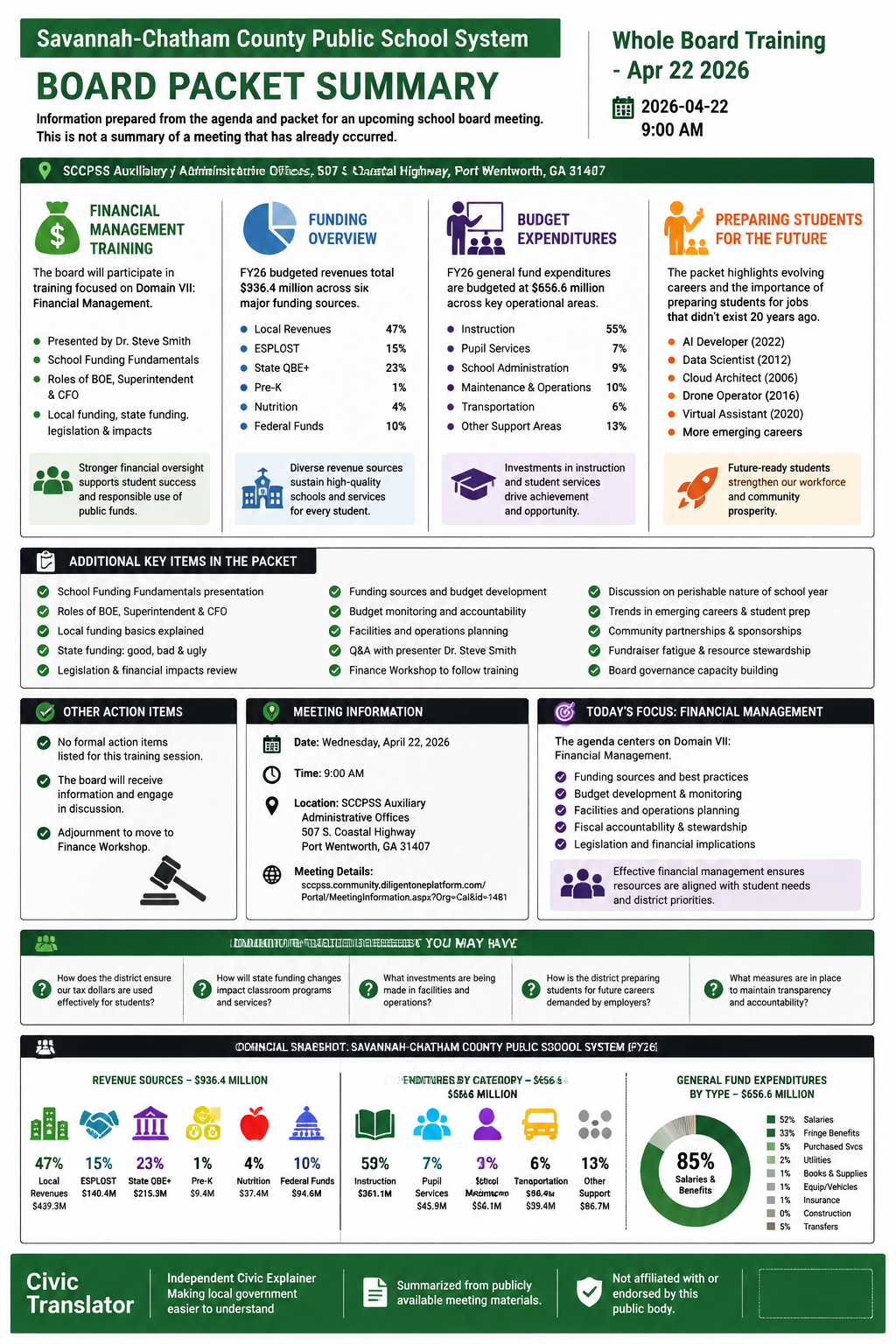
A major focus of the discussion was SCCPSS’s FY26 financial picture. The presentation identified a total budgeted revenue amount of approximately $936.4 million, with major revenue sources including local revenues, ESPLOST, state funding, federal funds, nutrition programs, and Pre-K funding. The session also reviewed how financial decisions affect classrooms, employees, facilities, transportation, and long-term district stability.
The training highlighted the importance of maintaining responsible reserves while balancing current needs. SCCPSS reported a general fund balance of $263.1 million as of June 30, 2025, representing approximately 40.1% of the FY26 general fund budgeted expenditures. The presentation discussed state discussions about reserve levels, financial oversight, and proposed changes affecting school district governance and accountability.
The meeting was informational rather than a vote-driven business meeting. It was designed to prepare board members for future decisions involving budgets, taxes, funding sources, financial monitoring, and district operations. The packet emphasized that school funding decisions involve local, state, and federal systems with many restrictions and competing demands.
Major Discussion and Action Items
School Funding Fundamentals and District Revenue Structure
The central topic of the training was how SCCPSS is funded and how those dollars support district operations. The presentation explained that school districts rely on multiple funding streams, including local property taxes, ESPLOST revenues, state Quality Basic Education (QBE) funding, federal programs, and other dedicated sources.
For FY26, SCCPSS budgeted approximately $936.4 million in revenues. The largest revenue category was local revenue at 47%, followed by state QBE and related funding at 23%, ESPLOST at 15%, federal funds at 10%, nutrition at 4%, and Pre-K at 1%.
The discussion was intended to help board members understand which funding sources are controlled locally and which are influenced by state or federal decisions.
Budget Development, Monitoring, and Financial Oversight
The training reviewed the roles of elected board members, the superintendent, and the chief financial officer in managing public funds.
The Board of Education’s responsibilities include establishing district goals, adopting policies, approving budgets, reviewing financial performance, levying taxes, and monitoring student achievement. The superintendent is responsible for implementing board policies, managing district operations, recommending personnel actions, and communicating district needs. The CFO manages financial operations, including budgeting, reporting, audits, grants accounting, cash management, and ESPLOST compliance.
The presentation emphasized that board members provide governance and oversight but individual members do not independently direct employees or manage daily operations.
Fund Balance, Reserves, and Financial Stability
Reserve levels were a significant discussion point. The packet explained that districts maintain reserves to protect against unexpected events such as state funding reductions, economic downturns, lower property values, emergencies, and future facility needs.
SCCPSS’s reported general fund balance was:
- $263,121,562 as of June 30, 2025
- $261,177,818 projected as of June 30, 2026
The presentation calculated the reserve level at approximately 40.1% of FY26 general fund expenditures and approximately 38.2% based on projected FY27 expenditures.
The training also discussed Georgia law regarding reserve limits and noted proposed legislative changes that could affect allowable reserve levels and financial oversight requirements.
Property Taxes, Millage Rates, and Local Funding
The board received information about how local property taxes contribute to school funding. The presentation explained Georgia’s ad valorem property tax system, including how assessed values and millage rates determine tax amounts.
The presentation noted that SCCPSS’s FY26 local funding includes significant property tax revenue and discussed how millage decisions affect both local revenue and state funding calculations.
The training included examples showing how changes in millage rates can affect homeowners. It also discussed public communication requirements related to tax increases and the importance of explaining the relationship between taxes and educational services.
ESPLOST and Capital Funding
The presentation reviewed ESPLOST, the Education Special Purpose Local Option Sales Tax, as a major district funding source.
ESPLOST is approved by voters and generally supports eligible purposes such as buildings, bonds, books, buses, and technology. SCCPSS’s FY26 revenue structure identified ESPLOST as approximately 15% of total budgeted revenues.
The training discussed how ESPLOST provides funding flexibility for capital needs while operating expenses continue to require other funding sources.
State Funding, QBE, and Funding Challenges
The meeting reviewed Georgia’s Quality Basic Education (QBE) funding formula and how state funding is calculated based on factors such as student enrollment, educational programs, and local funding capacity.
The presentation explained that SCCPSS receives state funding based on student counts, program needs, and other formulas. It also discussed historical state austerity reductions and the impact of past funding cuts.
The packet noted that SCCPSS historically experienced reductions in state funding through austerity adjustments, with the district’s total austerity reductions from 2010 through 2021 identified as approximately $135.9 million.
Financial Accountability and Legislative Changes
The training included discussion of proposed state legislation related to school district financial accountability. SB472 was discussed as legislation addressing circumstances involving accreditation concerns, financial mismanagement findings, and state oversight.
The presentation emphasized the importance of accurate financial reporting, strong internal controls, regular audits, and board oversight.
Financial Matters
The primary financial issue discussed was the district’s FY26 budget structure and financial management practices.
Key figures presented included:
- FY26 budgeted revenues: approximately $936.4 million
- FY26 general fund expenditures: approximately $656.6 million
- Salaries and benefits: approximately 85% of general fund expenditures
- General fund balance at June 30, 2025: $263.1 million
- FY26 ESPLOST revenue share: approximately 15% of total revenues
The presentation also reviewed transportation costs. SCCPSS operates 181 transportation routes. FY26 state transportation funding was listed at $7.35 million, while total FY26 transportation expenditures were budgeted at approximately $41.5 million.
Policies, Ordinances, Resolutions, and Governance
No formal policy adoption, ordinance approval, or resolution vote was identified as part of this training meeting.
The governance discussion focused on board responsibilities, superintendent authority, financial oversight duties, and legislative requirements affecting school district accountability.
The primary presentation was “School Funding Fundamentals” delivered by Dr. Steve Smith.
Topics included:
- School funding sources
- Budget development
- Financial monitoring
- Facilities and operations
- Board and superintendent responsibilities
- State funding formulas
- QBE funding
- Local funding mechanisms
- Financial accountability practices
The presentation also addressed future workforce needs, changing job markets, and the importance of preparing students for evolving careers.
Personnel, Appointments, and Organizational Matters
No specific personnel appointments, resignations, employment actions, or individual employee matters were presented.
The training discussed staffing costs broadly, noting that salaries and benefits represent the largest portion of district spending. It also reviewed challenges associated with funding employee benefits and maintaining qualified financial leadership.
Projects, Facilities, Infrastructure, and Operations
The training reviewed facilities and operations as part of the district’s overall financial management responsibilities.
ESPLOST funding was discussed as a primary source for eligible capital improvements, including buildings, technology, buses, and related needs.
Transportation operations were also reviewed, including the difference between state transportation funding and actual district transportation expenses.
No public hearing or public comment session was identified in the training agenda.
The meeting was a board training session intended to provide information for future governance and budget decisions.
Residents and taxpayers should understand that SCCPSS funding decisions involve a combination of local taxes, voter-approved sales tax programs, state funding formulas, and federal resources.
Students and families are affected by how funding decisions support instruction, staffing, transportation, technology, safety, and facilities.
Employees are affected because salaries, benefits, and staffing costs represent the largest portion of district spending.
Taxpayers may be affected by future decisions involving millage rates, budget priorities, and capital funding needs.
Community organizations and businesses may be affected by decisions involving ESPLOST-funded projects and district purchasing priorities.
- How does SCCPSS determine the appropriate level of reserves while balancing current student needs?
- What major priorities are driving future budget decisions?
- How will changes in state funding affect district planning?
- How are ESPLOST funds prioritized and communicated to the public?
- What financial reports does the Board review each month?
- How does SCCPSS monitor internal controls and prevent financial errors?
- What future facility needs require long-term planning?
- How does the district evaluate whether spending improves student outcomes?
- How could changes in employee benefit costs affect future budgets?
- How will the district communicate major financial decisions to residents?
Important Dates, Deadlines, and Next Steps
- April 22, 2026: Whole Board Training session held at 9:00 AM.
- Future budget discussions: The training provided background information intended to support upcoming financial planning and governance decisions.
- Future board actions: Any budget, tax, policy, or operational decisions would occur through later public meetings.
Key Takeaways
- The meeting focused on financial management training for the Savannah-Chatham County Public School System Board.
- FY26 budgeted revenues were approximately $936.4 million.
- Local revenues represented the largest identified funding source at 47%.
- General fund expenditures were approximately $656.6 million.
- Salaries and benefits accounted for about 85% of general fund expenditures.
- SCCPSS reported a general fund balance of $263.1 million as of June 30, 2025.
- ESPLOST provides voter-approved funding for eligible capital needs.
- The Board’s role is governance, policy, budgeting, and oversight rather than daily management.
- QBE and other state funding formulas significantly influence district finances.
- Transportation costs exceed direct state transportation funding.
- The training emphasized transparency, accurate financial reporting, and accountability.
- Future financial decisions will require balancing reserves, educational needs, and taxpayer resources.
Official Sources
About the Public Body
- Name: Savannah-Chatham County Public School System
- Organization type: school-district
- Government body: school-boards
- Location: Savannah, georgia
- County: Chatham County
- Provider: diligent-community
Keywords
Savannah-Chatham County Public School System, SCCPSS, Whole Board Training, school board governance, financial management, FY26 budget, school funding, QBE funding, ESPLOST, property taxes, millage rate, fund balance, reserves, superintendent, CFO, financial oversight, transportation, facilities, capital projects, state funding, federal funding, student achievement, Georgia education, public schools, budget development, financial accountability, Board of Education, Savannah schools, Chatham County