Source basis: This briefing was prepared from the extracted Finance Advisory Committee packet materials, including the April 8, 2026 agenda, minutes, and Finance presentation materials.
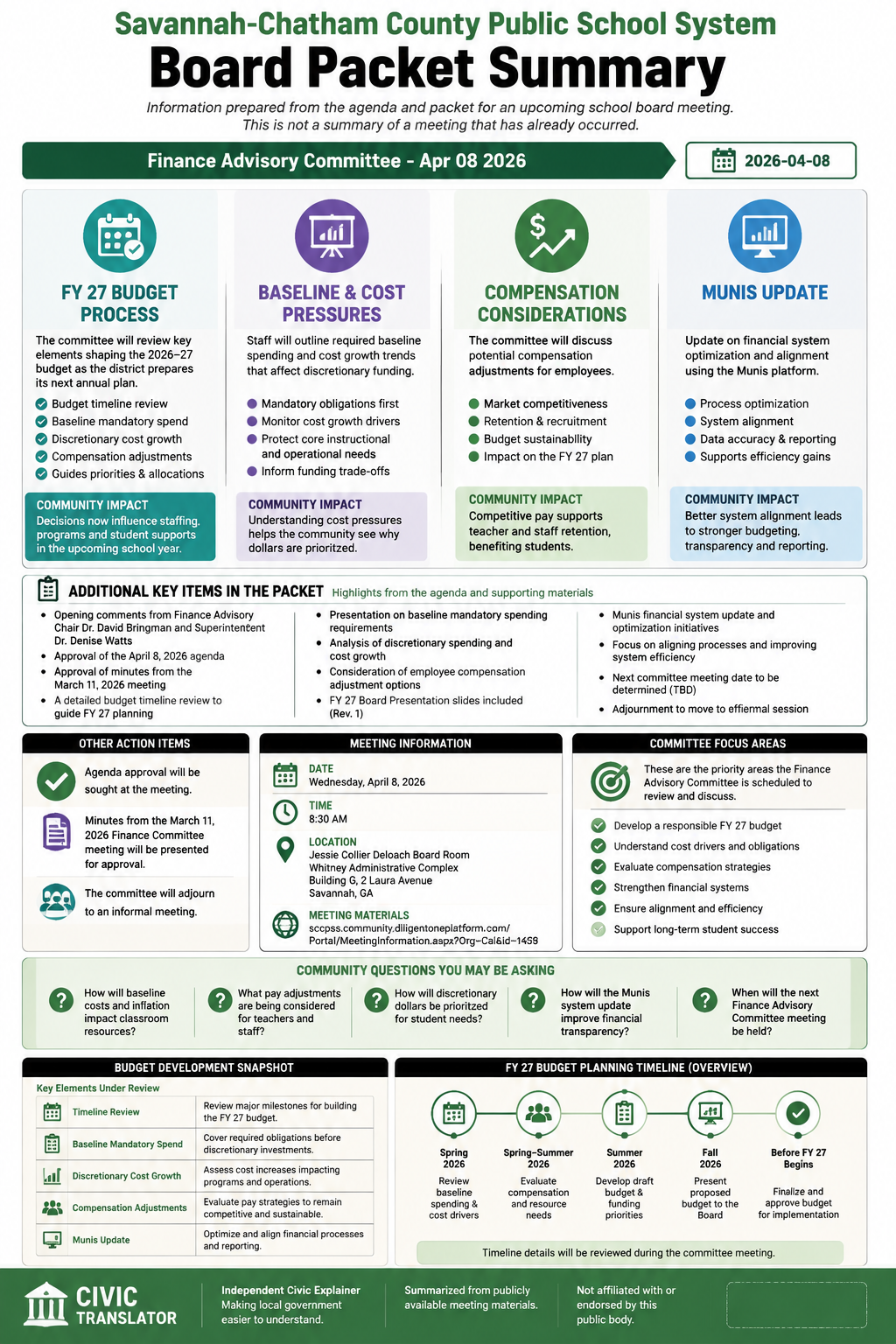
The Savannah-Chatham County Public School System Finance Advisory Committee met on April 8, 2026, to continue work on the Fiscal Year 2027 budget process and review progress on the district’s MUNIS financial and operational system optimization effort. The meeting focused on understanding the district’s baseline mandatory spending needs, the difference between state QBE funding and local funding responsibilities, possible compensation adjustments, and improving financial systems.
A major theme was that many district costs required to operate schools are not fully covered by Georgia’s Quality Basic Education (QBE) funding formula. The presentation explained that QBE provides baseline funding for certain positions and limited supports, while many services such as transportation costs, technology, facilities maintenance, security, additional student supports, and central office functions rely on local revenue.
The committee also reviewed the district’s approach to building the FY27 budget. The process is structured around identifying mandatory baseline costs, strategic investments, possible reductions or redesigns, and unresolved tradeoffs before a final budget and millage rate decision. Public hearings and board discussions are scheduled throughout May and June 2026.
Another significant discussion involved compensation. District leadership is considering responsible cost-of-living adjustment (COLA) approaches while seeking board guidance on how future adjustments should be structured across employee groups. The committee discussed questions involving teachers, central office staff, certified and non-certified employees, and lower-wage positions.
The committee received an update on MUNIS optimization, an effort to improve financial, payroll, human resources, and reporting processes. The district reported that an initial list of approximately 10 priority issues expanded to 51 identified process and system issues after a deeper review involving Finance, HR, and Technology teams.
Major Discussion and Action Items
FY27 Budget Development Process
The committee reviewed the timeline and framework for developing the FY27 budget. The district’s approach separates spending into categories including baseline mandatory spending, strategic investments, reductions or redesigns, and unresolved choices requiring additional discussion.
The budget process includes board input and stakeholder engagement before final approval. The packet identified upcoming milestones including a proposed April 24 budget workshop, May budget hearings, June budget discussions, and millage rate hearings later in June.
The purpose of this review was to establish a shared understanding of unavoidable costs before considering discretionary investments or reductions. The committee was not approving a final budget at this meeting but continuing the planning and decision-making process.
QBE Funding and Local Funding Responsibilities
The committee reviewed how Georgia’s QBE funding formula affects district finances. The presentation stated that QBE provides funding for a baseline of school-based positions and limited central office support, but many district expenses must be supported through local revenue.
For FY26, the presentation identified approximately $315 million in QBE “earnings,” with the district required to support about $109 million, or approximately 35 percent, as a local match.
The presentation compared QBE-funded positions with current district staffing levels. It identified 3,087 QBE-earned positions compared with 4,975 general fund-funded positions, creating a difference of 1,888 positions supported beyond QBE formulas.
The district explained that local funding supports many services not directly covered by QBE, including additional teachers, student and teacher devices, instructional materials, transportation costs, facilities maintenance employees, safety and security, many student support roles, and central office functions.
Mandatory Cost Growth and Budget Pressures
The committee reviewed costs that must generally be addressed before discretionary spending decisions are made. Examples included utilities, transportation contract increases, fuel and maintenance costs, software renewals, staffing changes caused by enrollment or student needs, technology replacement cycles, health insurance, retirement contributions, and other required obligations.
The district described these expenses as baseline costs necessary to maintain operations. Understanding these pressures is intended to help the board evaluate available funding for new investments or compensation decisions.
Compensation Adjustment Considerations
The committee discussed possible FY27 compensation adjustments. The presentation reviewed recent COLA history, including:
- 2023: 5% or greater COLA for all employees and implementation of a $15 per hour minimum wage.
- 2024: 5% COLA for all employees.
- 2025: 5.5% COLA for all employees, with certified employees receiving 5.5% or $2,500, whichever was greater.
- 2026: 3% COLA for all employees.
District leadership stated that future compensation decisions must consider long-term financial sustainability. Board discussion areas included whether a COLA should be applied, which employee groups should receive adjustments, and whether adjustments should vary by employee type, role, or compensation level.
MUNIS Optimization and Alignment
The committee received an update on efforts to improve the district’s MUNIS system. The district explained that MUNIS was implemented during the pandemic under urgent conditions, with the immediate goal of maintaining operations rather than completing long-term optimization.
A later review identified broader process needs across Finance, HR, and Technology. The district reported 51 identified issues across multiple categories, including reporting, employee data management, budget management, payroll, benefits management, and workflow processes.
The district reported:
- 51 total identified issues.
- 6 critical-priority issues.
- 16 high-priority issues.
- 19 completed or in-progress items.
- 29 items not yet started.
The district stated that many critical and high-priority items were expected to be resolved by mid-June 2026.
Financial Matters
The meeting focused primarily on financial planning rather than specific contracts or purchases.
Key financial issues included:
- QBE funding limitations and the district’s reliance on local revenue to support many operational needs.
- FY27 budget planning and identification of mandatory spending requirements before discretionary decisions.
- Potential compensation adjustments and their multi-year financial effects.
- Review of discretionary spending categories, including compensation adjustments, academic interventions, student supports, and non-ESPLOST capital projects.
The district’s presentation emphasized reviewing discretionary requests based on effectiveness, student impact, utilization, strategic alignment, and long-term sustainability.
Policies, Ordinances, Resolutions, and Governance
No new ordinances or policy changes were identified in the packet. The committee’s governance role focused on reviewing budget development assumptions, providing board guidance, and discussing financial priorities.
The committee approved the April 8 agenda and March 11 Finance Committee minutes by unanimous votes of those present.
The committee received two major informational presentations:
-
FY27 Budget Process Update
Presented by Alvarez & Marsal materials, the update reviewed budget timelines, QBE funding, mandatory spending, discretionary spending review, and compensation considerations.
-
MUNIS Optimization Update
The district reviewed progress toward improving system processes, reporting accuracy, payroll controls, and cross-department workflows involving Finance, HR, and Technology.
Personnel, Appointments, and Organizational Matters
The packet did not identify personnel actions such as hiring approvals, resignations, appointments, or employment agreements.
Personnel-related discussion focused on compensation planning, including how potential FY27 COLA decisions could affect different employee groups.
Projects, Facilities, Infrastructure, and Operations
The committee discussed operational issues connected to district budgeting and system improvements.
Budget-related operational costs identified included:
- Transportation.
- Utilities.
- Technology devices.
- Facilities maintenance.
- Security.
- Student support services.
The MUNIS update focused on operational infrastructure, including payroll accuracy, position control, reporting, workflow standardization, and improved use of district systems.
The packet identified several opportunities for public participation in the FY27 budget and millage process:
- May 6, 2026: Board meeting and public hearings on the budget.
- May 13, 2026: Second public hearing on the budget.
- June 17, 2026: Millage rate public hearings.
- June 24, 2026: Third millage rate hearing and special board meeting.
These hearings provide opportunities for residents and stakeholders to comment on proposed financial decisions.
Residents and taxpayers may be affected by future budget decisions involving spending priorities, compensation, and millage rates.
Students and families may be affected by decisions involving academic programs, student supports, staffing levels, technology, transportation, and other services supported through district funding.
Employees may be affected by future compensation decisions, including whether COLA adjustments are provided and how those adjustments are distributed among employee groups.
District operations may be affected by MUNIS improvements intended to improve financial reporting, payroll accuracy, data quality, and administrative efficiency.
- What are the projected costs of any FY27 compensation adjustment options?
- How will the district balance employee compensation needs with long-term budget sustainability?
- Which services currently supported by local funding are most affected by QBE funding limitations?
- What criteria will be used to evaluate discretionary spending requests?
- How will residents be able to review and comment on the proposed FY27 budget?
- What measurable improvements are expected from MUNIS optimization?
- When will the remaining critical and high-priority MUNIS issues be completed?
- How will budget decisions affect classroom resources and student services?
- Are there opportunities to reduce administrative costs while protecting school-based services?
- How will the district communicate final budget decisions to families and employees?
Important Dates, Deadlines, and Next Steps
- April 24, 2026: Proposed budget workshop.
- May 6, 2026: Board meeting and public hearings on the budget.
- May 13, 2026: Second budget public hearing.
- June 3, 2026: Board meeting for budget discussions.
- June 17, 2026: Millage rate public hearings.
- June 24, 2026: Millage rate hearing #3 and special board meeting.
- April–June 2026: Continue MUNIS optimization work, including critical and high-priority issue resolution, Tyler vendor support, and workflow improvements.
Key Takeaways
- The committee continued planning for the FY27 district budget.
- QBE funding covers only part of district operating needs, requiring significant local support.
- The district reported approximately $315 million in FY26 QBE earnings and a required local match of about $109 million.
- District staffing exceeds QBE-funded staffing levels in many areas.
- Compensation adjustments remain under discussion for FY27.
- The district is reviewing how COLA decisions should apply across employee groups.
- The budget process includes public hearings and board decision points in May and June 2026.
- MUNIS optimization identified 51 process and system issues across district operations.
- The district reported 19 MUNIS issues completed or in progress.
- Payroll accuracy, position control, reporting, and workflow improvements are current priorities.
Official Sources
About the Public Body
- Name: Savannah-Chatham County Public School System
- Organization type: school-district
- Government body: school-boards
- Location: Savannah, georgia
- County: Chatham County
- Provider: diligent-community
Keywords
Savannah-Chatham County Public School System, SCCPSS, Finance Advisory Committee, FY27 Budget, budget process, QBE funding, local revenue, compensation adjustments, COLA, millage rate, public hearings, school finance, mandatory spending, discretionary spending, Alvarez & Marsal, MUNIS, Tyler, HR, Finance, Technology, payroll accuracy, reporting, student supports, transportation, facilities, staffing, Savannah schools