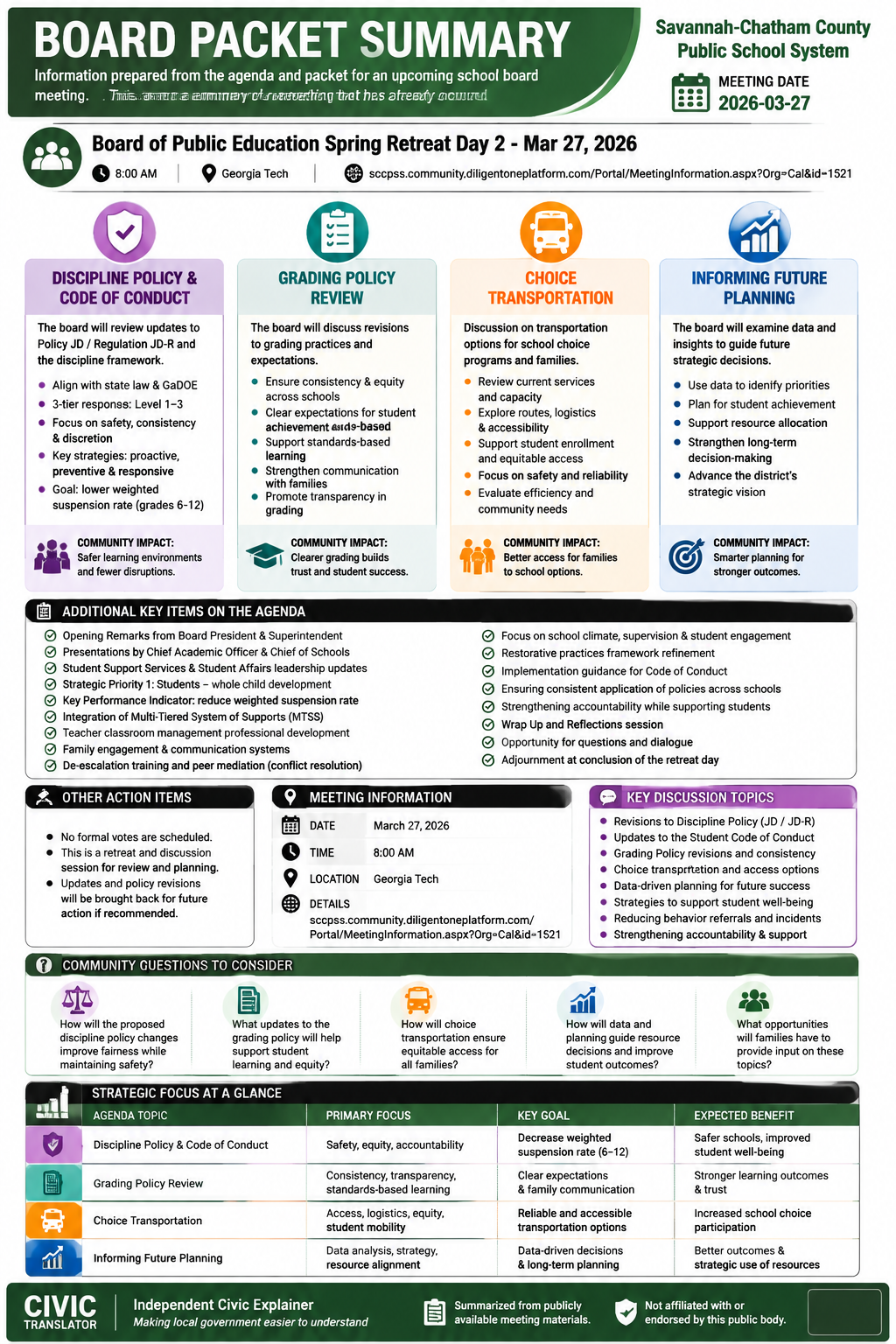
The Savannah-Chatham County Public School System Board of Public Education Spring Retreat Day 2 focused on major student experience issues: discipline practices, grading policy, transportation choice, and future planning. The retreat was scheduled for March 27, 2026, at 8:00 AM at Georgia Tech. The agenda centered on board discussion and guidance rather than final votes, with presentations from district leaders including Chief Academic Officer Derrick Butler, Chief of Schools Dr. Raymond Barnes, and other district staff.
Two major policy discussions involved proposed revisions to student discipline rules and grading practices. District leaders presented changes intended to create greater consistency across schools, improve communication with families, and align procedures with student support goals. The discipline discussion reviewed Policy JD and Regulation JD-R, while the grading discussion reviewed Policy/Regulation IHA-R.
The discipline presentation focused on reducing student behavior incidents, especially as measured by weighted suspension rates for grades 6-12. The district described a three-part approach: proactive strategies such as supervision and classroom management, preventive strategies such as early warning systems and peer mediation, and responsive strategies through the Student Code of Conduct.
The grading policy discussion addressed concerns identified through an audit and stakeholder engagement process. District materials stated that grading practices varied significantly between classrooms, including assignment weighting, grade recovery opportunities, and timeliness of grade entry. Proposed changes were presented as discussion items intended to improve fairness, transparency, and alignment between grades and student learning.
Major Discussion and Action Items
Student Discipline Policy and Code of Conduct Review
The board reviewed proposed updates to Policy JD and Regulation JD-R with the goal of improving consistency, accountability, and student support. District leaders stated that the review was intended to align district discipline practices with applicable state requirements and Georgia Department of Education policies.
The district identified several goals: reviewing the discipline matrix so consequences better match infractions, refining restorative practices, and creating implementation guidance so expectations are applied consistently across schools. Stakeholder feedback emphasized the importance of students understanding the Code of Conduct, families receiving clearer information, and administrators balancing consistency with appropriate discretion.
Proposed Discipline Consequence Changes
The proposed discipline matrix included revisions related to electronic smoking devices, violence against teachers, and restorative practices. For middle and high school students, proposed consequences for electronic smoking devices included three days of out-of-school suspension for Level 1 offenses, five days for Level 2 offenses, and seven days for Level 3 offenses. The proposal also referenced the N-O-T on Tobacco Program as part of balancing accountability and education.
The proposal increased the minimum consequence for middle and high school Level 3 incidents involving violence against teachers to 10 days of out-of-school suspension. The district also proposed removing restorative options from the discipline matrix while creating clearer restorative curriculum expectations.
Attendance and Electronic Device Policy Discussion
The discipline policy review included proposed language changes regarding absenteeism and electronic devices. The proposed absenteeism language stated that students with five or more unexcused absences would be considered truant and that students with 10 or more unexcused absences could be at risk of receiving No Credit for courses in which they are enrolled.
The proposed electronic device language addressed use of personal devices, access to social networking platforms through district resources, and parent rights regarding educational technology uses. The district proposed clearer guidance for students, families, and staff.
Grading Policy Review and Proposed IHA-R Changes
District leaders presented proposed grading policy revisions after identifying inconsistencies in assignment weighting, grade recovery, late work practices, and grade reporting. The district stated that these differences created concerns about fairness and whether grades accurately reflected student learning.
The district reported conducting a seven-month stakeholder engagement process and using Hanover Research to independently synthesize feedback. Four major themes emerged: consistency and fairness in grading, transparency and communication, supportive systems for teaching and learning, and academic mastery and assignment weighting.
Grade Recovery, Assignment Practices, and Reporting Changes
Proposed grading revisions included standardized opportunities for assessment recovery, clearer expectations for the number of grades entered, and more consistent grade reporting. One proposed benchmark would provide students scoring below 75% on an assessment with at least one recovery attempt after targeted reteaching and relearning opportunities.
The district also discussed setting minimum grading expectations, including proposed benchmarks of eight classwork assignments and four student assessments per semester in applicable categories. Another proposal would require grades to be entered into the gradebook weekly to improve family access to timely progress information.
Kindergarten Progress Reporting Changes
The board reviewed a proposal beginning in School Year 2027 for kindergarten academic progress reporting. Under the proposal, kindergarten teachers would use the Georgia Kindergarten Inventory of Developing Skills (GKIDS) exclusively for academic progress reporting in English Language Arts, mathematics, science, and social studies.
The proposal stated that kindergarten teachers would no longer enter quarterly academic content grades in PowerTeacher, reducing duplicate reporting requirements. PowerSchool would continue as the system of record for attendance, conduct, and special-area grades.
Choice Transportation and Future Planning Discussions
The retreat agenda also included presentations on Choice Transportation and Informing Future Planning by Megan Davidson. The packet identifies these topics as discussion items but does not provide detailed supporting presentation content.
Financial Matters
The accessible packet materials did not identify specific budgets, contracts, purchase amounts, grants, bids, tax matters, or other major financial commitments for this retreat session. The primary focus was policy development, implementation planning, and operational guidance.
Policies, Ordinances, Resolutions, and Governance
The major governance topics were revisions to student discipline policies JD and JD-R and grading policy/regulation IHA-R. The district presented these revisions as proposals for board feedback, not final adopted language.
The discipline policy timeline presented included board retreat feedback in March, a first policy read in May, a second read and adoption consideration in June, administrative guidance completion in June, and staff communication and professional development in July and August.
The retreat included presentations from Instructional Excellence and School Leadership. Reports highlighted concerns about inconsistent discipline application and grading practices, along with proposed systems for improving consistency.
The discipline presentation emphasized administrator calibration, data review, escalation and appeals processes, and accountability for implementation. The grading presentation emphasized research-supported policy development and stakeholder engagement.
Personnel, Appointments, and Organizational Matters
The packet identifies district presenters and leaders involved in the retreat, including Superintendent Dr. S. Denise Watts, Board President Roger Moss, Chief Academic Officer Derrick Butler, Chief of Schools Dr. Raymond Barnes, Kimberly McGuire, Ed.S., and Dr. Quentina Miller-Fields. No personnel actions, appointments, resignations, or employment agreements were identified in the accessible materials.
Projects, Facilities, Infrastructure, and Operations
The retreat did not contain detailed facility, construction, infrastructure, or capital project items. Operational discussions focused primarily on student discipline systems, grading processes, transportation planning, communication, and implementation structures.
The retreat agenda did not identify a formal public hearing. However, the district referenced stakeholder engagement processes involving students, families, teachers, administrators, and community groups for both discipline and grading policy reviews.
- Residents: The retreat addressed policies that shape student experiences across the district, particularly expectations for behavior, academic reporting, and communication with families.
- Students and families: Proposed changes could affect discipline consequences, access to grade recovery opportunities, understanding of student progress, and communication through district systems.
- Taxpayers: No major financial commitments were identified, but policy changes may influence district operations and resource priorities.
- Employees and staff: Teachers and administrators may experience new expectations for grading consistency, professional development, documentation, and implementation procedures.
- Schools and communities: The district emphasized consistent application of policies across schools as a central goal.
- How will the district measure whether discipline policy changes improve student outcomes?
- What safeguards will ensure discipline consequences are applied consistently across schools?
- How will students and families be informed about changes to the Code of Conduct?
- How will teachers be supported in implementing revised grading expectations?
- What feedback from students and families will continue to influence final policy language?
- How will the district evaluate whether grading changes improve accuracy and fairness?
- What training will administrators receive before new discipline procedures are implemented?
- How will the district monitor the impact of kindergarten reporting changes?
- What additional details will be provided about Choice Transportation planning?
- When will the public have additional opportunities to review proposed policy language?
Important Dates, Deadlines, and Next Steps
- March 27, 2026: Board retreat discussion and feedback on discipline and grading proposals.
- May 2026: Planned first policy read for proposed revisions.
- June 2026: Planned second policy read and adoption consideration.
- June 2026: Administrative guidance documents expected to be finalized.
- July-August 2026: Staff communication and teacher/leader professional development.
- September-November 2026: Stakeholder groups expected to review implementation progress and provide feedback on early impact.
- November-December 2026: Stakeholder reengagement related to grading implementation fidelity and early results.
Key Takeaways
- The March 27, 2026 retreat focused on student discipline, grading policy, transportation choice, and future planning.
- Discipline policy revisions are intended to improve consistency while balancing accountability and student support.
- The district is reviewing Policy JD and Regulation JD-R for alignment with state requirements.
- Proposed discipline changes include revised consequences for electronic smoking devices and violence against teachers.
- Grading policy revisions respond to concerns about inconsistent weighting, recovery practices, and grade reporting.
- Hanover Research was used to synthesize stakeholder feedback on grading policy changes.
- Proposed grading changes include clearer recovery opportunities and weekly grade-entry expectations.
- Kindergarten academic reporting may shift to GKIDS beginning in School Year 2027.
- The retreat materials describe implementation planning but do not identify major financial commitments.
- Future policy decisions are expected after additional review and board consideration.
Official Sources
About the Public Body
- Name: Savannah-Chatham County Public School System
- Organization type: school-district
- Government body: school-boards
- Location: Savannah, georgia
- County: Chatham County
- Provider: diligent-community
Keywords
Savannah-Chatham County Public School System, SCCPSS, Board of Public Education, Spring Retreat, March 27 2026, student discipline, Code of Conduct, Policy JD, Regulation JD-R, grading policy, IHA-R, student behavior, weighted suspension rate, restorative practices, MTSS, electronic devices, vaping policy, grade recovery, PowerSchool, GKIDS, kindergarten reporting, Hanover Research, stakeholder engagement, school climate, instructional excellence, school leadership, choice transportation, future planning