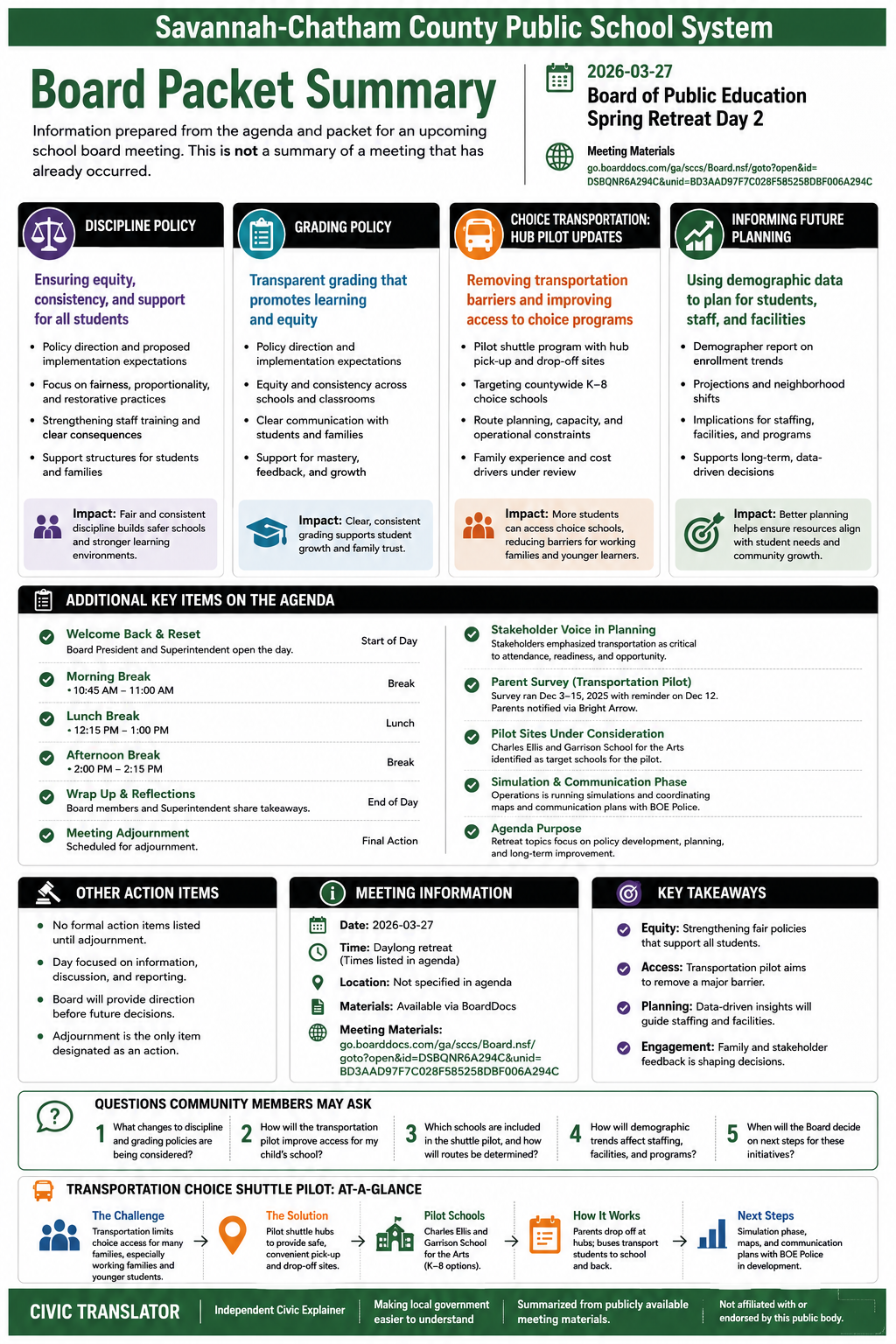
The second day of the Board of Public Education's spring retreat focused on long-range strategic issues rather than routine business. District leaders asked the board for guidance on major policy and operational initiatives involving student discipline, grading practices, transportation access to choice schools, and long-term enrollment planning. The packet emphasizes discussion and future direction rather than immediate final action.
The proposed grading revisions are among the most consequential topics. District leaders argue that inconsistent grading practices across schools have created inequities for students and confusion for families. Recommendations include standardized grade recovery opportunities, minimum expectations for grade entry, clearer assignment weighting, and revisions intended to make grades better reflect academic mastery rather than mathematical penalties from isolated low scores. The district describes these proposals as discussion drafts that would later move through formal board review.
Transportation also represents a significant strategic initiative. Staff propose piloting shuttle hubs for countywide choice schools beginning with Charles Ellis and Garrison School for the Arts. The goal is to reduce transportation barriers that prevent students from participating in specialized academic programs while improving equity of access for working families and households without reliable transportation. Performance metrics, phased implementation, and future expansion criteria are included in the presentation.
Another major discussion centers on demographic projections. Independent enrollment forecasts indicate gradual district enrollment declines over approximately the next decade rather than a sudden loss of students. The report recommends proactive planning for facilities, staffing, programming, and student recruitment while recognizing substantial differences among individual schools.
Major Discussion and Action Items
Student Discipline Policy and Code of Conduct
District administrators reviewed Policy JD and Regulation JD-R with the objective of improving consistency, fairness, and alignment with Georgia law and state guidance. Staff described three complementary approaches:
- Proactive school climate and classroom management.
- Preventive interventions using MTSS, early warning systems, de-escalation, and peer mediation.
- Responsive discipline emphasizing safety, consistency, accountability, and administrative discretion.
Stakeholder feedback highlighted concerns about fairness, consistent consequences, bullying procedures, transportation discipline, and balancing uniform expectations with administrator judgment. Staff indicated future implementation guidance would accompany any policy revisions.
Districtwide Grading Policy Revision
District leaders presented findings from an audit showing substantial differences among schools in assignment weighting, late work, reassessment practices, and grade reporting.
Topics under consideration include:
- Standardized assessment retake opportunities.
- Clear expectations for grade recovery.
- Weekly grade entry expectations in PowerSchool.
- Minimum numbers of graded assignments.
- Greater emphasis on standards-based mastery.
- Rebalancing assignment versus assessment weighting.
- Kindergarten reporting through GKIDS instead of duplicate academic grading in PowerSchool.
The district emphasized that these concepts are intended for board discussion before formal policy language is drafted.
Choice Transportation Shuttle Pilot
Transportation staff proposed a 2026-2027 shuttle hub pilot serving countywide choice schools.
Major features include:
- Parent drop-off and pickup at designated shuttle hubs.
- Initial service for Charles Ellis and Garrison School for the Arts.
- Supervised loading and unloading.
- BOE Police coordination.
- Parent communication plans.
- Practice simulations before launch.
The district links the proposal to strategic goals of improving educational access while reducing transportation barriers that disproportionately affect working families. Success measures include on-time performance, parent satisfaction, safety outcomes, and cost per student before considering expansion.
Long-Term Enrollment Forecast
Independent consultants presented projections extending through 2035-2036.
Key findings include:
- Gradual district enrollment decline under most scenarios.
- Largest pressures occurring at kindergarten, sixth grade, and ninth grade entry points.
- Continued effects from school choice, homeschooling, private schools, and demographic shifts.
- Different enrollment trajectories among individual schools.
- Significant available building capacity across the district.
Consultants recommend proactive planning rather than emergency responses because projected changes occur gradually over many years.
Facility and Strategic Planning
Enrollment projections are intended to guide future decisions regarding:
- Staffing.
- School programming.
- Boundary evaluation if necessary.
- Capital planning.
- Facility utilization.
- Long-term operational efficiency.
The consultants conclude that enrollment planning should emphasize right-sizing and optimization rather than expecting substantial future growth.
Financial Matters
The retreat agenda is primarily strategic and informational rather than focused on contract approvals or budget authorizations.
Financial implications discussed include:
- Transportation staff established a pilot performance goal of keeping shuttle transportation costs at or below $700 per participating student while maintaining at least 80 percent parent satisfaction and zero safety incidents.
- Transportation expansion decisions would depend upon operational results collected during the pilot.
- Enrollment projections are expected to influence future capital planning, staffing decisions, and facility utilization rather than requiring immediate expenditures.
- No major construction contracts, grants, bids, or significant spending approvals are identified in the retreat materials.
Policies, Ordinances, Resolutions, and Governance
The retreat centers on policy development rather than formal adoption.
Major governance topics include:
- Revision of student discipline policies and implementation guidance.
- Comprehensive revisions to grading regulation IHA-R.
- Clarification of grade recovery procedures.
- Standardization of grading expectations.
- Review of assignment weighting.
- Kindergarten reporting changes using GKIDS.
- Planned governance timeline including retreat discussion, first policy reading, second reading, adoption, administrative guidance, staff training, parent communication, and later implementation review.
Major presentations include:
- Discipline policy review emphasizing equitable implementation and restorative practices.
- Grading policy audit supported by Hanover Research, which independently synthesized stakeholder feedback gathered over several months.
- Transportation shuttle pilot update describing implementation phases, parent survey findings, operational planning, and evaluation metrics.
- Independent demographic report projecting gradual enrollment declines and identifying schools expected to experience the largest increases and decreases over the coming decade.
The enrollment report also discusses declining birth rates, competition from private education and homeschooling, housing affordability, aging population trends, and excess facility capacity as important planning considerations.
Personnel, Appointments, and Organizational Matters
The retreat does not primarily address personnel actions.
Staff leadership roles include presentations by:
- Superintendent Dr. S. Denise Watts.
- Board President Roger Moss.
- Chief Academic Officer Derrick Butler.
- Chief of Schools Dr. Raymond Barnes.
- Transportation leadership.
- Independent demographic consultants.
The materials also describe future professional development and implementation planning for administrators and teachers if grading policy revisions advance.
Projects, Facilities, Infrastructure, and Operations
Operational initiatives include:
- Choice transportation shuttle implementation.
- Route simulations.
- Parent communication planning.
- Coordination with BOE Police.
- Driver and monitor training.
- Monthly performance monitoring after launch.
- Facility planning informed by enrollment forecasts.
- Review of school capacity and long-range utilization.
The enrollment study indicates the district currently has substantial unused instructional capacity, providing flexibility for future planning even if enrollment declines continue.
The retreat itself is structured as a board discussion.
Community engagement already informing the recommendations includes:
- Multi-month stakeholder engagement regarding grading policy.
- Independent Hanover Research synthesis.
- Parent transportation surveys.
- Strategic planning feedback regarding transportation access.
Future opportunities include policy first readings, second readings, adoption meetings, parent communication campaigns, and follow-up stakeholder engagement after implementation. No separate public hearing dates are identified in the packet.
Students may experience more consistent grading, expanded reassessment opportunities, clearer academic expectations, and potentially improved access to choice programs.
Families could benefit from more timely grade reporting, standardized grading practices, transportation options that reduce logistical barriers, and clearer communication regarding student progress.
Employees may receive new implementation guidance, professional development, standardized grading expectations, and operational procedures supporting more consistent districtwide practice.
Taxpayers and community members receive a long-range planning framework that addresses enrollment changes before they become operational challenges while encouraging efficient use of existing facilities rather than reacting to sudden declines.
- How will grading consistency be monitored across schools?
- What safeguards will prevent abuse of assessment retakes?
- How will teachers be supported during implementation?
- What criteria will determine whether the transportation pilot expands?
- Which neighborhoods will benefit most from shuttle hubs?
- How will enrollment projections affect future staffing decisions?
- Will declining enrollment eventually require boundary or program changes?
- How will success of the revised discipline policy be measured?
- How will parent feedback continue after implementation?
- What additional data will the board review before adopting grading revisions?
Important Dates, Deadlines, and Next Steps
- March 27, 2026: Board retreat discussion and strategic guidance.
- May 2026: Planned first reading of grading policy revisions.
- June 2026: Anticipated second reading and policy adoption.
- June through August 2026: Administrative guidance and staff professional development.
- July through August 2026: Parent communication campaign.
- August 2026: Planned launch of the transportation shuttle pilot.
- August through December 2026: Live monitoring of transportation performance.
- November through December 2026: Stakeholder re-engagement regarding grading implementation.
- January through May 2027: Transportation pilot evaluation and possible expansion decisions.
Key Takeaways
- The retreat focused on long-term strategy rather than routine approvals.
- District leaders are proposing significant grading policy revisions.
- Transportation access to choice schools is a major equity initiative.
- Charles Ellis and Garrison School for the Arts are proposed pilot locations.
- Parent survey feedback shaped transportation planning.
- Enrollment is projected to decline gradually rather than suddenly.
- School-level enrollment changes will vary considerably across the district.
- Existing facilities provide substantial excess capacity.
- Discipline policy revisions emphasize consistency, restorative practices, and fairness.
- Additional policy readings and implementation planning are expected before major grading changes take effect.
Official Sources
About the Public Body
- Name: Savannah-Chatham County Public School System
- Organization type: school-district
- Government body: school-boards
- Location: Savannah, georgia
- County: Chatham County
- Provider: boarddocs
Keywords
Savannah-Chatham County Public School System, Board of Public Education, Spring Retreat, BoardDocs, grading policy, discipline policy, Code of Conduct, JD, IHA-R, Hanover Research, transportation, choice schools, shuttle pilot, Charles Ellis, Garrison School for the Arts, enrollment forecast, demographer, facilities planning, school capacity, GKIDS, PowerSchool, equity, strategic planning, student achievement, parent engagement, enrollment trends, school operations, Savannah, Chatham County