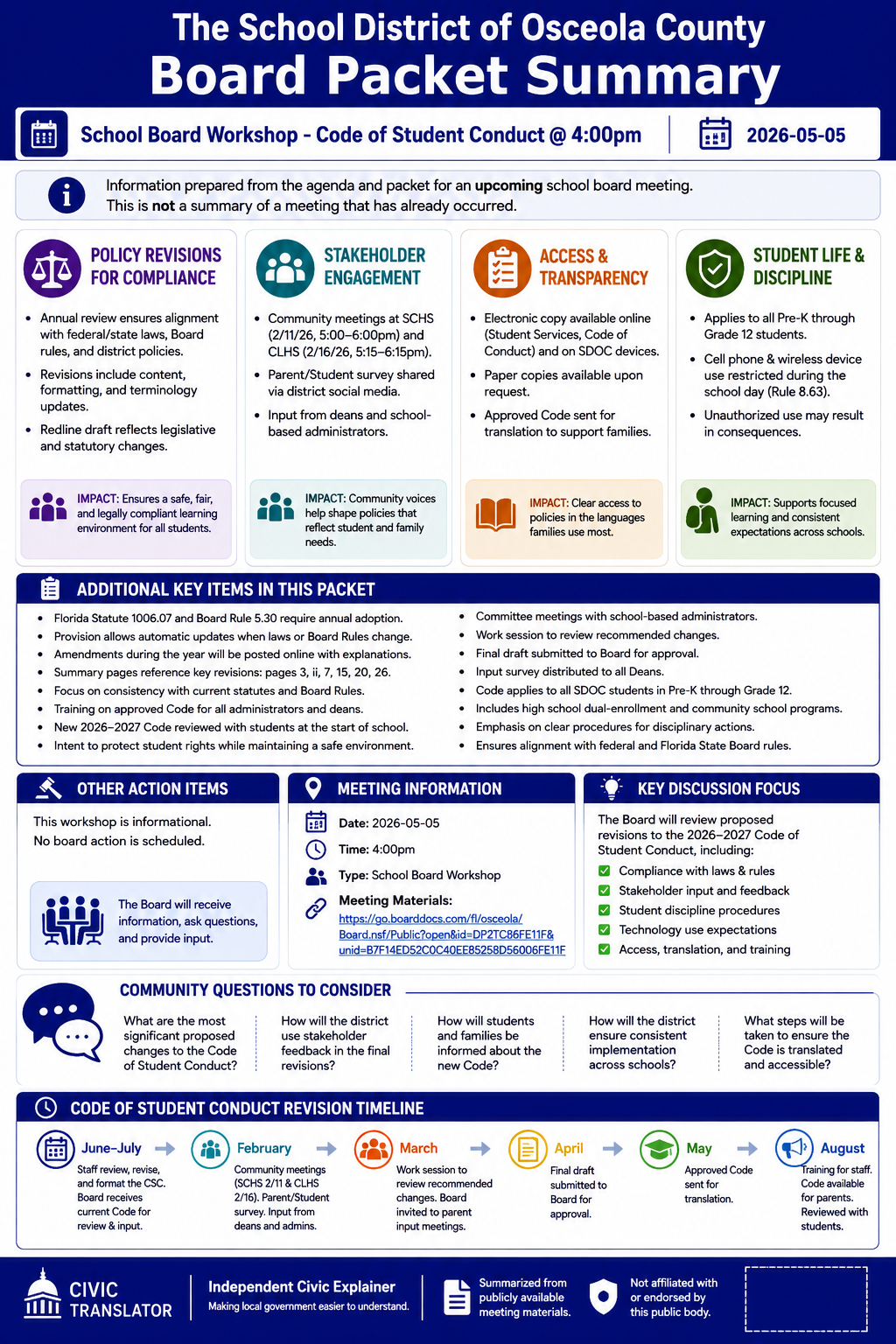
The primary focus of this workshop is a comprehensive review of proposed revisions to the School District of Osceola County's 2026–2027 Code of Student Conduct. Rather than taking action on routine district business, the board is scheduled to discuss updates intended to keep district disciplinary policies aligned with current federal law, Florida statutes, State Board of Education rules, School Board policies, and administrative procedures.
The packet outlines a year-long review process involving district staff, school administrators, board members, parents, students, and community stakeholders. Public meetings, surveys, committee discussions, and board work sessions were used to develop the proposed revisions before the final draft is presented for board approval. The workshop represents an important step before implementation of the updated Code for the 2026–2027 school year.
Several proposed revisions have practical implications for students and families. These include updated language governing student use of cell phones and other wireless devices, clarification regarding artificial intelligence use during standardized testing, revisions to disciplinary procedures, updated reporting requirements for threats and bullying, consolidation of disciplinary matrices, and procedural changes affecting expulsion hearings. The revisions generally emphasize consistency with state law while modernizing district policies and terminology.
The workshop also highlights how the district intends to communicate and implement the new Code. Following board approval, the Code will be translated, made available electronically, incorporated into administrator training, and reviewed with students before the beginning of the 2026–2027 academic year. Paper copies will remain available upon request, reflecting a shift toward primarily digital distribution.
Major Discussion and Action Items
Review of the 2026–2027 Code of Student Conduct
The central purpose of the workshop is an in-depth discussion of proposed revisions to the district's annual Code of Student Conduct. District leadership explains that revisions are intended to maintain compliance with applicable federal and state requirements while improving formatting, terminology, and consistency throughout the document. The presentation emphasizes that many changes are intended to align existing district language more closely with statutory language rather than fundamentally changing district philosophy regarding student discipline.
Community and Stakeholder Review Process
The packet documents a multi-stage review process extending from June and July through the following school year. Student Services staff revised the existing Code, conducted meetings with board members, held committee meetings with school administrators, distributed surveys to deans, and organized community meetings for parents and students. Public engagement included meetings at SCHS on February 11, 2026, and CLHS on February 16, 2026, along with online surveys distributed through district social media. This timeline demonstrates an effort to incorporate feedback from multiple stakeholder groups before final approval.
Student Cell Phone and Wireless Device Rules
One of the most significant revisions concerns student use of wireless communication devices. The proposed language references School Board Rule 8.63 and states that students generally may not use wireless communication devices during the school day unless permitted for academic or documented medical purposes. Devices remain permissible on school vehicles. The proposal expands the definition of covered devices to include cell phones, tablets, smart watches, smart glasses, cameras, and similar wireless technologies. Violations may result in confiscation, while devices involved in criminal activity may be turned over to law enforcement.
Artificial Intelligence and Academic Integrity
The revisions address emerging technology by explicitly prohibiting students from using artificial intelligence tools or applications to generate answers during district, state, or national standardized assessments. Including AI within the Code reflects the district's effort to address rapidly evolving technology while preserving testing integrity and compliance with assessment requirements.
The proposed Code updates definitions relating to threats, intimidation, bullying, and dating violence. The packet references Florida Administrative Code and Florida Statutes while clarifying reporting expectations and emphasizing incidents that require reporting to law enforcement. Bullying definitions include cyberbullying and describe repeated conduct involving a power imbalance. Dating violence reporting procedures include the Fortify Florida application and the district's Title IX reporting email.
Changes to Student Discipline Procedures
The district proposes several procedural revisions affecting disciplinary administration. These include limiting requests for expulsion hearings to within 14 days after the pre-expulsion meeting, removing obsolete references to the New Beginnings Code of Student Conduct, creating a unified disciplinary matrix covering both elementary and secondary students, clarifying that certain disciplinary consequences are assigned only at the district level after review, and removing outdated JUMP Program appendix information.
Digital Distribution of the Code
The revised Code continues the district's move toward electronic access. Schools will no longer distribute paper copies automatically to every student. Instead, families may access the Code through the district website or district-issued student devices, while printed copies remain available upon request. The district indicates this change is intended to conserve resources while maintaining public accessibility.
Financial Matters
The workshop packet does not identify significant contracts, capital expenditures, grants, budget amendments, vendor agreements, tax matters, or other major financial actions requiring board consideration.
The only financial implication discussed relates indirectly to operational efficiency. By distributing the Code of Student Conduct electronically rather than printing copies for every student, the district indicates it intends to conserve resources while still providing printed copies to families who request them. No estimated savings or budget figures are included in the packet.
Policies, Ordinances, Resolutions, and Governance
The workshop centers on annual revisions to the district's Code of Student Conduct, which Florida Statute Section 1006.07 and Board Rule 5.30 require the board to review and adopt each year. The proposed revisions are presented as updates necessary to maintain legal compliance and reflect current educational policies.
Among the governance-related changes are:
- Updated language reflecting current federal and state law.
- Authorization for future online updates when statutes or Board Rules change during the school year, accompanied by redlined amendments and explanatory footnotes.
- Modernized terminology and formatting.
- Revised disciplinary procedures.
- Updated definitions of student misconduct.
- Clarified reporting requirements.
- Revised technology and AI expectations.
The workshop serves as a discussion session before the final Code is submitted for board approval.
District staff present an overview of the annual Code revision process led by Student Services. The presentation explains why revisions are necessary, summarizes the review timeline, and describes stakeholder involvement throughout development of the updated Code.
The presentation also reviews significant content revisions, including disciplinary procedures, student technology expectations, reporting requirements, and administrative implementation plans. Rather than introducing new district initiatives, the presentation focuses on maintaining legal compliance, improving clarity, and preparing schools for implementation before the new academic year.
The implementation schedule includes administrator training, publication of translated materials, online posting of the final Code, and review of expectations with students before the school year begins.
Personnel, Appointments, and Organizational Matters
No personnel appointments, employment agreements, resignations, retirements, board appointments, or staffing changes are identified for board action.
The packet does indicate that Student Services staff, school administrators, deans, board members, parents, students, and community stakeholders participated in developing the revised Code. Following approval, administrators and deans are scheduled to receive training before implementation during the 2026–2027 school year.
Projects, Facilities, Infrastructure, and Operations
Although the workshop is policy-focused rather than infrastructure-focused, several operational matters are addressed.
Implementation of the revised Code requires districtwide administrator training, publication of translated materials, online distribution, and review with students before the school year begins.
Operational changes include the transition toward primarily electronic distribution of the Code while maintaining printed copies upon request, continued availability of reporting tools such as Fortify Florida, updated procedures for disciplinary documentation, and revised expectations governing student technology use on school campuses. These changes affect everyday school operations across the district rather than physical facilities or capital projects.
The packet documents multiple opportunities for public participation during development of the revised Code.
Community meetings were held at SCHS on February 11, 2026, from 5:00 p.m. to 6:00 p.m., and at CLHS on February 16, 2026, from 5:15 p.m. to 6:15 p.m. Parents and students were invited to provide input, and surveys were distributed through district social media platforms.
The May 5, 2026 workshop itself provides another opportunity for board discussion before the final draft proceeds to formal approval.
Students will experience updated expectations regarding acceptable conduct, technology use, AI-assisted testing, bullying, threats, and disciplinary procedures.
Parents and families will primarily access the Code electronically but may request printed copies if needed. They also benefit from expanded opportunities for participation during future annual Code revisions.
Teachers, administrators, and deans will receive training to ensure consistent implementation of revised disciplinary procedures across schools.
The district's emphasis on statutory alignment may improve consistency between school practices and Florida law while providing clearer guidance for disciplinary decision-making.
Community members concerned about school safety may be particularly interested in the revised reporting language covering bullying, threats, dating violence, and related incidents.
- How do the proposed revisions differ from the current Code in everyday classroom practice?
- What stakeholder feedback resulted in the most significant revisions?
- How will schools consistently enforce the updated cell phone policy?
- How will the district distinguish acceptable educational AI use from prohibited testing-related AI use?
- What training will administrators and teachers receive before implementation?
- How will families without reliable internet access obtain the Code?
- What metrics will the district use to evaluate whether the revised Code improves consistency?
- How will bullying and threat reporting procedures be communicated to students?
- What additional guidance will students receive regarding acceptable technology use?
- Will future statutory changes automatically become effective before the next annual Code revision?
Important Dates, Deadlines, and Next Steps
- February 11, 2026: Community input meeting at SCHS from 5:00 p.m. to 6:00 p.m.
- February 16, 2026: Community input meeting at CLHS from 5:15 p.m. to 6:15 p.m.
- May 5, 2026: School Board workshop reviewing recommended revisions to the 2026–2027 Code of Student Conduct.
- Following the workshop: Final draft scheduled for submission to the School Board for approval.
- After approval: Code translated into multiple languages.
- Before the 2026–2027 school year: Administrator and dean training conducted.
- Prior to student return: Updated Code posted online and reviewed with students.
- Ongoing: Future statutory or Board Rule changes may be reflected through online updates with redlined amendments and explanatory notes.
Key Takeaways
- The workshop focuses entirely on revisions to the 2026–2027 Code of Student Conduct.
- Revisions are intended to maintain compliance with federal and Florida law.
- Community meetings and surveys contributed to development of the proposed revisions.
- Student cell phone and wireless device expectations receive significant clarification.
- AI-generated responses during standardized assessments are expressly prohibited.
- Definitions and reporting requirements for bullying, threats, intimidation, and dating violence are updated.
- The district proposes one unified disciplinary matrix covering elementary and secondary students.
- Requests for expulsion hearings would generally be limited to 14 days after the pre-expulsion meeting.
- The Code will primarily be distributed electronically, with printed copies available upon request.
- Administrator training and student orientation are planned before implementation of the new Code.
- Future legal changes may be incorporated through online Code updates during the school year.
Official Sources
About the Public Body
- Name: The School District of Osceola County
- Organization type: school-district
- Government body: school-boards
- Location: Kissimmee, florida
- County: Osceola County
- Provider: boarddocs
Keywords
The School District of Osceola County, Kissimmee, Osceola County, Florida, School Board Workshop, Code of Student Conduct, Student Services, 2026-2027 Code of Student Conduct, student discipline, cell phone policy, wireless communication devices, artificial intelligence, standardized assessments, bullying, cyberbullying, threat reporting, dating violence, Fortify Florida, Board Rule 8.63, Florida Statute 1006.07, expulsion hearings, discipline matrix, administrator training, parent survey, community meetings, school safety, board workshop, student conduct revisions