Duval County Public Schools Packet Summary — 2026-08-19
Meeting: Wednesday Aug 19, 2026 9:15 AM EDT August 19, 2026, Board Workshop Amended on: August 20, 2026 3:56 PM School Board
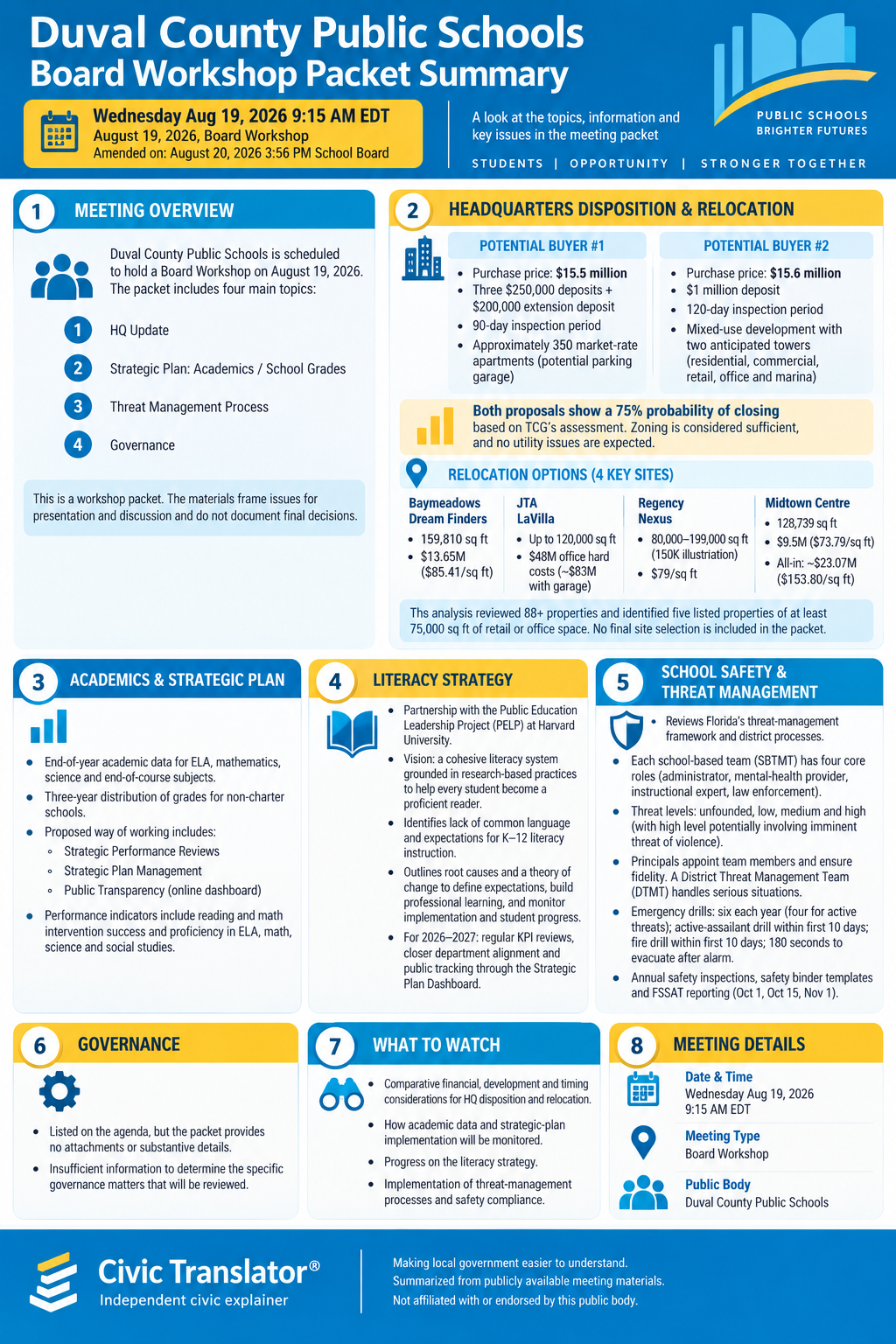
Duval County Public Schools is scheduled to hold a Board Workshop focused on four topics: an update on headquarters disposition and relocation, academic outcomes and strategic-plan monitoring, the district's threat-management and school-safety processes, and governance. The packet provides substantial presentation material for the first three topics; the governance item is listed without supporting attachments.
Key Items on the Agenda
Headquarters Disposition and Relocation
The Board is scheduled to review the district's headquarters strategy from two directions: potential disposition of the existing headquarters property and options for relocating district operations.
For disposition of the current property, the packet compares two potential purchasers and development concepts:
- One proposal lists a $15.5 million purchase price and contemplates approximately 350 market-rate apartments, potentially with a parking garage depending on final density. Its deposit structure includes three $250,000 deposits plus a $200,000 extension deposit, with a 90-day inspection period.
- A second proposal lists a $15.6 million purchase price with a $1 million deposit and a 120-day inspection period. Its concept is a mixed-use development with two anticipated towers incorporating residential, commercial, retail, office and marina uses.
- The presentation assigns both proposals a 75% probability of closing, described as TCG's opinion based on its assessment of the deal points, buyer, proposed use and deal structure.
- The packet characterizes zoning as sufficient for both concepts and says no utility issues are expected. It also identifies differing potential traffic and community effects based on the proposed development intensity and uses.
The relocation analysis says more than 88 properties were filtered and contacted, with five listed properties of at least 75,000 square feet of retail or office space identified on the open market.
Headquarters Relocation Alternatives
The packet compares four leading relocation approaches:
- Baymeadows / Dream Finders: An existing 159,810-square-foot, four-story office building on 10.18 acres. The packet lists a $13.65 million acquisition price, or $85.41 per square foot, with comparatively limited modifications anticipated. It is characterized as having the highest physical and financial certainty among the options and potentially the fastest path to occupancy.
- JTA / LaVilla: A purpose-built civic/public partnership involving up to 120,000 square feet of office space and structured parking. The packet models $48 million in office hard costs and an approximately $83 million project including a garage, with a $35 million garage assumption. The presentation describes this as having high strategic civic value but greater complexity and dependence on outside capital.
- Regency / Nexus: A redevelopment concept involving a former JCPenney/mall property, with between 80,000 and 199,000 square feet available and a 150,000-square-foot illustration used in the comparison. The packet lists $79 per square foot for acquisition and notes substantial existing parking capacity, while identifying construction, site and legal complexity as risks.
- Midtown Centre: A multi-building office acquisition and renovation option totaling 128,739 square feet in the comparison. The packet lists a $9.5 million acquisition price, or $73.79 per square foot, and a seller-case indicative all-in cost of approximately $23.07 million, or $153.80 per square foot. The presentation identifies renovation cost as the primary risk and describes Midtown as a potential "value winner."
The packet also notes a seller benefit associated with Midtown involving a donation of improved value and a delayed closing structure. Additional presentation material identifies Broward, Koger, Baldwin, Pottsburg and the district-owned Schultz Center as part of the Midtown breakdown/site discussion.
The workshop presentation is structured to conclude this topic with superintendent comments and Board discussion. The packet does not document a final selection or approval of a headquarters sale or relocation site.
Academics and Strategic Plan
End-of-Year Academic Outcomes
The Board is scheduled to receive an "Advancing Student Outcomes" presentation covering end-of-year academic data, the district's system for monitoring its strategic plan, and work associated with the Public Education Leadership Project at Harvard University.
The packet includes year-over-year academic outcome data across ELA, mathematics, science and end-of-course subjects, along with a three-year distribution of grades for non-charter schools. Because portions of the extracted presentation table combine grade levels, years and percentages without clear separation, the packet summary does not infer individual values where the underlying table structure is ambiguous.
The district's proposed way of working places greater emphasis on recurring performance reviews and public tracking of strategic-plan implementation. The presentation identifies three components:
- Strategic Performance Reviews: Regular conversations focused on results, barriers and improvement actions.
- Strategic Plan Management: Tracking district initiatives, milestones and progress.
- Public Transparency: Reporting strategic-plan progress and key performance indicators to the community.
A public Strategic Plan Dashboard is described as providing on-track/off-track measures, target metrics, graphics showing progress through the strategic-plan lifecycle, and a transparent and accessible view of district progress.
A sample strategic performance review would examine what the data shows, factors influencing results, successes that could be replicated, barriers to improvement, needed supports and resources, cross-department dependencies, and resulting commitments. Listed performance indicators include reading and math intervention success and proficiency in ELA, math, science and social studies.
Literacy Strategy
The academic presentation also describes Duval County Public Schools' work through the Public Education Leadership Project (PELP) at Harvard University, with a focus on literacy.
The district's stated vision is a cohesive literacy system grounded in research-based instructional practices that supports educator growth and helps every student become a proficient reader. The packet identifies the central problem of practice as a lack of common language and expectations for implementing K–12 research-based literacy practices.
Three root causes are identified:
- Lack of clarity about literacy instructional practices and expectations.
- Incoherent communication systems that produce inconsistencies in information about literacy instruction.
- Lack of a common system for monitoring the delivery of literacy instruction.
The proposed theory of change centers on clearly defining and consistently communicating K–12 literacy expectations, building coherent professional-learning systems and structures, and establishing a common system to monitor both implementation and student progress so that support can be adjusted.
For 2026–2027, the presentation describes a way of work that includes regular internal reviews of Strategic Plan key performance indicators, closer alignment of department work with strategic priorities and measurable outcomes, and tracking district initiatives through the public Strategic Plan Dashboard.
School Safety and Threat Management
Florida Threat-Management Framework
The Board is scheduled to review the district's school-safety and behavioral threat-management process. The packet traces the development of Florida requirements governing school-based threat assessment and management, including statutory requirements for multidisciplinary teams and statewide standardized processes.
The presentation says Florida's current Harm Prevention and Threat Management Model has been implemented in every public school. It also describes the transition from the former behavioral threat-assessment model following identified deficiencies and subsequent state-level work to establish a standardized threat-management instrument, process and portal.
School-Based Threat Management Teams
Each School Based Threat Management Team, or SBTMT, has four core roles:
- A school administrator who cannot be the principal.
- A school-based mental-health services provider, such as a certified school psychologist, social worker, counselor or licensed mental-health professional.
- A member with expertise in school instruction who meets applicable statutory or certification requirements.
- A certified law-enforcement officer with the required Florida model training; a Guardian cannot fill this role.
Additional members may be assigned beyond the core four.
The presentation describes a threat-management framework that includes unfounded, low, medium and high levels of concern. An unfounded determination applies when there is no sufficient factual basis, a threat was never made, the statement clearly was not a threat, or the reported concern did not occur or pose a threat of harm to the school.
A high-level concern is described as potentially involving an imminent threat of violence, continuing intent to cause harm combined with efforts to develop the capacity to carry out a plan, or other concerning behavior requiring immediate intervention and protective measures.
Principal and District Responsibilities
Principals are responsible for appointing SBTMT members and alternates before the beginning of each school year, designating a chair and vice-chair, and reviewing team decisions and recommendations for completeness and fidelity.
The packet also describes a District Threat Management Team (DTMT) that receives referrals involving serious situations from school-based teams. The district team evaluates whether the student's support and management plan meets the student's needs, may modify interventions or supports, and can continue providing recommendations to the school-based team.
Emergency Preparedness and Safety Compliance
Required Drills
The presentation outlines school emergency-drill requirements, including:
- Elementary, middle and high schools are required to conduct six emergency drills each school year, separate from fire drills.
- An active-assailant drill must occur within the first 10 school days.
- Law enforcement must be physically present and directly involved in active-assailant drills; the presentation specifies that this role cannot be filled by a Guardian.
- The remaining emergency drills must occur at least once every nine weeks.
- Four of the six emergency drills must address active threats.
- The other two may address emergencies such as severe weather, natural disasters, hazardous materials or reunification.
- A fire drill also must occur during the first 10 days of school.
The packet provides additional requirements for fire drills by school level and notes that state law allows 180 seconds from fire-alarm activation to the call to evacuate.
School Safety Documentation and Inspections
The district says it created school safety binder templates to support annual unannounced safety inspections at every district school. Binder materials include school safety plans, emergency- and fire-drill documentation, SBTMT membership and training certifications, annual threat-management refresher certificates, School Environment Safety Incident Report materials and documentation of monthly SBTMT meetings.
The presentation says the Florida Department of Education's Office of Safe Schools is required to conduct unannounced safety-compliance inspections at every public and public charter school in Florida at least once every three years. The district reports that it conducts its own annual inspections in advance of that cycle.
Inspection focus areas identified in the packet include physical security, access controls, emergency preparedness, staffing and personnel documentation, and behavioral threat-management procedures and intervention records.
The packet describes the Florida Safe Schools Assessment Tool (FSSAT) as an online platform supporting security-risk assessment, field reporting, data analytics and information sharing.
The presentation identifies several upcoming reporting deadlines:
- School security risk assessments must be submitted in FSSAT by October 1.
- Districts must report to the Florida Department of Education by October 15 that all public schools in the district have completed their security-risk assessments.
- School safety specialists must report findings and remedies to the Office of Safe Schools within 30 days after the School Board publicly meets on the findings and recommendations, and no later than November 1.
Governance
The fourth scheduled workshop topic is Governance. The agenda includes the item, but the packet lists no attachments and provides no substantive description, recommendation, financial impact or expected outcome for it.
Accordingly, the packet does not provide enough information to characterize what specific governance matters are expected to be reviewed.
What to Watch at the Workshop
Because this is a workshop packet rather than a record of completed Board action, the materials primarily frame issues for presentation and Board discussion rather than documenting decisions.
Key points likely to warrant attention based on the packet include the comparative financial, development and timing considerations surrounding headquarters disposition and relocation; how academic performance data will inform strategic-plan implementation; how the district intends to standardize and monitor K–12 literacy instruction; and how school-level and district-level threat-management responsibilities are being implemented alongside state safety requirements.
The packet does not document a final headquarters transaction, relocation-site selection, governance action or other Board approval arising from this workshop.
This Civic Translator packet summary is based on publicly available meeting materials from Duval County Public Schools.
Civic Translator summarized publicly available meeting materials from the official public-body source.