This briefing is based on the meeting packet and supporting workshop materials contained in the attached extracted source.
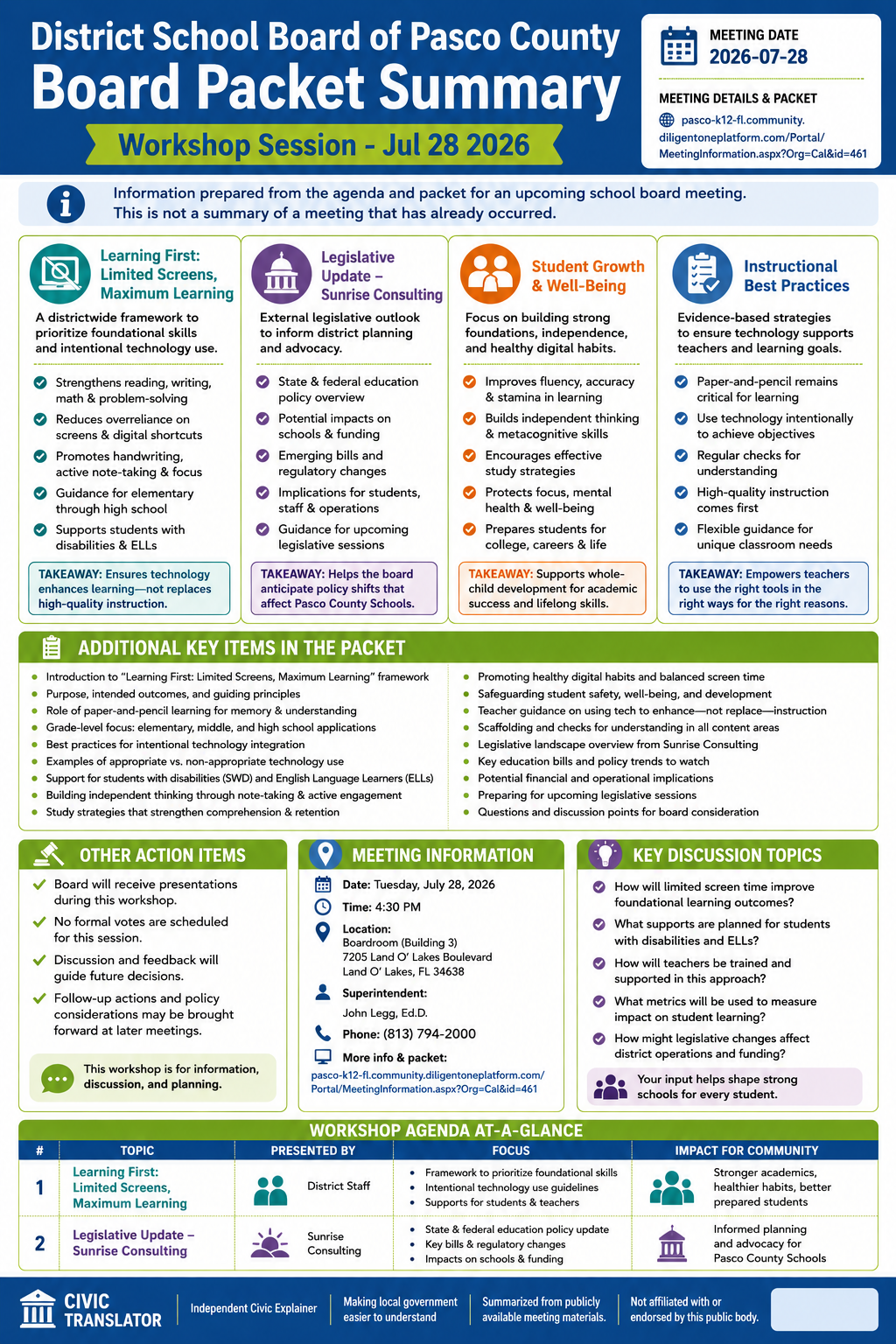
This workshop was primarily informational rather than a business meeting focused on contracts or approvals. Instead, the School Board received two significant presentations that could influence district operations over the coming school year: a new instructional framework titled "Learning First: Limited Screens, Maximum Learning" and a legislative update reviewing major education laws enacted during Florida's 2026 legislative session.
The instructional presentation centers on reducing unnecessary classroom screen time while preserving technology for clearly defined educational purposes. District staff emphasized that technology should strengthen—not replace—teacher instruction, handwriting, reading, discussion, mathematical reasoning, and independent thinking. The guidance is presented as a professional resource for educators rather than a mandatory compliance policy.
The legislative presentation summarized numerous new state laws affecting Florida school districts. Topics included academic standards, extracurricular activities, school governance, autism training, educator certification, student safety, school property reporting, and potential statewide property tax changes. While many measures require district implementation, others inform future planning or await voter approval.
For families, teachers, and residents, the workshop signals continued emphasis on foundational literacy and mathematics, more intentional classroom technology use, adaptation to new state requirements, and preparation for policy changes that may affect school operations during the coming academic years.
Major Discussion and Action Items
Learning First: Limited Screens, Maximum Learning
District administrators presented research-based guidance designed to ensure technology enhances instruction without replacing fundamental teaching practices. The initiative supports the district's strategic goal of improving English Language Arts and mathematics proficiency by strengthening foundational learning.
The presentation explains that literacy, numeracy, critical thinking, and problem-solving develop most effectively through explicit instruction, guided practice, teacher feedback, and sustained student engagement. Technology should therefore support these activities rather than become the primary method of instruction.
Classroom Screen Time Expectations
One of the workshop's most notable discussions involved recommended daily technology use by grade level.
The guidance recommends:
- Kindergarten through Grade 1: generally no more than approximately 30 minutes per day on average.
- Grades 2–5: approximately 30–60 minutes per day on average.
- Middle school: approximately 60 minutes per day on average.
- High school: generally 60–90 minutes per day on average when instructional goals justify technology use.
Rather than establishing rigid limits, the document describes these recommendations as professional guidance intended to help educators make instructional decisions appropriate for their classrooms.
Technology Should Support—not Replace—Teaching
The workgroup stressed that technology is most effective when it reinforces teacher-directed learning.
Appropriate uses include:
- diagnostic assessments,
- targeted skill practice,
- research,
- collaboration,
- presentations,
- revision,
- feedback,
- intervention,
- progress monitoring.
The presentation discourages using devices as substitutes for direct instruction, classroom management, or extended passive screen time. Examples of discouraged practices include relying primarily on videos, apps, or software to introduce new concepts or using devices simply to occupy students.
Guidance for Students with Disabilities and English Language Learners
The workshop also addressed how technology should continue supporting students with disabilities and English language learners.
The guidance recommends maintaining accommodations such as text-to-speech, speech-to-text, translation tools, captions, and accessibility supports while continuing strong teacher-led instruction. Staff emphasized that technology should increase access without reducing academic expectations or replacing development of underlying literacy and communication skills.
Legislative Changes Affecting Florida Schools
The Sunrise Consulting presentation reviewed major legislation adopted during the 2026 Florida legislative session.
Topics included:
- education policy,
- athletics,
- school governance,
- counselor certification,
- autism training,
- student safety,
- educator certification,
- property reporting,
- graduation requirements,
- school board authority.
The workshop prepares board members and administrators for implementation rather than requesting immediate policy adoption.
School Board Governance Changes
One significant legislative update covered HB 1073, creating a statutory School Board Members' Bill of Rights.
According to the presentation, the law provides board members with expanded access to district documents, financial information, staff information, and public meeting materials while protecting members' rights to participate in public discussion. The legislation also requires meeting attachments to remain public records and became effective July 1, 2026.
Education Policy and Academic Requirements
Several education bills received attention because they affect district instructional planning.
Examples discussed included:
- mandatory cursive instruction and Grade 5 proficiency,
- revised graduation pathways,
- career-aligned mathematics pathways,
- expanded parent notification regarding missed IEP services,
- new mentoring options for teachers in D and F schools,
- expanded flexibility in certain educational programs.
These statewide requirements may require future district implementation and administrative planning.
Financial Matters
Unlike many regular board meetings, this workshop contained relatively little district-specific financial business.
The legislative presentation summarized the state's FY 2026–27 budget process, noting competing proposals before final agreement during Special Session E. Budget figures presented included:
- Governor proposal: approximately $117.4 billion
- House proposal: approximately $113.5 billion
- Senate proposal: approximately $115.02 billion
- Final agreement: approximately $114.6 billion, with overall settlement information presented at approximately $117.63 billion as part of the legislative summary.
The workshop also reviewed legislation related to athletics that would establish a $15,000 annual spending cap for certain coach support spending under specified circumstances and highlighted proposed property tax changes that could affect local government finances if approved by voters.
No major district construction contracts, vendor awards, budget amendments, grants, or purchasing actions were identified within the workshop materials.
Policies, Ordinances, Resolutions, and Governance
The "Learning First" guidance represents an instructional framework rather than a disciplinary or compliance policy. District leaders repeatedly described it as a practical guide supporting teacher decision-making.
The legislative briefing summarized numerous enacted state policies requiring varying levels of district implementation, including:
- School Board Members' Bill of Rights.
- New reporting requirements for unimproved district property.
- Changes affecting extracurricular eligibility.
- Graduation requirement revisions.
- Autism-related professional learning requirements.
- School safety provisions.
- Educator certification revisions.
- Student health and seizure care updates.
The workshop itself focused on understanding these changes rather than adopting formal board resolutions.
The primary instructional presentation explained research supporting intentional technology use. Key themes included:
- direct instruction remains essential for foundational skills;
- handwriting, reading physical texts, discussion, and paper-and-pencil problem solving continue to play important educational roles;
- technology should improve learning through purposeful practice rather than passive consumption;
- healthy digital habits should be developed alongside academic skills.
The workgroup developing the guidance included teachers, instructional coaches, principals, and district staff. Their recommendations were informed by educational research and aligned with district curriculum, the K–12 Technology Continuum, and the district's Artificial Intelligence Guidebook.
The legislative presentation summarized Florida's 2026 legislative session, including 1,926 bills filed, 237 bills passed, eight gubernatorial vetoes, multiple special sessions, and numerous education-related enactments affecting school districts.
Personnel, Appointments, and Organizational Matters
The packet did not identify major district personnel appointments, resignations, retirements, or employment agreements requiring board action.
However, several legislative updates have workforce implications, including:
- new teacher mentoring options,
- revised counselor certification requirements,
- annual autism-focused professional learning for instructional staff and school-based administrators,
- expanded professional learning opportunities for educator certification renewal,
- autism endorsement salary supplements established under state legislation.
These measures may influence future district staffing, training, and professional development.
Projects, Facilities, Infrastructure, and Operations
No major district construction projects or capital improvement proposals formed the focus of this workshop.
Operational discussions instead centered on classroom instructional practices and implementation of statewide requirements.
The legislative presentation also reviewed new requirements for annual reporting of unimproved school district property, including parcel-level inventories and statewide reporting requirements with a December 1, 2026 publication deadline.
This meeting was conducted as a workshop intended for discussion and information sharing.
The packet does not identify separate public hearings, zoning matters, or formal public comment periods beyond normal School Board meeting participation procedures.
Residents interested in these topics may monitor future School Board meetings where implementation of instructional guidance or legislative changes could return for additional discussion or formal action.
For students, the instructional guidance emphasizes stronger foundational reading, writing, mathematics, and independent thinking while reducing unnecessary dependence on digital devices.
Families may notice greater emphasis on handwriting, printed reading materials, classroom discussion, note-taking, and teacher-directed instruction, particularly in elementary grades.
Teachers receive a framework supporting professional judgment instead of mandatory technology quotas. The guidance encourages selecting instructional approaches based on learning objectives rather than device availability.
Students with disabilities and English language learners remain eligible for technology supports, but those supports are intended to complement—not replace—teacher instruction and individualized educational services.
School administrators must continue preparing for implementation of numerous state legislative changes affecting governance, reporting, curriculum, professional learning, athletics, and student services.
Taxpayers and residents should also monitor the statewide property tax proposal discussed during the legislative update because voter approval could affect local government taxation beginning in 2027.
- How will schools measure whether reduced screen time improves student achievement?
- Will individual schools have flexibility in applying the recommended technology guidelines?
- How will teachers receive training on the new instructional guidance?
- How will the district balance technology innovation with foundational academic instruction?
- How will accommodations for students with disabilities be protected under the new guidance?
- What implementation timeline is expected for newly enacted Florida education laws?
- Which legislative changes require School Board action versus administrative implementation?
- How could statewide property tax proposals affect school district finances?
- How will parents be informed about classroom technology expectations?
- What metrics will the district use to evaluate the success of the "Learning First" initiative?
Important Dates, Deadlines, and Next Steps
- July 28, 2026: School Board workshop reviewing instructional guidance and legislative updates.
- July 1, 2026: Effective date noted for the School Board Members' Bill of Rights legislation.
- December 1, 2026: Statewide publication deadline referenced for school district unimproved property inventory reporting.
- November 3 (statewide election): Proposed constitutional property tax amendment (HJR 1-F) scheduled to appear on the ballot, requiring 60% voter approval if presented as described in the legislative update.
- 2027: Proposed non-school homestead exemption changes would begin if approved by voters, according to the legislative presentation.
- Future School Board meetings are expected to address implementation of applicable state legislation and continued instructional planning.
Key Takeaways
- The workshop focused on instructional strategy and statewide legislation rather than routine board business.
- District leaders promoted intentional technology use that supports—not replaces—teacher instruction.
- Elementary classrooms are encouraged to rely heavily on foundational paper-and-pencil learning.
- Technology remains appropriate for research, collaboration, assessment, intervention, and feedback.
- The guidance is presented as a professional resource rather than a strict compliance policy.
- Students with disabilities and English language learners remain eligible for instructional technology accommodations.
- Florida's 2026 legislative session produced numerous education changes affecting school districts.
- New governance provisions expand statutory rights and information access for school board members.
- Several new state laws affect curriculum, athletics, educator certification, and student safety.
- Property reporting requirements and possible statewide property tax changes could influence future district operations.
- District staff will continue preparing for implementation of newly enacted state requirements.
Official Sources
About the Public Body
- Name: District School Board of Pasco County
- Organization type: school-district
- Government body: school-boards
- Location: Land O' Lakes, florida
- County: Pasco County
- Provider: diligent-community
Keywords
District School Board of Pasco County, Workshop Session, Learning First, Limited Screens Maximum Learning, classroom technology, screen time, foundational learning, literacy, mathematics, direct instruction, instructional technology, English Language Arts, teacher guidance, Florida Legislature, Sunrise Consulting, HB 1073, SB 182, HB 1279, autism training, educator certification, school safety, extracurricular activities, property tax, school governance, Land O' Lakes, Pasco County, strategic goals, professional learning