School Board Meeting Summary – NHPS – July 20, 2026
Meeting date: July 20, 2026
Summary type: Meeting Summary
Use the direct share buttons for a link preview, or copy the ChatGPT prompt to create a longer platform-specific post.
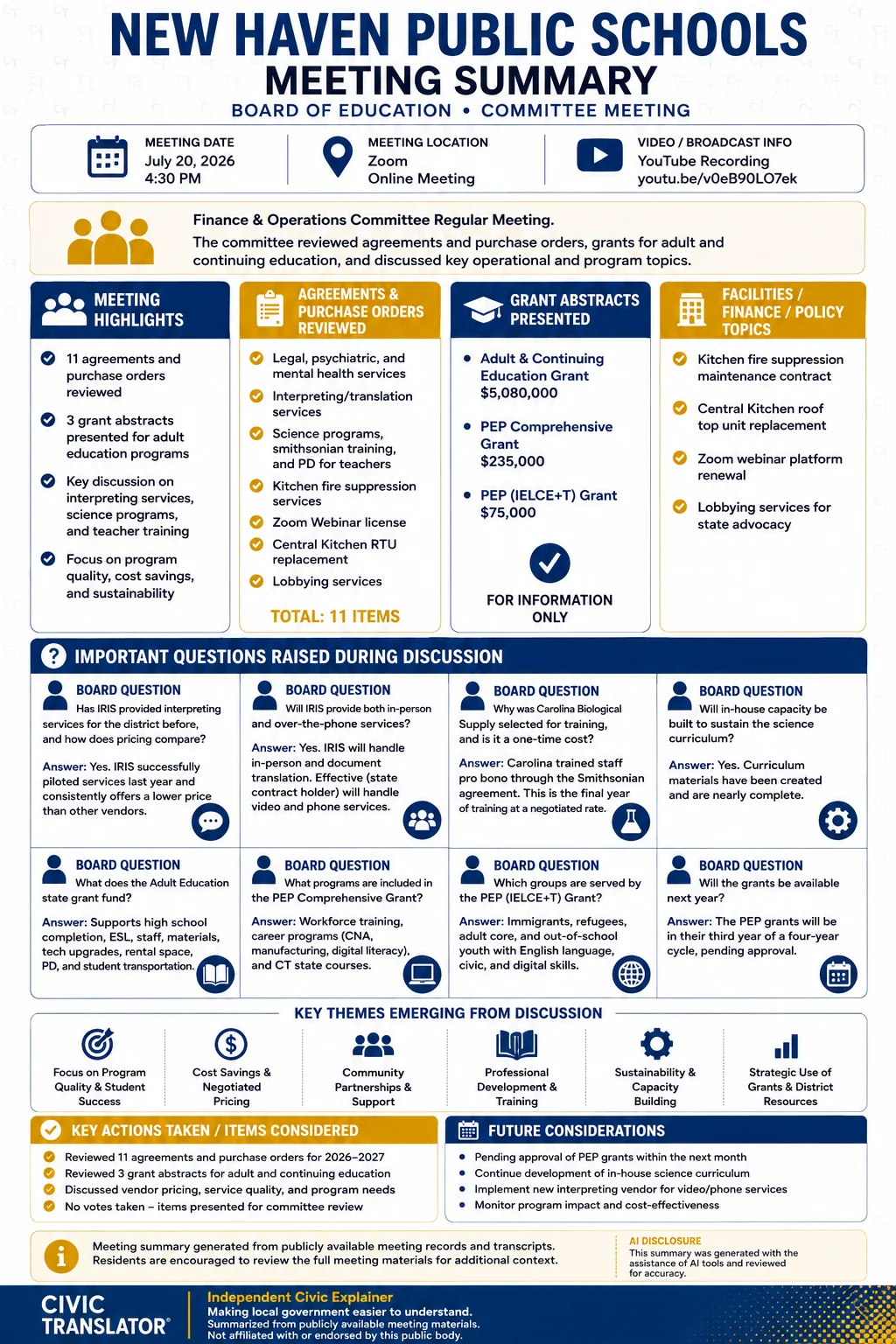
View full-resolution imageLarge PNG download
About this summary
Generated from official public meeting materials.
This summary was created from publicly available agenda, packet, minutes, reports, and other official materials published for the New Haven Public Schools School Board meeting.
Civic Translator uses automated and AI-assisted publishing workflows. Official government records, agendas, packets, minutes, recordings, and notices remain the authoritative source.
- Last updated
- July 24, 2026
- Public body
- New Haven Public Schools
- Meeting date
- July 20, 2026
Community Meeting Summary
Meeting Information
- Public Body: New Haven Public Schools
- Organization Type: school-district
- Government Body: school-boards
- Meeting Body: Board of Education
- Meeting Title: Finance & Operations Committee Regular Meeting - Jul 20 2026
- Meeting Date: 07-20-2026
- Meeting Type: Committee Meeting
- City: New Haven
- County: New Haven
- State: connecticut
- Meeting Source URL: https://nhps.community.diligentoneplatform.com/Portal/MeetingInformation.aspx?Org=Cal&id=346
- Meeting Listing URL: https://nhps.community.diligentoneplatform.com/Portal/MeetingTypeList.aspx
- Public Body Website: https://www.nhps.net/page/board-of-education
- Meeting Video URL: https://youtu.be/v0eB90LO7ek
- Video Channel URL: https://www.youtube.com/@NewHavenPublicSchools
What Community Members Should Know
The Finance & Operations Committee met to review a substantial number of grant applications, service agreements, contracts, and operational purchases that support New Haven Public Schools during the upcoming school year. Much of the meeting focused on preparing items for later Board of Education consideration rather than taking final action. Committee members questioned staff about costs, implementation plans, long-term sustainability, and how proposed expenditures would benefit students and families.
Adult and Continuing Education was one of the largest topics. Staff presented more than $5 million in state-supported funding that serves as the foundation for adult education programming. The funding supports high school completion programs, English language instruction, workforce development, instructional materials, technology, transportation, facilities, and student support services. Staff also described additional grant opportunities intended to expand workforce pathways, family literacy, and English language learning.
Board members spent considerable time discussing workforce development programs and grants designed to prepare adult learners for employment. Staff highlighted successful partnerships that have placed English language learners into Certified Nursing Assistant positions and discussed plans to expand programming into construction trades while increasing services in neighborhood schools.
Another major discussion centered on after-school programming. Staff described multiple state-funded grants supporting neighborhood learning hubs, extended learning opportunities, summer programming, and enrichment services. Administrators reported strong participation at neighborhood learning hubs serving Fair Haven and Newhallville and emphasized that these programs are open to students throughout the surrounding communities rather than only those attending the host schools.
The committee also reviewed numerous operational contracts involving curriculum, assessment systems, technology, translation services, legal services, school health, special education, food service, facilities, and instructional software. Several contracts represented annual renewals of existing services, while others reflected new or expanded initiatives.
Science education received significant attention. Committee members discussed continued investment in Smithsonian-based science instruction, professional development, curriculum development, classroom assessments aligned with the Next Generation Science Standards (NGSS), and district science fair programming. Members questioned whether outside training costs would decline over time as district staff developed their own internal expertise, and administrators indicated that the current year is expected to be the final year requiring extensive outside training.
Technology initiatives included approval-ready agreements for district assessment platforms, literacy software, artificial intelligence tools for educators, and webinar services. Staff described MagicSchool AI as the district's selected instructional AI platform following a pilot program and emphasized student privacy protections, educator support, and classroom applications rather than replacing teacher judgment.
Facilities and operational discussions included kitchen fire suppression maintenance, replacement of rooftop equipment at the Central Kitchen, health clinic partnerships, lobbying services, food service purchasing, and legal contracts. These items reflected ongoing efforts to maintain district operations while supporting instructional programs.
Throughout the meeting, committee members generally focused on asking clarifying questions about pricing, future funding, sustainability, implementation timelines, staffing capacity, and long-term value. Based on the available meeting materials, the committee reviewed and discussed these items in preparation for later Board consideration rather than taking clearly documented final votes during this committee meeting.
Major Discussion and Action Items
Adult and Continuing Education State Grant
Staff presented the district's Adult and Continuing Education budget totaling approximately $5.08 million.
The funding supports:
- Adult high school completion
- English as a Second Language (ESL)
- Student support staff
- Technology upgrades
- Professional development
- Instructional materials
- Student transportation
- Facility expenses
Staff explained that approximately 65 percent of funding comes from the State of Connecticut while the district provides the required local match.
Committee members also discussed the future Adult Education facility currently expected to open during 2027 and asked about future funding needs once the new building becomes operational.
No verified final committee action was established in the available materials.
Program Enhancement Project (PEP) Grants
Staff presented two state grant applications:
- PEP Comprehensive Grant — $235,000
- PEP IELCE+T Grant — $75,000
The grants would support:
- Workforce training
- Family literacy
- Integrated English Literacy and Civics Education
- Digital literacy
- Career navigation
- English language acquisition
- CNA workforce preparation
- Technology integration
Administrators reported that prior grant funding successfully helped dozens of English language learners complete CNA training, with many obtaining employment afterward.
Staff also described plans to:
- Expand construction career pathways
- Partner with the National Construction Consortium
- Expand programming into Fair Haven Middle School
- Continue seeking outside grants and philanthropic support.
Neighborhood After-School and Extended Learning Programs
Several state-funded grants were reviewed supporting:
- Barack Obama School
- Fair Haven neighborhood
- King Robinson School
- Hill Central
- FAME
- Nathan Hale
Administrators reported:
- Strong participation
- High demand
- Community-wide access
- Partnerships with neighborhood organizations
Programs provide:
- Academic support
- Enrichment
- Social-emotional learning
- Workforce opportunities
- Summer programming
Staff indicated they intend to continue applying for competitive grant funding.
Science Education and Professional Development
The committee reviewed several science-related agreements covering:
- Smithsonian instructional support
- Carolina Biological Supply training
- Science Fair programming
- NGSS assessments
- Teacher professional development
Board members questioned why outside training continued after several years.
Administrators explained:
- Smithsonian originally provided training through Carolina Biological.
- Carolina extended support beyond the original agreement.
- Curriculum materials are now largely complete.
- District staff are expected to assume most training responsibilities after one final year.
Translation and Interpretation Services
The district discussed expanding work with Integrated Refugee and Immigrant Services (IRIS).
Staff explained:
- A successful pilot occurred during the previous year.
- IRIS offered consistently lower pricing than competing providers.
- Families often prefer in-person interpreters for Planning and Placement Team meetings.
- IRIS will provide document translation and in-person interpretation.
- Another state-contracted vendor will provide telephone and video interpretation.
Staff emphasized both cost savings and the value of working with a community-based organization familiar with district families.
Literacy, Assessment, and AI Technology
The committee reviewed multiple instructional technology agreements including:
- Lexia
- NWEA MAP
- Houghton Mifflin Harcourt
- RocketLit Inner Orbit
- MagicSchool AI
Staff explained these tools support:
- Reading instruction
- Benchmark assessments
- Science assessment
- Student progress monitoring
- Professional development
- Artificial intelligence tools for educators
Administrators described MagicSchool AI as the district's selected platform after a pilot program and highlighted FERPA and COPPA compliance, educator customization, reporting tools, and safeguards designed specifically for K–12 education.
School Health and Student Services
The committee reviewed agreements involving:
- School-based health centers
- Hearing and vision screenings
- Dental services
- Psychological evaluations
- Specialized communication assessments
Several agreements address staffing shortages by bringing in outside professionals while maintaining legally required student services.
Facilities and Operational Services
Operational discussions included:
- Kitchen fire suppression maintenance
- Central Kitchen rooftop unit replacement
- Zoom webinar licensing
- Lobbying services
- Food service purchasing
- Legal representation
- Printing contracts
These items support routine district operations and infrastructure.
Votes, Decisions, and Direction
The available meeting materials do not establish verified final committee votes on the agenda items.
The committee:
- Reviewed numerous grant abstracts.
- Discussed contracts and purchase orders.
- Asked questions of staff.
- Requested clarification regarding costs, implementation, staffing, and future funding.
- Prepared items for future Board of Education consideration.
Where discussion occurred, the available materials do not verify final approval, denial, or vote counts.
Financial Matters
Major financial items discussed included:
- Adult & Continuing Education Grant — $5,080,000
- PEP Comprehensive Grant — $235,000
- PEP IELCE+T Grant — $75,000
- Youth Service Prevention Grant — $75,000
- Fair Haven After School Grant — $153,800
- King Robinson After School Grant — $153,800
- 21st Century Learning Centers Grant — $50,000
- Extended School Hours Grant — $310,043
Significant agreements included:
- Excel Academy CNA Training — $96,288
- CREC AAC Assessments — $78,900
- Bilingual Psychological Evaluations — $154,000
- RocketLit Inner Orbit — $67,500
- American Education Solutions — $140,000
- Lexia Learning — $370,058.33
- NWEA MAP — $96,634
- Houghton Mifflin Harcourt — $881,938
- Nurses for Daycare — $66,105
- Cornell Scott Health Center — $150,000
- MagicSchool AI — $109,320
Operational contracts also included food service, legal services, facilities maintenance, lobbying, health services, and printing services.
Policies, Ordinances, Resolutions, and Governance
Discussion focused primarily on administrative agreements rather than new board policies.
Governance-related topics included:
- Use of AI within district instructional practices.
- Student privacy protections associated with educational technology.
- Contract language concerning legal liability and data security for instructional software.
- Continued compliance with state and federal education grant requirements.
Reports, Presentations, and Updates
Staff presented updates regarding:
- Adult Education programming
- Workforce development initiatives
- Family literacy expansion
- After-school participation
- Summer programming
- Science curriculum implementation
- Assessment systems
- AI implementation planning
- School health partnerships
- Facilities maintenance
- Special education services
Administrators reported strong participation in neighborhood-based after-school hubs and successful employment outcomes from adult workforce programs.
Personnel, Appointments, and Organizational Matters
The committee discussed:
- Contracted psychologists to address vacancies.
- Outside consultants providing specialized evaluations.
- Teacher professional development.
- Science instructional coaching.
- Expanded staffing support through grants.
- School health personnel.
- Interpreter services.
No verified personnel appointments or employment actions were documented in the available meeting materials.
Projects, Facilities, Infrastructure, and Operations
Operational topics included:
- Kitchen fire suppression maintenance.
- Central Kitchen rooftop unit replacement.
- School-based health clinic operations.
- Hearing and vision screenings.
- Webinar platform licensing.
- AI implementation.
- Assessment platforms.
- Curriculum software.
- Food service contracts.
- Printing services.
Administrators also discussed progress toward a new Adult Education facility anticipated to open during 2027.
Public Comment and Community Input
The available meeting materials do not document substantive public comment during this committee meeting.
Discussion reflected questions from committee members and responses from district staff.
Questions and Answers
Committee members asked staff about:
- Why IRIS was selected for interpretation services and how pricing compared with previous vendors.
- Whether science training costs would continue in future years.
- Whether district staff would eventually assume science professional development internally.
- Future funding needs associated with the new Adult Education facility.
- Sustainability of federal grant funding.
- Participation levels in after-school programs.
- Whether software licensing levels reflected actual student use.
- Cost increases associated with literacy software.
- Privacy protections built into the selected AI platform.
- Reporting and analytics available through MagicSchool AI.
Staff generally responded by explaining operational plans, grant funding, long-term implementation strategies, and anticipated future transitions.
Community Impact
Students and families may benefit from expanded:
- Adult education programming.
- Career pathways.
- English language services.
- Family literacy.
- After-school opportunities.
- School health services.
- Science instruction.
- AI-supported classroom tools.
- Reading intervention.
- Student assessments.
Teachers may receive:
- Additional professional development.
- Curriculum support.
- AI instructional tools.
- Science coaching.
- Improved assessment resources.
Residents may see continued investment in neighborhood learning hubs, workforce development, and school facilities while the district continues pursuing outside grant funding to reduce pressure on local operating budgets.
Questions Community Members May Want to Ask
- How will the district measure success for the expanded AI platform?
- What outcomes are expected from the new construction career pathway?
- Will additional grant funding be needed once the Adult Education building opens?
- How will neighborhood after-school programs continue if competitive grants are not renewed?
- What measures will be used to evaluate workforce training success?
- How will the district monitor student privacy within AI tools?
- What additional language access improvements are planned?
- When will the remaining science curriculum development be completed?
- How will district staff transition away from outside science trainers?
- What performance measures will be used for major instructional software investments?
Important Dates and Next Steps
- Staff expect decisions on PEP grant awards within approximately one month.
- Extended learning and after-school grants will continue into the upcoming school year if funded.
- Adult Education construction is expected to conclude during 2027 with a future opening celebration anticipated after completion.
- Multiple agreements reviewed by the committee are expected to proceed to the full Board of Education for formal consideration.
- Staff will continue seeking additional state, federal, and community grant opportunities.
Key Takeaways
- The committee reviewed a large package of grants and contracts supporting the 2026–2027 school year.
- Adult Education funding totals approximately $5.08 million.
- Workforce development remains a major district priority.
- New construction career pathways are being explored.
- Family literacy programming is expanding.
- Adult ESL programming continues to grow.
- After-school participation remains strong.
- Neighborhood learning hubs serve students beyond individual schools.
- Science curriculum implementation continues.
- Smithsonian-based professional development is nearing completion.
- District staff expect to assume more science training internally.
- Translation services will expand through IRIS.
- Multiple instructional technology agreements were reviewed.
- MagicSchool AI will become the district's instructional AI platform.
- Student privacy was a major consideration in AI selection.
- Literacy software investments continue.
- Assessment systems remain a district priority.
- School health partnerships will continue.
- Facilities maintenance projects remain ongoing.
- Committee members focused heavily on cost effectiveness and long-term sustainability.
Official Sources
- Meeting source: https://nhps.community.diligentoneplatform.com/Portal/MeetingInformation.aspx?Org=Cal&id=346
- Meeting listing: https://nhps.community.diligentoneplatform.com/Portal/MeetingTypeList.aspx
- Public body website: https://www.nhps.net/page/board-of-education
- Meeting video: https://youtu.be/v0eB90LO7ek
- Video channel: https://www.youtube.com/@NewHavenPublicSchools
About the Public Body
- Name: New Haven Public Schools
- Organization type: school-district
- Government body: school-boards
- Location: New Haven, connecticut
- County: New Haven
- Provider: diligent-community
Keywords
New Haven Public Schools, Board of Education, Finance and Operations Committee, adult education, workforce development, PEP grant, ESL, family literacy, CNA training, construction careers, after-school programs, Fair Haven, King Robinson, science curriculum, Smithsonian, Carolina Biological, IRIS translation services, Lexia, NWEA MAP, MagicSchool AI, RocketLit, Houghton Mifflin Harcourt, school health, facilities maintenance, grants, curriculum, assessment, educational technology, New Haven, Connecticut
Continue exploring this meeting
More summaries from New Haven Public Schools
New Haven Public Schools — School Board Meeting Packet Summary — July 20, 2026
July 20, 2026 · Packet Summary